


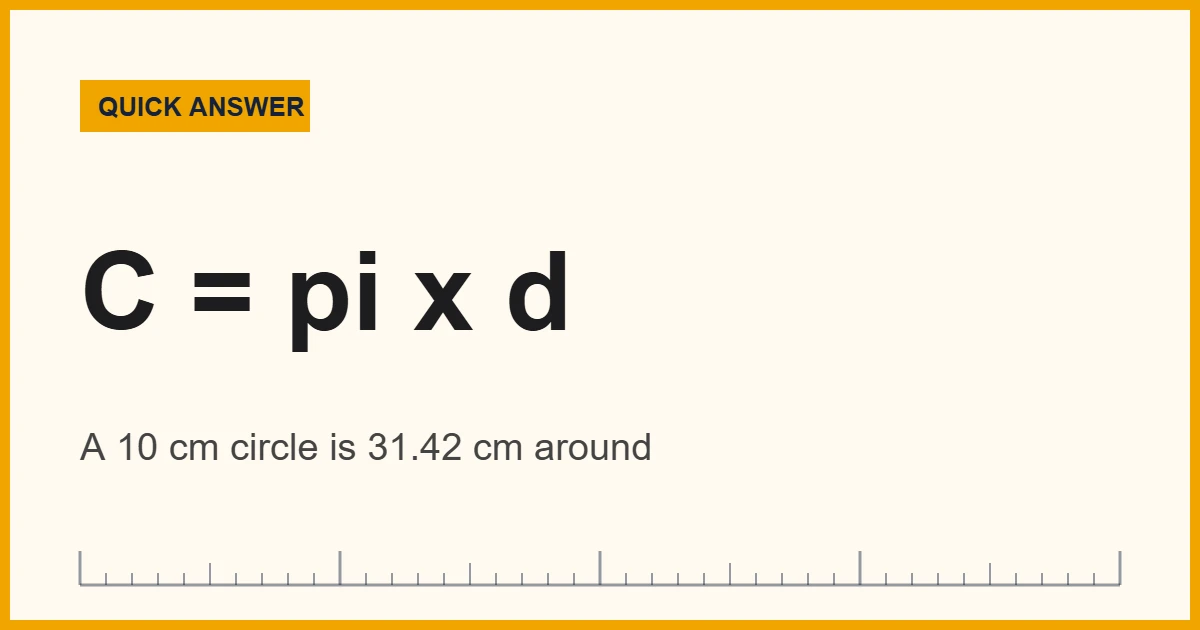
The circumference of a circle is the distance around its edge, and you find it with C = pi x d. For example, a circle 10 cm across measures about 31.42 cm around, and a 10 inch circle measures about 31.42 inches. Measure straight across the middle, multiply by 3.14159, and you have the answer.
Indeed, circles are everywhere, from pipes and wheels to lids, tree trunks and garden beds. However, the distance around one is hard to measure directly, because a ruler cannot bend. Fortunately, geometry gives you a shortcut: measure one straight line, and the rest follows.
In this guide, you will first see the formulas, then a quick calculator, and after that a string method that needs no math at all. In addition, you will find worked examples, a table of common sizes, and the mistakes that throw measurements off by a few percent.
Circumference of a Circle Formulas
First, every circle follows one rule. Divide the distance around the circle by the distance across it, and you always get the same number, called pi. Because of this, you only need one measurement to get the others.
| You know | You want | Use |
|---|---|---|
| Diameter (d) | Circumference (C) | C = pi x d |
| Radius (r) | Circumference (C) | C = 2 x pi x r |
| Circumference (C) | Diameter (d) | d = C / pi |
| Circumference (C) | Radius (r) | r = C / (2 x pi) |
| Radius (r) | Area (A) | A = pi x r x r |
Here, pi is about 3.14159265. In class, for instance, 3.14 is the usual rounding. On a calculator, however, use the pi key for the best result.
Circumference of a Circle Calculator and Unit Converter
Simply type a length below to convert it between inches, centimeters, millimeters, feet and meters. First, multiply your diameter by 3.14159 to get the circumference. Next, enter that answer here to see it in the unit you need. Likewise, enter a measured string length to turn it into a diameter in any unit after dividing by pi.
Recommended Tools for Measuring the Circumference of a Circle
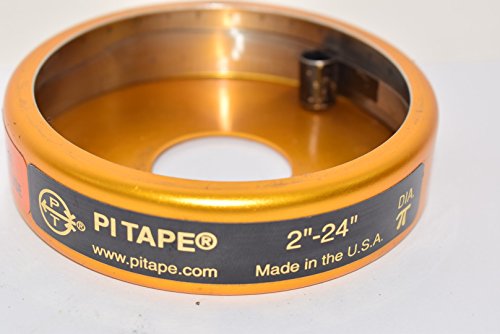
A few simple tools, therefore, make the job faster and more accurate. First, a flexible tape follows a curved edge, so it reads the circumference directly. Next, calipers give a precise diameter for small round parts. Also, a drawing compass helps you draw and check circles on paper. Finally, a diameter tape (often called a pi tape) shows the diameter when you wrap it around a pipe or a trunk.


As an Amazon Associate, Measuring Expert earns from qualifying purchases.
Key Takeaways
- The circumference is the distance around a circle, whereas the diameter is the distance across it.
- In short, C = pi x d, and C = 2 x pi x r, with pi about 3.14159.
- To go backward, simply divide the circumference by pi to get the diameter.
- Also, a string and a ruler can measure any round object, flat or not.
- Similarly, using 3.14 for pi gives an answer about 0.05 percent too small.
- Always give the unit, and convert before you calculate, not after.
How to Measure the Circumference of a Circle With String
The string method works on coins, jar lids, tree trunks and anything else round. In fact, it is also the best way to check your math.
- Mark a start point. Put a small dot or a strip of masking tape on the edge of the circle so that you know where you began.
- Wrap the string once around. Hold the string snug against the edge, without stretching it, and then bring it back to your start point.
- Mark where the string meets itself. Next, pinch the string at the overlap or mark it with a pen.
- Lay the string flat. Then straighten it along a ruler or tape measure, with no slack or twist.
- Read the length. Finally, the distance from the end of the string to your mark is the circumference.
- Check it with the formula. Measure the diameter too, multiply by 3.14159, and compare. As a result, the two numbers should agree within a few millimeters.
Worked Examples: Circumference of a Circle by Size
These values use pi = 3.14159265 and are rounded to two decimals. Also, inches are converted at exactly 2.54 cm per inch.
| Diameter | Radius | Circumference | In centimeters |
|---|---|---|---|
| 1 in | 0.5 in | 3.14 in | 7.98 cm |
| 2 in | 1 in | 6.28 in | 15.96 cm |
| 4 in | 2 in | 12.57 in | 31.92 cm |
| 6 in | 3 in | 18.85 in | 47.88 cm |
| 10 in | 5 in | 31.42 in | 79.80 cm |
| 12 in | 6 in | 37.70 in | 95.76 cm |
| 24 in | 12 in | 75.40 in | 191.51 cm |
Here is one full example. For example, say you want to put edging around a round flower bed that is 6 feet across. The circumference is 3.14159 x 6 = 18.85 feet, or about 5.75 m. Therefore, buy at least 19 feet of edging, and add a little extra for overlap.
Next, here is a second example, going the other way. A string wrapped once around a jar lid measures 25 cm. The diameter is 25 / 3.14159 = 7.96 cm, so the radius is about 3.98 cm.
Finding the Diameter From the Circumference
Sometimes, however, the circumference is the only thing you can measure. For example, pipes in a wall, tree trunks and posts are typical cases. In that situation, wrap a tape around the object and divide the reading by pi.
- First, wrap the tape once around the object and read the length, for example 100 cm.
- Next, divide by 3.14159, which gives 31.83 cm.
- Finally, halve the result to get the radius, here about 15.92 cm.
For example, this is how foresters turn a girth reading into a trunk diameter. Our guide to girth measurement of cylindrical objects shows the same idea on pipes and poles.
Circle Terms People Mix Up
| Term | What it means | Unit |
|---|---|---|
| Circumference | Distance around the whole circle | Length (cm, in) |
| Perimeter | Distance around any shape; for a circle, it is the circumference | Length |
| Diameter | Straight line across the circle through the center | Length |
| Radius | Center to edge, half the diameter | Length |
| Arc | A piece of the circumference | Length |
| Area | Surface inside the circle | Square units (cm2, in2) |
Unfortunately, the most common slip is mixing up circumference and area. Circumference is a length, so it uses plain units. In contrast, area is a surface, so it uses square units. If you also work with round solids, see our pages on the surface area of a cylinder and volume of common shapes, which both start from the circumference or radius.
Pi and the Circumference of a Circle
Pi is the ratio of circumference to diameter, and it is the same for every circle, big or small. It is an irrational number, so its digits never end or repeat. The Welsh mathematician William Jones was the first to use the Greek letter in 1706. Long before that, however, Archimedes showed that pi lies between 223/71 and 22/7.
| Value of pi | Compared with true pi | Circumference of a 100 cm circle |
|---|---|---|
| 3.14 | about 0.05% too small | 314.00 cm |
| 22/7 (3.142857) | about 0.04% too large | 314.29 cm |
| 3.14159 | less than 0.0001% off | 314.16 cm |
As the table shows, even 3.14 is off by only 0.16 cm on a one-meter circle. Meanwhile, NASA’s Jet Propulsion Laboratory says it uses 15 decimal places of pi for its highest-accuracy calculations. For comparison, a circle the size of Earth’s equator (radius 6,378.137 km) comes out near 40,075 km, or 24,901 miles.
Do and Don’t When You Measure a Circle
- First, measure the diameter at its widest point.
- Also, take two or three readings and average them.
- Keep the string or tape snug but not stretched.
- Instead of guessing, write the unit with every number.
- Use the pi key on a calculator because it is more exact.
- Mix inches and centimeters in one formula, because the result will be wrong.
- Measure a chord and call it the diameter.
- Round pi to 3 for anything that must fit.
- Let the string twist or sag, because slack adds length.
- Confuse radius with diameter.
Honest Limits of These Measurements
The formula is exact for a perfect circle, but real objects are not perfect. For instance, a pipe may be slightly oval, and a tree trunk certainly is. As a result, the diameter you compute from a wrapped tape is an average, not the width in every direction. In short, treat the answer as the best single number for a round-enough object. In addition, a thick tape, a stretched string or a tilted ruler can each add a millimeter or two. For most home projects, though, that is fine.
When Accuracy Really Matters
Three situations, however, call for more care than a string and a ruler:
- Machined parts and bearings. Use calipers or a micrometer, because a tape cannot resolve hundredths of a millimeter.
- Pipe fittings and flanges. Always check the manufacturer’s size chart, since a pipe’s nominal size is not its true outside diameter.
- Anything cut to fit. Therefore, measure twice, and cut a test piece before you cut the real one.
Frequently Asked Questions
How do you find the circumference of a circle?
Multiply the diameter by pi (3.14159), or multiply the radius by 2 and then by pi. For example, a circle with a 10 cm diameter has a circumference of about 31.42 cm.
What is the formula for the circumference of a circle?
The formula is C = pi x d, which is the same as C = 2 x pi x r. Here C is the circumference, d is the diameter, and r is the radius.
How do you measure the circumference of a circle with string?
Wrap a string once around the edge, mark where it meets itself, and lay it flat along a ruler or tape. The length from the end to the mark is the circumference.
How do you find the diameter from the circumference?
Divide the circumference by pi. For example, a circumference of 62.83 cm gives a diameter of about 20.00 cm.
How do you find the radius from the circumference?
Divide the circumference by 2 x pi, or divide the diameter by 2. A circumference of 31.42 cm gives a radius of about 5.00 cm.
What is the angle at the circumference of a circle?
An angle at the circumference (an inscribed angle) is half the angle at the center that stands on the same arc. Also, an angle drawn from the ends of a diameter to any point on the circle is always 90 degrees.
Is the circumference of a circle always a little more than three diameters?
Yes. The ratio of circumference to diameter is pi, about 3.14159, for every circle. As a result, the distance around is always three diameters plus about 14 percent of one more.
Should I use 3.14 or 22/7 for pi?
Both are approximations. 3.14 is about 0.05 percent too small, and 22/7 is about 0.04 percent too large. For most schoolwork and home projects, either works, but a calculator’s pi key is better.
How many digits of pi do I need?
Four or five digits cover nearly every practical task. NASA’s Jet Propulsion Laboratory uses 15 decimal places for its most exacting navigation work.
Can I use a ruler to measure a round object?
Yes, but a ruler gives the diameter at best, and only if you find the widest point. A flexible tape or a string is better for the circumference itself.
Circumference of a Circle: The Bottom Line
To sum up, measure the diameter, multiply by pi, and you have the circumference. If you only have the string, wrap it once, straighten it, and read the length. Either way, write down the unit and check your result against the other method.
Finally, use the converter above whenever you need the same length in another unit, and pick the tool in the list that suits your job.