

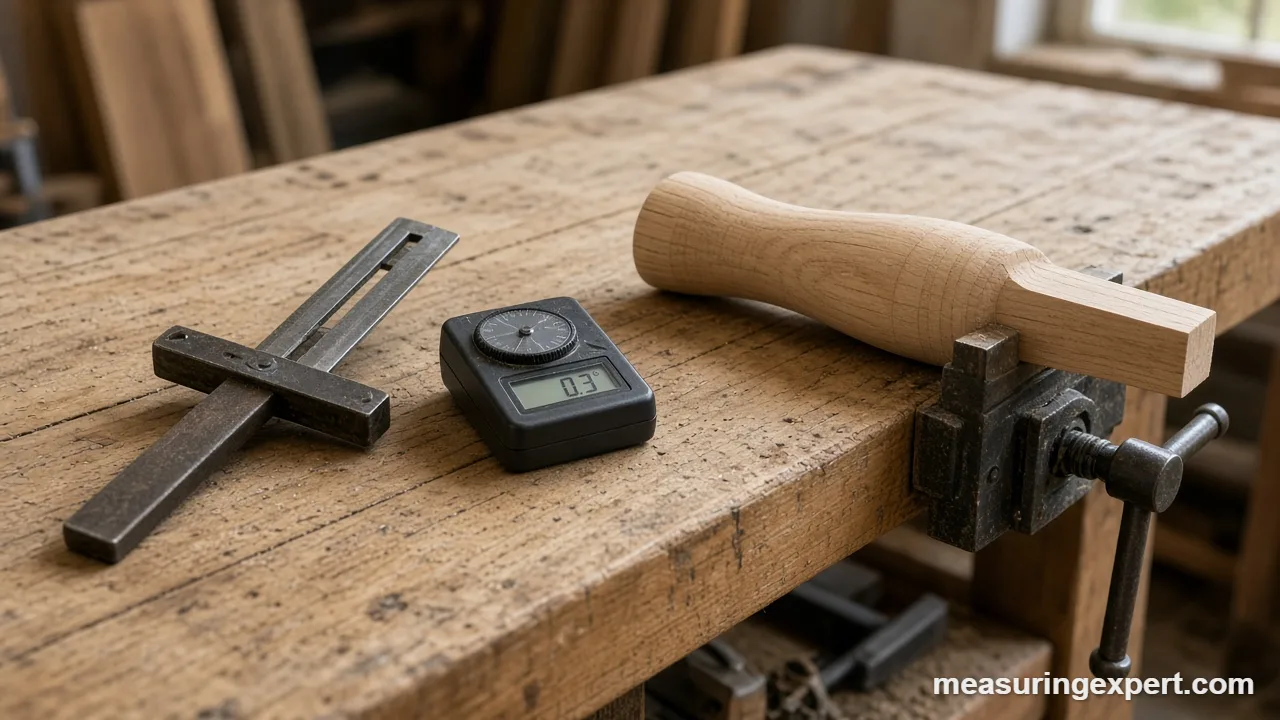
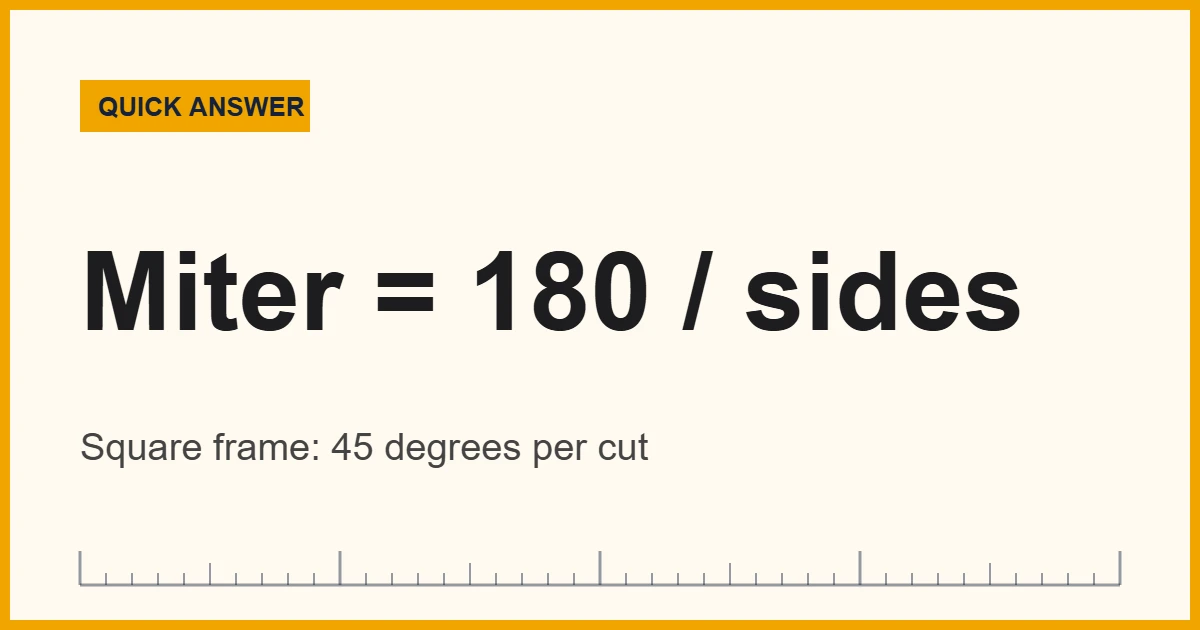
To measure angles for furniture, set a sliding T-bevel or a digital angle gauge against the joint, lock it, and read or copy the angle onto your stock. For a closed frame, the miter cut is 180 divided by the number of sides, so a four-sided frame needs 45 degrees at each corner.
Angle Converter: Measure Angles for Furniture in Degrees, Grade or Pitch
Plans, saw scales and apps do not always speak the same language. A plan may say 10 degrees, a jig may be set by rise over 12 inches, and a phone app may show percent grade. Therefore, type your angle below and the converter shows it in all three forms.
Why Small Angle Errors Show Up So Fast
Furniture is mostly a game of angles that are close to square. Because of that, a small error shows up fast: a gap in a miter, a rocking table, or a chair that leans the wrong way. If you know how to measure angles for furniture, you can copy an old piece, check a drawing, or set up a saw with confidence.
First, you need one idea. An angle is the opening between two surfaces that meet, and it is usually given in degrees, where a full turn is 360 degrees and a square corner is 90 degrees. The US National Institute of Standards and Technology lists the degree as a unit accepted for use with the SI in its Guide for the Use of the International System of Units (SP 811). In other words, a degree is a precisely defined unit, so any good tool reads it the same way.
Below, you will see which tool suits which job, a step-by-step method, the angles that come up again and again, and the limits of each tool. Also, if you want to understand the unit itself, read our short guide to degrees and gradians.
Recommended Tools to Measure Angles for Furniture
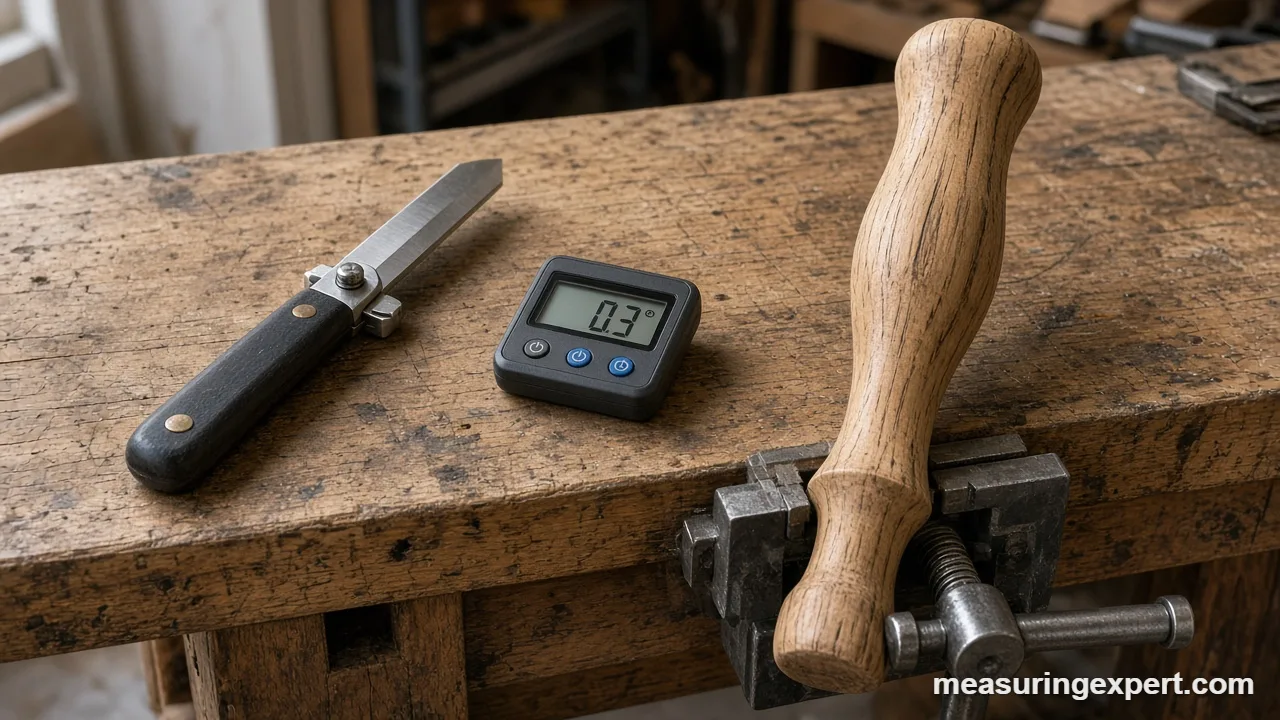
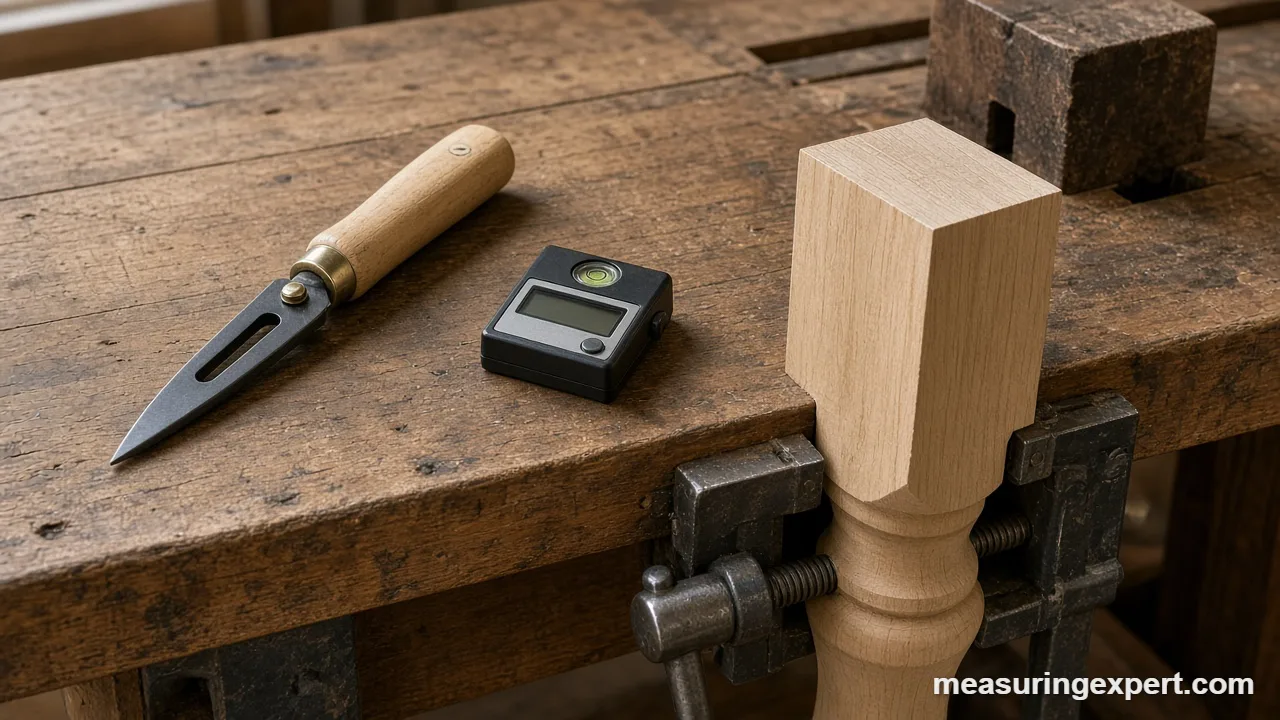
You do not need a full workshop. Even so, one tool that reads an angle and one that copies it will cover nearly every project. For example, a digital gauge gives a number, while a T-bevel holds an angle you cannot easily measure. In addition, a miter protractor helps you set a saw fence to match.

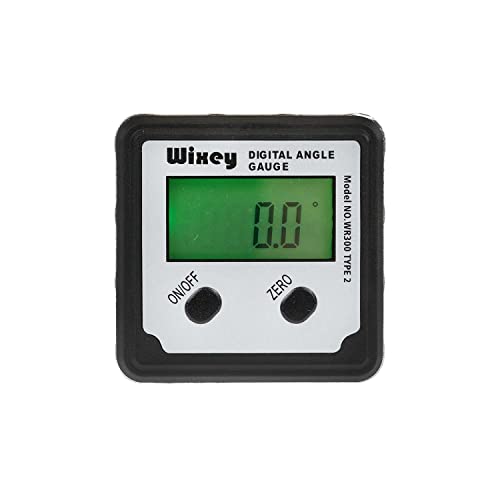
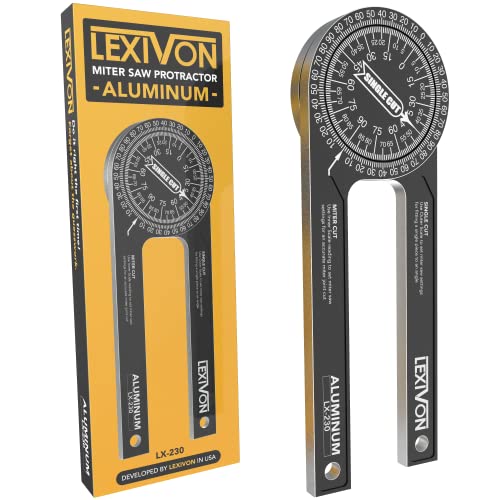


As an Amazon Associate, Measuring Expert earns from qualifying purchases.
Key Takeaways
- Copy odd angles with a T-bevel, and read exact angles with a digital gauge or a good protractor.
- For a closed frame with equal sides, each miter cut is 180 divided by the number of sides.
- A 1 degree error over 30 inches opens a gap of about 0.52 inches (13 mm).
- Chair seats usually tilt back 5 to 10 degrees, according to Cornell ergonomics notes.
- Always check your tool against a known 90 degree corner before you trust it.
- Measure twice, then test the angle on scrap wood before cutting good stock.
Which Angle Tool Fits Which Job
Each tool answers a slightly different question. Some tell you a number, while others simply remember the shape. The table below compares the usual choices.
| Tool | Best for | Gives you | Watch out for |
|---|---|---|---|
| Plastic or steel protractor | Drawings and small parts | A number, read by eye | Parallax and thick lines |
| Sliding T-bevel | Copying an angle from a joint | A locked copy, no number | Blade can slip if the lock is loose |
| Digital angle gauge | Saw blades, tilt and leg splay | A number to a tenth of a degree | Zero it on a flat reference |
| Miter protractor | Setting a saw to match a corner | A number and a locked arm | Reading the wrong scale |
| Ruler and square (rise and run) | Quick slope checks | Rise per 12 inches | Needs a conversion to degrees |
If you are torn between the first two, our comparison of a protractor versus a bevel gauge explains when each one wins.
How to Measure Angles for Furniture Step by Step
- Check the tool first. Hold the tool against a corner you trust, such as a machinist square, and confirm it reads 90 degrees.
- Clean the surfaces. Wipe off dust and glue, because even a thin crumb tilts the blade.
- Seat the tool fully. Press the stock of the T-bevel or the base of the gauge flat against one face, and swing the blade until it touches the other face without a gap.
- Lock it. Tighten the thumbscrew gently so the blade cannot drift.
- Read or copy the angle. With a gauge, note the number. With a T-bevel, set it on a protractor, or carry it straight to the saw.
- Repeat from the other side. If both readings differ by more than a degree, the joint is out of square or the tool slipped.
- Test on scrap. Cut a spare piece, join it to another, and check the fit before you cut real stock.
Common Furniture Angles and Where They Come From
Many angles are not guesses. In fact, a closed frame with equal sides follows one simple rule: each miter is half of the outside turn. Equal sides mean the miter equals 180 degrees divided by the number of sides. We computed the values below from that rule, and our guide to angles in a polygon shows why it works.
| Shape | Sides | Inside corner | Miter cut on each piece |
|---|---|---|---|
| Triangle frame | 3 | 60 degrees | 60 degrees |
| Picture frame or box | 4 | 90 degrees | 45 degrees |
| Pentagon | 5 | 108 degrees | 36 degrees |
| Hexagon table top | 6 | 120 degrees | 30 degrees |
| Octagon table top | 8 | 135 degrees | 22.5 degrees |
| Decagon | 10 | 144 degrees | 18 degrees |
Leg splay is another favorite. The sideways shift of a splayed leg equals its height times the tangent of the angle. For example, an 18 inch leg tilted 10 degrees moves its foot about 3.17 inches (80.6 mm) outward. On the other hand, a 5 degree tilt moves it only 1.57 inches (40 mm).
Measure Angles for Furniture Legs, Chairs and Tables
Different pieces ask different questions. Therefore, think about the job before you pick the tool.
Chairs and stools
Comfort drives chair angles. Cornell University ergonomics notes recommend a seat that tilts back about 5 to 10 degrees, and a backrest that leans back roughly 15 degrees from vertical, which is the same as about 100 to 110 degrees between seat and back. To check an existing chair, lay a digital gauge on the seat and zero it on the floor, then measure the back along the rail. Because chairs flex, measure with the chair sitting on a flat floor.
Tables and desks
Tables are simpler, since most of their joints are square. Nevertheless, an angled apron or a drafting-style top needs a real number. Place the gauge on the top surface, zero it on the floor, and tilt the top until it reads the desired angle. Meanwhile, check each leg with a square so the table does not rock.
Cabinets and shelves
Cabinets rely on square corners, so checking for 90 degrees matters more than measuring odd angles. Compare the two diagonals of a carcase. If they match, the box is square. If not, adjust a clamp until they do.
Transferring an Angle to the Workpiece
Reading an angle is only half the job. After that, you must get it onto the wood without drifting. First, lay the locked T-bevel flat on the board and scribe a fine line with a sharp pencil or marking knife. Next, extend the line across the face with a square so you can see both ends. Finally, set the saw by matching its fence to the same locked bevel instead of trusting the saw scale.
To cut accurately, saw on the waste side of the line and leave a hair of wood to pare away. In addition, keep the blade of the bevel short, because a long blade magnifies small shifts.
Do and Don’t When You Measure Angles
Do
- Zero a digital gauge on a flat surface first.
- Press the tool tight against both faces.
- Cut a test joint from scrap.
- Write the angle on the part as soon as you measure it.
- Check the saw angle with a gauge, not just its scale.
Don’t
- Trust a cheap tool before you test it on a square corner.
- Measure through glue squeeze-out or finish drips.
- Set a long blade when a short one will do.
- Assume both sides of an old piece match.
- Force a locked bevel that has slipped.
Honest Limits of Angle Measurements
Every tool has a floor. A plastic protractor is usually marked in whole degrees, and reading it by eye adds about a degree of doubt. A digital gauge shows tenths of a degree, but its accuracy depends on the model and on how well you zero it, so check the maker’s specification. Also, old furniture is rarely perfect. Wood moves with humidity, joints loosen, and glue lines are never uniform. As a result, two measurements on the same joint can disagree by a degree or two.
Size matters too. A 1 degree error across a 30 inch edge opens a gap of about 0.52 inches (13.3 mm), because 30 times the tangent of 1 degree is 0.52. That is why long parts such as table aprons need extra care, while a small drawer front forgives more.
When to Ask a Professional
Most home projects need nothing more than a bevel and a steady hand. Still, some jobs justify expert help. A structural piece such as a loft bed, a bunk bed or a heavy wall unit must carry real loads, so ask a qualified carpenter or furniture maker to check your angles and joints. Likewise, restoring a valuable antique calls for a conservator, since a wrong cut cannot be undone.
Frequently Asked Questions
How do I measure angles for furniture without a protractor?
Use a ruler and square to find rise over 12 inches, then convert it with the converter above. For example, a 2.12 inch rise over 12 inches is about 10 degrees.
What is the best tool to measure angles for furniture?
A digital angle gauge is the easiest way to get a number, and a T-bevel is the best way to copy an angle. Many woodworkers keep both.
How do I measure angles for furniture legs that splay outward?
Place a digital gauge on the leg and zero it on a level floor. The reading is the tilt from vertical. Alternatively, measure the sideways shift and the leg height, then divide the shift by the height to find the tangent.
Can I measure angles for furniture with my phone?
Yes, but with care. Phone sensors can be off by a degree or so, so zero the phone on a flat surface and compare it with a known angle. See our guide to the angle measuring app for more.
What angle should I cut for a four-sided frame?
Cut each end at 45 degrees. Two 45 degree miters join to make a 90 degree corner.
What miter angle do I need for a hexagon table?
Cut each end at 30 degrees, because 180 divided by 6 is 30. Six pieces then close the shape.
What angle should a chair seat have?
Cornell ergonomics notes suggest a seat that tilts back about 5 to 10 degrees. Your own comfort and the chair style matter, so test a mock-up.
How accurate does a furniture angle need to be?
For tight joints, aim for within half a degree. A 0.5 degree error across 30 inches leaves a gap of about 0.26 inches (6.6 mm), which is visible.
How do I check whether my tool is accurate?
Press it against a trusted square, or flip a gauge end for end on a flat surface. If the two readings differ, the tool or the surface is off.
How do I convert an angle in degrees to rise over 12 inches?
Multiply 12 by the tangent of the angle. For 10 degrees, 12 times 0.1763 is 2.12 inches.
Measure Angles for Furniture: The Bottom Line
To sum up, measure the angle with a gauge or copy it with a T-bevel, double-check against a trusted 90 degrees, and test on scrap. For equal-sided frames, the miter is simply 180 divided by the number of sides.
Finally, use the converter at the top of this page whenever a plan, a saw and a phone app use different units. Small angle errors grow fast over long edges, so a few extra minutes of checking pays off in tight, square joints.