

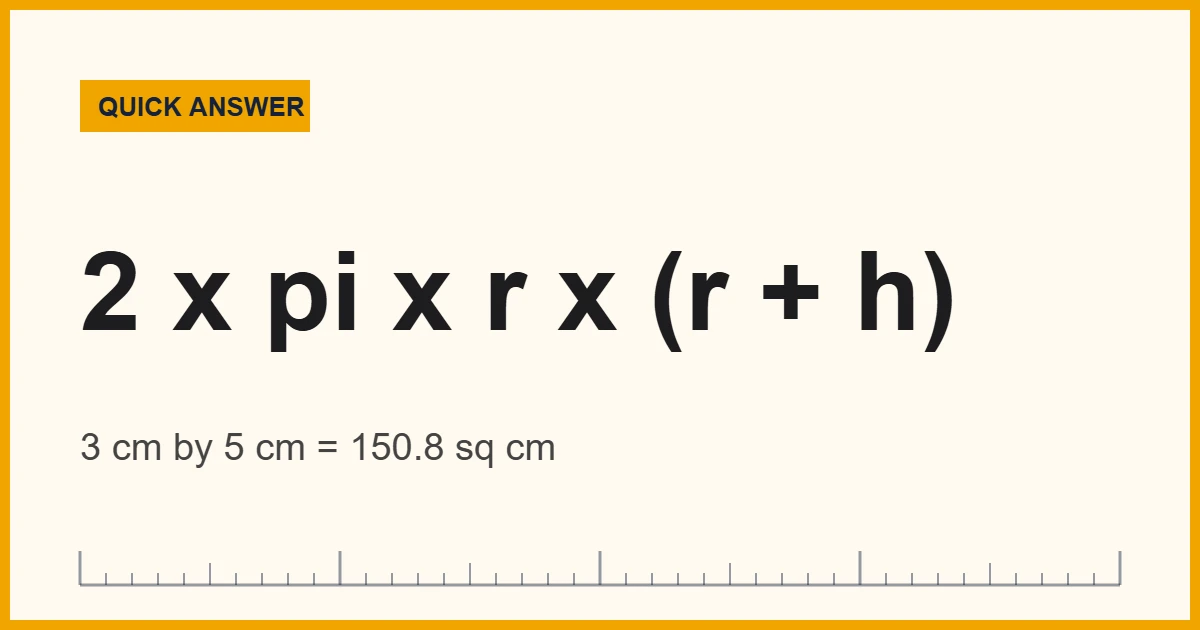
Cylinder surface area equals 2 x pi x r x (r + h), where r is the radius and h is the height. For example, a cylinder with a 3 cm radius and a 5 cm height has a total surface area of about 150.8 square centimeters (23.4 square inches). Measure r and h with calipers or a ruler.
Convert Cylinder Surface Area Between Units
First, work out the area with the formula below, then type the result here. Also, the converter switches it between square centimeters, square meters, square inches and square feet using exact unit definitions.
Cylinder Surface Area in Plain Words
For example, a soup can is the classic cylinder: two flat circles joined by a curved wall. In other words, its surface area is the size of all the skin you would need to cover it, so it tells you how much label, paint, insulation or wrapping paper the object takes. However, people often mix up the radius with the diameter, or forget the two ends. As a result, answers drift by a lot.
First, only two measurements matter: the radius of the circular end and the height of the side. In fact, once you have those, the math takes one line. Next, you will see the formulas, a step-by-step way to measure, worked examples in metric and US units, and the limits of real-world measuring.
For unit conversions, the NIST guide to SI units, Special Publication 811, lists the conversion factors in its Appendix B. Because 1 inch equals exactly 2.54 centimeters, 1 square inch equals exactly 6.4516 square centimeters. For more unit switching, see our guide to imperial to metric conversion in construction.
- Total cylinder surface area is 2 x pi x r x (r + h).
- The curved side alone, called lateral area, is 2 x pi x r x h.
- Also, each circular end adds pi x r squared.
- Halve the diameter first, because the formula needs the radius.
- Therefore, use the same unit for radius and height, and expect square units in the answer.
- Finally, use a calculator’s pi key, not 3.14, when precision matters.
Recommended Tools for Measuring a Cylinder
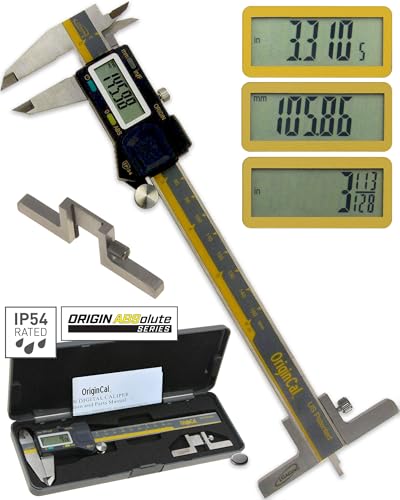
First, good numbers start with the right tool. For example, a caliper reads the diameter of small cylinders to a fraction of a millimeter, while a steel rule suits larger parts and heights. Meanwhile, a flexible tape handles round objects that are too wide for calipers. If you want to keep your tools accurate, our guide to measurement tool calibration explains how to check them.




As an Amazon Associate, Measuring Expert earns from qualifying purchases.
Cylinder Surface Area Formulas
First, everything comes from unrolling the cylinder. Then the curved side flattens into a rectangle whose width is the circumference, 2 x pi x r, and whose length is the height. Also, the two ends are plain circles. Therefore, the three parts simply add.
| What you need | Formula | Use it when |
|---|---|---|
| Lateral (curved) area | 2 x pi x r x h | Pipes, labels, open tubes |
| One circular end | pi x r x r | Lids and bases |
| Total, closed cylinder | 2 x pi x r x (r + h) | Cans, tanks with flat ends |
| Total, open top | pi x r x r + 2 x pi x r x h | Cups, buckets, pots |
| Total, from diameter d | pi x d x (d / 2 + h) | You measured the diameter |
| Lateral, from circumference C | C x h | You wrapped a tape around it |
How to Measure a Cylinder for Surface Area
- Choose one unit. First, pick centimeters, millimeters or inches, and use that single unit for every measurement. Mixing units is, in fact, the most common source of wrong answers.
- Measure the diameter. First, close the jaws of a caliper across the widest circular section, or wrap a flexible tape around the cylinder and read the circumference.
- Find the radius. Next, divide the diameter by 2. If you measured the circumference, divide it by 6.2832 instead.
- Measure the height. Next, stand the cylinder upright and measure straight along the side from one flat end to the other. Also, keep the ruler parallel to the axis.
- Calculate the lateral area. Next, multiply 2 x pi x r x h. In other words, this is the curved surface, like the label on a can.
- Add the end areas. Next, add 2 x pi x r squared for two ends. However, for an open top, add only pi x r squared.
- Convert and record. Finally, use the converter above to switch units, then write down the radius, height, formula and result so you can check the work later.
Worked Examples of Cylinder Surface Area
Here are worked examples with every step shown. First, take a small metal can with a radius of 3 cm and a height of 5 cm.
| Step | Calculation | Result |
|---|---|---|
| Lateral area | 2 x pi x 3 x 5 | 94.25 square cm |
| Two ends | 2 x pi x 3 x 3 | 56.55 square cm |
| Total | 94.25 + 56.55 | 150.80 square cm |
| In square inches | 150.80 / 6.4516 | 23.37 square in |
Next, try US units. A cylinder with a 1.5 inch radius and a 4 inch height has a lateral area of 2 x pi x 1.5 x 4 = 37.70 square inches. In addition, its two ends add 2 x pi x 1.5 x 1.5 = 14.14 square inches, so the total is 51.84 square inches, or about 334.5 square centimeters.
Next, take a taller cylinder. A 3 cm by 10 cm one has a lateral area of 188.50 and a total of 245.04 square centimeters. For open-top versions, subtract one end: the 3 cm by 5 cm cup then has 122.52 square centimeters.
Cylinder Surface Area Quick Chart
Therefore, use this chart to sanity-check your own answer. Also, all values are in square centimeters and use the full value of pi.
| Radius (cm) | Height (cm) | Lateral area | Two ends | Total |
|---|---|---|---|---|
| 1 | 2 | 12.57 | 6.28 | 18.85 |
| 2 | 4 | 50.27 | 25.13 | 75.40 |
| 3 | 5 | 94.25 | 56.55 | 150.80 |
| 3 | 10 | 188.50 | 56.55 | 245.04 |
| 5 | 10 | 314.16 | 157.08 | 471.24 |
| 5 | 20 | 628.32 | 157.08 | 785.40 |
| 10 | 20 | 1256.64 | 628.32 | 1884.96 |
For example, doubling both the radius and the height multiplies the total by four. That is because the area scales with length squared. In fact, you can see it in the first two rows.
Lateral vs Total Cylinder Surface Area
| Term | Includes | Typical object |
|---|---|---|
| Lateral (curved) area | Side wall only | Pipe, label, rolled sheet |
| Total area, closed | Side plus both ends | Sealed can, capped tank |
| Total area, open one end | Side plus one end | Cup, bucket |
| Outer plus inner area | Both faces of a hollow wall | Pipe coating inside and out |
In short, read the question first. For example, if a problem asks how much material wraps around a pipe, it wants the lateral area. However, if it asks how much paint covers a closed can, it wants the total.
Which Tool Measures Cylinder Dimensions Best?
| Tool | Best for | Watch out for |
|---|---|---|
| Digital caliper | Diameters up to about 6 inches (150 mm) | Tilting the jaws gives a larger reading |
| Steel rule | Height and larger diameters | Parallax and a worn end |
| Flexible tape | Circumference of wide, round objects | A tape that is not square to the axis |
| Straight edge plus rule | Diameter of a flat end | Measuring a chord, not the full width |
Common Cylinder Surface Area Mistakes
- Using the diameter as the radius. This quadruples the end areas and doubles the side, so the result is far too large.
- Forgetting an end. Closed cylinders have two, but open ones have one.
- Mixing units. A radius in inches with a height in centimeters therefore gives nonsense.
- Rounding pi to 3.14 too early. The error is small, but it adds up on large objects.
- Measuring a slanted height. Instead, always measure parallel to the axis. Our guide to construction measurement mistakes covers more of these habits.
Do and Don’t When Measuring
Do
- Measure the diameter in two or three directions.
- Write the unit next to every number.
- Keep extra digits until the final answer.
- Check the result against the chart.
- Convert units only at the end.
Don’t
- Press calipers hard enough to bend a thin wall.
- Use the outer radius for an inside coating.
- Round the radius before squaring it.
- Assume the ends are flat on a tank.
- Leave the units off your notes.
Honest Limits of Cylinder Surface Area Math
First, the formula describes a perfect cylinder. Real objects are not perfect, so treat the answer as an estimate. For instance, a can has rolled rims and seams, a pipe may be slightly oval, and a tank may bulge. Moreover, paint and coating needs depend on texture, because a rough surface holds more area than a smooth one.
How Measurement Error Changes the Answer
The radius counts twice in the formula, so it dominates the error. For a cylinder with a 30 mm radius and a 100 mm height, a 1 mm error in the radius changes the total by about 4.1 percent. By contrast, a 1 mm error in the height changes it by only about 0.8 percent. As a result, measure the diameter carefully and take it at more than one spot.
Calipers and Rules Have Limits Too
Likewise, every tool has a stated accuracy, and it is usually looser than the number of digits on the display. For example, a digital caliper may show 0.01 mm but be accurate to only 0.02 mm or more. Therefore, check the maker’s spec sheet, and keep only as many digits as your tools justify.
When to Call a Professional
First, for a hobby project the formulas above are enough. However, if the cylinder is a pressure vessel, a fuel tank or a structural column, ask an engineer or the manufacturer. In addition, coating contractors use coverage rates that include waste, overlap and surface prep, which a pure surface area cannot capture.
Frequently Asked Questions
What is the formula for cylinder surface area?
First, the total is 2 x pi x r x (r + h), where r is the radius and h is the height. In other words, it adds the curved side, 2 x pi x r x h, to the two circular ends, 2 x pi x r squared.
How do you find cylinder surface area from the diameter?
Halve the diameter to get the radius, then use the standard formula. As a shortcut, the total equals pi x d x (d / 2 + h). For example, d = 6 cm and h = 5 cm give 150.8 square centimeters.
What is the difference between lateral and total cylinder surface area?
First, lateral area is only the curved side, 2 x pi x r x h. In contrast, total area also includes both circular ends. For example, a 3 cm by 5 cm cylinder has 94.25 square centimeters lateral and 150.80 total.
How do I measure the radius of a cylinder?
First, measure the diameter across the widest point with calipers, then divide by 2. Alternatively, wrap a flexible tape around the cylinder and divide the circumference by 6.2832, which is 2 x pi.
Does cylinder surface area include the top and bottom?
Total surface area does, because it counts both ends. However, an open can has only one base, so use pi x r squared + 2 x pi x r x h. Likewise, a bare pipe wall uses only the lateral part.
How do you find the surface area of a pipe or tube?
First, use the lateral formula, 2 x pi x r x h, with the outer radius for the outside surface. Then repeat with the inner radius for the inside surface. Finally, add the ring-shaped ends only if they matter.
What units does cylinder surface area use?
First, it uses square units, such as square centimeters or square inches. To convert, remember that 1 square inch equals exactly 6.4516 square centimeters, because 1 inch equals 2.54 centimeters.
Should I use 3.14 for pi when finding cylinder surface area?
Instead, use your calculator’s pi key. With 3.14, a 3 cm by 5 cm cylinder comes out at 150.72 square centimeters rather than 150.80. The gap is small, but it grows with larger sizes.
How accurate do my measurements need to be?
It depends on the job, but the radius matters most because it appears twice in the formula. For example, a 1 mm radius error on a 30 mm radius and 100 mm height shifts the total by about 4.1 percent.
Can I use the cylinder formula for a tank?
Yes, but only if the tank is a plain cylinder with flat ends. However, many tanks have domed or conical ends, so ask the maker for the real dimensions before you order paint or insulation.
The Bottom Line
To sum up, cylinder surface area is 2 x pi x r x (r + h): measure the diameter, halve it, measure the height, and add the side and the ends. Then use the converter at the top to switch units.
Finally, keep your units consistent, take the diameter at several spots, and remember that the radius drives most of the error. As a result, with those habits you will get a reliable number every time.