

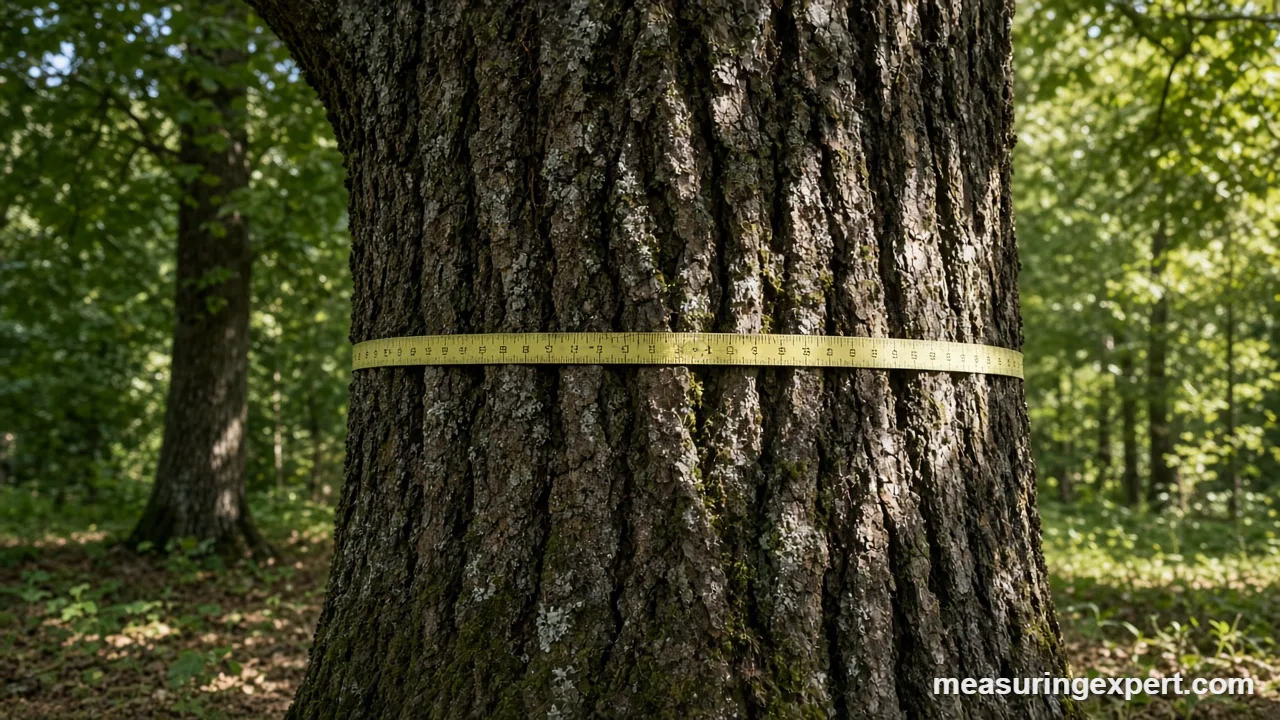
Tree girth is the distance around a trunk, taken with a tape at breast height: 4.5 feet (1.37 m) above the ground on the uphill side in the US, or 1.3 m in most metric countries. Divide girth by pi (3.1416) to get the diameter at breast height (DBH). For example, a 60-inch girth means a 19.1-inch DBH.
Foresters, arborists, city tree crews and curious homeowners all start with the same simple number. In fact, a tape around the trunk tells you how big a tree is, how fast it grows, roughly how old it might be, and whether it could be a local champion. However, the number only means something when everyone takes it the same way, at the same height, with the tape level.
That is why forestry uses a fixed reference point called breast height. In the US, for example, it sits 4.5 feet up the trunk, measured from the uphill side. The Forest Measurements textbook from Open Oregon Educational Resources explains that this spot sits above most butt swell and brush, and it is also a comfortable height for your arms.
In short: wrap a flexible tape level around the trunk at 4.5 feet, read the circumference, and divide by pi if you need the diameter. Then the rest of this guide covers the awkward trunks, the conversions and the age estimates.
Tree Girth Converter: Inches, Feet and Centimeters
First, enter your tape reading below and pick the unit on your tape. The converter then shows the same girth in centimeters, meters, feet and inches. To get diameter, however, divide the result by 3.1416, or use the chart further down.
Recommended Tools for Measuring Tree Girth
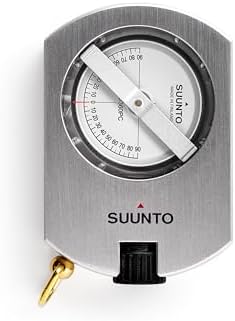
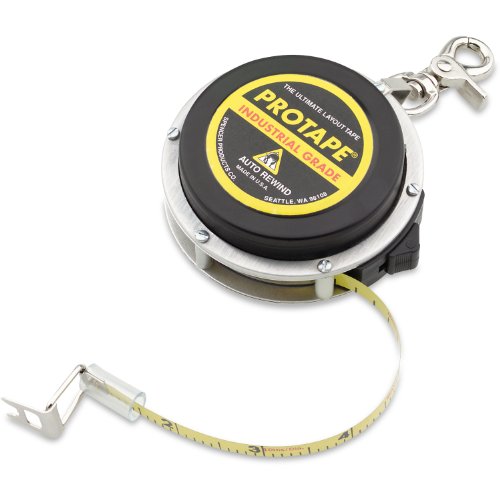
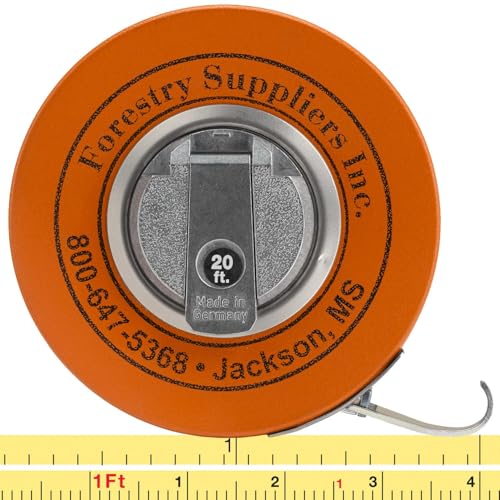
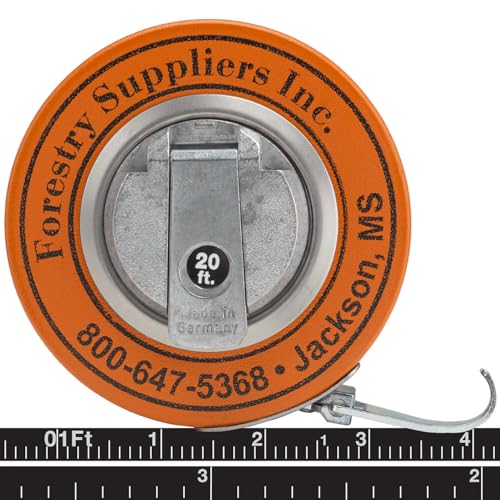
A soft sewing tape works on a sapling, but it stretches and is too short for a mature oak. Instead, look for a diameter tape (D-tape). That is because it has ordinary inches on one side and pi-divided inches on the other, so it reads diameter directly. In addition, a long fiberglass reel tape handles very large trunks, and a clinometer lets you add height for big tree scores.


As an Amazon Associate, Measuring Expert earns from qualifying purchases.
Key Takeaways
- Breast height in the US is 4.5 feet (1.37 m); most metric countries use 1.3 m.
- Always start from the uphill side when the ground slopes.
- Diameter equals girth divided by pi, so a 31.4-inch girth is about a 10-inch DBH.
- A D-tape also skips the math by printing pi-inch marks.
- Age estimates multiply DBH by a species growth factor, and they are rough.
- Big tree programs add girth in inches, height in feet and a quarter of crown spread.
- Keep the tape level and snug, but never pressed into soft bark.
Tree Girth vs DBH: What Is the Difference?
In fact, both numbers describe the same slice of trunk. Girth is the distance around it, while DBH is the distance straight through it. Foresters usually record DBH, because diameter feeds directly into volume and basal area formulas. Tree registers, by contrast, often record circumference, since that is what a plain tape shows.
| Term | What it measures | Typical unit | Who uses it |
|---|---|---|---|
| Girth (circumference) | Distance around the trunk at breast height | inches or cm | Big tree registers, gardeners, UK tree surveys |
| DBH (diameter at breast height) | Width through the trunk at breast height | inches or cm | Foresters, timber cruisers, city tree inventories |
| Breast height | The height where you take both readings | 4.5 ft (US), 1.3 m (metric) | Everyone, so data can be compared |
| Basal area | Cross-section area of the trunk at breast height | sq ft or sq m | Forest stand density studies |
Besides trees, girth is also a word for body, horse and parcel measurements. For those, see our separate guide to taking girth measurements. This page, however, stays with trees.
How to Measure Tree Girth at Breast Height
- Find the uphill side. First, stand where the ground meets the trunk highest. On flat ground, any side works.
- Mark 4.5 feet up. Next, hold a tape or stick against the bark and mark 54 inches (1.37 m) with chalk. In metric surveys, mark 1.3 m instead.
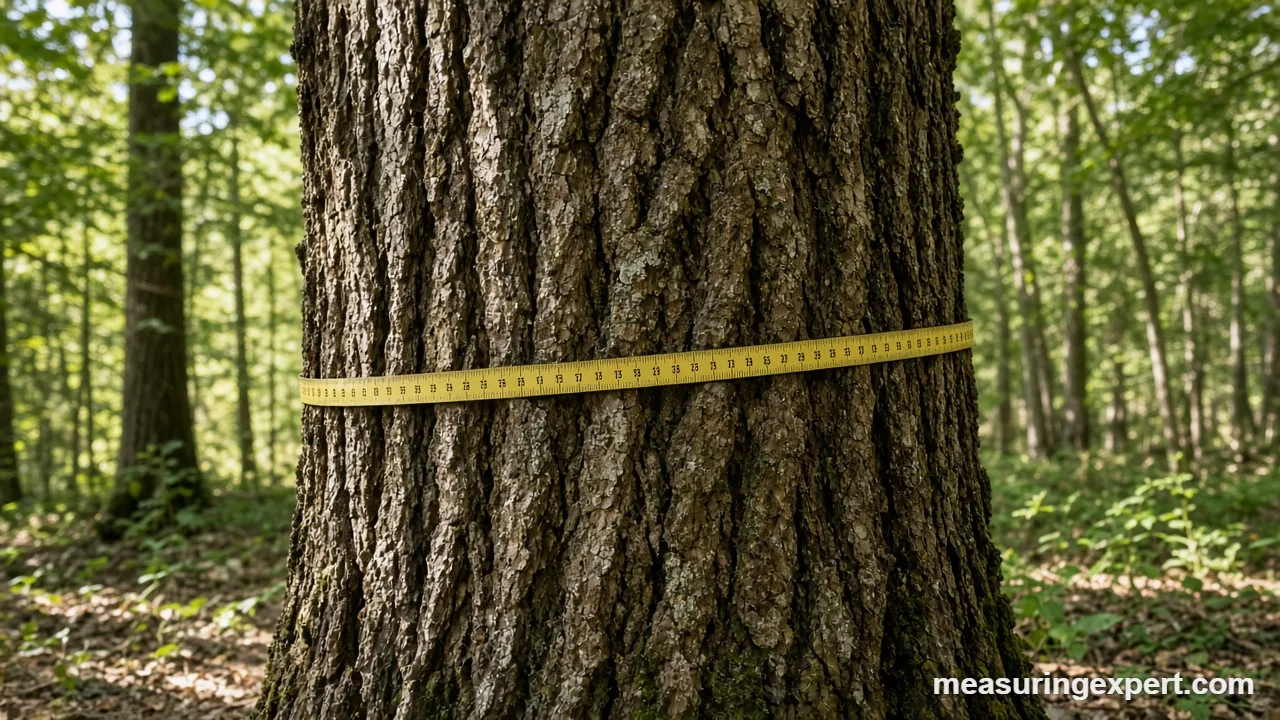
- Wrap the tape level. Then pass the tape around the trunk at the mark. Keep it at a right angle to the stem, not tilted toward the ground.
- Clear the path. Also, slide the tape under vines and loose moss so they do not add length.
- Pull it snug. Tighten until the tape lies flat on the bark, then read where the zero end meets the tape.
- Record the reading. Finally, write down the girth, the unit, the date and the side you measured from. Then enter it in the converter above.
Slopes, Leans, Forks and Swellings
Real trunks, however, rarely behave. So the Forest Measurements textbook gives practical rules for the common problems, summarized here:
- Sloping ground: measure 4.5 feet up from the uphill side.
- Leaning trunk: hold the tape perpendicular to the stem, on the uphill side or the short side of the lean.
- Fork below breast height: treat each stem as its own tree and measure each one.
- Fork at or above breast height: count it as one tree and measure below the fork.
- Branch or bulge at the mark: move just above it, where the trunk is normal again.
- Large burl or canker: measure the same distance above and below it, then average the two.
- Exposed roots: start the 4.5 feet from the root crown, not from the soil.
Converting Tree Girth to Diameter
Overall, the math is simple: diameter equals circumference divided by pi. Because pi is about 3.1416, every inch of tree girth adds roughly 0.32 inch of diameter. Similarly, every 10 cm of girth adds about 3.2 cm of diameter. Also, the chart below uses exact values and rounds to one decimal.
| Girth (in) | Girth (cm) | DBH (in) | DBH (cm) |
|---|---|---|---|
| 12 | 30.5 | 3.8 | 9.7 |
| 24 | 61.0 | 7.6 | 19.4 |
| 31.4 | 79.8 | 10.0 | 25.4 |
| 36 | 91.4 | 11.5 | 29.1 |
| 48 | 121.9 | 15.3 | 38.8 |
| 60 | 152.4 | 19.1 | 48.5 |
| 72 | 182.9 | 22.9 | 58.2 |
| 94.2 | 239.3 | 30.0 | 76.2 |
| 120 | 304.8 | 38.2 | 97.0 |
| 157 | 398.8 | 50.0 | 126.9 |
In addition, a D-tape does this division for you. Each diameter mark on its back sits 3.1416 inches apart, so wrapping it around the trunk shows DBH straight away. Also, a round trunk is an assumption: an oval trunk gives a slightly larger diameter from girth than from calipers, so note which method you used.
Estimating Tree Age From Tree Girth
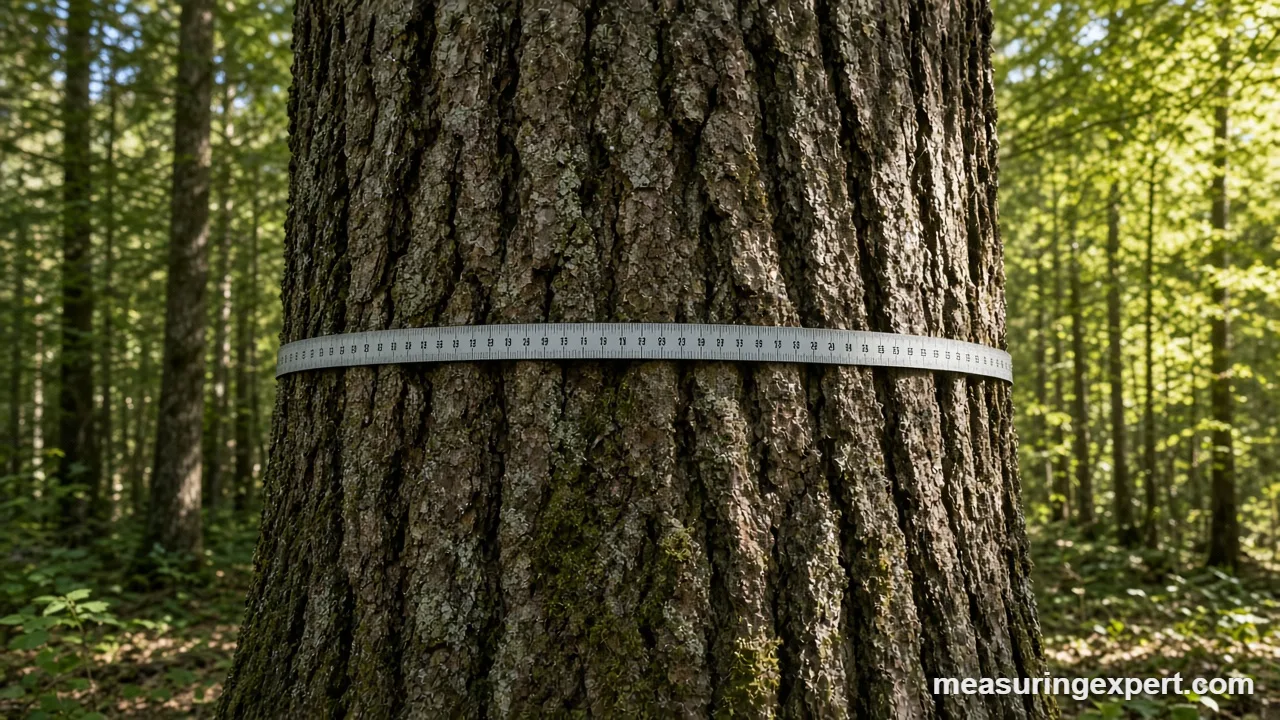
You can estimate the age of a living tree without cutting or coring it. First, measure girth at 4.5 feet. Next, divide by pi to get DBH in inches. Finally, multiply DBH by a growth factor for the species. The Forest Preserve District of Will County publishes this method with the factors below.
| Species | Growth factor | Estimated age at 60-inch girth (19.1-inch DBH) |
|---|---|---|
| Cottonwood | 2.0 | about 38 years |
| Linden (basswood) | 3.0 | about 57 years |
| Red oak | 4.0 | about 76 years |
| Red maple | 4.5 | about 86 years |
| Black walnut | 4.5 | about 86 years |
| White oak | 5.0 | about 95 years |
| White birch | 5.0 | about 95 years |
| Dogwood | 7.0 | about 134 years |
| Shagbark hickory | 7.5 | about 143 years |
For example, a red oak with a 60-inch girth has a DBH of 19.1 inches, and 19.1 x 4.0 gives roughly 76 years. However, the same source warns that the result is only an approximation. That is because soil, water, climate, root stress and competition for light all change growth rates. In addition, it notes that urban trees usually grow more slowly than woodland trees, so a street tree may be older than the number suggests.
Champion Trees and Big Tree Scores
State big tree registers turn tree girth into a contest. The New York State Big Tree Register, for instance, scores trees with a simple sum: trunk circumference in inches at 4.5 feet, plus height in feet, plus one quarter of the average crown spread in feet.
So a tree with a 150-inch girth, 85 feet of height and a 60-foot crown spread scores 150 + 85 + 15 = 250 points. Because girth is often the biggest term, an accurate tape reading matters most. For the height part, you can also use a clinometer; our guide on what a clinometer is and how to use it walks through the angle method.
Do and Don’t
Do
- Measure from the uphill side on a slope.
- Keep the tape level and perpendicular to the stem.
- Write down the unit and the date every time.
- Check a cheap cloth tape against a steel rule for stretch.
- Re-measure at the same marked spot each year.
Don’t
- Measure at waist height or “about chest high”.
- Let the tape sag lower on the far side of the trunk.
- Include vines, loose bark or ivy in the reading.
- Pull hard enough to dent soft, spongy bark.
- Treat an age estimate as a counted ring age.
Honest Limits of Tree Girth Numbers
Above all, a tape gives a precise reading of an imperfect object. Trunks are rarely perfect circles, so dividing by pi slightly overstates the diameter of an oval stem. Moreover, bark thickness varies by species and age, and thick, furrowed bark adds girth that is not wood. Trees also swell and shrink a little with moisture across the seasons.
For instance, two people measuring the same tree can easily differ by an inch, mainly because of tape height and tension. Even so, that is only about 0.3 inch of diameter, which is fine for most uses. Age estimates are much rougher, though: a growth factor is an average, and a single tree can easily sit far from it. In short, use these numbers for comparison and tracking, not as exact facts.
When to Call an Arborist or Forester
Measuring girth is safe and simple. Still, some situations need a professional. Call a certified arborist if the trunk has cracks, cavities, fungus or a sudden lean, since those can signal a failing tree. Likewise, contact a consulting forester if you need timber volume for a sale, or if the number goes into a legal permit, a property dispute or an insurance claim.
Tree Girth FAQs
What height do you measure tree girth at?
In the US, measure at 4.5 feet (54 inches, 1.37 m) above the ground on the uphill side. However, most metric countries use 1.3 m.
How do I convert tree girth to diameter?
Divide the girth by pi, about 3.1416. For example, a 48-inch girth equals a diameter of about 15.3 inches.
Is tree girth the same as DBH?
No. Girth is the distance around the trunk, while DBH is the diameter through it. Both are taken at breast height, and DBH equals girth divided by pi.
What is a diameter tape?
A diameter tape, or D-tape, is a tape with marks spaced 3.1416 inches apart for each inch of diameter. So when you wrap it around a trunk, it reads DBH directly.
Can I estimate a tree’s age from tree girth?
Yes, roughly. Divide girth in inches by pi to get DBH, then multiply by a species growth factor, such as 4.0 for red oak or 5.0 for white oak.
How accurate is the growth factor method?
It is only an approximation. Soil, water, climate, competition and urban stress all change growth, so the real age can be quite different.
How do I measure a tree on a slope?
Stand on the uphill side and measure 4.5 feet up the trunk from the ground there, then wrap the tape level around the stem.
What if the trunk forks below breast height?
Most forestry guides treat each stem as a separate tree and measure each one at breast height. Some programs combine stems, so check their rules.
What tape should I use for tree girth?
Use a non-stretch diameter tape or a fiberglass reel tape. In contrast, cloth sewing tapes stretch over time and are usually too short for mature trees.
How are champion trees scored?
Many big tree registers add circumference in inches at 4.5 feet, height in feet, and one quarter of the average crown spread in feet.
The Bottom Line on Tree Girth
Tree girth is easy to measure well once you fix the height. Wrap a level, snug tape at 4.5 feet on the uphill side, or at 1.3 m in metric surveys, and divide by pi to get DBH. After that, the same number feeds age estimates, growth tracking and big tree scores.
Finally, remember what each number can and cannot tell you. In other words, a girth reading is solid data, while a growth factor age is a rough guess. Use the converter at the top of the page for quick unit changes, and call an arborist whenever the tree itself looks unsafe.
1 thought on “Tree Girth: How to Measure It at Breast Height, Convert to DBH and Estimate Age”