

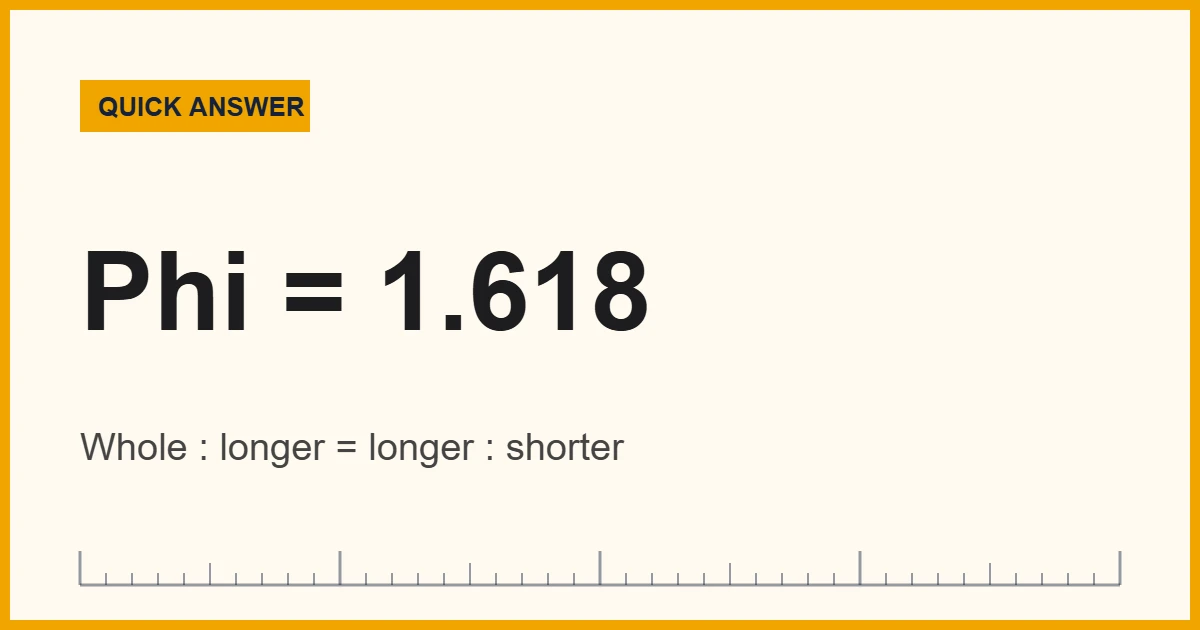
The golden ratio is an irrational number, about 1.618, that appears when a line is cut so the whole is to the longer part as the longer part is to the shorter. To measure it, divide the whole by the longer part, or the longer part by the shorter, and compare the result with 1.618.
In fact, the golden ratio is one of the few numbers that has both a clean definition and a long list of tall tales. For one thing, the definition is solid math. By contrast, the tales, such as “every beautiful face follows it,” are mostly not. This guide separates the two, so that you can use the number correctly.
First, the math. Indeed, Greek geometers described the idea more than 2,000 years ago. Euclid called it a line cut in “extreme and mean ratio” in Book VI of his Elements, and the definition fits in one sentence: the whole line is to the greater piece as the greater piece is to the less.
Next, the measuring. In fact, you only need two lengths and a calculator, although a good caliper helps. Below, you will find a calculator that splits any length, the exact value, a step-by-step method, and an honest look at where the golden ratio shows up and where it does not.
Golden Ratio Calculator: Split Any Length
To split a length in the golden ratio, divide it by 1.618. The result is the longer part, and the leftover is the shorter part. For example, 30 cm splits into 18.54 cm and 11.46 cm. Then use the length converter to switch the result between centimeters, inches and feet.
Key Takeaways
- The golden ratio is (1 + the square root of 5) / 2, which is 1.6180339887 and so on.
- Its reciprocal is 0.618, and its square is 2.618, because phi squared equals phi plus 1.
- To test a shape, divide the longer side by the shorter side and compare with 1.618.
- Ratios of neighboring Fibonacci numbers get closer and closer to it.
- A 1 mm slip on a 62 mm part moves your result by about 0.026, so use a caliper.
- Many popular claims about faces, shells and famous buildings are disputed or false.
- It is a handy layout guide, not a law of beauty.
The Golden Ratio Value, Formula and Definition
The Greek letter phi stands for the golden ratio. Its exact value is (1 + the square root of 5) / 2. Moreover, as MathWorld lists it, the decimal begins 1.6180339887 and never ends or repeats. In other words, phi is irrational, so no fraction can match it exactly.
The definition leads to a short equation. For example, suppose a line of length a + b is cut into a longer part a and a shorter part b. Then (a + b) / a = a / b. If you call that shared ratio x, the equation becomes x squared = x + 1. As a result, the positive answer is x = 1.618.
| Quantity | Value | Why it matters |
|---|---|---|
| Phi | 1.6180339887 | Longer part divided by shorter part |
| 1 / phi | 0.6180339887 | Longer part divided by the whole |
| Phi squared | 2.6180339887 | Equals phi plus 1 |
| Shorter part / whole | 0.3819660113 | Equals 1 minus 1 / phi |
| Golden angle | 137.5078 degrees | 360 degrees divided by phi squared |
The pattern is easy to remember. In fact, phi and 1 / phi share the same digits after the decimal point, because phi minus 1 equals 1 / phi. As a result, you can get the longer part of any length by multiplying by 0.618 instead of dividing by 1.618.
How the Golden Ratio Connects to Fibonacci Numbers
The Fibonacci sequence starts 1, 1, 2, 3, 5, 8, 13, and each new number is the sum of the two before it. Next, divide each number by the one before it, and the answers close in on phi. The table shows how quickly that happens.
| Pair | Ratio | Gap from 1.6180 |
|---|---|---|
| 3 / 2 | 1.5000 | 0.1180 below |
| 5 / 3 | 1.6667 | 0.0486 above |
| 8 / 5 | 1.6000 | 0.0180 below |
| 13 / 8 | 1.6250 | 0.0070 above |
| 21 / 13 | 1.6154 | 0.0026 below |
| 55 / 34 | 1.6176 | 0.0004 below |
| 144 / 89 | 1.6180 | 0.0001 below |
The ratios swing above and below phi, and the swings shrink every step. Also, according to MathWorld, Robert Simson proved this limit in 1753. As a result, Fibonacci pairs make handy whole-number stand-ins when you build something by hand.
Recommended Tools for Measuring the Golden Ratio
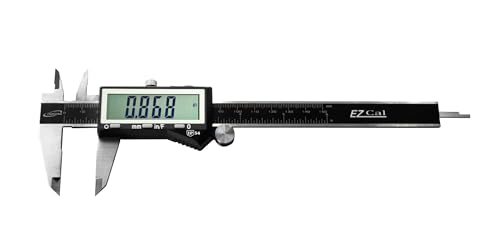
To check a ratio, you need two lengths measured well. First, a caliper reads small parts to a fraction of a millimeter, while proportional dividers let you step a 1 to 1.618 ratio on paper. We chose these based on manufacturer specs and buyer reports, favoring established tool brands. Next, compare range, resolution and whether the scale shows both inches and millimeters.



As an Amazon Associate, Measuring Expert earns from qualifying purchases.
How to Measure the Golden Ratio on Any Object
- Pick the two parts. Decide which long and short edges you are testing, and write them down before you measure.
- Measure the whole. First, record the full length in millimeters or hundredths of an inch.
- Measure the longer part. Use the same tool and the same zero point for every reading.
- Subtract to get the shorter part. Whole minus longer part gives the shorter part, so you avoid a third reading.
- Divide twice. Next, compute whole / longer and longer / shorter.
- Compare with 1.618. Finally, both answers should land near the same number, and that number should sit near phi.
- Set a tolerance. Decide in advance how close counts, such as within 2 percent, which is 1.586 to 1.650.
Here is a worked example. Suppose a shelf is 100 mm tall in total, and its upper section is 62 mm. Then the lower section is 38 mm. As a result, the ratios are 100 / 62 = 1.613 and 62 / 38 = 1.632. Both fall inside the 2 percent band, so the shelf is close to golden.
However, the measuring error matters more than most people expect. If the 62 mm reading were 61 mm, the result would jump to 1.639. Likewise, if it were 63 mm, the result would drop to 1.587. In short, a 1 mm slip on a small part moves the answer by about 0.026, so measure the largest parts you can.
Building a Golden Ratio Rectangle With a Compass
A golden rectangle has sides in the ratio 1 to 1.618. For this, a paper compass and a straightedge are enough to draw one. In short, the method uses the fact that the distance from a side’s midpoint to the opposite corner is 1.118 times the side.
- Draw a square with side s.
- Mark the midpoint M of the bottom side.
- Place the compass point on M and open it to the top right corner of the square.
- Swing an arc down to the extended bottom line.
- Measure from the square’s left corner to the arc. That length is 1.618 times s.
- Complete the rectangle with that long side.
Also, the result has a neat property. For instance, if you cut a square off the rectangle, the leftover piece has the same 1 to 1.618 shape. Next, repeat the cut again and again, and the square corners trace a spiral. However, that spiral is built from quarter circles, so it only approximates a true golden spiral. For a deeper look at angles in drawings like this, read our guide to angle measurement.
Golden Ratio Myths Versus Facts
Popular books and videos make bold claims. In fact, some are true, some are partly true, and many collapse once you measure carefully. George Markowsky, a mathematician at the University of Maine, has argued that much of what people say about the golden ratio in art, architecture and aesthetics is seriously misleading or false, even though the math itself is usually stated correctly.
| Claim | Verdict | What to know |
|---|---|---|
| Phi equals (1 + sqrt 5) / 2 | True | An exact mathematical definition. |
| Fibonacci ratios approach phi | True | A proven limit. |
| Many sunflower and pinecone spirals count in Fibonacci numbers | Often true | Linked to the golden angle of 137.5 degrees, but not every plant follows it. |
| Seashells grow in golden spirals | Mostly false | Shells grow in logarithmic spirals, but the growth rate is usually not phi. |
| Faces and bodies follow phi | Unproven | Human proportions vary, and the supporting measurements are weak. |
| Famous buildings and paintings were built on phi | Disputed | The result depends on where you place the measuring lines. |
| It is the most beautiful ratio | Not established | Preference tests show weak or mixed results. |
One warning is worth repeating. First, when a claim fits a shape “perfectly,” check where the lines were drawn. For instance, move a line a few millimeters on a photo, and nearly any rectangle can be made to look golden. Therefore, always ask for the raw measurements.
Where the Golden Ratio Is Genuinely Useful
Even without the myths, the number still earns its place as a layout aid. For example, designers use it to pick pleasing proportions, but treat it as a starting point and trust your eye afterward.
- Page layouts. A 960 px column splits into about 593 px and 367 px, which gives a main area and a sidebar.
- Photo and video crops. A 1920 px wide frame divides at about 1187 px, which places a subject off center.
- Woodworking and furniture. A 36 in (91.4 cm) tabletop might pair with a 22.25 in (56.5 cm) shelf depth.
- Panels, beds and rooms. A 12 in by 19.4 in (30.5 cm by 49.3 cm) panel is close to golden.
- Plant spacing. The 137.5 degree golden angle is a handy model for spiral seed and leaf layouts.
Real-world proportions are often near 1.6 but rarely exact. For example, a credit card measures 85.6 mm by 53.98 mm, which is 1.586. Meanwhile, A4 paper sits at the square root of 2, or 1.414, and US letter paper is 11 in by 8.5 in, or 1.294. Therefore, neither is golden. If you work with circles as well, see how pi differs from phi in our guide to the circumference of a circle.
Do and Don’t When Using the Golden Ratio
Do
- Measure the largest parts you can.
- Use the same tool and zero point throughout.
- Set your tolerance before you measure.
- Keep at least four decimals in calculations.
- Treat it as a layout guide only.
Don’t
- Round phi to 1.6 for precise work.
- Draw measuring lines after you see the result.
- Assume a close match proves a design choice.
- Judge faces or people against it.
- Mix up phi with pi.
Honest Limits of Golden Ratio Measurements
Phi is exact only in theory. In practice, every physical object has edges that are rounded, worn or fuzzy, so real golden ratio readings carry some error. A school ruler reads to about 1 mm, whereas a decent caliper reads to about 0.02 mm. As a result, small parts need better tools than large ones.
Moreover, rounding hides small gaps. For example, a shape at 1.60 and another at 1.62 look nearly identical, yet one sits about 1.1 percent below phi and the other about 0.1 percent above it. In short, a ratio near 1.6 shows that a shape is roughly golden, not that anyone designed it that way.
When Precision Matters
For crafts and layouts, a ruler and a calculator are plenty. However, for machined parts, architectural drawings or legal documents, calibrated instruments and a trained person are safer. Also, check your caliper against a known gauge block now and then, as explained in our guide to measurement tool calibration.
Frequently Asked Questions
What is the golden ratio in simple terms?
The golden ratio is the number 1.618. It appears when a line is cut so the whole is to the longer part as the longer part is to the shorter part.
How is the golden ratio measured?
Measure the whole and the longer part with the same tool. Then divide the whole by the longer part, or the longer part by the shorter, and compare the answer with 1.618.
What is the exact value of the golden ratio?
The exact value is (1 + the square root of 5) divided by 2. As a decimal, it begins 1.6180339887 and never ends or repeats.
Why is 1.618 so special?
It is the only positive number that becomes its own reciprocal plus 1. As a result, it links geometry, algebra and the Fibonacci sequence in one simple equation.
Is the golden ratio the same as the Fibonacci sequence?
No. The Fibonacci sequence is a list of whole numbers. However, the ratio of neighboring Fibonacci numbers gets closer and closer to 1.618.
How do I calculate the golden ratio of a length?
Divide the length by 1.618 to get the longer part. For example, 100 cm gives 61.8 cm for the longer part and 38.2 cm for the shorter part.
Does the human body follow the golden ratio?
There is no solid evidence that it does. In fact, human proportions vary from person to person, and many published claims depend on where the measuring lines are drawn.
What is the golden angle?
The golden angle is about 137.5 degrees. You get it by dividing 360 degrees by phi squared. Some plants place new seeds or leaves at about this angle.
What tool do I need to measure the golden ratio?
A ruler is enough for large objects. However, for small parts, use a caliper, and for drawings, use proportional dividers or a compass.
Is the golden ratio the same as pi?
No. Instead, pi is about 3.14159 and relates a circle’s circumference to its diameter. Phi is about 1.618 and relates the parts of a divided line.
Golden Ratio: The Bottom Line
To sum up, the golden ratio is a precise number, 1.6180339887 and so on, defined by one neat proportion. In addition, you can calculate it, build it with a compass and measure it with a caliper. It is also tied to Fibonacci numbers through a proven limit.
Finally, keep the claims in perspective. The math is solid, but many stories about faces, shells and famous buildings are not. Therefore, measure carefully, set your tolerance first, and use the golden ratio as one handy layout guide among several.