

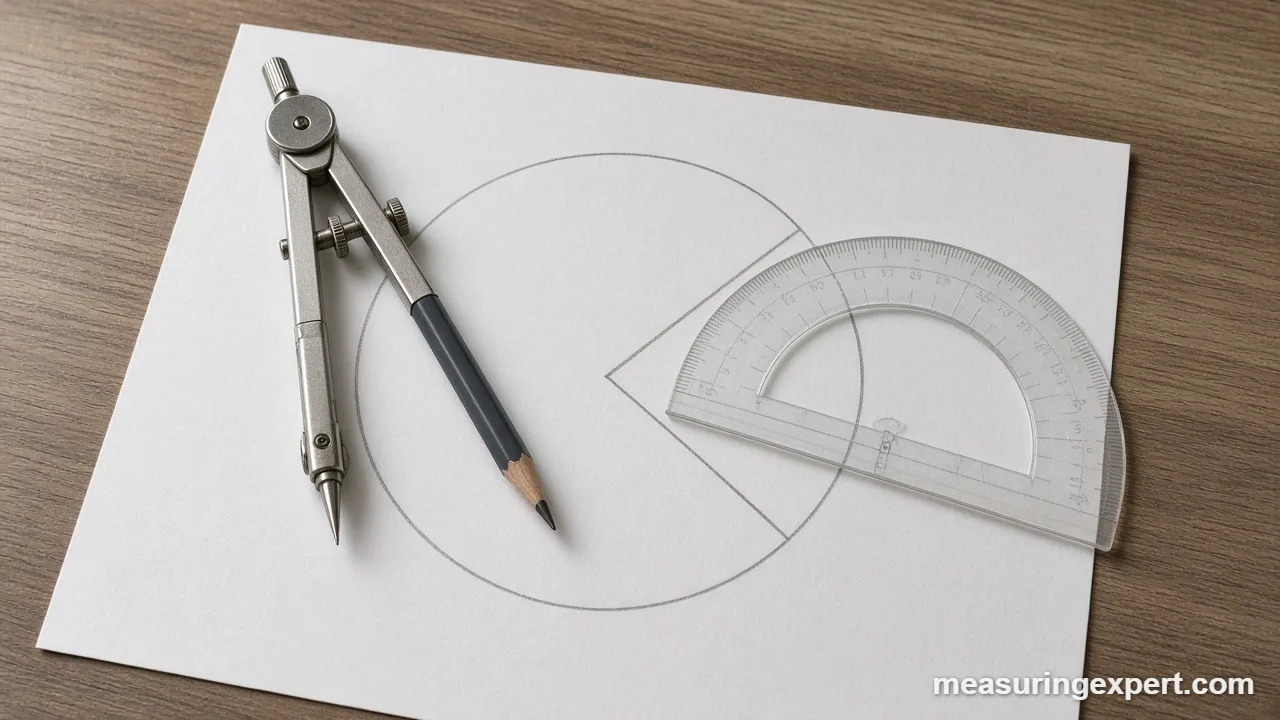
Angles and arcs in a circle are linked by simple ratios. A central angle has the same measure in degrees as the arc it cuts off, while an inscribed angle measures exactly half of its arc. In addition, arc length equals the radius times the central angle in radians.
Angle Converter for Angles and Arcs Work
For example, many circle problems start with an angle that must become something else, such as a slope for a curved ramp or a setting on a tool. Therefore, enter a central angle below and the converter shows the matching percent grade and rise per 12 inches.
What Connects Angles and Arcs
First, take a circle and draw two radii from its center. Then the two radii form an angle, and the piece of the circle between their ends is an arc. Because the circle is a fixed shape, a bigger angle always cuts off a longer arc. For this reason, that one fact explains most of the rules about angles and arcs.
A full circle turns through 360 degrees. In the same way, the whole circumference is one complete arc. Therefore, a bigger angle always means a bigger share of the circle. Each degree of angle therefore takes up 1/360 of the circle. The US National Institute of Standards and Technology lists both the degree and the radian in its Guide for the Use of the International System of Units (SP 811), where one radian is 180 divided by pi degrees, or about 57.2958 degrees.
Next, you will learn the central angle rule, the inscribed angle rule, and how to find arc length and sector area. After that, you will see the rules for chords, secants and tangents, and some real examples. For related background, read our guides on degrees and gradians and the circumference of a circle.
Central Angles and Arcs: The Basic Rule
A central angle has its vertex at the center of the circle. Its sides are two radii, so they cut off an arc. In fact, the rule is direct: the arc measure, in degrees, equals the central angle. A 60 degree central angle therefore cuts off a 60 degree arc. As a result, the central angle is the easiest one to read with a protractor.
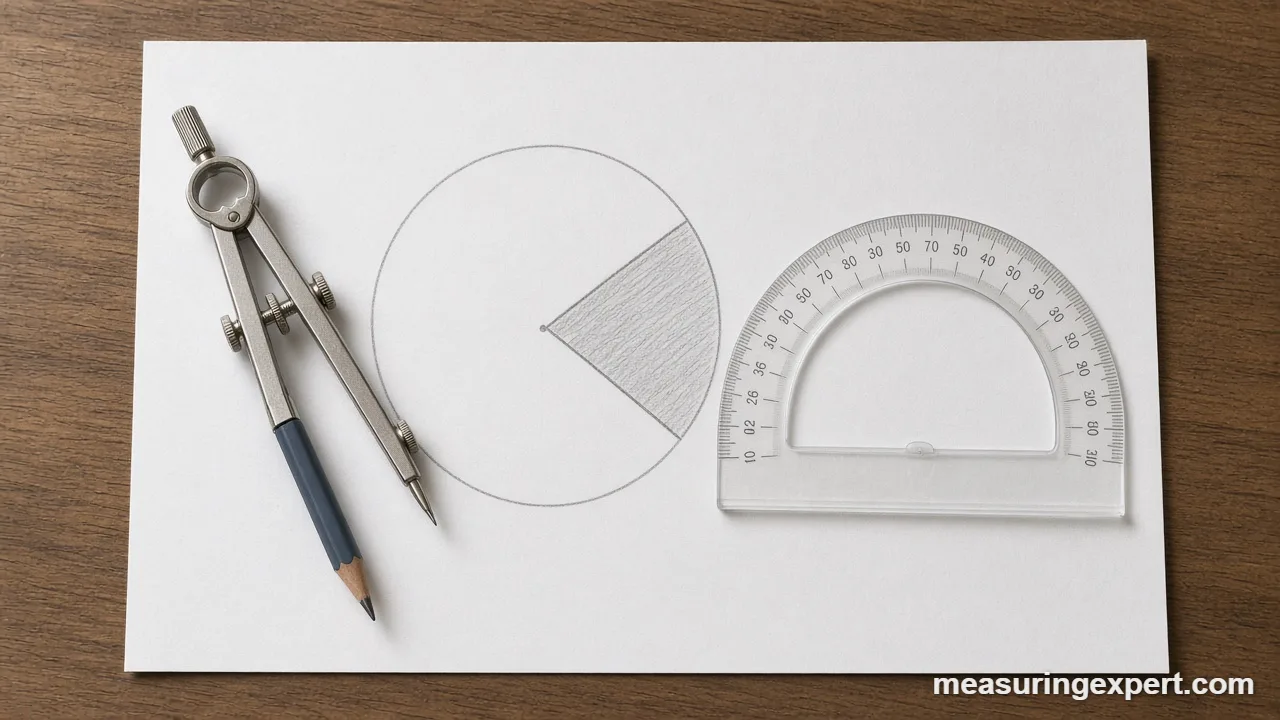
In addition, all the central angles around a point add up to 360 degrees. For example, four equal slices each take 90 degrees, and eight equal slices each take 45 degrees. As a result, equal slices always make equal arcs. Also, a half circle, or semicircle, is a 180 degree arc.
Inscribed Angles and Arcs: Half the Arc
An inscribed angle has its vertex on the circle itself, and its sides are chords. Its measure is therefore half of the arc it intercepts. So, if the arc is 80 degrees, the inscribed angle is 40 degrees. As the inscribed angle theorem explains, the angle stays the same wherever the vertex sits on the far side of the arc.
As a result, a handy special case follows. A diameter cuts off a 180 degree arc, so any inscribed angle that rests on a diameter measures 90 degrees. In practice, builders use this idea, known as Thales’ theorem, to check a right angle with a circle.
| Feature | Central angle | Inscribed angle |
|---|---|---|
| Vertex | At the center | On the circle |
| Sides | Two radii | Two chords |
| Relation to arc | Equal to the arc | Half of the arc |
| Example with an 80 degree arc | 80 degrees | 40 degrees |
| Arc of 180 degrees | 180 degrees | 90 degrees |
Therefore, you can always switch between the two angles by halving or doubling.
Arc Length and Sector Area
First, arc length is the distance along the curve. Because the arc is a fraction of the circumference, the formula is simple: arc length = (angle / 360) x 2 x pi x radius, when the angle is in degrees. Otherwise, if the angle is in radians, the formula shortens to arc length = radius x angle.
For example, let the radius be 5 units and the central angle 60 degrees. Then the arc length is (60 / 360) x 2 x pi x 5, which is about 5.24 units. The sector area is (60 / 360) x pi x 5 x 5, or about 13.09 square units.
| Radius | Central angle | Arc length | Sector area |
|---|---|---|---|
| 3 units | 45 degrees | 2.36 units | 3.53 sq units |
| 6 units | 45 degrees | 4.71 units | 14.14 sq units |
| 5 units | 60 degrees | 5.24 units | 13.09 sq units |
| 10 units | 90 degrees | 15.71 units | 78.54 sq units |
| 12 units | 30 degrees | 6.28 units | 37.70 sq units |
Notice the first two rows. In particular, doubling the radius from 3 to 6 doubles the arc length for the same angle, since arc length grows in direct proportion to the radius. In other words, arc length scales with both the angle and the radius.
Chords, Secants and Tangents
Angles can also sit inside or outside the circle. In those cases, however, the arcs still decide the angle, but the rule changes. Therefore, the table below summarizes the three most common ones.
| Where the angle sits | Rule | Example |
|---|---|---|
| Tangent and chord at a point on the circle | Half of the intercepted arc | 110 degree arc gives 55 degrees |
| Two chords crossing inside the circle | Half the sum of the two arcs | Arcs of 70 and 50 give 60 degrees |
| Two secants meeting outside the circle | Half the difference of the two arcs | Arcs of 100 and 40 give 30 degrees |
In short, on the circle you halve one arc, inside you average two arcs, and outside you take half of the gap between them. For instance, the tangent and chord case turns a 110 degree arc into a 55 degree angle.
Recommended Tools for Angles and Arcs
Fortunately, you can check every rule above with simple drawing tools. First, a compass draws a clean circle. Next, a protractor reads the central angle. Finally, a ruler or flexible tape measures the chord or the arc itself. In addition, a circle template helps when you need small, repeatable circles. As a result, a basic geometry set covers every example on this page.


As an Amazon Associate, Measuring Expert earns from qualifying purchases.
Key Takeaways
- A central angle equals its arc in degrees.
- An inscribed angle is half of its arc.
- Arc length = (angle / 360) x 2 x pi x radius, or radius x angle in radians.
- One radian is about 57.2958 degrees.
- An angle inscribed in a semicircle is always 90 degrees.
- Arc measure is in degrees; arc length is in units of distance.
How to Find an Arc From an Angle Step by Step
- Write down what you know. Note the radius (or diameter) and the central angle.
- Check the units. Make sure the angle is in degrees, or convert it with 1 radian = 57.2958 degrees.
- Find the fraction of the circle. Divide the angle by 360. For 60 degrees, that is 1/6.
- Find the circumference. Multiply 2 x pi x radius. For a radius of 5, that is about 31.42.
- Multiply the two. One sixth of 31.42 is about 5.24, so the arc is 5.24 units long.
- Check the result. The arc should be longer than the straight chord between its ends but shorter than the circumference.
Real-World Examples of Angles and Arcs
Circles are everywhere, so these rules show up in daily life. For instance, the minute hand of a clock turns 6 degrees every minute, so at 15 minutes past it has moved through a 90 degree arc. Likewise, at 30 minutes past it has moved through 180 degrees. Meanwhile, the hour hand turns 0.5 degrees per minute.
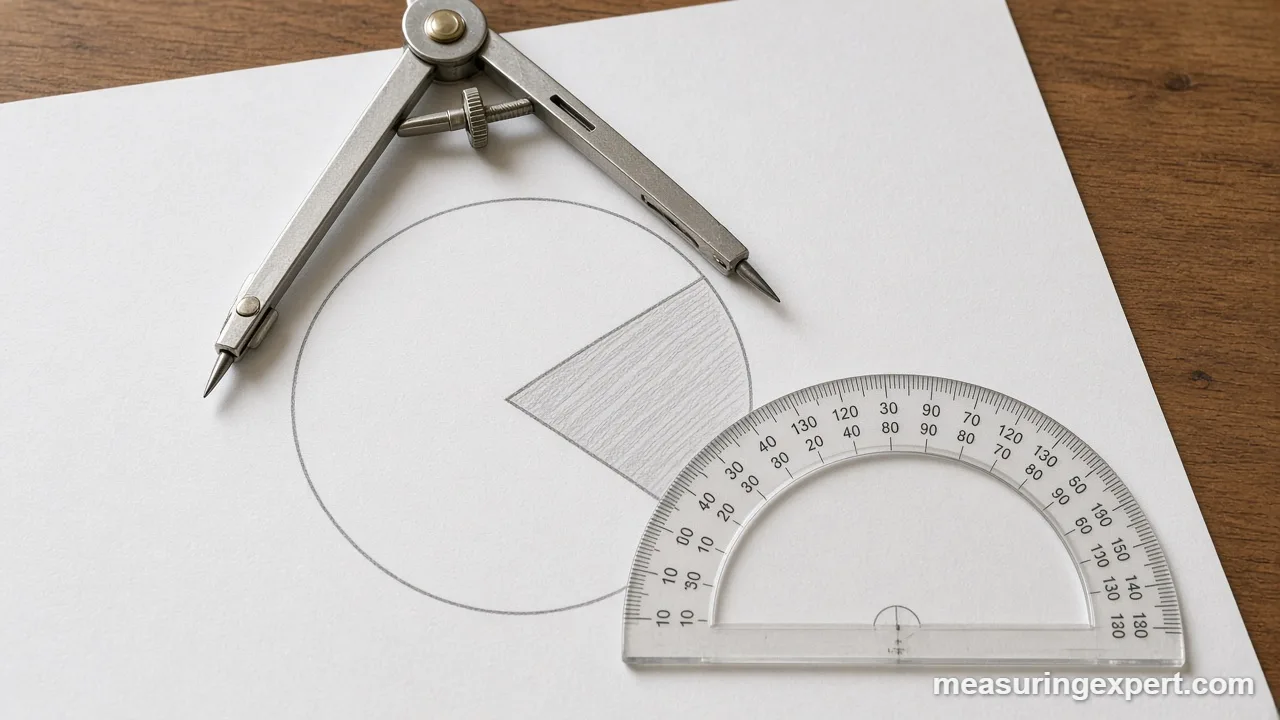
Next, food gives another example. A pizza with a 6 inch radius, cut into 8 equal slices, has a central angle of 45 degrees per slice. Each crust edge is therefore about 4.71 inches (119.7 mm) long. Similarly, pie charts turn each percentage into a central angle by multiplying it by 3.6 degrees. For example, a 25 percent slice takes 90 degrees.
Moreover, curved roads, pipes and arches are set out from a radius and a central angle. Likewise, surveyors and astronomers describe positions as angles, because the arc across the sky or the ground depends on the distance. For a tool-focused view, see our overview of angle measurement.
Common Mistakes With Angles and Arcs
Do
- Say whether an angle is central or inscribed first.
- Keep the angle in degrees or radians, not both.
- Use the radius, not the diameter, in the arc formula.
- Label arc measure and arc length separately.
- Sketch the circle and mark each arc.
Don’t
- Halve a central angle by mistake.
- Forget to halve an inscribed angle.
- Mix up a chord with its arc.
- Round pi to 3 when a precise answer matters.
- Use a calculator set to the wrong angle mode.
Honest Limits of These Rules
However, these rules describe perfect circles. Also, a drawn circle is never perfect, and a protractor reads to about a degree at best, so a measured 60 degree angle may really be 59 or 61. For this reason, quote results with a sensible number of digits. Moreover, the formulas assume a flat plane. On a sphere such as the Earth, for example, arcs follow curved paths, and flat circle geometry only works over short distances. Because of this, round only at the end of a calculation, not in the middle. In short, treat the numbers on this page as exact for ideal shapes and as close estimates for physical objects.
Frequently Asked Questions
What is the relationship between angles and arcs?
A central angle equals the measure of its arc in degrees, and an inscribed angle is half of its arc. A bigger angle always cuts off a longer arc on the same circle.
How do you find the angles and arcs rule for a central angle?
Take the angle in degrees as the arc measure. For example, a 75 degree central angle cuts off a 75 degree arc.
How do you find an inscribed angle from an arc?
Divide the arc by 2. An arc of 140 degrees gives an inscribed angle of 70 degrees.
How do you convert angles and arcs between degrees and radians?
Multiply degrees by pi/180 to get radians, or multiply radians by 180/pi to get degrees. So 90 degrees is about 1.5708 radians.
What is the formula for arc length?
Arc length = (angle / 360) x 2 x pi x radius, with the angle in degrees. With radians, use radius x angle.
Why is an angle in a semicircle 90 degrees?
A semicircle is a 180 degree arc, and an inscribed angle is half its arc. Half of 180 is 90.
Do equal angles always make equal arcs?
Yes, on the same circle or on circles of equal radius. On circles of different radii, equal angles give arcs of different lengths but the same degree measure.
What is the difference between a sector and a segment?
A sector is bounded by two radii and an arc, like a pizza slice. A segment is bounded by a chord and an arc.
How many degrees are in an arc of one radian?
One radian is about 57.2958 degrees. That is the angle whose arc is exactly as long as the radius.
How do I measure angles and arcs on a drawing?
Place a protractor at the center and read the central angle. Then use the arc length formula, or lay a flexible tape along the curve.
Angles and Arcs: The Bottom Line
To sum up, a central angle matches its arc, an inscribed angle is half its arc, and arc length is the fraction of the circumference that the angle covers. With those three ideas, therefore, most circle problems become simple arithmetic.
Finally, use the converter at the top whenever you need an angle in another form, and sketch each problem before you calculate. For a deeper look at the polygons that circles contain, see angles in a polygon.