

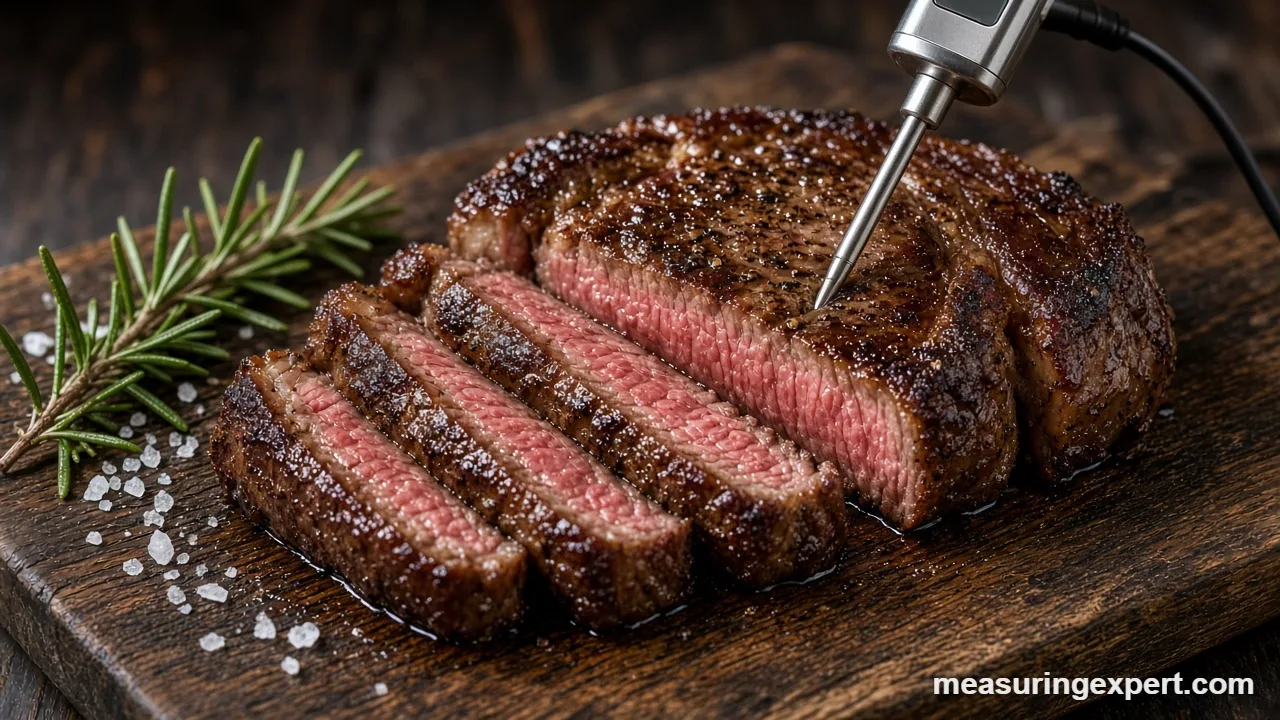
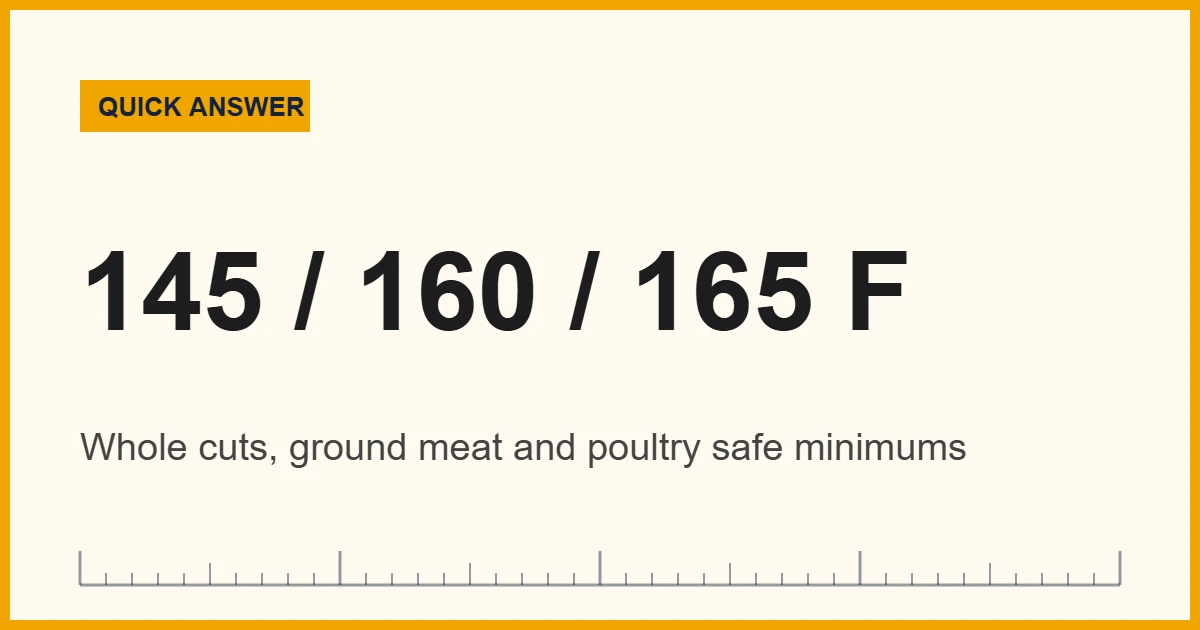
A meat thermometer tells you when meat is done: 165 F (74 C) for poultry, 160 F (71 C) for ground meat, and 145 F (63 C) plus a 3-minute rest for whole cuts of beef, pork, lamb and fish. Insert it into the thickest part, and take the meat off the heat a few degrees early.
Unfortunately, color and cooking time are poor guides to doneness. For example, a steak can look done and still be rare inside, and a chicken breast can turn pink-free well below a safe temperature. In short, a meat thermometer ends that guessing with one number.
This page is a doneness reference. First, it covers the safe minimums, the steak scale from rare to well-done, and how carryover cooking changes the number you should aim for. If you want the technique itself, such as probe types and calibration, read our guide to using a digital thermometer for cooking.
Throughout, temperatures appear in both Fahrenheit and Celsius. As a result, you can follow a US recipe on a metric display, or the other way around.
Meat Thermometer Temperature Converter
First, enter a doneness target below to switch between Fahrenheit, Celsius and Kelvin. In addition, the converter shows its formula, so you can check the math.
Safe Minimum Temperatures for Meat
To start, these are the USDA safe minimum internal temperatures. In fact, they are the floor for food safety, not a preference for taste. The agency lists them on its safe minimum temperature chart.
| Meat | Safe minimum | Rest time |
|---|---|---|
| Beef, pork, veal, lamb (steaks, chops, roasts) | 145 F (63 C) | 3 minutes |
| Ground beef, pork, veal, lamb | 160 F (71 C) | None listed |
| All poultry, including ground poultry | 165 F (74 C) | None listed |
| Fresh ham (raw) | 145 F (63 C) | 3 minutes |
| Fish and shellfish | 145 F (63 C) | None listed |
| Egg dishes | 160 F (71 C) | None listed |
| Leftovers and casseroles | 165 F (74 C) | None listed |
Steak Doneness by Meat Thermometer
Steak lovers, for instance, use a finer scale than the USDA minimum. However, these ranges are common chef guidance for whole-muscle steaks, and they are a matter of taste. Note that the three rarest levels sit below the 145 F (63 C) USDA minimum.
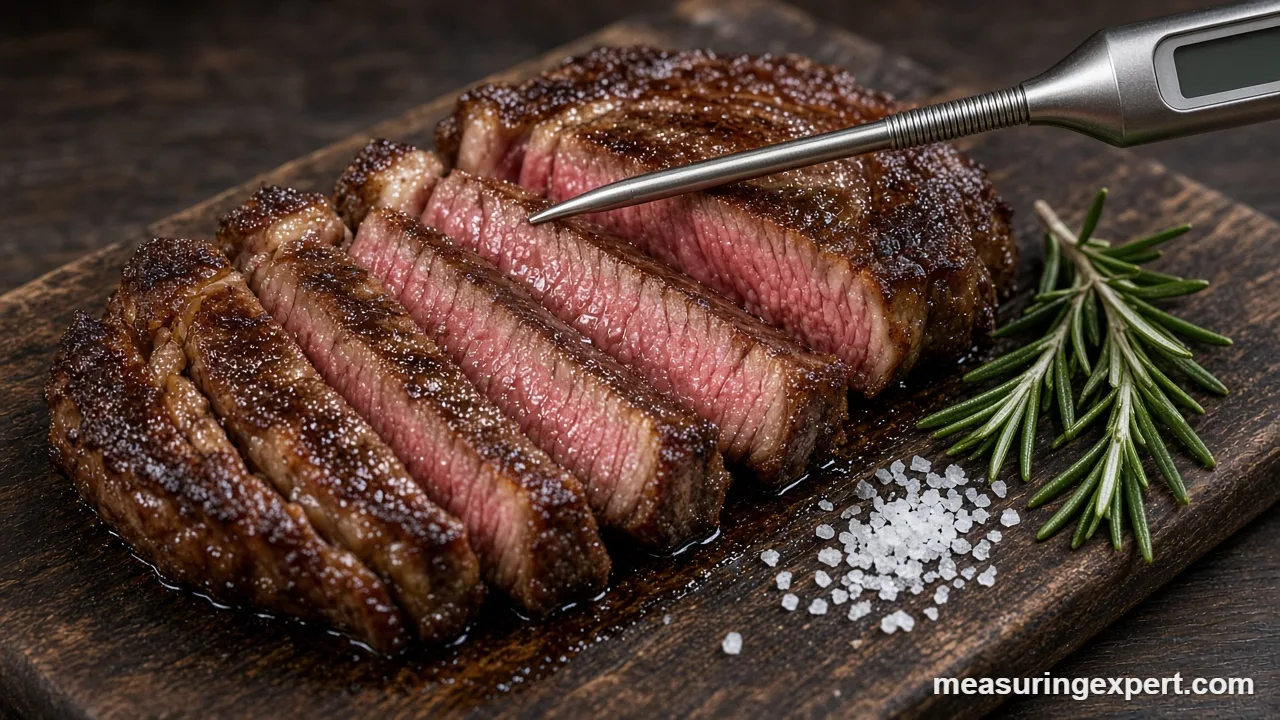
| Doneness | Pull from heat | Final temperature | Center looks like |
|---|---|---|---|
| Rare | 115 to 120 F (46 to 49 C) | 120 to 125 F (49 to 52 C) | Cool, red |
| Medium-rare | 125 to 130 F (52 to 54 C) | 130 to 135 F (54 to 57 C) | Warm, red |
| Medium | 135 to 140 F (57 to 60 C) | 140 to 145 F (60 to 63 C) | Hot, pink |
| Medium-well | 145 to 150 F (63 to 66 C) | 150 to 155 F (66 to 68 C) | Slight pink |
| Well-done | 155 to 160 F (68 to 71 C) | 160 F (71 C) and up | No pink |
Pull Temperature and Carryover Cooking
Hot meat keeps cooking after you remove it from the pan, grill or oven. The reason is simple: the outside is hotter than the center, so heat keeps flowing inward. As a result, the center climbs while the meat rests.
In general, the rise depends mostly on size and cooking heat. A thin steak gains only a few degrees, whereas a large roast can gain 5 to 10 degrees F (3 to 6 degrees C) or more. Therefore, pull big cuts earlier.
| Cut | Typical rise while resting | Pull this far below target |
|---|---|---|
| Thin steak or chop (under 1 inch) | About 3 to 5 F (2 to 3 C) | 3 to 5 F |
| Thick steak (1.5 inches or more) | About 5 F (3 C) | 5 F |
| Roast or whole chicken | About 5 to 10 F (3 to 6 C) | 5 to 10 F |
| Very large roast or turkey | Up to 10 to 15 F (6 to 8 C) | 10 to 15 F |
In fact, these rises are rules of thumb, not guarantees. For instance, oven temperature, bone and fat all change the result. Because of that, keep the probe in during the rest and watch the peak. In the end, the peak number, not the pull number, is your final temperature.
Meat Thermometer Temperatures by Cut
Safety targets are firm, but texture targets vary. Tough, collagen-rich cuts taste best far above the minimum, because the connective tissue needs high heat to melt. So the table separates the two.
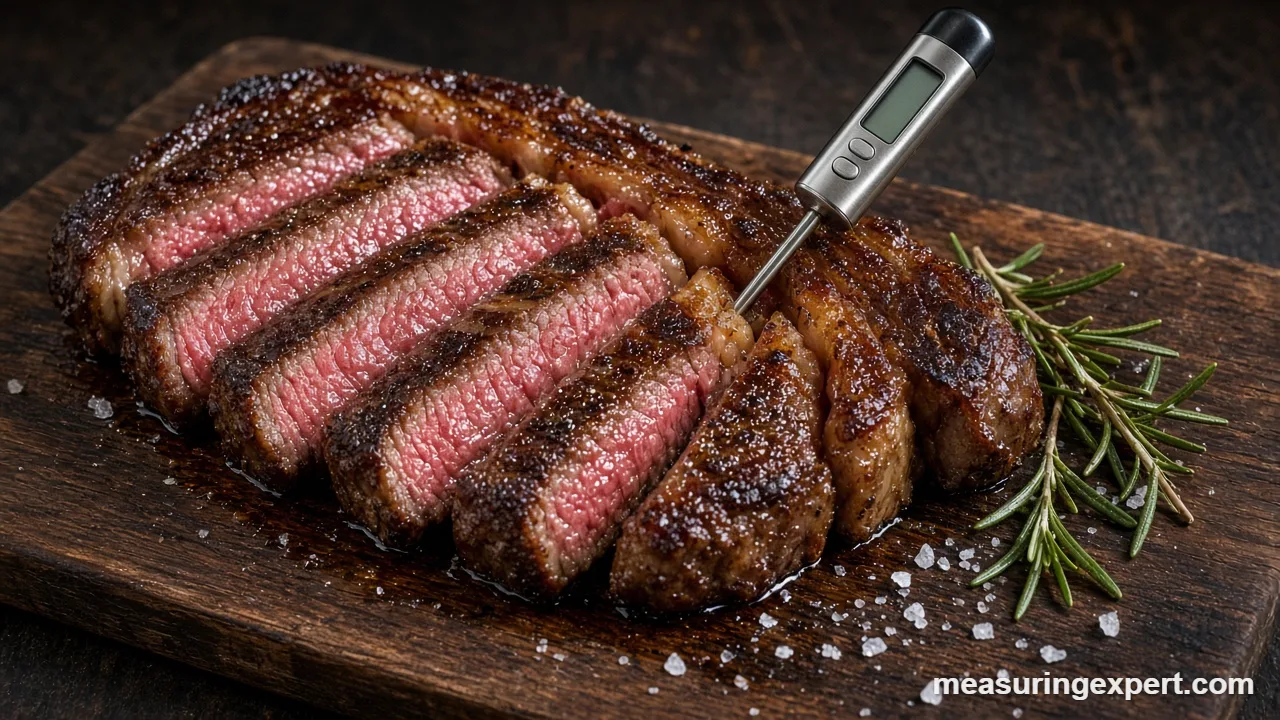
| Cut | Safe minimum | Best texture range |
|---|---|---|
| Beef steak, tenderloin, rib roast | 145 F (63 C) | Rare to medium, per chart above |
| Beef brisket and chuck roast | 145 F (63 C) | 195 to 205 F (91 to 96 C) for fork-tender |
| Pork chop or loin | 145 F (63 C) plus 3-minute rest | 145 to 150 F (63 to 66 C) |
| Pork shoulder for pulled pork | 145 F (63 C) | 195 to 205 F (91 to 96 C) |
| Chicken or turkey breast | 165 F (74 C) | 165 F (74 C), then rest |
| Chicken or turkey thigh and leg | 165 F (74 C) | 175 to 185 F (79 to 85 C) |
| Lamb chop, leg or rack | 145 F (63 C) plus 3-minute rest | 130 to 145 F (54 to 63 C) |
| Ground meat patties and meatloaf | 160 F (71 C) | 160 F (71 C) |
| Ground poultry | 165 F (74 C) | 165 F (74 C) |
| Fish fillet | 145 F (63 C) | Opaque and flaky at 140 to 145 F |
For turkey, check three places: the thickest part of the breast, the innermost part of the thigh, and the wing joint. Each one should reach 165 F (74 C) before you carve. Also, a stuffed bird needs the stuffing itself to reach 165 F too.
Recommended Meat Thermometers for Roasts and Smoking
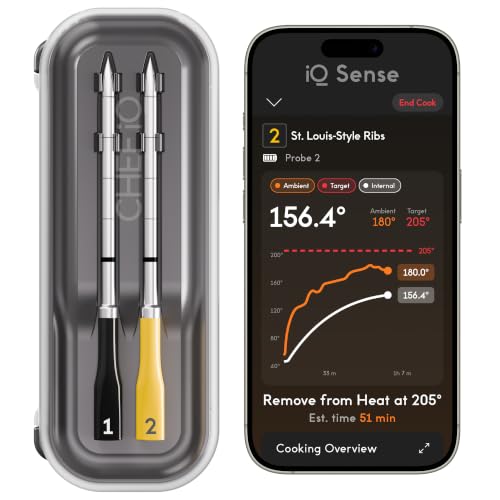
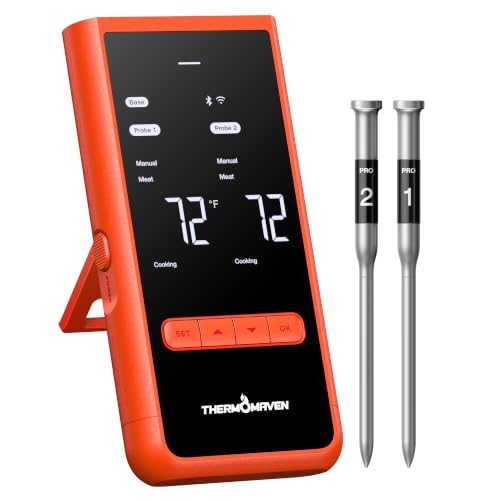
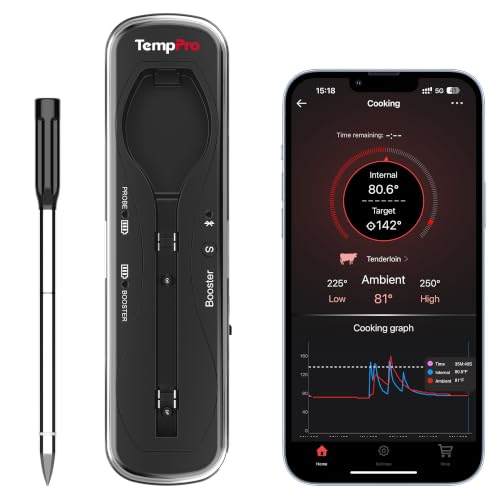
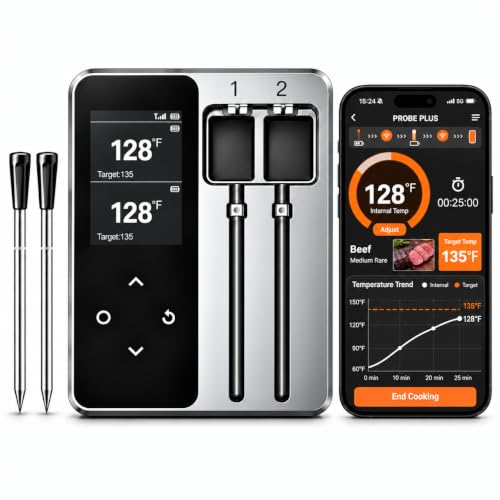
An instant-read model handles steaks and chops. For roasts, turkey and long smokes, however, a leave-in or wireless probe is easier because it tracks the climb for you. Below are widely reviewed options, based on manufacturer specs and buyer reports. For more choices, see our list of the best wireless meat thermometers.
As an Amazon Associate, Measuring Expert earns from qualifying purchases.
Key Takeaways
- Poultry needs 165 F (74 C), and ground meat needs 160 F (71 C).
- Also, whole cuts of beef, pork and lamb need 145 F (63 C) plus a 3-minute rest.
- Steak doneness is a taste scale, so rare to medium sits below the USDA minimum.
- Pull roasts 5 to 10 degrees F early, because carryover cooking raises the center.
- Meanwhile, brisket and pork shoulder taste best around 195 to 205 F (91 to 96 C).
- Finally, always measure the thickest part, away from bone.
How to Check Doneness With a Meat Thermometer
- Set your target. Choose the safe minimum or your steak level, and then subtract the carryover rise to get the pull number.
- Start checking early. Test about 10 degrees F (6 C) below the pull temperature so you do not overshoot.
- Insert into the thickest part. Aim for the center, and then keep the tip clear of bone, fat and the pan.
- Wait for a steady reading. Read the number once it stops climbing, because early readings run low.
- Pull the meat and rest it. Next, move it to a board, loosely tent it, and rest it for at least 3 minutes for whole beef, pork and lamb.
- Confirm the peak. Probe again after the rest, because the final number should meet your target.
Common Meat Thermometer Mistakes
Do
- Always check two spots in large cuts.
- Instead, insert from the side in thin steaks and chops.
- Also wipe the probe between raw and cooked meat.
- Finally, rest meat before slicing.
- Test your thermometer in ice water now and then.
Don’t
- Touch bone, which reads too hot.
- Pull poultry early and skip the final check.
- Judge ground meat by color.
- Poke the meat again and again, since juices escape.
- Leave an instant-read model in a hot oven.
Honest Limits of a Meat Thermometer
A thermometer measures one spot at one moment. Meat is uneven, so the coolest part may sit away from the probe. For example, a bone-in roast heats differently near the bone than in the open muscle. In short, the readings and ranges here are guides, and your cooker, cut and pan will shift them. Therefore, check a second spot whenever safety matters.
Also, some people should stay at or above the safe minimum for every meat. This includes, for example, young children, older adults, pregnant cooks and anyone with a weakened immune system.
Meat Thermometer FAQs
What temperature should a meat thermometer read for chicken?
Chicken is safe at 165 F (74 C) in the thickest part. Also check the thigh, and keep the tip away from bone.
What temperature is pork done?
Whole cuts of pork are safe at 145 F (63 C) followed by a 3-minute rest. Meanwhile, ground pork needs 160 F (71 C).
What temperature is a medium-rare steak?
Medium-rare steak is usually 130 to 135 F (54 to 57 C) after resting. Therefore, pull it at about 125 to 130 F (52 to 54 C).
What is the safe temperature for ground beef?
Ground beef must reach 160 F (71 C) because grinding spreads bacteria through the meat. Color, however, is not a reliable sign of doneness.
What is carryover cooking?
In other words, it is the rise in internal temperature after meat leaves the heat. A large roast can climb 5 to 10 degrees F (3 to 6 C) or more while it rests.
Should I leave a meat thermometer in while cooking?
Leave it in only if it is a leave-in or wireless probe made for oven or grill heat. However, instant-read models should come out after each reading.
Why does the USDA say 145 F if I like steak rare?
The USDA sets the minimum to cover all meat and all eaters. Therefore, a rarer steak is a personal choice, and higher-risk groups should follow the minimum.
How long should meat rest after cooking?
In general, rest whole cuts of beef, pork and lamb for at least 3 minutes. Large roasts, for example, often rest 15 to 30 minutes, which also lets the juices settle.
Where do you put a meat thermometer in a turkey?
First, check the thickest part of the breast, the innermost part of the thigh, and the wing joint. Each should reach 165 F (74 C).
How accurate is a meat thermometer?
In general, good kitchen models are accurate to within about a degree or two. Also, test yours in ice water, where it should read 32 F (0 C).
The Meat Thermometer Bottom Line
To sum up, a meat thermometer turns doneness into a number. First, use 165 F (74 C) for poultry, 160 F (71 C) for ground meat, and 145 F (63 C) plus a rest for whole cuts. Then treat steak levels as taste, and remember that carryover cooking adds heat after you pull.
Next, bookmark the converter above for recipes in the other scale. For probe types, placement and calibration, return to our guide on the digital thermometer for cooking.
2 thoughts on “Meat Thermometer Doneness Chart: Temperatures for Every Meat”