

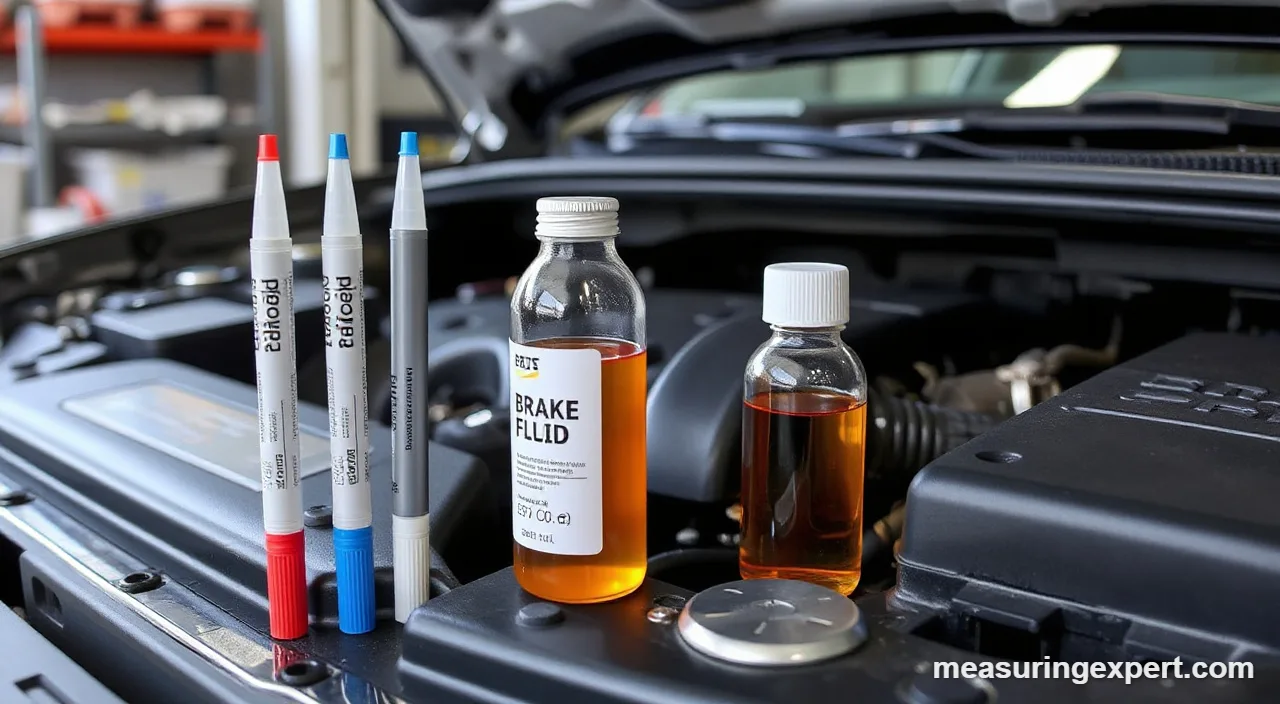
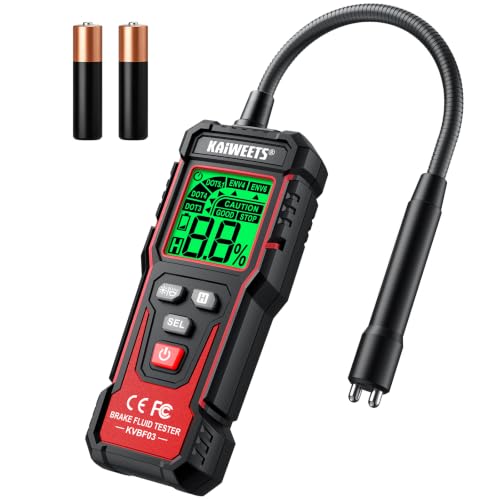
The best brake fluid tester for most drivers is the KAIWEETS KVBF03, which reads water content from 0% to 4% and sounds an alarm above 3%. However, pens only estimate moisture, strips screen for copper, and only a boil test such as the Laser 6802 measures the boiling point itself.
In short: pick the KAIWEETS for a simple digital reading, the Laser 6802 for a true boiling point, and Phoenix strips for a cheap screen.
As an Amazon Associate, Measuring Expert earns from qualifying purchases. Our picks are based on research, specifications and owner feedback, not paid placement.
Best Overall
Best Boiling Point Test

Best Test Strips

Quick Answer: Best Brake Fluid Tester by Need
- Easiest digital reading: KAIWEETS KVBF03, with percent water and color alerts.
- Actual boiling point: Laser 6802, a boil test powered by the vehicle battery.
- Cheapest screen: Phoenix Systems strips, which also check coolant.
- Pocket pens: OEMTOOLS 25269 or Powerbuilt 647766.
- DOT 4 only: OTC 4598 DOT 4 tester.
- Budget gooseneck: KINGBOLEN BF200, though it publishes no accuracy.
On This Page
- Best Brake Fluid Tester: Comparison Table
- The 7 Best Brake Fluid Tester Picks, Reviewed
- How We Chose the Best Brake Fluid Tester
- Best Brake Fluid Tester Types: Pens, Strips or Boil Test
- Best Brake Fluid Tester Basics: Water and Boiling Points
- Brake Fluid Boiling Point Converter
- How to Test Brake Fluid
- Do and Don’t When Testing
- Where a Tester Falls Short
- FAQ
- Bottom Line: Best Brake Fluid Tester
Best Brake Fluid Tester: Comparison Table
Every pick gets one row below. The reviews then explain the specs and trade-offs.
| # | Product | Best For | Standout Feature | Amazon |
|---|---|---|---|---|
| 1 | KAIWEETS KVBF03 | Digital water reading with alarm | 0 to 4% water, +/-0.3%, work light | View |
| 2 | Laser 6802 Boiling Point Tester | Real boil test with pass/fail status | Reports actual boiling point; vehicle powered | View |
| 3 | Phoenix Systems Double-Ended Test Strips (15-Pack) | Disposable copper and moisture screen | Double-ended brake and coolant strips | View |
| 4 | OEMTOOLS 25269 | Pocket pen with fluid-type button | DOT 3/4/5.1 pen, auto shut-off | View |
| 5 | Powerbuilt 647766 LED Tester | Five-LED water level pen | 5 LEDs, DOT 3/4/5.1, AAA battery | View |
| 6 | OTC 4598 DOT 4 Tester | Fluid-specific moisture pen | Series reads 0 to 4% moisture with LEDs | View |
| 7 | KINGBOLEN BF200 | Backlit LCD with gooseneck probe | DOT 3/4/5.1, alarm, auto power-off | View |
The 7 Best Brake Fluid Tester Picks, Reviewed
This list covers testers for the fluid itself: pens, strips and a boiling point unit. For other engine and electrical checks, see our battery load tester and vacuum pressure tester guides. Also, the picks below are research-based and use manufacturer pages we opened.
Best Overall
1. KAIWEETS KVBF03
Best for: Home mechanics who want a clear digital reading and a built-in alarm.
In short, the KAIWEETS tester is the best brake fluid tester for most home garages. It shows moisture content as a percentage, so you get a number instead of a guess. The flexible gooseneck probe also reaches into a reservoir without much fuss.
In addition, color and sound alerts take the interpretation out of the job. KAIWEETS lists green for 0 to 2%, orange with a slow beep for 2 to 3%, and red with a rapid beep above 3%. That matches the common advice to replace fluid at about 3% water, so the alerts are easy to follow. Keep in mind that the page does not describe the sensing method. Also, we matched this listing to model KVBF03 by its features, so confirm the model on the Amazon page.
- Water content 0% to 4%, stated accuracy +/-0.3%
- Fluids: DOT 3, DOT 4, DOT 5.1, ENV4 and ENV6
- Flexible gooseneck probe, backlit display, built-in work light
- Data hold; auto shut-off after 5 minutes
- Two AAA batteries included; operating range 0 to 40 C (32 to 104 F)
Pros
- Percentage readout with a stated accuracy
- Color and beep alerts are easy to read
- Covers newer ENV4 and ENV6 fluids
Cons
- Sensing method is not described by the maker
- Not for DOT 5 silicone fluid
- Reads moisture only, not boiling point
Skip it if: you want a measured boiling point, since this model estimates water content instead.
Best True Boiling Point Test
2. Laser 6802 Boiling Point Tester
Best for: Shops and serious DIYers who want the boiling point itself, not an estimate.
However, most testers on this list estimate moisture. The Laser 6802 does something different, because it boils a small sample of your fluid and reports the temperature at which it boils. Therefore, that number is what matters for safety, since it shows how close the fluid is to vaporizing under heat.
Moreover, the display compares your result with the standard dry and wet boiling points for the grade you select, and it shows an OK, warning or replace status. On the other hand, it takes more effort than a pen. First, you draw a sample with a syringe into a glass container, and the unit runs from the vehicle’s battery.
- Performs a boil test and displays the boiling point
- Uses a 20 ml syringe and a 25 ml glass sample container
- Status display: OK, warning or replace immediately
- Shows the standard dry and wet boiling points for the chosen grade
- Powered by the vehicle battery; the maker says calibration can be checked with clean water
Pros
- Measures boiling point directly
- Compares your result to dry and wet standards
- Works on all brake fluid grades
Cons
- Slower than a pen test
- Needs a vehicle battery connection
- No numeric accuracy is published
Skip it if: you only want a quick yes-or-no check, because a pen is faster.
Best Test Strips
3. Phoenix Systems Double-Ended Test Strips (15-Pack)
Best for: Owners who want a cheap screening test and a coolant check in one strip.
First, Phoenix Systems makes the BrakeStrip line, and this pack pairs it with a coolant test on the other end of each strip. Also, Phoenix says the brake end responds to copper that leaches into fluid as the system corrodes, and its guidance treats water at 3% or higher, or a positive copper reading, as a signal to plan a full fluid exchange.
First, strips need no batteries and cost little per test. However, you read the color pads by eye under good light and follow the timing on the package. Phoenix also notes that strips cannot detect aerated fluid, wrong-fluid contamination or worn seals, so treat a strip as a screen and not a full diagnosis.
- Double-ended strip: brake fluid end plus coolant end
- Brake end gives a visual reference for copper corrosion levels
- Recommended for DOT 3, 4 and 5.1 fluid
- Phoenix guidance: water at 3% or more, or a positive copper reading, means plan a fluid exchange
- No batteries; read the colors under bright, natural light after the timed development period
Pros
- No batteries or calibration
- Also checks coolant
- Low cost per test
Cons
- Color reading depends on your eyes and light
- Pack of 15 runs out quickly in a shop
- No boiling point number
Skip it if: you want a digital number you can log, since strips give a color match only.
Best Pocket Pen
4. OEMTOOLS 25269

Best for: Hobbyists who want a pocket-size pen with a self-test.
The OEMTOOLS 25269 is a simple pen-style moisture tester, so it suits quick checks. First, a push button switches between fluid types, and a built-in LED helps you confirm that the tips are touching the fluid. It also has a self-test, which is useful because you can check that it works before you trust a reading.
Meanwhile, the listing does not give percent-water thresholds or explain what each LED pattern means. Therefore, read the manual before you rely on it. It is a good low-cost choice. However, it gives less detail than a digital model with a numeric readout.
- Fluids: DOT 3, DOT 4 and DOT 5.1 (polyglycol based)
- Push button to switch fluid types
- Built-in LED to confirm the tips contact the fluid; built-in self-test
- One AAA battery included; automatic shut-off
- Pocket clip
Pros
- Pocket sized with a clip
- Self-test before use
- Brand known in shop tools
Cons
- Listing gives no LED thresholds
- No numeric readout described
- Not for DOT 5 silicone
Skip it if: you need a percentage display, since this listing does not describe one.
Best Simple LED Pen
5. Powerbuilt 647766 LED Tester

Best for: Beginners who want a no-fuss five-LED pen.
First, Powerbuilt’s pen uses five LEDs to show water level and to tell you when to replace the fluid. It also runs on one included AAA battery, and the testing prongs sit under a plastic cap. As a result, it slips into a toolbox easily.
However, Powerbuilt’s page does not state what percentage each LED stands for. Consequently, the manual is your only guide to the scale. It suits a quick check at each oil change, but it will not give you a figure to track over time.
- Five LEDs show water level and when to replace fluid
- Fluids: DOT 3, DOT 4 and DOT 5.1
- One AAA battery included
- Pocket-sized with a protective cap over the prongs
- One-year warranty listed
Pros
- Very simple to use
- Compact
- Covers the common glycol fluids
Cons
- No percent-water scale on the product page
- No display for tracking numbers
- Method and calibration are not described
Skip it if: you want exact percentages, because LEDs only show a level band.
Best for DOT 4 Only
6. OTC 4598 DOT 4 Tester

Best for: Owners of DOT 4 vehicles who prefer a dedicated tester from a shop-tool brand.
First, OTC sells this tester in separate DOT 3 and DOT 4 versions. OTC’s page for the DOT 3 model lists a moisture range of 0% to 4%, LED indicators, one AAA battery and automatic shut-off after 12 seconds. We are assuming the DOT 4 version shares those basics, so confirm them on the DOT 4 listing before you buy.
Furthermore, a fluid-specific tester removes the chance of picking the wrong setting. On the other hand, you need a different unit if you service both fluid types, and the page does not explain what each light means or give replacement thresholds.
- Series range: moisture 0% to 4% (from OTC’s DOT 3 page)
- LED lights show the moisture percentage
- One AAA battery included
- Automatic shut-off after 12 seconds (DOT 3 page)
- Sold as separate DOT 3 and DOT 4 testers
Pros
- Fluid-specific, so no setting to get wrong
- Well-known tool brand
- Simple LED display
Cons
- Specs shown here come from the DOT 3 sibling
- No threshold guidance on the page
- Cannot test the other fluid type
Skip it if: you maintain both DOT 3 and DOT 4 vehicles, since a multi-fluid tester is more flexible.
Best Budget Gooseneck
7. KINGBOLEN BF200

Best for: Budget buyers who want a backlit screen and a flexible probe.
First, the BF200 pairs a backlit LCD with a universal gooseneck probe. Also, a menu button cycles through DOT 3, DOT 4 and DOT 5.1, and an alarm sounds when moisture exceeds the standard. It uses two AAA batteries, so plan to buy them because they are not included.
Nevertheless, the maker’s page does not state a measuring range, an accuracy figure or the alarm threshold. As a result, we cannot compare it with the KAIWEETS on precision. Therefore, treat it as a screening tool and confirm doubtful readings with a second method.
- Fluids: DOT 3, DOT 4 and DOT 5.1 via a menu button
- Backlit LCD shows results
- Universal gooseneck probe
- Two AAA batteries (not included); auto power-off after 5 minutes of standby
- Audible alarm when moisture exceeds the standard
Pros
- Flexible probe for tight reservoirs
- Backlit screen
- Alarm warns of high moisture
Cons
- No stated range or accuracy
- Batteries not included
- Alarm threshold is not published
Skip it if: you need a documented accuracy figure, because the maker does not publish one.
How We Chose the Best Brake Fluid Tester
We did not test these tools ourselves, so we compared manufacturer pages, listings and published guidance, and we kept only specs we could confirm.
- Clear purpose: each pick measures water content, copper or boiling point in brake fluid.
- Stated fluid support: DOT 3, DOT 4 and DOT 5.1 where listed.
- Published thresholds: picks with alarm levels or guidance rank higher.
- Distinct methods: digital pens, LED pens, strips and a boil test, with no more than two models per brand.
Also, for the numbers, we used the federal rule FMVSS 116 (49 CFR 571.116), Phoenix Systems’ strip guidance and AMSOIL’s brake fluid overview.
Best Brake Fluid Tester Types: Pens, Strips or Boil Test
The best brake fluid tester depends on how much detail you want, so the table compares the main approaches.
| Type | What it reports | Strength | Weakness |
|---|---|---|---|
| Digital pen or probe | Water content, as a percentage or alert | Fast, reusable, easy to log | Estimates moisture; not a boiling point |
| LED pen | A level band from a few LEDs | Cheap and simple | Scale often unpublished |
| Test strip | Copper and moisture by color | No batteries; also flags corrosion | Read by eye; single use |
| Boiling point tester | The actual boiling temperature | Measures the key safety property | Slower; needs a sample and power |
For example, a pen or strip is enough for a yearly check. However, if a reading is borderline, a boil test gives a firmer answer.
Best Brake Fluid Tester Basics: Water and Boiling Points
Brake fluid absorbs water over time, so testers exist for a reason. For example, a car that sits in a humid climate can pick up moisture faster. AMSOIL explains that moisture can enter through packaging, while pouring, and through hoses and seals. Water lowers the boiling point, which matters because hot fluid that boils creates vapor, and vapor compresses far more than liquid.
First, FMVSS 116 sets two boiling point minimums for each grade. The dry value applies to fresh fluid, while the wet value applies after the fluid has absorbed water to about 3.7% in a lab conditioning test. In addition, both are measured as an equilibrium reflux boiling point, or ERBP.
| Grade | Minimum dry boiling point | Minimum wet boiling point |
|---|---|---|
| DOT 3 | 205 C (401 F) | 140 C (284 F) |
| DOT 4 | 230 C (446 F) | 155 C (311 F) |
As a result, a tester reading near 3% water signals that the fluid is approaching its wet minimum. Similarly, Phoenix gives an example: fresh DOT 4 sits above 446 F, while contaminated fluid can boil near 300 F.
Brake Fluid Boiling Point Converter
First, enter a Celsius boiling point from a tester or a spec sheet. Then the converter shows the Fahrenheit and Kelvin values. For example, 205 C is 401 F.
How to Test Brake Fluid
These steps work for most pens and probes, but always follow your own tester’s manual first.
- First, check the reservoir cap or owner’s manual to find the fluid type, such as DOT 3, DOT 4 or DOT 5.1.
- Park on level ground with the engine off and the car cool, then wipe dirt from around the reservoir cap.
- Next, open the cap, keeping dirt and water out of the fluid.
- Then turn on the tester and select the fluid type if it has a selector.
- After that, place the probe or prongs in the fluid and hold still until the reading settles.
- Next, read the percentage, color or LED level, and write down the date and result.
- Finally, wipe the probe clean, close the reservoir cap firmly and compare the result with the replacement guidance in your tester’s manual.
Also, to keep your instruments honest, see our guide to measurement tool calibration. In addition, our tire tread depth gauge roundup covers another quick safety check.
Do and Don’t When Testing
Where a Tester Falls Short
A tester checks the fluid, not the brakes, so its readings are only part of the picture. For example, it cannot find a leak, a worn pad or air in the lines. In addition, Phoenix notes that strips cannot detect aerated fluid or the wrong fluid, and pen makers rarely publish how their sensors work. Therefore, if your pedal feels soft, the brake warning light is on, or the fluid looks dark or dirty, have a qualified mechanic inspect the system. Bleeding and replacing fluid are safety-critical jobs, so leave them to a professional unless you are trained.
FAQ
What is the best brake fluid tester?
The KAIWEETS KVBF03 is the best brake fluid tester for most drivers, because it shows water content as a percentage and alerts you at 2% and 3%. However, the Laser 6802 is better if you want a measured boiling point.
How do brake fluid test pens work?
Most pens estimate water content from an electrical reading, because they only touch the fluid with two probe tips. The makers we checked do not describe the method, so treat a pen as a screening tool. For example, a red result means you should have the fluid checked or replaced.
Are strips the best brake fluid tester?
Not necessarily, because strips are cheap and need no batteries, and Phoenix strips also flag copper from corrosion. On the other hand, a digital pen gives a number you can log and compare from year to year.
What water percentage means I should replace brake fluid?
Phoenix advises planning a full exchange at 3% water or more, and KAIWEETS marks above 3% as replace immediately. In addition, FMVSS 116 rates wet boiling point at 3.7% water, so fluid near that level has lost much of its margin.
What are the boiling points of DOT 3 and DOT 4 fluid?
Federal standard FMVSS 116 sets a minimum dry boiling point of 205 C (401 F) for DOT 3 and 230 C (446 F) for DOT 4. Meanwhile, the minimum wet boiling points are 140 C (284 F) and 155 C (311 F). Some products exceed these minimums, so check the label.
Can I test DOT 5 silicone brake fluid with a pen?
No, because the testers we checked list DOT 3, DOT 4 and DOT 5.1, and none list DOT 5. Therefore, silicone fluid needs a different method, such as asking a shop to check it.
How often should I test my brake fluid?
For example, AMSOIL recommends changing brake fluid about every two years, and a yearly test is a sensible check in between. Humid climates can speed up moisture build-up, so test more often there.
Is a boiling point tester the best brake fluid tester?
A boil test measures the property that matters directly, so it avoids the guesswork of estimating from moisture. However, it takes longer. As a result, many shops use a quick pen first and a boil test when a result looks borderline.
Does a good tester reading mean my brakes are safe?
No, because a tester only checks the condition of the fluid. A soft pedal, a warning light or odd noises need a qualified mechanic, regardless of what a tester shows.
Can I use one tester for several cars?
Yes, if the vehicles use fluids the tester supports. Rinse or wipe the probe between cars, because carry-over from one sample can cloud the next reading. Also check each reservoir cap for the fluid type first.
Bottom Line: Best Brake Fluid Tester
For most drivers, the KAIWEETS KVBF03 is the best brake fluid tester, because it gives a clear percentage and alerts you before the fluid is spent. However, the Laser 6802 is the better choice if you want the boiling point itself, and Phoenix strips are the cheapest screen.