

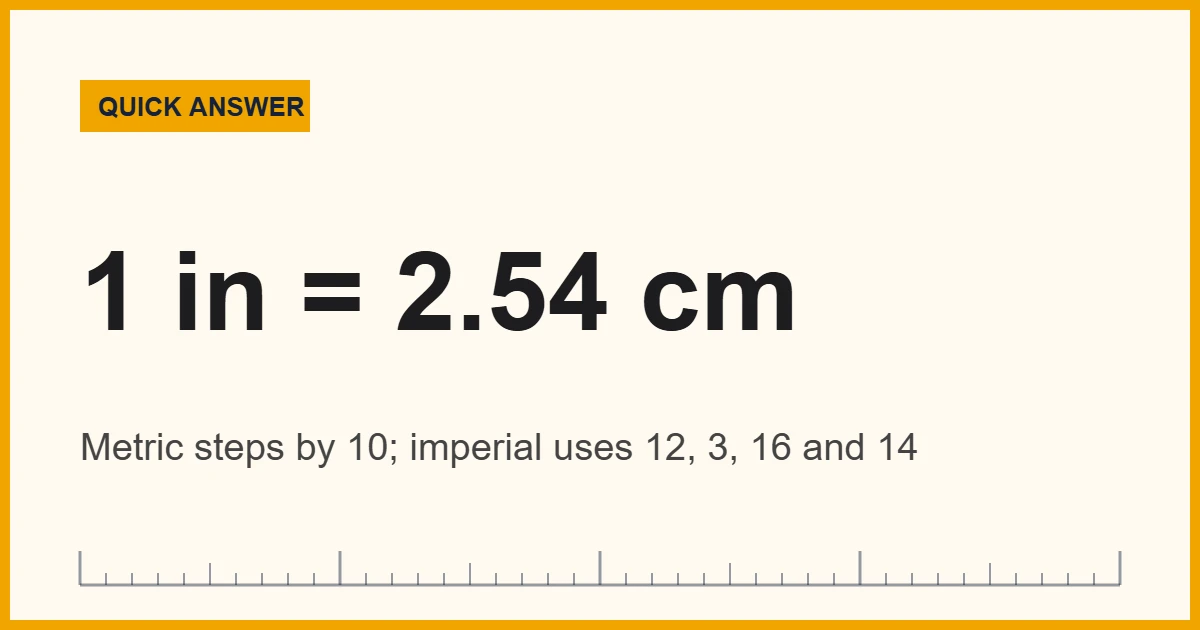
Metric vs imperial comes down to structure: the metric system scales every unit by powers of 10 (1 meter = 100 centimeters), while imperial units use mixed steps such as 12 inches to a foot and 16 ounces to a pound. Since 1959, both systems share exact links, so 1 inch is exactly 2.54 cm.
Most people meet both systems every week. For example, a soda bottle says 2 liters, the road sign says 55 mph, and a recipe from London asks for grams of flour. So it helps to know how the two systems work, where each one came from, and how to move between them without mistakes.
In short: metric is a decimal system built on the meter, the kilogram and the liter, and almost every country uses it for daily life. Imperial is the older British system of inches, pounds, stones, pints and gallons. Meanwhile, the United States uses its own close cousin, US customary units, which shares most lengths and weights with imperial but not its volumes.
The official definitions come from national standards bodies. For instance, NIST, the US measurement agency, describes the seven SI base units that every modern measurement rests on. In addition, the UK Weights and Measures Act lists the legal size of each imperial unit, from the inch to the gallon, as an exact metric amount.
Below, you will find a converter, a side-by-side unit table, a short history, and a step-by-step method for converting by hand.
Convert Feet and Inches to Metric
Enter a length and pick its unit. The converter then shows the same length in meters, centimeters, inches and yards, using the exact 1959 definitions.
Metric vs Imperial Units Side by Side
This table pairs the units people convert most often. Also, every value comes from the exact legal definitions, rounded to four significant figures where the factor does not end.
| Quantity | Imperial / US unit | Metric equal | Reverse |
|---|---|---|---|
| Length | 1 inch | 2.54 cm (exact) | 1 cm = 0.3937 in |
| Length | 1 foot (12 in) | 30.48 cm (exact) | 1 m = 3.281 ft |
| Length | 1 yard (3 ft) | 0.9144 m (exact) | 1 m = 1.094 yd |
| Length | 1 mile (1,760 yd) | 1.609344 km (exact) | 1 km = 0.6214 mi |
| Mass | 1 ounce (avoirdupois) | 28.35 g | 100 g = 3.527 oz |
| Mass | 1 pound (16 oz) | 0.45359237 kg (exact) | 1 kg = 2.205 lb |
| Mass | 1 stone (14 lb, UK) | 6.350 kg | 10 kg = 1.575 st |
| Area | 1 acre | 4,047 m² | 1 hectare = 2.471 acres |
| Temperature | Fahrenheit | C = (F – 32) x 5/9 | F = C x 9/5 + 32 |
You can print this table and tape it inside a cupboard door. For a closer look at the US units alone, read our guide to American units of measurement.
Recommended Tools for Metric vs Imperial Measuring
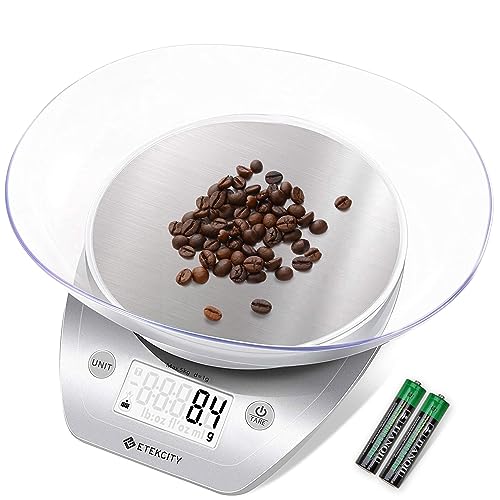
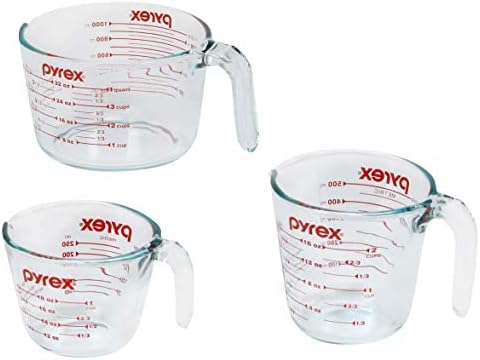
The easiest way to skip conversions is to measure in the unit you need. First, a dual-scale tape measure shows inches on one edge and centimeters on the other. Next, a kitchen scale with a unit button switches between grams and ounces with one press. Finally, glass measuring cups with both mL and cup markings handle liquids. We picked these items based on manufacturer specs and buyer reports, not our own testing.



As an Amazon Associate, Measuring Expert earns from qualifying purchases.
Key Takeaways
- Metric units step up and down by 10, 100 or 1,000.
- Imperial units use uneven steps: 12, 3, 1,760, 16 and 14.
- One inch equals exactly 2.54 cm, and one pound equals exactly 0.45359237 kg.
- A UK (imperial) gallon holds about 20% more than a US gallon.
- US customary and imperial share lengths and weights, yet differ in volume.
- Science, medicine and most of the world work in metric.
- Write the unit next to every number so nobody has to guess.
Metric vs Imperial vs US Customary Volumes
Many articles treat “imperial” and “American” as the same thing, but they are not. In fact, the US never adopted the British Weights and Measures Act of 1824, which created the imperial gallon. As a result, US customary volumes stayed with the older wine gallon of 231 cubic inches, while Britain switched to a larger gallon.
| Unit | UK imperial | US customary | Difference |
|---|---|---|---|
| Fluid ounce | 28.41 mL | 29.57 mL | US is about 4% bigger |
| Pint | 568.3 mL (20 fl oz) | 473.2 mL (16 fl oz) | UK is about 20% bigger |
| Quart | 1.137 L | 946.4 mL | UK is about 20% bigger |
| Gallon | 4.54609 L (exact) | 3.785411784 L (exact) | UK is about 20% bigger |
| Ton | long ton, 2,240 lb | short ton, 2,000 lb | metric tonne is 1,000 kg |
Fuel economy shows the same trap. For example, 30 miles per UK gallon is only about 25 miles per US gallon. Therefore, car reviews from Britain and the US can quote different mpg figures for the very same car.
Metric vs Imperial: Where Each System Came From
Imperial units grew slowly out of older Roman, Anglo-Saxon and medieval English measures. For example, the Roman foot measured roughly 296 mm, or about 11.65 inches, a little shorter than today’s foot. Over the centuries, English kings and parliaments tried again and again to fix the sizes. Then, in 1824, Britain finally set one national standard, and it spread across the British Empire.
The metric system, by contrast, came from a deliberate design. During the French Revolution, scientists wanted one system for everyone, so they tied the meter to the size of the Earth and the kilogram to the mass of a liter of water. France made the system official in 1795. Later, on May 20, 1875, seventeen countries, including the United States, signed the Treaty of the Meter, which set up shared international standards.
Next came the modern SI, short for the International System of Units, in 1960. Since 2019, every SI unit rests on fixed constants of nature, such as the speed of light for the meter, rather than on a physical object kept in a vault. Today, imperial and US units borrow that precision too, because each one now has an exact metric definition.
How to Convert Metric vs Imperial Units by Hand
The converter above handles lengths, but sometimes you need to work on paper. Here is a simple method that works for any pair of units.
- Write the number with its unit. For example, write “6 ft”, not just “6”.
- Find the exact factor. Look it up in the table above, such as 1 ft = 0.3048 m.
- Set up the fraction so units cancel. Next, multiply 6 ft by (0.3048 m / 1 ft) so “ft” cancels out.
- Do the arithmetic. In this case, 6 x 0.3048 gives 1.8288 m.
- Round at the end only. Then round to a sensible precision, such as 1.83 m for a height.
- Sanity-check the size. Finally, ask whether the answer makes sense: a meter is a bit longer than a yard, so 6 ft should land just under 2 m.
For quick work with lengths, our page on how many feet are in 60 inches walks through the inch-to-foot step in detail.
Why Metric Feels Easier to Calculate
Metric prefixes do the work for you. Kilo means 1,000, centi means 1/100, and milli means 1/1,000. So 1.25 km becomes 1,250 m simply by moving the decimal point. In contrast, turning 1.25 miles into feet means multiplying by 5,280, which most people cannot do in their heads.
Imperial units, however, have a real strength in daily life. Because 12 divides evenly by 2, 3, 4 and 6, a foot splits neatly into halves, thirds and quarters. Likewise, carpenters like fractions such as 3/8 inch because they halve easily on a ruler. That is one reason US builders still work in feet and inches.
| People often confuse | What it really is |
|---|---|
| Ounce (oz) | A unit of weight: about 28.35 g |
| Fluid ounce (fl oz) | A unit of volume: 29.57 mL (US) or 28.41 mL (UK) |
| Ton | 2,000 lb (US short ton) or 2,240 lb (UK long ton) |
| Tonne | The metric ton: exactly 1,000 kg, about 2,205 lb |
Who Uses Metric vs Imperial Today?
Nearly every country now uses metric as its main system. The United States stands out, since Americans still buy gas by the gallon and give heights in feet. Even so, US law has called metric “the preferred system of weights and measures for United States trade and commerce” since 1988, according to 15 U.S.C. 205a. Consequently, soda comes in 2-liter bottles, medicine doses come in milligrams, and food labels show both systems.
The UK, meanwhile, uses a mix. Road signs show miles and pints of beer stay on the menu, yet supermarkets sell food by the gram and kilogram. Similarly, many British people give their weight in stones and pounds.
Some fields also keep special units. Aviation, for instance, measures altitude in feet and speed in knots worldwide, while science works almost entirely in SI. If you are switching building plans between systems, see our guide to converting construction measurements from imperial to metric.
Do and Don’t When Mixing Metric vs Imperial
Do
- Write the unit next to every number.
- Keep full precision until the final step.
- Check whether a recipe is UK or US before measuring liquids.
- Use a dual-scale tape or scale when you switch often.
- Agree on one system at the start of a project.
Don’t
- Assume a UK gallon equals a US gallon.
- Mix up fluid ounces with weight ounces.
- Round a factor such as 2.54 to 2.5 for precise work.
- Convert back and forth repeatedly, since rounding errors add up.
- Trust a rough rule of thumb for medicine or engineering.
Honest Limits of Metric vs Imperial Conversions
Exact factors do not make every conversion exact. First, many factors never end, so 1 kg is about 2.2046 lb and you must round somewhere. Second, a converted number can look more precise than the original measurement. For example, “about 6 feet” does not become 1.8288 m of real accuracy; 1.8 m is more honest. Third, older US land surveys used the US survey foot, which differs from the international foot by about 2 parts per million. That gap barely matters at home, but it adds up over miles of property lines. Finally, volume-to-weight swaps, like cups of flour to grams, depend on the ingredient and how you pack it, so no single factor fits every case.
When to Call a Professional
For cooking or a DIY shelf, a careful conversion is usually enough. However, some jobs deserve an expert check. For instance, a licensed surveyor should handle property lines and legal descriptions. Likewise, an engineer should confirm structural loads and fastener torques, and a calibration lab should certify instruments used for trade. Most of all, a pharmacist or doctor should confirm any medicine dose.
Metric vs Imperial: Frequently Asked Questions
What is the main difference in metric vs imperial?
Metric scales by powers of 10, so conversions only move the decimal point. Imperial uses uneven steps, such as 12 inches per foot and 16 ounces per pound.
Is the US system the same as imperial?
Not quite. US customary units share inches, feet, miles, ounces and pounds with imperial, but US pints, quarts and gallons are about 17% smaller than imperial ones.
How many centimeters are in an inch?
There are exactly 2.54 centimeters in one inch, by international agreement since 1959.
How many pounds are in a kilogram?
One kilogram equals about 2.2046 pounds. In the other direction, one pound equals exactly 0.45359237 kilograms.
How big is a UK gallon compared with a US gallon?
A UK gallon holds exactly 4.54609 liters and a US gallon holds 3.785411784 liters. So the UK gallon is about 20% larger.
Which countries still use imperial units?
The UK still uses miles, pints and stones in daily life, and the US uses its own customary units. Most other countries use metric for nearly everything.
Why does the US not use the metric system?
The US does use metric in science, medicine and many products, and federal law calls it the preferred system for trade. Still, cost and habit have kept customary units in everyday life.
Which is more accurate, metric or imperial?
Neither one. Accuracy depends on the measuring tool, not the system. Today, imperial units even rest on exact metric definitions.
What is a stone in kilograms?
One stone equals 14 pounds, or about 6.35 kilograms. The unit is common in the UK for body weight.
How do I convert Fahrenheit to Celsius?
Subtract 32 from the Fahrenheit value and then multiply by 5/9. For example, 100 F is about 37.8 C.
The Bottom Line
To sum up, metric wins on easy arithmetic because everything steps by 10, while imperial and US customary units survive because they are familiar and split neatly into fractions. Both systems now rest on the same exact definitions, so 1 inch is 2.54 cm and 1 pound is 0.45359237 kg wherever you are.
So the practical answer is to get comfortable with both. Use the converter above for lengths, keep the comparison table handy, and watch out for the UK vs US gallon. Above all, write the unit next to every number you share.
2 thoughts on “Metric vs Imperial: Differences, History and Easy Conversions”