

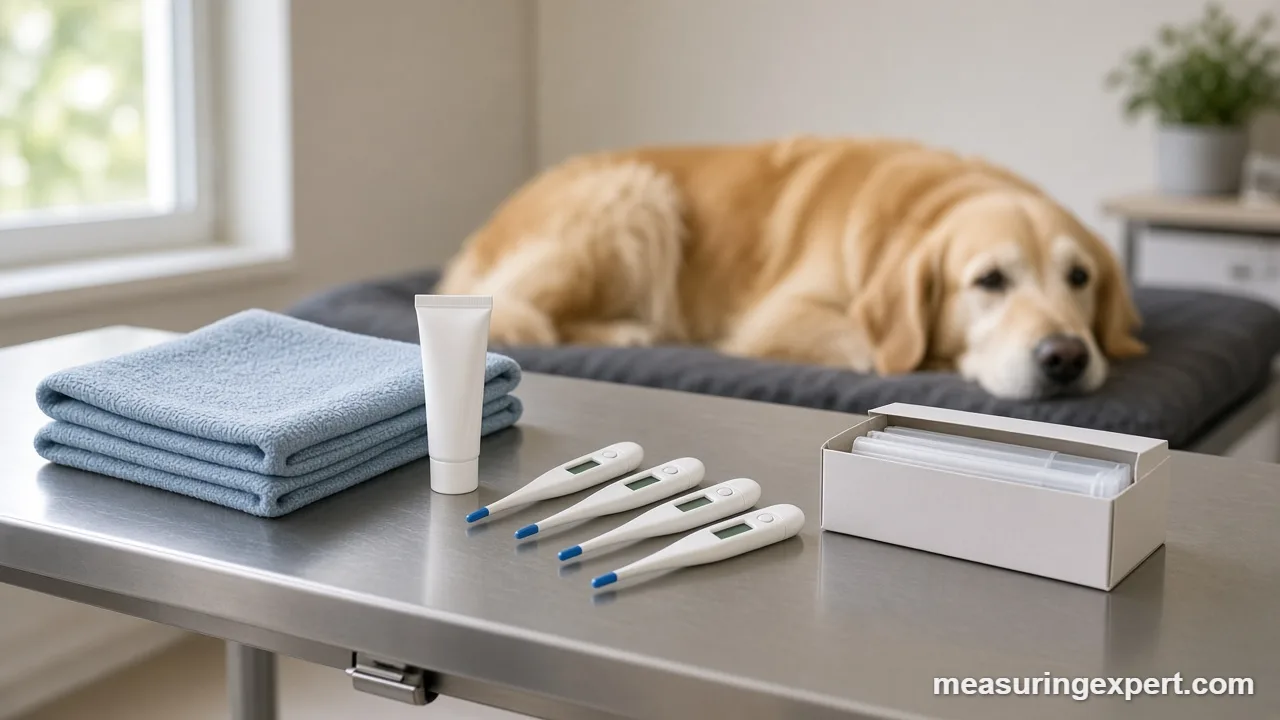
The best veterinary thermometer for most pet owners is the iProven Dog and Cat Thermometer, a digital rectal model with a soft, waterproof tip. Rectal digital readings are the most accurate at home. So the right pick depends on the species, how fast you need a reading, and whether you want an app log.
In short: get the iProven for dogs and cats, the ADC Adtemp 422 for published accuracy, and the Kinsa QuickCare to log a fever.
As an Amazon Associate, Measuring Expert earns from qualifying purchases. Our picks are based on research, specifications and owner feedback, not paid placement.
Best Overall

Best Vet-Grade

Best Smart
Quick Answer: Our Best Veterinary Thermometer Picks
- iProven Dog and Cat Thermometer: a pet-only rectal stick with a soft tip and a waterproof body.
- ADC Adtemp 422: a true veterinary model with a stated +/-0.2 F accuracy and a 10-second read.
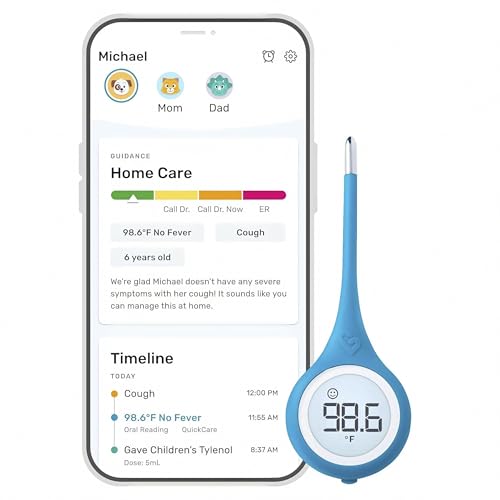
- Kinsa QuickCare: logs every reading in an app, which helps during a long illness.
- Vicks SpeedRead: reads in about 8 seconds; just ignore its human fever colors.
- Welch Allyn SureTemp Plus 690: a clinic unit with a 4 ft probe cord for large animals.
- Agri-Pro and Reddoudou: low-cost spares for the barn or a travel kit.
On This Page
- Comparison table
- The 7 picks, reviewed
- How we chose
- Rectal, ear and livestock thermometers
- Normal temperatures by species
- Pet temperature converter
- When to call a vet
- How to take a temperature
- Specs that matter
- Care and accuracy checks
- FAQ
- Bottom line
Best Veterinary Thermometer Comparison Table
First, use this table to narrow the field. Then read the reviews below for the measurement details behind each pick.
| # | Product | Best For | Standout Feature | Amazon |
|---|---|---|---|---|
| 1 | iProven Dog and Cat Thermometer | Most dog and cat owners | Flexible, waterproof tip made for pets | View |
| 2 | ADC Adtemp 422 Veterinary Thermometer | Accuracy on a budget | Published +/-0.2 F accuracy and 10-second read | View |
| 3 | Kinsa QuickCare Smart Thermometer | Tracking a fever over days | Bluetooth app log | View |
| 4 | Vicks SpeedRead Digital Thermometer | Fast checks at home | About 8-second reading | View |
| 5 | Welch Allyn SureTemp Plus 690 (Rectal Probe) | Clinics, kennels and barns | 4 ft rectal probe cord with monitor mode | View |
| 6 | Agri-Pro Digital Vet Thermometer | A spare for the farm kit | Farm-supply brand, animal-only use | View |
| 7 | Reddoudou Digital Pet Thermometer | A cheap backup | Waterproof, flexible tip for pets | View |
The 7 Best Veterinary Thermometer Picks, Reviewed
We put pet-friendly rectal models first, because they suit the most readers. After that come the smart, fast and clinic picks, and finally the budget spares.
Best Overall
1. iProven Dog and Cat Thermometer
Best for: dog and cat owners who want a pet-only rectal thermometer that is simple to clean and gentle to use.
The iProven pet thermometer is a plain digital stick, and that is its strength. Also, it is sold for dogs and cats only, so it never ends up back in the family medicine drawer. In addition, the soft tip bends with the body, which makes a nervous pet less likely to flinch. Because it is the best veterinary thermometer for most homes, it sits at the top of our list.
On the measurement side, expect a reading in about 20 seconds. Admittedly, that is slower than a predictive clinic model. However, a slower, steady reading is fine for a home check. The unit also keeps the last result, so you can compare a morning and evening reading without a notebook.
- Reading time: about 20 seconds
- Tip: soft and flexible
- Cleaning: waterproof, so you can rinse it
- Memory: last reading recall
- Power: one LR41 button cell with low-battery alert and auto-off
Pros
- Made for pets, so it stays out of the human first-aid kit
- Flexible tip is gentle on small dogs and cats
- Easy to rinse and disinfect
Cons
- Slower than predictive models
- The maker does not publish a numeric accuracy figure
Skip it if: you need a reading in under 10 seconds for a squirmy pet, or you want a published accuracy spec.
Best Vet-Grade
2. ADC Adtemp 422 Veterinary Thermometer
Best for: owners, breeders and farm users who want a veterinary model with a published accuracy figure.
American Diagnostic Corporation (ADC) builds the Adtemp 422 as a veterinary thermometer. As a result, its numbers are clear. ADC states an accuracy of +/-0.2 F (+/-0.1 C) and a predictive reading in about 10 seconds. That makes the 422 a strong best veterinary thermometer pick for people who track a fever closely.
In addition, the range runs from 90.0 to 109.9 F (32.0 to 43.9 C). So it covers a cold puppy, a feverish dog and even a hot chicken. The probe is rigid, though, and ADC says to use probe sheaths. Therefore, use a sheath and lubricant every time.
- Accuracy: +/-0.2 F (+/-0.1 C)
- Reading time: about 10 seconds (predictive)
- Range: 90.0 to 109.9 F (32.0 to 43.9 C)
- Units: switchable F and C, with last-reading memory
- Power: LR41 cell, rated for about 5,000 readings
Pros
- Clear, published accuracy and range
- Fast predictive reading
- Wide range suits many species
Cons
- Rigid probe, not flexible
- Water resistant, not waterproof
- Needs probe sheaths for hygiene
Skip it if: you want a soft, bendable tip for a small cat or a dog that hates being handled.
Best Smart
3. Kinsa QuickCare Smart Thermometer
Best for: owners who need to log readings during an illness or after surgery and share them with the vet.
Kinsa sells the QuickCare as a family thermometer, so it is not a pet product. Even so, VCA notes that a human digital thermometer can be used rectally on a pet. In that case, buy one for the pet only and label it. Next, use the app as a log. It records each reading with a time stamp, which helps when your vet asks how the fever changed overnight.
For example, readings take 8 seconds or less, and the tip is flexible. Also, it works without a phone if the app is not handy. One caution: the app gives advice for people. So ignore its fever guidance and compare the number with the pet ranges in this guide instead.
- Reading time: 8 seconds or less
- Sites: oral, rectal or underarm (use rectal for pets)
- Tip: flexible comfort tip
- App: Bluetooth sync to iPhone and Android, works without a phone
- Power: replaceable CR2032 battery
Pros
- Time-stamped log you can show the vet
- Fast reading
- Flexible tip
Cons
- App guidance is written for humans
- Water resistant only, so do not soak it
Skip it if: you only take a temperature once in a while and do not need a log.
Best Fast Read
4. Vicks SpeedRead Digital Thermometer

Best for: households that want a quick, waterproof, low-cost thermometer to set aside for the pet.
The Vicks SpeedRead V912US reads in about 8 seconds, and Vicks lists its accuracy as +/-0.2 F. In addition, it is waterproof, so cleaning is easy. For a pet that will only hold still for a moment, speed matters more than features.
However, the Fever InSight screen glows green, yellow or red based on human fever levels. For instance, a healthy dog at 101.5 F is normal, yet the screen may flag it. So read the number and ignore the color.
- Reading time: about 8 seconds
- Accuracy: +/-0.2 F
- Sites: oral, rectal or underarm
- Cleaning: waterproof
- Display: color-coded Fever InSight screen, with auto shut-off
Pros
- Very fast for a stick thermometer
- Waterproof for easy cleaning
- Published accuracy figure
Cons
- Color alerts use human ranges and mislead for pets
- Rigid tip compared with pet models
Skip it if: others in the house might mix it up with the family thermometer.
Best Clinic Grade
5. Welch Allyn SureTemp Plus 690 (Rectal Probe)
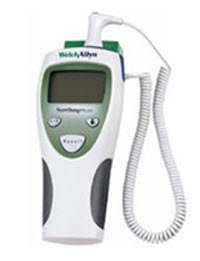
Best for: clinics, kennels, shelters and large-animal owners who take many readings a day.
The SureTemp Plus 690 is a handheld electronic thermometer that clinics have used for years. Welch Allyn also sells a veterinary version of the same unit. In practice, it pairs a base with a rectal probe on a 4 ft (1.22 m) coiled cord. So you can stand clear of a horse or cow while the probe does its job. Rectal readings take about 10 to 13 seconds, and accuracy is listed at +/-0.2 F.
There is also a monitor mode for a full 3 to 5 minute reading. That helps when a predictive reading seems off. Meanwhile, three AA batteries last for about 6,000 readings, which suits busy places. The trade-off is cost and bulk, so this is a pro pick rather than a home one.
- Rectal reading: about 10 to 13 seconds
- Accuracy: +/-0.2 F
- Probe cord: 4 ft (1.22 m)
- Monitor mode for 3 to 5 minute readings
- Power: 3 AA batteries, about 6,000 readings, with battery indicator
Pros
- Long cord keeps hands clear of large animals
- Monitor mode checks a doubtful reading
- Built for heavy daily use
Cons
- Far more costly than stick thermometers
- Needs disposable probe covers
- Overkill for one pet at home
Skip it if: you only own one dog or cat; a stick model does the job.
Best for the Barn
6. Agri-Pro Digital Vet Thermometer

Best for: horse, goat and cattle owners who want a cheap, dedicated digital thermometer for the barn kit.
Agri-Pro Enterprises of Iowa supplies animal health tools to farms and feed stores. Similarly, this listing is sold as a digital veterinary thermometer for animal use. In short, it is a basic barn thermometer that lives in the tack room, not the house.
Agri-Pro does not publish a reading time or accuracy figure for this listing. Therefore, check it against a second thermometer when it arrives. For cattle and horses, also tie a string with a clip to the end so it cannot slip out of reach.
- Type: digital stick thermometer for animals
- Maker: Agri-Pro, a livestock health supplier
- Use: rectal, for farm and companion animals
Pros
- Low cost for a dedicated barn tool
- From a farm-supply brand
- Easy to keep with the first-aid kit
Cons
- Few published specs
- Add your own string and clip for large animals
Skip it if: you want a spec sheet or a long-probe clinic model.
Best Budget
7. Reddoudou Digital Pet Thermometer

Best for: owners who want an inexpensive pet-labeled backup for travel or a second home.
The Reddoudou thermometer is a budget pet model with a flexible, waterproof tip. Readings take about 20 seconds, and it switches between F and C.
Some owners report uneven results, though. So treat it as a backup and confirm any odd reading with a second thermometer or a vet visit.
- Reading time: about 20 seconds
- Tip: flexible
- Cleaning: waterproof
- Units: F and C
Pros
- Low cost
- Flexible, pet-friendly tip
- Easy to spot
Cons
- Mixed reports on accuracy
- Durability is so-so
Skip it if: this will be your only thermometer; get the iProven or the ADC instead.
How We Chose the Best Veterinary Thermometer
We did not run hands-on tests. Instead, our picks are research-based. We read maker spec sheets, veterinary guidance and published studies, and we weighed owner feedback. Then we scored each model on the points below.
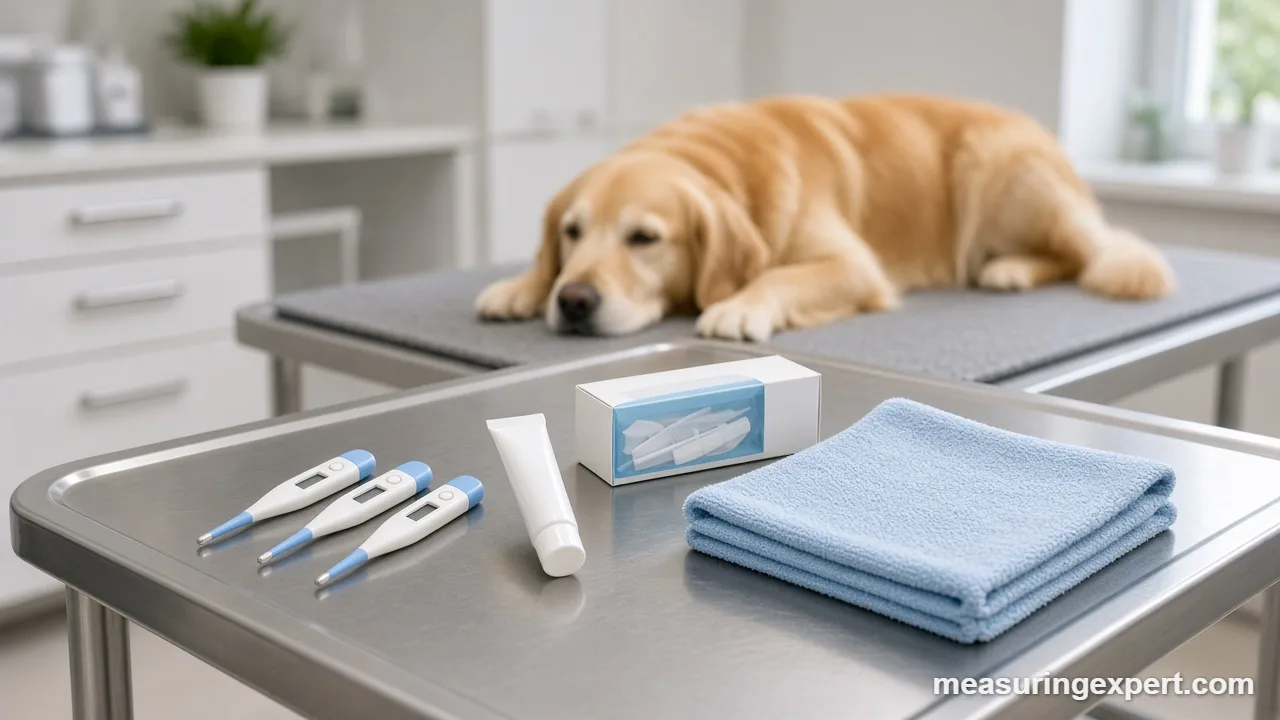
- Measuring site: rectal models came first, because rectal is still the reference method in veterinary care.
- Published specs: a stated accuracy, range and reading time earned extra credit. If a maker gives no figure, we say so.
- Animal fit: we looked at tip flexibility, probe length and cord length for small pets versus horses and cattle.
- Hygiene: waterproof bodies and probe cover support matter when one tool serves several animals.
- Range of use: we included home, smart, clinic and barn picks, with no more than two models per brand.
Our sources include the Merck Veterinary Manual temperature table, VCA guidance on taking a pet’s temperature, and maker spec pages from ADC, Kinsa, Vicks and Welch Allyn.
Rectal, Ear or Livestock: Which Best Veterinary Thermometer Type?
Three kinds of thermometer show up in pet and farm kits. However, each one measures a different spot, so each one has a different level of trust.
| Type | Where it reads | Accuracy at home | Best use |
|---|---|---|---|
| Rectal digital | Inside the rectum | Highest; the clinical reference | Dogs, cats, rabbits and small livestock |
| Ear (infrared) | Ear canal and eardrum area | Lower; readings can drift from rectal | Quick screening on a calm dog |
| Livestock digital | Inside the rectum, often on a string or long cord | High when placed well | Horses, cattle, sheep, goats and pigs |
Rectal digital: the best veterinary thermometer for accuracy
A rectal digital thermometer measures close to core body heat. For that reason, vets still rely on it, and it is the best veterinary thermometer type for home use. In addition, a digital stick costs little, reads in 8 to 20 seconds, and gives a clear number. Also, a flexible tip makes it gentler for cats and small dogs.
Ear thermometers for dogs and cats
Ear models are fast and most pets accept them. However, the evidence is mixed. A study of 300 dogs found that ear and rectal readings moved together, yet the gap between them was too wide for clinical use (PubMed abstract). Humidity also changed the results. So if you use an ear model, such as the clinic-sold Vet-Temp, confirm any worrying number with a rectal reading. Human ear thermometers are built for a human ear canal, which is shaped differently from a dog’s L-shaped canal.
Livestock thermometers for horses and cattle
The best veterinary thermometer for large animals needs a few extras. First, a thermometer should have a string and clip, or a long cord, so it cannot be lost or pulled inside. Second, you should stand to the side, out of kick range. Clinic units like the SureTemp Plus 690 add a 4 ft cord for this reason. Finally, a wide range helps, because poultry and some livestock run hotter than pets.
Normal Temperature Ranges for Dogs, Cats, Horses and Cattle
Even the best veterinary thermometer is only useful if you know the normal range. After all, pets run warmer than people, so a number that means fever in a child can be normal for a dog. The ranges below come from the Merck Veterinary Manual table of normal rectal temperatures.
| Species | Normal rectal range (F) | Normal rectal range (C) |
|---|---|---|
| Dog | 99.5 to 102.5 | 37.5 to 39.2 |
| Cat | 100.5 to 102.5 | 38.1 to 39.2 |
| Horse (mare) | 99.1 to 100.8 | 37.3 to 38.2 |
| Horse (stallion) | 99.0 to 100.6 | 37.2 to 38.1 |
| Cattle (beef cow) | 98.0 to 102.4 | 36.7 to 39.1 |
| Cattle (dairy cow) | 100.4 to 102.8 | 38.0 to 39.3 |
| Sheep | 100.9 to 103.8 | 38.3 to 39.9 |
| Goat | 101.3 to 103.5 | 38.5 to 39.7 |
| Pig | 101.6 to 103.6 | 38.7 to 39.8 |
| Rabbit | 101.5 to 104.2 | 38.6 to 40.1 |
Keep in mind that each animal has its own baseline. So take a few readings when your pet is healthy and calm, and write them down. Then you can spot a change early. Exercise, heat and stress can also raise a reading for a short time.
Pet Temperature Converter (F, C and K)
Many pet thermometers switch between Fahrenheit and Celsius, but vet records and studies often use Celsius. So use this converter to check a reading against the table above.
The math is simple: C = (F – 32) x 5/9, and F = C x 9/5 + 32. For example, 102.5 F works out to 39.2 C. For more on clinical units, see our guide to medical units of measurement.
When to Call a Vet About a Temperature
A number alone does not tell the whole story. Still, some readings call for a quick phone call. VCA, a large veterinary hospital group, gives these guide points for dogs and cats in its guide to taking your pet’s temperature:
- Above 104 F (40.0 C): treat it as an emergency and call a vet right away.
- Below 99 F (37.2 C): also an emergency, especially in a puppy, kitten or older pet.
- Above 102.5 F (39.2 C) after a recheck: let the pet rest for 10 minutes, measure again, and call the vet if it stays high.
- Any reading with other signs: lethargy, vomiting, trouble breathing, collapse or pain all need a vet, even at a normal temperature.
For horses and cattle, call your vet when a recheck stays outside the Merck range for that species, or when the animal stops eating or acts dull. In the same way, track heart rate with temperature; our note on the best time to measure resting heart rate explains why a calm baseline matters.
How to Take Your Pet’s Temperature, Step by Step
These steps follow standard veterinary advice. They work for dogs, cats and, with care, for horses and cattle.
- Prepare the thermometer: Turn it on, add a probe cover if you use one, and coat the tip with petroleum jelly or a water-based lubricant.
- Get a helper: Have one person hold and calm the animal while the other takes the reading; a treat can help.
- Position the animal: Lay a small pet on its side, because a standing pet may sit on the thermometer; stand to the side of a horse or cow, never behind it.
- Insert gently: Lift the tail and slide the tip in until the metal sensor is fully inside; go beside any stool, not through it.
- Hold it steady: Keep a hand on the thermometer until it beeps, so it does not slip out or go deeper.
- Read and record: Remove it, wipe it, read the number and write down the time; ignore any human fever colors.
- Recheck if odd: If the result looks high or low, let the animal rest for 10 minutes and measure again before you decide.
Specs That Matter in the Best Veterinary Thermometer
Product pages are full of claims. However, only a few specs decide which is the best veterinary thermometer for your animal. Here is what each one means.
Accuracy. Accuracy tells you how close the reading is to the true value. A stated +/-0.2 F (+/-0.1 C), as with the ADC 422 and the Vicks SpeedRead, is a good mark. If no figure is listed, treat the number as a guide and confirm odd results.
Reading time and predictive mode. Fast models predict the final value from the early rise in heat. As a result, they finish in 8 to 13 seconds. In contrast, slower models wait for the reading to settle. A predictive reading is handy for a wriggly pet, while a monitor mode, as on the SureTemp, double-checks a doubtful number.
Range and resolution. Typically, pet thermometers show tenths of a degree. That resolution matters, because the gap between normal and fever can be one degree. Also check the range: the ADC 422 reads from 90.0 to 109.9 F, which covers hypothermia and high fever.
Tip, cord and water resistance. First, a flexible tip is kinder to small pets. Second, a long cord or a string helps with large animals. Finally, waterproof bodies can be rinsed, while water-resistant ones should only be wiped.
For a wider look at thermometers for people and the home, see our best thermometer guide.
Care, Cleaning and Accuracy Checks
The best veterinary thermometer is still a small measuring tool, so a little care keeps it honest.
- Clean after every use: wipe off lubricant, then clean the tip with soap and water or rubbing alcohol.
- Use probe covers: they help when one thermometer serves several animals.
- Do a side-by-side check: take two readings in a row, or compare with a second thermometer. Readings that differ by more than a few tenths call for a battery change or a new unit.
- Replace weak batteries: a low battery can cause errors, so swap it when the warning shows.
- Label it: mark the pet thermometer clearly, and store it apart from the family one.
Do lubricate the tip, hold the thermometer the whole time, and record the time of each reading. Don’t force the tip, use a glass mercury thermometer, or measure right after exercise or a hot car ride.
Honest limits: Even the best veterinary thermometer only measures heat. In other words, it cannot tell you why a pet has a fever or how sick it is. Furthermore, ear and other non-rectal readings can miss a fever. So when in doubt, call your vet.
Best Veterinary Thermometer FAQ
What is the best veterinary thermometer for home use?
For most homes the best veterinary thermometer is a digital rectal model with a flexible tip, such as the iProven Dog and Cat Thermometer. If you want a published accuracy figure, the ADC Adtemp 422 states +/-0.2 F.
Is a rectal or ear thermometer more accurate for dogs?
Rectal is more accurate. A study of 300 dogs found ear readings correlated with rectal ones, but the gap was too wide for clinical use, so rectal remains the reference method.
What is a normal temperature for a dog?
The Merck Veterinary Manual lists 99.5 to 102.5 F (37.5 to 39.2 C) for dogs. So a reading of 101.5 F is normal for a dog, even though it would be a fever in a person.
What is a normal temperature for a cat?
Merck lists 100.5 to 102.5 F (38.1 to 39.2 C) for cats. Stress at the vet can push a cat a little higher, so a calm home reading is often the better baseline.
What is a normal temperature for a horse or cow?
Merck lists 99.1 to 100.8 F (37.3 to 38.2 C) for mares and 99.0 to 100.6 F (37.2 to 38.1 C) for stallions. Beef cows run 98.0 to 102.4 F (36.7 to 39.1 C) and dairy cows 100.4 to 102.8 F (38.0 to 39.3 C).
Can I use a human thermometer on my pet?
Yes. A digital human thermometer works rectally on a pet. However, keep it for the pet only, label it, and avoid glass mercury thermometers because they can break.
When should I call the vet about my pet’s temperature?
For dogs and cats, VCA treats readings above 104 F (40.0 C) or below 99 F (37.2 C) as emergencies. Also call if a reading stays above 102.5 F after the pet rests 10 minutes, or if your pet seems ill at any reading.
Which best veterinary thermometer suits horses and cattle?
For large animals, choose a model you can tether, or a clinic unit with a long probe cord such as the Welch Allyn SureTemp Plus 690. Tie a string and clip to a stick thermometer so it cannot be lost.
How far do I insert a pet thermometer?
Insert a digital thermometer until the metal tip is fully inside the rectum. That is a short distance in a cat or small dog, so go slowly and never force it if the animal clamps down.
How do I clean a veterinary thermometer?
Wipe it, then clean the tip with soap and water or rubbing alcohol. Only rinse models the maker calls waterproof, and use disposable probe covers if several animals share one thermometer.
Bottom Line on the Best Veterinary Thermometer
For most dogs and cats, the iProven Dog and Cat Thermometer is the best veterinary thermometer to keep at home: it is rectal, gentle and easy to clean. If you want a published accuracy figure, choose the ADC Adtemp 422. For horses and cattle, add a tethered barn thermometer or a long-cord clinic unit. Above all, learn your animal’s normal range, and call your vet when a reading falls outside it.