

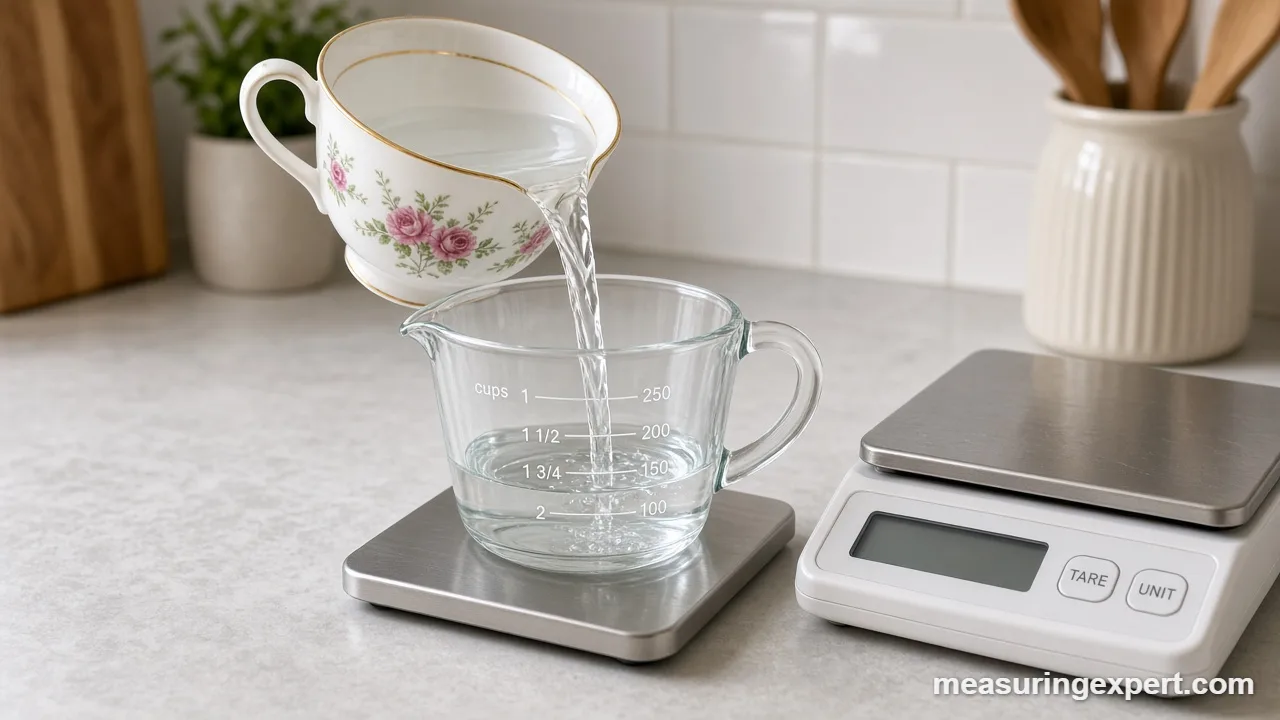
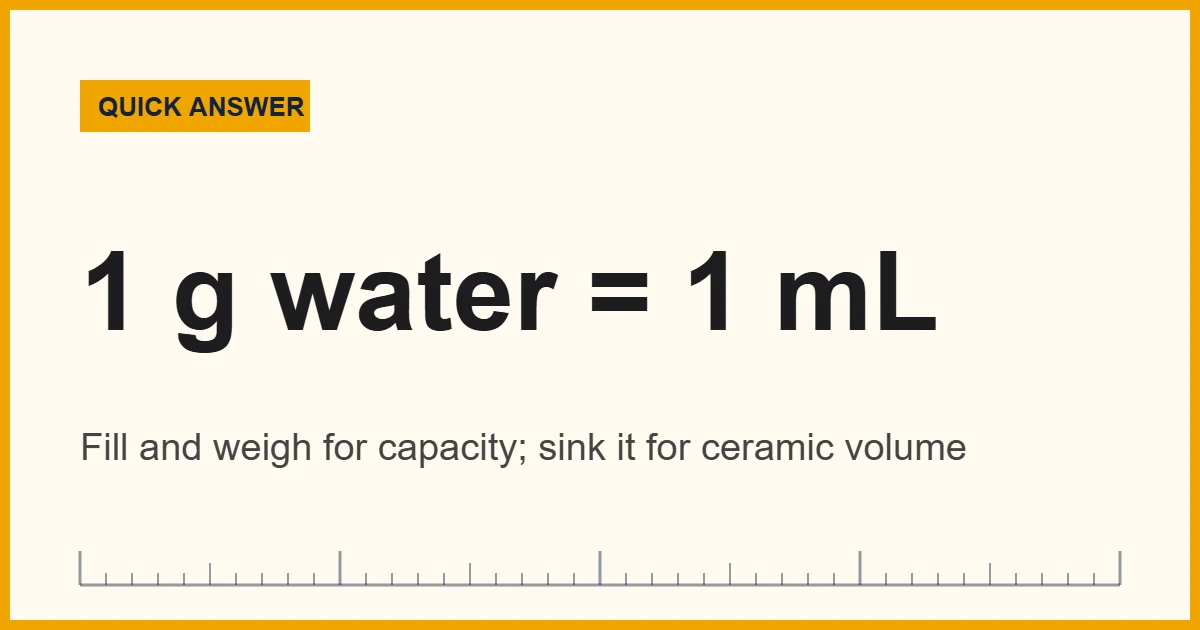
The volume of a teacup has two meanings. Its capacity is how much liquid it holds: fill it to the brim, then pour the water into a measuring cup, or weigh it, since 1 gram of water is about 1 mL. Its material volume is the space the ceramic fills, which you find by water displacement.
A teacup is the classic example of an awkward shape. It has a curved bowl, a flared rim, a foot ring and a handle. So no school formula fits it, and a ruler will not help much either. Fortunately, you do not need a formula at all. Instead, you let water take the shape of the cup for you.
In short: decide first which volume you need. If you want to know how much tea the cup holds, measure its capacity by filling it with water. Then pour that water into a marked measuring jug, or weigh it on a kitchen scale. If you want the volume of the porcelain itself, for example for a science project or to work out the material’s density, sink the empty cup in water and measure how much water it pushes aside. Either way, the answer comes out in milliliters, and 1 mL is the same as 1 cubic centimeter.
The Most Common Teacup Volume Mistake
Most mistakes come from mixing up these two numbers. For example, many guides tell you to sink the teacup and read the rise in water level as “the volume of the teacup”. However, a submerged cup fills with water. As a result, the rise you see is only the volume of the ceramic, not how much tea fits inside.
The US National Institute of Standards and Technology (NIST) confirms the key unit fact in its guide to SI units of volume: the milliliter is simply a special name for the cubic centimeter. Because of that, a reading in mL from a jug is already a volume in cubic centimeters.
This guide is about cups and other hollow objects. If you need to measure a solid object such as a rock, a key or a shell, see our step-by-step guide to the volume of an irregular object, which compares four displacement methods in detail.
Convert the Volume of a Teacup to Cups and Ounces
Once you have a reading in milliliters (or grams of water), type it below. The converter then shows the same amount in US fluid ounces, cups, tablespoons and cubic centimeters, so you can compare your teacup with a recipe or a mug.
Recommended Tools for Measuring a Teacup
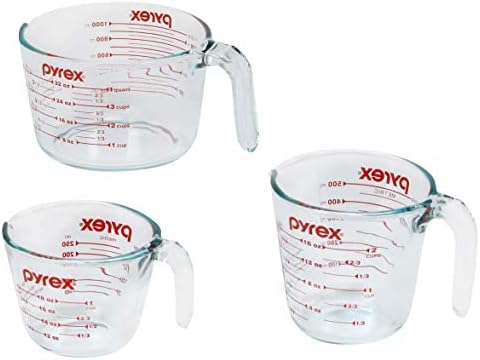
You can do this with a basic kitchen kit. First, a clear liquid measuring cup with mL and ounce markings handles the pour method. Next, a digital kitchen scale that reads in 1 g steps is the most precise way to measure capacity at home. Finally, a plastic graduated cylinder helps with small cups, such as espresso cups, where a big jug is too coarse to read.



As an Amazon Associate, Measuring Expert earns from qualifying purchases.
Two Meanings of the Volume of a Teacup
Before you fill anything, pick the question you are trying to answer. The table below sets the two meanings side by side, along with a third number people sometimes want.
| What you want to know | Name | Best method | Typical use |
|---|---|---|---|
| How much liquid the cup holds | Capacity (inside volume) | Fill with water, then pour into a jug or weigh it | Recipes, serving sizes, comparing cups |
| How much space the porcelain itself fills | Material volume | Sink the empty cup and measure the displaced water | Science class, density, glaze or clay estimates |
| How much room the whole cup takes up | Outer (envelope) volume | Add capacity and material volume together | Packing, shelf space, model making |
In everyday kitchen talk, “how big is this teacup” almost always means capacity. On a science worksheet, by contrast, “find the volume of a teacup” usually means the displacement method. So read the question carefully, and if it is unclear, report both numbers.
How to Measure the Volume of a Teacup With a Measuring Cup
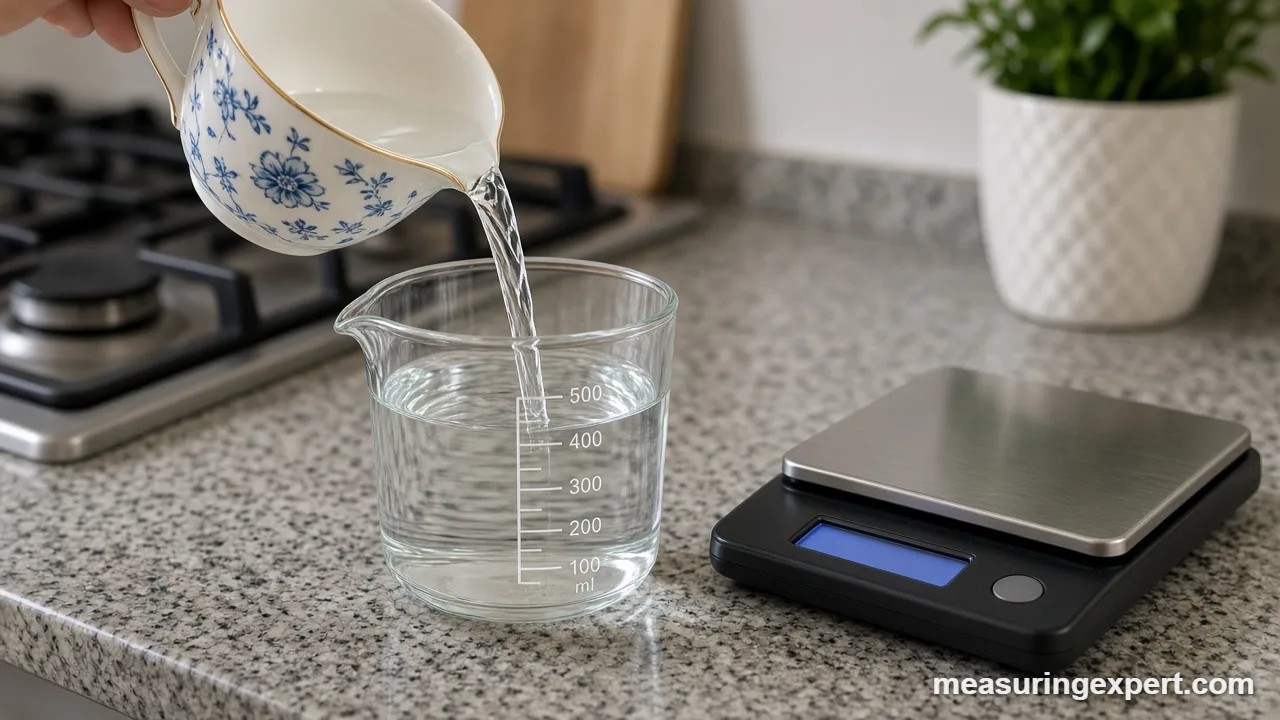
This is the quickest method and the one most people mean. It works with any clear, marked jug. If you have never read one closely, our guide on how to use a measuring jug covers eye level and the meniscus.
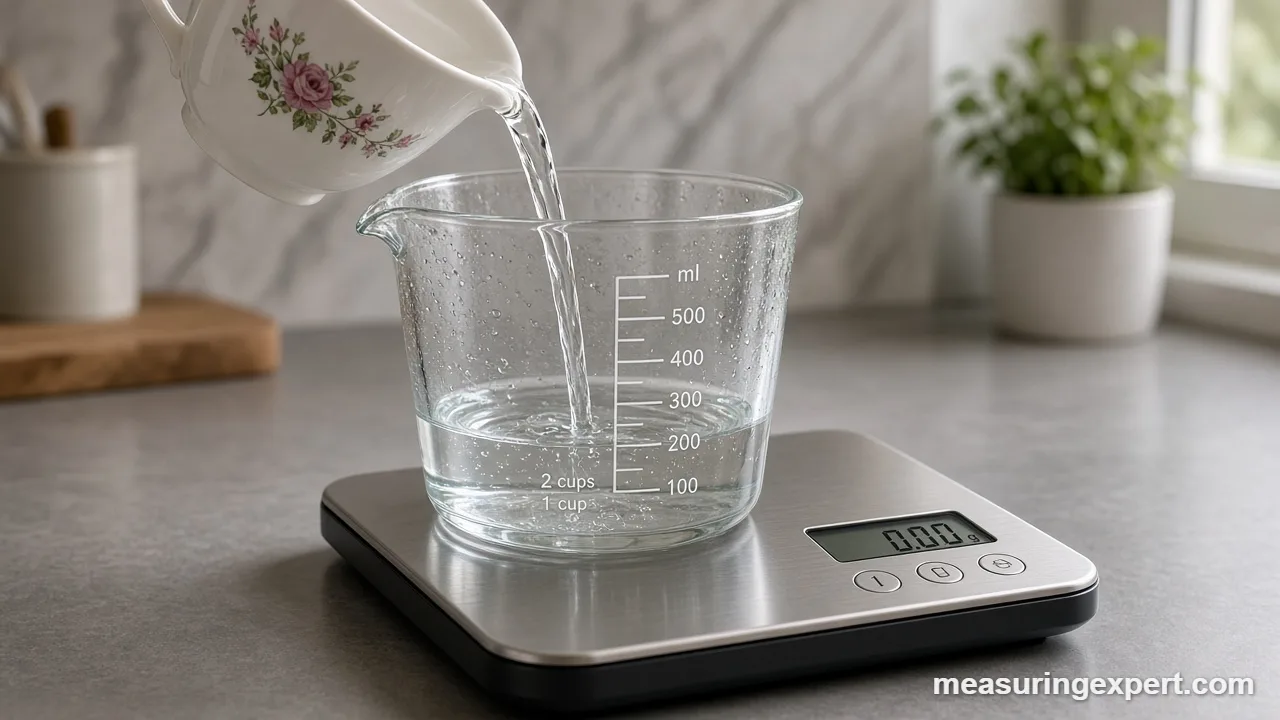
- Set the teacup on a level surface. A tilted cup holds less, so check it sits flat on the counter.
- Fill it with room-temperature water. Pour slowly until the water reaches the very rim, or the fill line you care about.
- Pour the water into a measuring cup. Tip it out slowly and let the last drops drain for a few seconds.
- Read the level at eye height. Crouch so your eye is level with the water, and read the bottom of the curved surface.
- Write down the reading in mL. This number is the capacity, and it equals the same number of cubic centimeters.
- Repeat and average. Do it two or three times, then use the converter above for ounces or cups.
Measure the Volume of a Teacup by Weighing the Water
A kitchen scale beats most jugs for precision. That is because a scale with 1 g steps reads to about 1 mL, while a typical jug has marks every 25 or 50 mL. In addition, you skip the pouring step, so no water is lost on the way.
- Place the empty teacup on the scale. Then press “tare” so the display shows zero.
- Fill the cup to the brim while it stays on the scale.
- Read the grams. Each gram of water is very close to 1 mL, so 210 g means about 210 mL.
- Wipe up any drips before you read, since spilled water on the platform counts too.
Why does 1 g equal 1 mL? Water’s density is almost exactly 1 gram per cubic centimeter. According to the US Geological Survey’s water density table, it is 1.00000 g/cm3 at 4 degrees C and about 0.998 g/cm3 at 21 degrees C. So at room temperature, 210 g of water fills about 210.4 mL. In other words, the shortcut is off by only 0.2%, which is far smaller than the error in reading a jug.
Find the Material Volume of a Teacup by Displacement
Now for the other meaning: the space taken up by the ceramic itself. Here you use the old principle that a sunken object pushes aside its own volume of water. Also, because the cup is hollow, it must fill completely, or trapped air will add to the reading.
The cleanest home setup is an overflow method. First, stand a bowl that is bigger than the cup inside a dry baking tray. Next, fill the bowl right to the brim. Then lower the empty teacup in sideways, so water flows into the cup and pushes the air out. The water that spills into the tray equals the volume of the porcelain. Finally, pour the tray’s water into a measuring cup, or weigh it, to get the result.
Alternatively, use a large measuring jug. Read the water level, sink the cup on its side so it fills, wait for bubbles to escape, and read again. The rise is the material volume. However, a big jug has coarse markings, so this version suits larger, heavier cups best.
Why a Ruler Alone Falls Short
Some guides suggest marking the water level with a ruler. The trouble is that a ruler measures height in centimeters or inches, not volume. To turn a rise into a volume, you also need the container’s cross-section area, and that only works when the sides are straight.
For example, take a straight-sided tub that measures 20 cm by 15 cm inside. Its cross-section is 300 square centimeters. So if the water rises 0.32 cm, the displaced volume is 300 x 0.32 = 96 cubic centimeters. Yet a reading error of just 1 mm changes the answer by 30 cubic centimeters. That is why a jug or a scale is a better choice for something as small as a teacup.
Volume of a Teacup: A Worked Example
Here is how the numbers fit together for one ordinary porcelain teacup. The values are an illustration, so expect your own cup to differ.
| Step | Reading | What it means |
|---|---|---|
| Weigh the water in a brim-full cup | 210 g | Capacity about 210 mL = 7.10 US fl oz = 0.89 US cup |
| Collect the overflow when the empty cup sinks | 95 g of water | Material volume about 95 cm3 = 5.80 cubic inches |
| Add the two | 210 + 95 | Outer volume about 305 cm3 = 18.61 cubic inches |
| Weigh the dry cup, then divide by material volume | 230 g / 95 cm3 | Density of this ceramic about 2.42 g/cm3 |
To convert cubic centimeters to cubic inches, divide by 16.387, because 1 inch is exactly 2.54 cm. Similarly, to get US fluid ounces from mL, divide by 29.574. Meanwhile, the converter near the top of the page does both for you.
Small Cups, Mugs and Other Odd Shapes
The same two methods work for any hollow object. Still, the best tool changes with size:
- Espresso cups and shot glasses: a 100 mL graduated cylinder or the scale gives a clear reading where a jug cannot.
- Mugs and soup bowls: the scale method is easiest; just tare the empty vessel first.
- Vases and jugs with narrow necks: fill them and weigh the water, since pouring out is slow and messy.
- Things that cannot get wet: fill the inside with dry rice or fine sand, level it off, and then measure the grains in a measuring cup. This is rougher, but it is safe for wood or paper.
For solid objects with no hollow, use the displacement methods in our irregular object volume guide instead.
Do and Don’t When Measuring Cup Volume
Do
- Decide whether you need capacity or material volume.
- Read the jug at eye level.
- Tare the scale with the empty cup on it.
- Tilt the cup as it sinks so air escapes.
- Repeat each measurement and average.
Don’t
- Read the rise from a sunken cup as its capacity.
- Use a ruler on a curved bowl.
- Pour hot water into cold china.
- Ignore drips on the scale platform.
- Assume a teacup equals one measuring cup.
Honest Limits of These Methods
Home measurements are good to a few percent, not to a fraction of a milliliter. For one thing, “brim-full” is hard to repeat, because surface tension lets water bulge slightly above the rim. Moreover, a kitchen jug’s markings are spaced far apart, so you may estimate between them. A scale removes most of that guesswork, but cheap scales can drift by a gram or two. On the displacement side, a single trapped bubble can add a few cubic centimeters. Even so, for comparing cups, sizing a recipe or finishing a school project, these methods are more than accurate enough.
When You Need Lab-Grade Precision
Some jobs need tighter numbers. For example, a ceramics studio checking glaze thickness, or a lab measuring density for a report, will want a calibrated balance and Class A glassware. In those cases, a university lab or an accredited calibration service is the right place to go. Likewise, if you sell cups with a stated capacity, check the labeling rules that apply where you sell.
Volume of a Teacup FAQs
How do you find the volume of a teacup?
Fill the teacup to the brim with water, then pour the water into a measuring cup or weigh it. The reading in mL, or in grams of water, is its capacity.
How much does a teacup hold?
It varies by design. Many teacups hold less than one US measuring cup of 236.6 mL, so measure yours rather than assume a size.
Is the volume of a teacup the same as its capacity?
Not always. Capacity is the liquid it holds. Material volume is the space the ceramic fills, which you find by displacement.
Why does 1 gram of water equal 1 mL?
Water’s density is very close to 1 g per cubic centimeter. At room temperature it is about 0.998 g/cm3, so the error is only about 0.2%.
Can I use water displacement to find how much a cup holds?
No. A sunken cup fills with water, so the rise shows the volume of the ceramic, not its capacity. Fill the cup and measure that water instead.
Is 1 mL the same as 1 cubic centimeter?
Yes. NIST defines the milliliter as a special name for the cubic centimeter, so the two are exactly equal.
How do I convert teacup volume to fluid ounces?
Divide the mL value by 29.574. For example, 210 mL is about 7.10 US fluid ounces.
What is the most accurate way to measure the volume of a teacup at home?
Weigh the water on a digital kitchen scale with 1 g steps. It reads to about 1 mL and avoids pouring losses.
How do I measure a cup that must stay dry?
Fill it with dry rice or fine sand, level the top, and pour the grains into a measuring cup. The result is approximate.
How do I find the density of a teacup?
Weigh the dry cup in grams, then divide by its material volume in cubic centimeters from the displacement method.
The Bottom Line on the Volume of a Teacup
To sum up, a teacup has two useful volumes. Its capacity is what it holds, measured by filling it and pouring or weighing the water. Its material volume is the ceramic itself, measured by sinking the empty cup and collecting the overflow.
So start by deciding which number you need, use a scale whenever you can, and remember that 1 mL of water weighs about 1 g. Then drop your reading into the converter above to see it in ounces and cups.
1 thought on “How to Measure the Volume of a Teacup (or Any Odd-Shaped Cup)”