

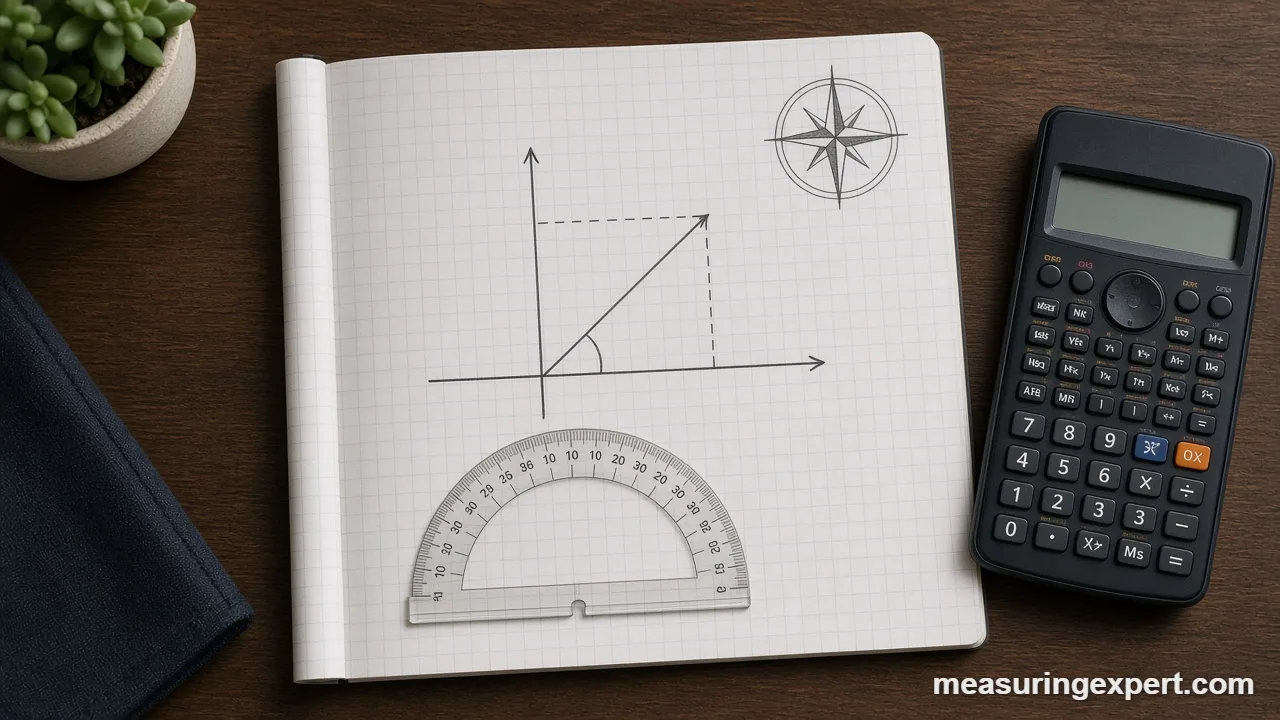
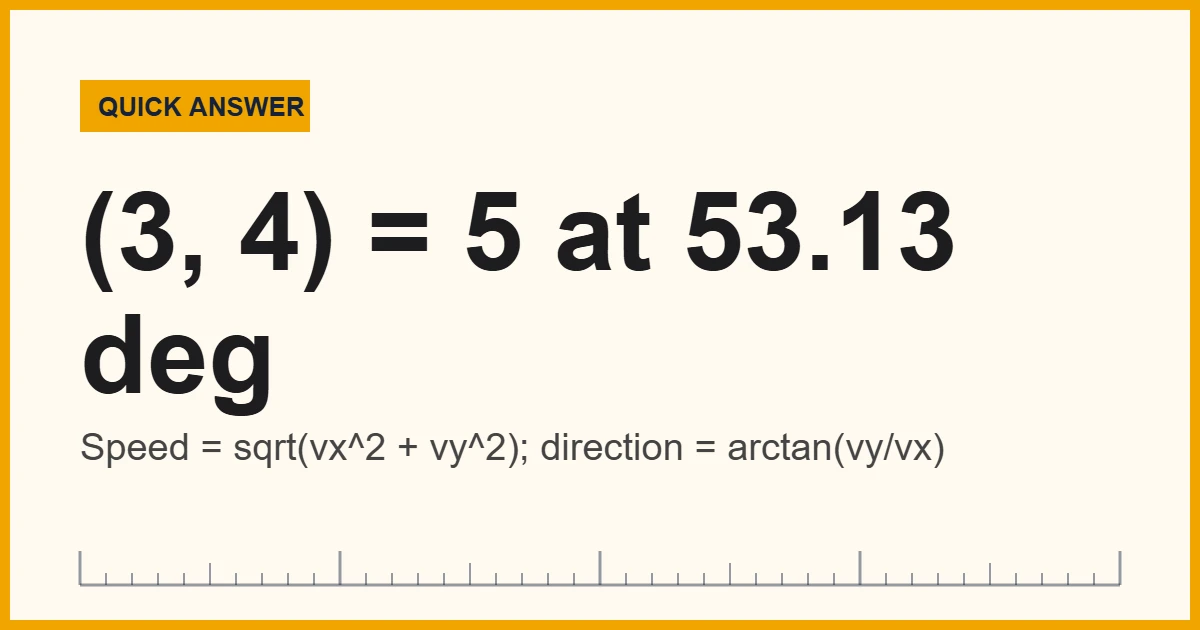
To find the speed and direction of a velocity vector, split it into x and y components. The speed is the magnitude, the square root of (vx squared + vy squared). The direction is the angle, arctan(vy / vx), measured from the positive x-axis. For example, components of 3 and 4 m/s give 5 m/s at 53.13 degrees.
What Speed and Direction Mean for a Vector
A velocity vector packs two facts into one arrow: how fast something moves and which way it is heading. Physics classes, navigation, sports science and engineering all need both numbers. However, most problems hand you the vector in pieces, such as “6 m/s east and 8 m/s north”, and you have to rebuild the full answer yourself.
The method is short. First, write the vector as horizontal and vertical components. Next, use the Pythagorean theorem for the length of the arrow, which is the speed. Finally, use the inverse tangent for the angle, which is the direction, and then check which quadrant the arrow points into. That last check is where most mistakes happen, because a calculator’s arctan key cannot tell “up and to the left” from “down and to the right”.
In short: speed = square root of (vx2 + vy2), and direction = arctan(vy / vx), corrected by 180 degrees when vx is negative.
These are the same formulas taught in the free OpenStax textbook University Physics, Volume 1, which gives the magnitude equation and the 180-degree quadrant rule. Its chapter on velocity vectors also computes speed as the magnitude of the velocity vector, including a three-dimensional example.
This page fixes two gaps in the earlier version. First, the old FAQ said direction is simply arctan(y/x), which gives the wrong answer for half of all vectors. Second, it never covered compass bearings or unit conversion, so both now appear below with worked examples.
Convert the Speed of Your Vector to mph or km/h
Vector math works in any consistent unit, so you usually finish with meters per second. Enter that magnitude below to see it in kilometers per hour, miles per hour, feet per second and knots. The converter uses exact definitions (1 mile = 1.609344 km), so the result matches textbook answers.
Recommended Tools for Vector Problems
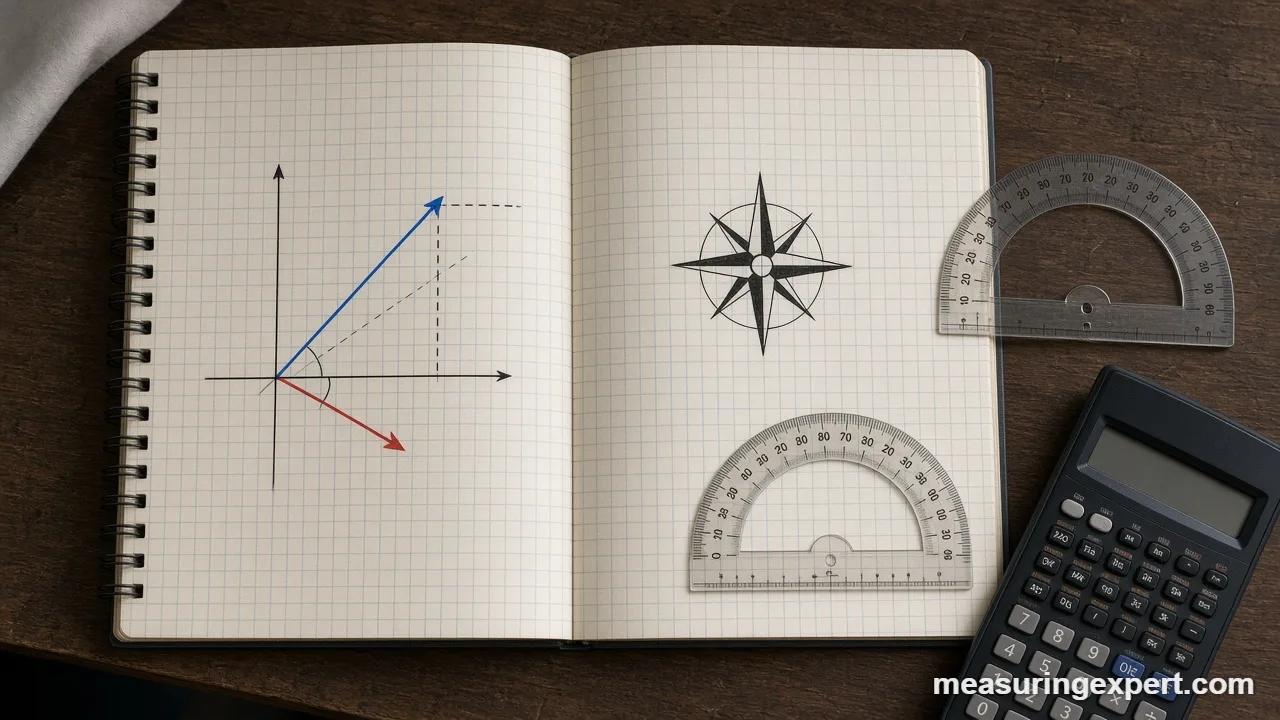
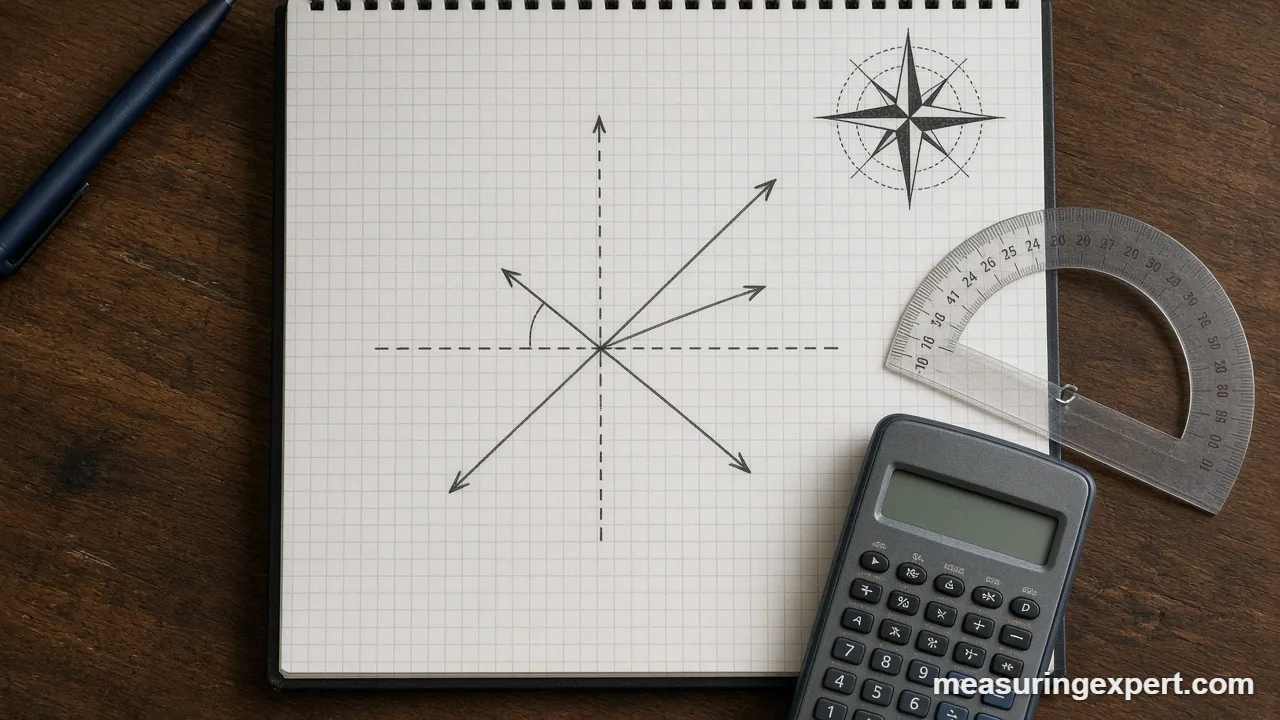
You only need two things for these problems: a calculator with inverse trig keys and somewhere to sketch the arrow. A scientific calculator that shows the full expression helps you spot a misplaced minus sign. Also, check that it has a degree/radian mode indicator on screen, because the wrong mode is the most common source of strange angles. Graph paper, meanwhile, makes it easy to draw components to scale and check your answer by eye.


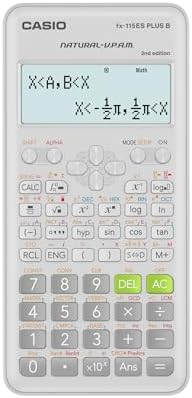

As an Amazon Associate, Measuring Expert earns from qualifying purchases.
Key Takeaways
- Speed is the magnitude (length) of the velocity vector; direction is its angle.
- Magnitude: square root of (vx squared + vy squared), plus vz squared in 3D.
- Direction: arctan(vy / vx) from the positive x-axis, counterclockwise.
- When vx is negative, add 180 degrees to the arctan result.
- Compass bearings run clockwise from north, so convert before you report them.
- Keep units consistent and the calculator in degree mode.
- To combine two velocities, add components first, then find speed and direction.
Speed and Direction: Speed vs Velocity in One Minute
Speed is a scalar. It tells you only how fast, such as 20 m/s. Velocity, by contrast, is a vector, so it carries both speed and direction, such as 20 m/s at 30 degrees north of east. Two cars at the same speed on opposite sides of a highway therefore have different velocities.
So “finding the speed of a vector” really means finding the magnitude of a velocity vector. The magnitude is never negative, because it is a length. The direction holds all the sign information. For a deeper look at the difference, see our guide to calculating speed vs velocity, and our walkthrough on finding speed from velocity.
| Quantity | Type | Example | Can it be negative? |
|---|---|---|---|
| Speed | Scalar (magnitude only) | 5 m/s | No |
| Velocity | Vector (magnitude + direction) | 5 m/s at 53.13° | Its components can be |
| Velocity component vx | Signed number | -6 m/s (moving left) | Yes |
| Direction angle | Angle | 126.87° from +x | Usually written 0 to 360° |
The Speed and Direction Formulas
For a velocity vector v = (vx, vy) on a flat x-y plane, use these two equations:
direction theta = arctan(vy / vx) (add 180 deg if vx < 0)
The first formula is just the Pythagorean theorem. The components form the two short sides of a right triangle, and the velocity arrow is the hypotenuse. The second formula comes from the tangent of the angle, which equals the opposite side over the adjacent side.
In three dimensions, you simply add the third component under the square root. For instance, OpenStax works out a velocity of (8.0, 3.0, 5.0) m/s, which gives a speed of the square root of 98, or about 9.9 m/s. Direction in 3D, however, needs two angles, so most courses stop at the magnitude.
How to Find Speed and Direction Step by Step
Here is the full method, using a boat that moves 6 m/s west and 8 m/s north. Take west as negative x, so vx = -6 m/s and vy = 8 m/s.
- Write the components with signs. Right and up are positive; left and down are negative. Here vx = -6 m/s and vy = 8 m/s.
- Square and add them. 36 + 64 = 100.
- Take the square root for the speed. The square root of 100 is 10, so the boat moves at 10 m/s (about 22.37 mph).
- Divide vy by vx and take the arctan. arctan(8 / -6) = -53.13 degrees on a calculator.
- Correct for the quadrant. Because vx is negative, add 180 degrees: -53.13 + 180 = 126.87 degrees from the positive x-axis.
- State the answer in words. The boat moves at 10 m/s, 126.87 degrees counterclockwise from east, which is 36.87 degrees west of north.
Notice how step 5 changes the answer completely. Without it, you would report a heading toward the southeast, which is the opposite of where the boat actually goes.
Speed and Direction in Every Quadrant
The arctan key always returns an angle between -90 and +90 degrees. As a result, it can only point right. You fix this by checking the signs of the components first, as the table shows.
| Quadrant | Signs (vx, vy) | Example vector | Calculator arctan | Correct direction | Speed |
|---|---|---|---|---|---|
| I | +, + | (3, 4) | 53.13° | 53.13° | 5 |
| II | -, + | (-6, 8) | -53.13° | 126.87° (add 180) | 10 |
| III | -, – | (-5, -5) | 45° | 225° (add 180) | 7.071 |
| IV | +, – | (4, -3) | -36.87° | 323.13° (add 360) or -36.87° | 5 |
Two special cases need care as well. If vx = 0, the vector points straight up (90 degrees) or straight down (270 degrees), and the division fails. Similarly, if both components are 0, the object is not moving, so it has a speed of 0 and no defined direction.
Speed and Direction as a Compass Bearing
Math angles start at east (the positive x-axis) and turn counterclockwise. Navigation bearings, on the other hand, start at north and turn clockwise. The same arrow therefore gets two different numbers, so always say which system you use.
| Arrow points | Math angle (from +x, counterclockwise) | Compass bearing (from north, clockwise) |
|---|---|---|
| East | 0° | 090° |
| North | 90° | 000° |
| West | 180° | 270° |
| South | 270° | 180° |
| Our boat example | 126.87° | 323.13° |
To convert, use bearing = 90 – math angle, then add 360 if the result is negative. For the boat, 90 – 126.87 = -36.87, and adding 360 gives a bearing of 323.13 degrees. In other words, the boat heads northwest, slightly closer to north than to west.
Finding the Resultant Speed and Direction of Two Velocities
Real motion often combines two velocities, such as a plane and the wind, or a swimmer and a river current. In that case, add the x components together and the y components together, and only then apply the two formulas. Never add the speeds directly, because they point in different directions.
Example: a plane in a crosswind. A plane flies north at an airspeed of 200 km/h, and the wind blows toward the east at 50 km/h. The ground velocity is therefore (50, 200) km/h. Its speed is the square root of (2,500 + 40,000), or about 206.16 km/h (128.10 mph). Next, the math angle is arctan(200 / 50) = 75.96 degrees, so the plane tracks 14.04 degrees east of north, a bearing of about 014 degrees.
Example: a swimmer crossing a river. A swimmer pushes straight across at 1.5 m/s while the current carries them downstream at 0.8 m/s. Their speed relative to the bank is the square root of (2.25 + 0.64), which is exactly 1.7 m/s (about 3.80 mph). Meanwhile, the angle from straight across is arctan(0.8 / 1.5) = 28.07 degrees downstream.
The same component method also solves crash problems, where momentum replaces velocity. Our guide on finding speed and direction after a collision uses it for two-dimensional impacts.
Going Backward: Components From Speed and Direction
Sometimes you know the speed and direction and need the components instead, for example before you add two velocities. In that case, multiply the speed by the cosine and sine of the angle:
vy = speed x sin(theta)
For instance, a ball kicked at 25 m/s and 30 degrees above the ground has vx = 25 x cos 30 = 21.65 m/s and vy = 25 x sin 30 = 12.5 m/s. You can then check your work by running the numbers forward again: the square root of (21.65 squared + 12.5 squared) brings you back to 25 m/s. This round trip is the quickest way to catch an error on a test.
Do and Don’t for Speed and Direction Problems
Do
- Sketch the arrow before you calculate.
- Keep the minus signs on components.
- Check the quadrant after every arctan.
- State the reference: from +x, or a bearing from north.
- Add components, not speeds, when combining velocities.
Don’t
- Report a negative speed; flip the direction instead.
- Mix m/s and km/h in one calculation.
- Trust arctan(vy / vx) blindly when vx is negative.
- Leave the calculator in radian mode by accident.
- Round components early; round only the final answer.
Honest Limits of These Formulas
The two formulas are exact, but your answer is only as good as your inputs. For one thing, rounding the components to one decimal place can shift the angle by a few tenths of a degree. In addition, the method gives the velocity at a single instant. If the object speeds up or turns, you need the components at the exact moment you care about, which in calculus means the derivative of position. Finally, real measurements such as GPS speed or wind direction carry their own uncertainty, so a reported heading of 75.96 degrees implies far more precision than most field data can support. In short, keep extra digits while you work and round the final answer to match your data.
When to Ask an Expert
For homework and everyday estimates, this method is all you need. However, some situations call for professional tools and training. Flight planning, for example, uses wind triangles with magnetic variation and published winds aloft, so pilots should follow their training and official sources. Likewise, crash reconstruction, structural loads and ballistics involve forces and uncertainties well beyond a two-component sketch, so leave them to a qualified engineer or reconstructionist.
Frequently Asked Questions
How do you find the speed and direction of a vector?
Split the vector into x and y components. The speed is the square root of (vx squared + vy squared), and the direction is arctan(vy / vx) from the positive x-axis, plus 180 degrees when vx is negative.
What is the formula for the speed of a velocity vector?
Speed equals the magnitude of the velocity vector: the square root of (vx squared + vy squared), or the square root of (vx squared + vy squared + vz squared) in three dimensions.
Is speed the same as the magnitude of velocity?
Yes. Instantaneous speed is the magnitude of the instantaneous velocity vector. Velocity adds the direction, so two objects can share a speed but have different velocities.
Why does my calculator give the wrong direction angle?
The arctan key only returns angles between -90 and +90 degrees. When vx is negative, add 180 degrees. Also check that the calculator is in degree mode, not radian mode.
How do I find speed and direction from a compass heading?
Convert the bearing to a math angle with angle = 90 – bearing, then use vx = speed x cos(angle) and vy = speed x sin(angle). Reverse the steps to turn components back into a bearing.
Can speed be negative?
No. Speed is a magnitude, so it is zero or positive. A negative sign belongs to a velocity component and simply means the object moves in the negative direction along that axis.
How do you find the resultant speed and direction of two velocities?
Add the x components together and the y components together. Then use the magnitude formula for the resultant speed and the arctan formula, with the quadrant check, for its direction.
What is the direction of a vector with a zero x component?
It points straight along the y-axis: 90 degrees if vy is positive and 270 degrees if vy is negative. If both components are zero, the speed is zero and the direction is undefined.
What units should I use for speed and direction?
Use any speed unit, as long as both components share it. Give the direction in degrees and say whether it is measured from the positive x-axis or as a compass bearing from north.
How do I convert vector speed from m/s to mph?
Multiply meters per second by 2.23694 to get miles per hour, or by 3.6 to get kilometers per hour. For example, 10 m/s is 36 km/h or about 22.37 mph.
Speed and Direction: The Bottom Line
To sum up, every velocity vector hides two answers. The speed is the length of the arrow, found with the Pythagorean theorem, and the direction is its angle, found with the inverse tangent and a quick quadrant check. So once you sign your components correctly, the rest is two lines of arithmetic.
Finally, remember to name your reference direction and keep your units consistent. Then use the converter at the top of this page to express the speed in mph, km/h or knots, and you have a complete, correct answer.