

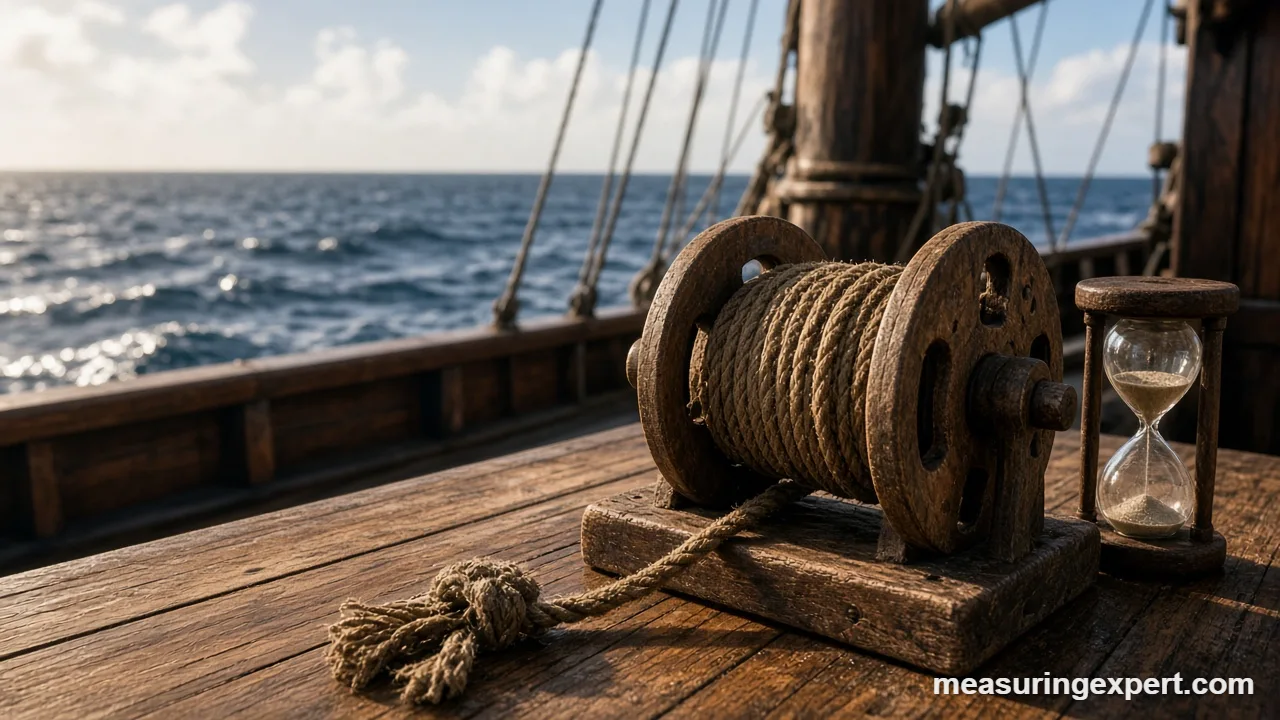
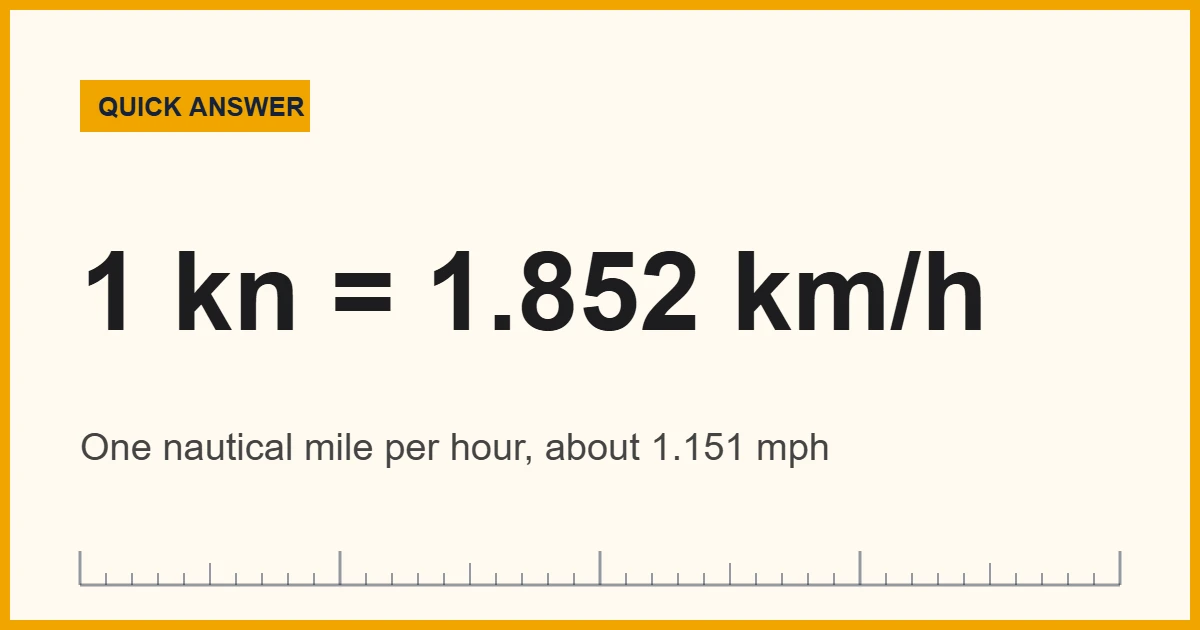
Ships measure speed in knots because one knot is one nautical mile per hour, and one nautical mile was built to match one minute of latitude. As a result, speed, distance and chart position all share one unit. Today 1 knot equals exactly 1.852 km/h, or about 1.151 mph.
Ask a captain how fast the ship is going and you will hear “12 knots”, not “14 miles per hour”. After all, the habit is older than engines, older than radio, and older than the meter itself. Yet it has survived satellites and digital bridges for a practical reason: the unit fits the way sailors find their position on a chart.
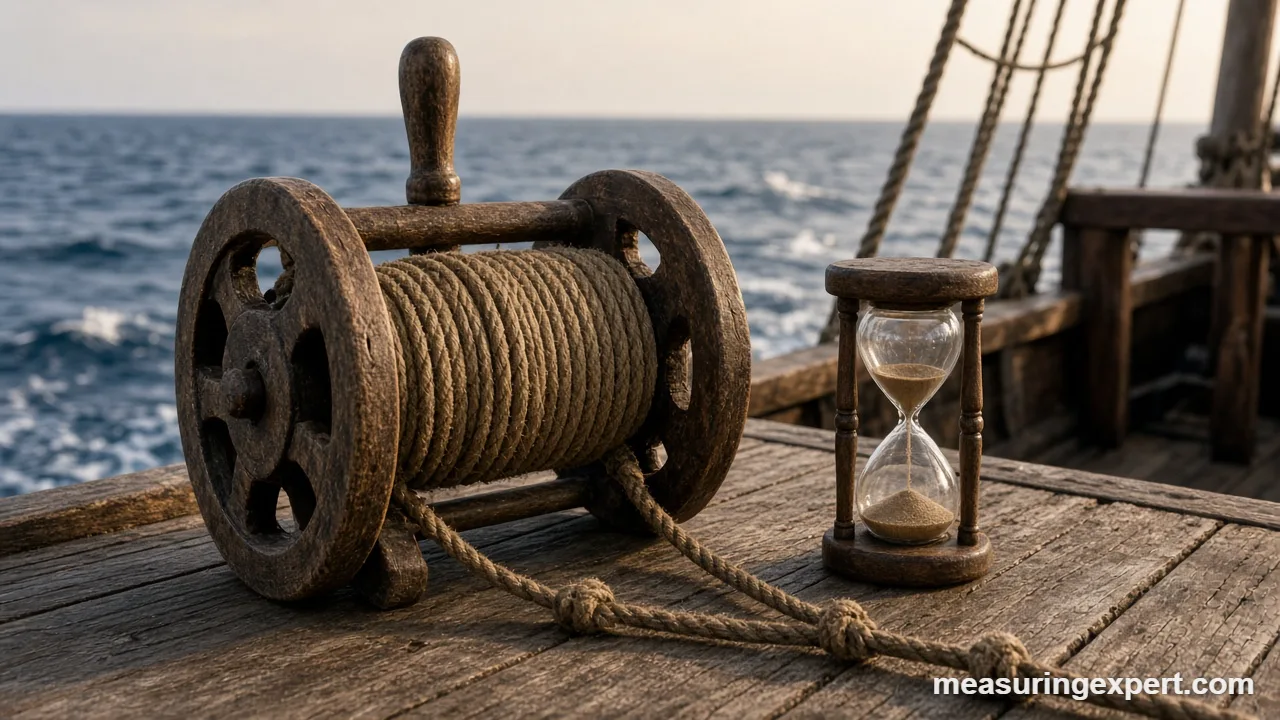
The story starts with a piece of wood, a long rope with knots tied along it, and a small sandglass. Sailors threw the wood over the stern and counted how many knots ran out through their fingers before the sand emptied. Because the spacing of the knots matched the timing of the glass, that count became the ship’s speed. In other words, the name of the unit is a literal description of how it was first measured.
What Speed in Knots Means
In short: a knot is a speed, not a distance. Saying “knots per hour” is therefore a mistake, because the “per hour” is already built in. One knot means one nautical mile every hour, and a nautical mile is 1,852 meters, or about 6,076 feet.
Importantly, the definition is official. For example, the US National Oceanic and Atmospheric Administration (NOAA) explains that a nautical mile is based on one minute of latitude and that one knot equals one nautical mile per hour. Similarly, the NIST unit guide lists the nautical mile as exactly 1,852 meters.
Below, you will find a converter for your own numbers, then the chip log history, the math behind the nautical mile, and how modern ships measure speed today.
Convert Speed in Knots to mph and km/h
First, enter a speed and pick its unit. The converter uses the exact definition of 1,852 meters per nautical mile, so the results match official tables.
Recommended Navigation Tools for Speed and Distance
You do not need special gear to understand knots. Still, a few tools make the idea practical on the water. First, a handheld GPS shows speed over ground in knots and works even on a small boat. Next, a parallel ruler, dividers and a course plotter let you measure distance on a paper chart against the latitude scale, which is exactly how the nautical mile was meant to be used.


As an Amazon Associate, Measuring Expert earns from qualifying purchases.
Speed in Knots: Key Takeaways
- A knot is one nautical mile per hour, so “knots per hour” is wrong.
- Since 1929 the international nautical mile has been exactly 1,852 meters.
- So 1 knot is exactly 1.852 km/h, about 1.151 mph, or about 0.514 m/s.
- The nautical mile was based on one minute of latitude, which makes chart work simple.
- The name comes from the chip log, a knotted rope timed with a sandglass.
- Aircraft, weather services and ships all report speed in knots today.
- Modern ships use GPS and electronic logs instead of rope, but the unit stayed.
The Chip Log: Where Speed in Knots Began
Before the chip log, sailors judged speed by eye. One early trick was to drop a floating object at the bow and time how long the ship took to pass it. However, that method gave only a rough figure, and it was hard to repeat at night or in rough water.
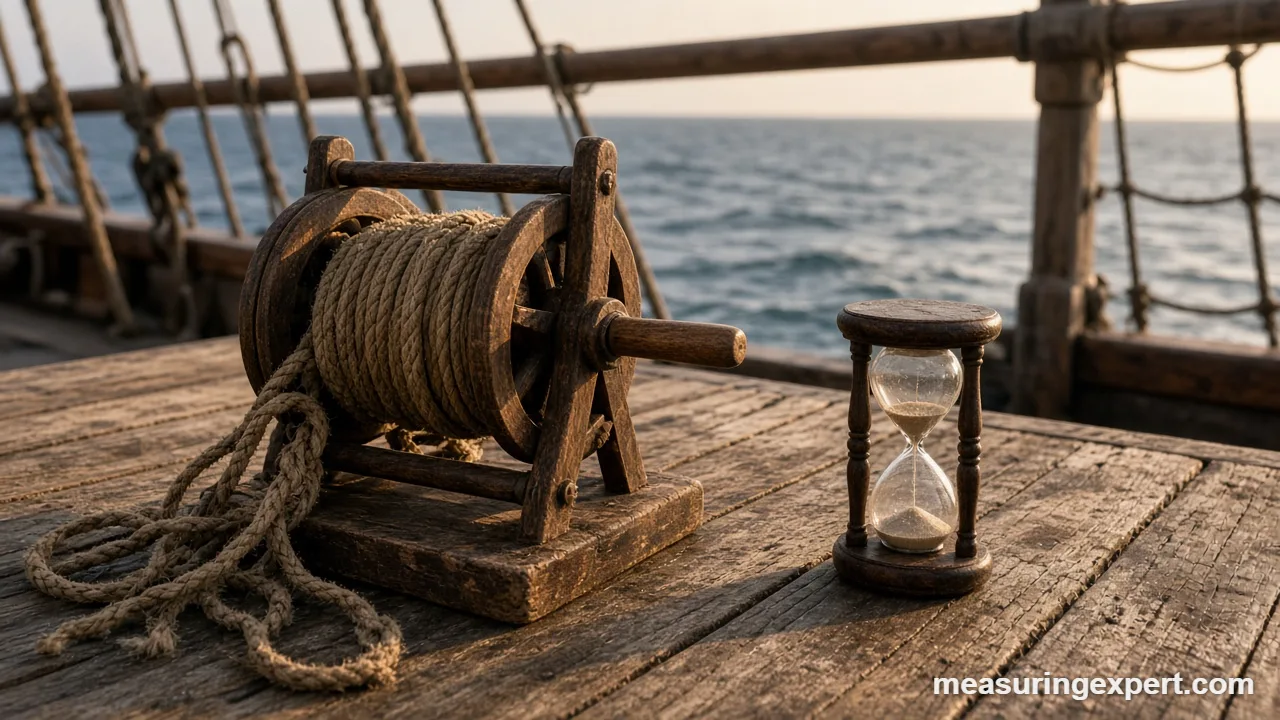
The chip log made the measurement repeatable. Basically, it was a flat wooden board, often shaped like a slice of pie, weighted along its curved edge so it floated upright. Next, a long line was tied to it and wound on a reel. Then, along that line, sailors tied knots at fixed spacing. The English writer William Bourne gave the first known printed description of the device in 1574, in his book A Regiment for the Sea, and NOAA notes that the method was in common use by the 17th century.
How a Chip Log Reading Worked
To take a reading, one sailor dropped the board over the stern. Because the board dragged in the water, it stayed roughly in place while the ship sailed away from it. Meanwhile, a second sailor turned a small sandglass. When the sand ran out, the line was stopped, and the number of knots that had run out was the speed. So if seven knots slipped through the sailor’s hand, the ship was making seven knots.
Afterward, the reading was written in the ship’s logbook every hour or so. That is also why we still call a ship’s record a “log”, and why the instrument that measures speed through water is still called a log today.
Why the Nautical Mile Matches a Minute of Latitude
To begin with, navigators measure position as latitude and longitude, in degrees and minutes. A full circle around the Earth through the poles is 360 degrees, and each degree has 60 minutes, so there are 21,600 minutes in that circle. If you make one nautical mile equal one minute of latitude, the distance around the globe becomes about 21,600 nautical miles, which is roughly 40,000 kilometers.
The Earth, however, is not a perfect sphere. It bulges slightly at the equator, so a minute of latitude is a little shorter there and a little longer near the poles. Using the WGS84 model of the Earth, one minute of latitude is about 1,843 meters at the equator, about 1,852 meters at 45 degrees, and about 1,862 meters at the poles. As a result, different countries once used slightly different nautical miles.
To end the confusion, the International Hydrographic Conference adopted the international nautical mile of exactly 1,852 meters in 1929. The United States adopted it in 1954, and the United Kingdom followed in 1970. Therefore, the modern knot is a fixed unit, while the latitude link remains a very close approximation. For a deeper look at the unit itself, see our guide to the concept of nautical miles.
| Unit | Length | What it is based on | Speed unit |
|---|---|---|---|
| Nautical mile | 1,852 m (about 6,076 ft) | One minute of latitude | Knot (nmi/h) |
| Statute (land) mile | 1,609.344 m (5,280 ft) | Old English land measure | mph |
| Kilometer | 1,000 m | Metric system | km/h |
Why Speed in Knots Suits Navigation and Charts
The real advantage of knots shows up on a nautical chart. To start, every chart has a latitude scale running up its left and right edges. Because one minute on that scale is one nautical mile, a navigator can open a pair of dividers, measure a distance on the chart, and read it straight off the side. As a result, no conversion is needed.
Then speed and time fit in just as easily. For example, a ship making 20 knots for 6 hours covers 120 nautical miles, which is 2 degrees of latitude. Similarly, a navigator who knows the distance to port in nautical miles can divide by the speed in knots and get the hours to arrival at once. This is the basis of dead reckoning, the method sailors used to estimate position long before GPS.
Likewise, aviation uses the same logic. Pilots fly great-circle routes across the globe, so they also benefit from a unit tied to latitude. That is why airspeed and winds aloft are given in knots too. Our article on how airplanes measure speed explains the cockpit side of the story.
Speed in Knots Conversion Chart
These values use the exact definition (1 knot = 1.852 km/h) and are rounded to two decimals. In addition, they cover the range from a slow sailboat to a jet airliner.
| Knots | mph | km/h | m/s | Typical example |
|---|---|---|---|---|
| 1 | 1.15 | 1.85 | 0.51 | Gentle current |
| 5 | 5.75 | 9.26 | 2.57 | Small sailboat in light wind |
| 10 | 11.51 | 18.52 | 5.14 | Slow cargo ship |
| 15 | 17.26 | 27.78 | 7.72 | Economical cargo speed |
| 20 | 23.02 | 37.04 | 10.29 | Container ship or ferry |
| 25 | 28.77 | 46.30 | 12.86 | Fast ferry or cruise ship at top speed |
| 30 | 34.52 | 55.56 | 15.43 | Fast warship |
| 50 | 57.54 | 92.60 | 25.72 | Racing powerboat |
| 100 | 115.08 | 185.20 | 51.44 | Small plane on approach |
| 450 | 517.85 | 833.40 | 231.50 | Jet airliner at cruise (true airspeed) |
To go the other way, 1 mph is about 0.869 knots and 1 km/h is about 0.540 knots. For more examples, our page on how fast a knot is covers knots to mph, km/h and m/s in detail.
How to Work Out Speed in Knots
You can find a boat’s speed in knots with nothing more than a chart, a watch and simple division:
- Note your start time and position. Mark where you are on the chart and write down the time.
- Travel on a steady course. Keep the heading and engine or sail setting the same for a fixed period, such as 30 minutes.
- Mark your new position. Plot where you are at the end of the period.
- Measure the distance on the latitude scale. Set your dividers between the two marks and read the minutes of latitude; each minute is one nautical mile.
- Divide distance by time in hours. For instance, 6 nautical miles in 0.5 hours equals 12 knots.
- Convert if you need to. Enter the result in the converter above to see mph, km/h or m/s.
How Ships Measure Speed Today
Nobody throws a knotted rope over the side anymore. Instead, modern ships use two kinds of speed, and the difference matters.
| Measure | Instrument | What it tells you |
|---|---|---|
| Speed over ground (SOG) | GPS or other satellite receiver | How fast the ship moves relative to the seabed and the chart |
| Speed through water (STW) | Log: paddlewheel, electromagnetic or Doppler sensor | How fast the hull moves through the surrounding water |
The two can differ by several knots. For example, a ship making 12 knots through the water against a 2-knot current covers ground at only about 10 knots. Speed through water matters for fuel use and handling, while speed over ground matters for arrival times and position. So bridge systems usually display both, and both are shown in knots.
The mechanical “patent log”, a spinning rotor towed behind the ship, appeared in the 18th century and replaced the chip log in the 19th century. Today, in contrast, electronic logs and satellite positioning have taken over. Even so, the unit and the name have stayed the same for more than 400 years.
Do and Don’t With Speed in Knots
Do
- Say “10 knots”, meaning 10 nautical miles per hour.
- Measure chart distances on the latitude scale.
- Check whether a display shows SOG or STW.
- Use 1.852 for km/h and about 1.151 for mph.
- Allow for current when planning arrival times.
Don’t
- Say “knots per hour”; that would be an acceleration.
- Mix statute miles with nautical miles in one plan.
- Measure distance on the longitude scale.
- Assume GPS speed equals speed through the water.
- Round 1 knot to 1 mph in long calculations.
Honest Limits of the Knot
The knot is precise by definition, but the link to latitude is only approximate. Because a real minute of latitude ranges from about 1,843 to 1,862 meters, the “one minute equals one nautical mile” rule can be off by up to about half a percent. For coastal sailing, therefore, this is too small to notice. For long ocean passages, however, modern electronic charts handle the exact geometry.
The old chip log had bigger limits. Sandglasses ran fast or slow with humidity, the line stretched when wet, and the log board drifted with the current. As a result, old logbook speeds were estimates, and navigators often found themselves miles from where they expected. Finally, a speed reading of any kind is a snapshot: wind, waves and currents change it constantly.
When to Rely on a Professional
For learning and recreational boating, a GPS and the converter on this page are enough. On the other hand, commercial voyages, offshore passages and anything involving traffic separation schemes call for trained navigators and certified equipment. If your speed log reads very differently from GPS in still water, a marine electronics technician can calibrate it. Likewise, a navigation course from a recognized boating organization is the best way to learn chart work properly.
Frequently Asked Questions
Why do ships measure speed in knots instead of mph?
One knot is one nautical mile per hour, and a nautical mile matches about one minute of latitude. So speed, distance and chart position all use the same unit, which makes navigation simpler.
How much is 1 knot in mph and km/h?
One knot is exactly 1.852 km/h and about 1.151 mph, or about 0.514 meters per second.
Where does the word knot come from?
It comes from the chip log, a wooden board on a knotted rope. Sailors counted how many knots ran out during a sandglass timing, and that count was the speed.
Is it correct to say knots per hour?
No. A knot already means one nautical mile per hour, so knots per hour would describe a change in speed, not a speed.
How long is a nautical mile?
The international nautical mile is exactly 1,852 meters, about 6,076 feet or about 1.151 statute miles.
How fast is 20 knots on a boat?
20 knots is about 23.02 mph or 37.04 km/h. As a speed in knots, that is typical for a container ship or a ferry.
How fast is 25 knots?
25 knots is about 28.77 mph or 46.30 km/h, which is fast for a large ship.
Why do pilots also give speed in knots?
Pilots navigate across the globe with latitude and longitude, just like sailors, so the nautical mile and the knot fit their charts too.
Who first described the chip log?
The English writer William Bourne gave the first known printed description in 1574, in A Regiment for the Sea.
Do modern ships still use a log to measure speed in knots?
Yes, but it is electronic. Ships use GPS for speed over ground and an electronic log for speed through water, and both read in knots.
Speed in Knots: The Bottom Line
To sum up, ships measure speed in knots because the unit grew out of the chip log and fits the way navigators use charts. One knot is one nautical mile per hour, and a nautical mile is exactly 1,852 meters, close to one minute of latitude. That link lets sailors and pilots turn chart distances into travel times with simple division.
Finally, if you just need a number, use the converter at the top of this page. For example, 20 knots is about 23 mph or 37 km/h, and 1 knot is exactly 1.852 km/h.