

The best clamp meter for HVAC work is the Fluke 902 FC, because it is built for the trade: it reads motor amps, capacitors, flame sensor microamps and temperature, and it comes with a probe. If you want more inputs for the money, the Extech EX623A adds DC amps and dual temperature inputs.
In short: pick the Fluke 902 FC for dedicated HVAC work, the Extech EX623A for the most features, and the Klein CL390 for a lower-cost AC/DC meter.
As an Amazon Associate, Measuring Expert earns from qualifying purchases. Our picks are based on research, specifications and owner feedback, not paid placement.
Best Overall

Best Features
Best Value

Quick Answer: Which Best Clamp Meter for HVAC Fits Your Work?
- Dedicated HVAC meter: the Fluke 902 FC with probe, microamps and capacitance.
- Most functions: the Extech EX623A with DC amps and dual Type K inputs.
- Value AC/DC clamp: the Klein CL390 with microamps and 4000 uF capacitance.
- Pipe temperature kit: the UEi DL579COMBO with the ATTPC4 pipe clamp.
- Tight panels: the Fieldpiece SC260 with 0.01 A resolution.
- Basic amp checks: the Klein CL120, 400 A AC only.
- Flame sensor work: skip the SC260 and CL120, since neither lists a microamp range.
On This Page
- Comparison table
- The 6 picks, reviewed
- How we chose
- HVAC jobs and the functions they need
- Specs that matter
- How to check motor amps
- Safety and CAT ratings
- Amps and watts calculator
- FAQ
- Bottom line
Best Clamp Meter for HVAC Comparison at a Glance
| # | Product | Best For | Standout Feature | Amazon |
|---|---|---|---|---|
| 1 | Fluke 902 FC (HVAC, Wireless) | Dedicated HVAC service calls | Microamps, capacitance and probe in one meter | View |
| 2 | Extech EX623A (600A AC/DC, IR and Dual Type K) | Techs who want DC amps and a temperature split | Dual Type K inputs plus an IR thermometer | View |
| 3 | Klein Tools CL390 (400A AC/DC) | DC microamps and capacitance on a budget | Reverse-contrast display and built-in NCV | View |
| 4 | UEi DL579COMBO (600A with Pipe Clamp) | Line set and pipe temperature checks | Includes the ATTPC4 pipe clamp probe | View |
| 5 | Fieldpiece SC260 (Compact HVACR) | Tight panels and quick amp and capacitor checks | Slim body with 0.01 A resolution | View |
| 6 | Klein Tools CL120 (400A AC) | Checking motor amps and voltage only | Simple auto-ranging 400 A AC clamp | View |
The 6 Best Clamp Meter for HVAC Picks, Reviewed
Overall, a clamp meter measures current without breaking the circuit. Because HVAC work also needs capacitance, microamps and temperature, this list favors meters with those functions. For general voltage and resistance work, see our best digital multimeter guide.
Best Overall
1. Fluke 902 FC (HVAC, Wireless)
Best for: technicians who want a meter designed around furnace, condenser and air handler checks.
According to the Fluke 902 FC page, this meter is made for HVAC. In fact, it measures AC current through the jaw up to 600 A, and it also reads DC microamps, capacitance and contact temperature. As a result, one tool covers the usual motor, capacitor and flame sensor checks on a service call.
In particular, the maker lists 200 microamps of DC range at 0.1 microamp resolution, and 100 uF and 1000 uF capacitance ranges. In addition, the contact temperature range runs from -40 to 400 C (-40 to 752 F), and an 80BK temperature probe is included. However, the Fluke page shows a different low temperature limit in its overview, so use the specification table as your guide. Finally, the meter also connects to a phone through Fluke Connect, which helps when you log readings.
- AC current: up to 600.0 A, 0.1 A resolution, 2.0% + 5 digits at 45 to 65 Hz
- DC microamps: 200 uA range, 1% + 5 digits
- Capacitance: 100.0 uF and 1000 uF ranges, 1% + 4 digits
- Temperature: -40 to 400 C (-40 to 752 F) with the included probe
- Safety: CAT III 600 V, CAT IV 300 V; power: two AA batteries
Pros
- Built around HVAC tests
- Probe, leads and case are included
- Microamp range for flame sensors
- Wireless logging to a phone
Cons
- Jaw measures AC current only
- Resistance tops out at 60 kohm
- The page does not list jaw opening or warranty terms
Skip it if: you need to measure DC amps through the jaw or resistance above 60 kohm.
Best Feature-Packed Pick
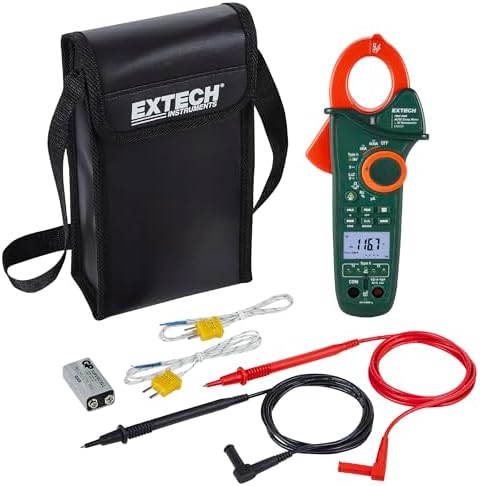
2. Extech EX623A (600A AC/DC, IR and Dual Type K)
Best for: service techs who want the widest set of HVAC functions in one clamp.
In fact, the Extech EX623A packs more functions than any other meter on this list. The Extech specification table shows 600 A AC and DC current, DC microamps from 0.1 to 600, and capacitance up to 40 mF. Therefore, it covers motor amps, DC loads, flame sensors and large run capacitors.
Temperature is where it stands out. For example, two Type K inputs let you read T1, T2 and the difference between them, which is useful for temperature split checks. In addition, a built-in IR thermometer reads from -50 to 270 C (-58 to 518 F) with a laser pointer. Extech also lists a low impedance (LoZ) mode, a low pass filter and a 100 ms inrush capture.
- AC and DC current: 0.01 to 600 A, AC accuracy 1.5% + 5 digits
- DC microamps: 0.1 to 600 uA
- Capacitance: 0.001 nF to 40 mF
- Type K: -50 to 1000 C; IR: -50 to 270 C
- 6000 counts, 32 mm (1.25 in) jaw, CAT III 600 V, two-year warranty
Pros
- DC amps and microamps in one clamp
- Dual Type K inputs for temperature split
- Low impedance mode and inrush capture
- Two-year warranty
Cons
- CAT III 600 V only
- Check the listing for which probes are included
- Dual probes and an IR sensor may be more than you need
Skip it if: you only need amps and capacitance; a simpler meter costs less and has fewer menus.
Best Value AC/DC Clamp
3. Klein Tools CL390 (400A AC/DC)
Best for: HVAC and electrical techs who want AC/DC amps, microamps and capacitance from a well-known brand.
Overall, the Klein CL390 is a general-purpose electrician clamp that still handles most HVAC jobs. Klein lists 400 A AC/DC, a 200 microamp DC range and 4000 uF of capacitance, so it can check run capacitors and flame sensors. For example, the 4000 uF range is plenty for common motor run capacitors.
In addition, the clamp has a jaw opening of 1.6 in. (4.1 cm), which is roomy for larger wires. It also has an integrated non-contact voltage detector in the jaw. However, the Klein page lists the temperature range as -40 to 1832 F without saying what comes in the box, so check the listing for a probe before you count on it.
- Current: 400 A AC/DC; DC microamps: 200 uA
- Capacitance: 4000 uF; resistance: 40 Mohm
- Temperature: -40 to 1832 F (-40 to 1000 C), per Klein
- 4000-count reverse-contrast LCD, true RMS, CAT III 600 V
- Jaw: 1.6 in. (4.1 cm); power: three AAA batteries; 6.6 ft (2 m) drop rating
Pros
- Microamps, capacitance and DC amps together
- Large jaw
- Built-in NCV
- Well-known brand
Cons
- No low impedance mode listed
- Probe inclusion is unclear
- Smaller range than 600 A meters
Skip it if: you often work on 480 V systems or larger services; look for CAT IV or CAT III 1000 V ratings.
Best Kit With Pipe Clamp
4. UEi DL579COMBO (600A with Pipe Clamp)
Best for: techs who check pipe and line set temperatures all day and want the clamp probe in the same box.
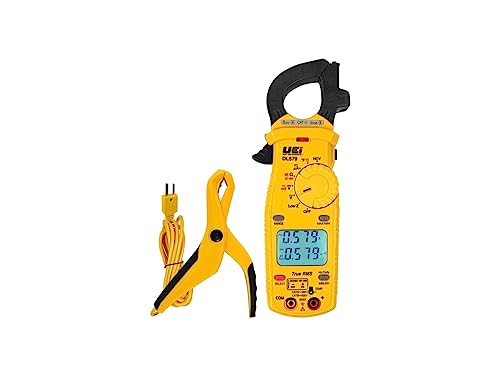
First, the UEi DL579COMBO is a kit built around a 600 A dual display clamp and the ATTPC4 pipe clamp probe. The UEi product page describes the ATTPC4 as a wired K-type pipe clamp with a thermally isolated probe for tight spaces. As a result, a pipe clamp holds the probe against the line, so it stays put while you work.
In addition, UEi lists 2000 uA DC and AC microamps through the test leads, plus 6000 uF capacitance and a wide temperature range of -328 to 2462 F. Also, the display is a backlit 6000-count dual screen. However, the page does not list a jaw opening, and it does not list a DC amp range for the jaw.
- AC current: 600 A through the jaw
- Microamps: 2000 uA DC and AC via leads
- Capacitance: 6000 uF
- Temperature: -328 to 2462 F (-200 to 1350 C)
- CAT IV 300 V and CAT III 600 V; one-year limited warranty
Pros
- Pipe clamp probe included
- Large microamp range
- Dual display
- CAT IV 300 V and CAT III 600 V
Cons
- Jaw opening is not listed
- No DC jaw amps listed
- One-year warranty
Skip it if: you need DC current through the jaw, which the page does not list.
Best Compact Clamp
5. Fieldpiece SC260 (Compact HVACR)

Best for: techs who work in cramped disconnects and want amps, capacitance and temperature in a slim body.
Overall, the Fieldpiece SC260 is a compact true RMS clamp designed for HVACR work. The SC220, SC240 and SC260 manual lists 40 A and 400 A AC ranges with 0.01 A resolution, which is helpful on small loads such as fan motors. In addition, the jaw opens 1.2 in. (30 mm).
For the SC260, the manual lists capacitance from 4 nF to 4 mF and Type K temperature from -30 to 752 F (-35 to 400 C). However, the manual shows no DC microamp function on the SC260, so it cannot check a flame sensor. Still, other Fieldpiece models list microamps, so check the specs before you buy.
- AC current: 40 A and 400 A ranges, 0.01 A resolution
- Capacitance: 4 nF to 4 mF
- Type K temperature: -30 to 752 F (-35 to 400 C)
- 4000 counts, true RMS, CAT III 600 V, blue backlight
- One 9 V battery; about 150 hours typical battery life
Pros
- Fine 0.01 A resolution
- Slim body
- True RMS and backlight
- Capacitance and temperature
Cons
- No DC microamps on this model
- 1.2 in. jaw is smaller
- Temperature probe inclusion not confirmed
Skip it if: you test flame sensors; choose a meter with a microamp range.
Best Basic Amp Check
6. Klein Tools CL120 (400A AC)
Best for: newer techs and homeowners who mainly need to compare motor amps with a nameplate.
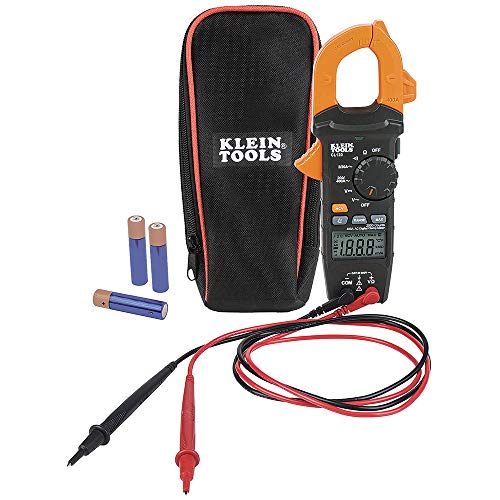
In fact, the Klein CL120 does only the basics, but it does them cheaply. According to the Klein page, it measures 400 A AC, 600 V AC/DC and up to 20 Mohm, with a 2000-count backlit display. In addition, the jaw opens 1.6 in. (4.1 cm), and it has a built-in non-contact voltage detector.
However, the page lists no capacitance, no temperature and no DC current. As a result, it cannot check a run capacitor or a flame sensor. Therefore, treat it as a first clamp for amp draw, and add a multimeter with capacitance for the rest. Our best digital multimeter guide covers that side.
- AC current: 400 A auto-ranging
- Voltage: 600 V AC/DC; resistance: up to 20 Mohm
- 2000-count backlit display, accuracy 1.0% + 3 digits
- CAT III 600 V; jaw 1.6 in. (4.1 cm)
- Three AAA batteries; 6.6 ft (2 m) drop rating
Pros
- Simple to use
- Large jaw
- Built-in NCV
- Lower cost
Cons
- No capacitance or temperature
- No microamps
- True RMS is not stated
Skip it if: you need to test capacitors, flame sensors or temperature.
How We Chose the Best Clamp Meter for HVAC Technicians
To be clear, we did not test these meters by hand. Instead, we compared maker pages and manuals, then kept clamps with a published HVAC-relevant function list. In fact, every number below comes from a page we opened, and we left out any spec we could not find.
- HVAC functions: AC amps, plus at least capacitance or temperature.
- Microamps: a DC microamp range for flame sensors, listed by the maker.
- Safety rating: a stated CAT rating and voltage for field use.
- Documentation: a maker page or manual with ranges, flagged where it was thin.
- Background: for service procedures we followed the Fluke HVAC multimeter guide.
Which Functions the Best Clamp Meter for HVAC Work Needs
Overall, HVAC service uses a small set of electrical checks. The table below links each job to the clamp function that does it, and shows which of our picks list that function.
| HVAC job | Function needed | Listed on |
|---|---|---|
| Compressor and fan motor amps | AC current through the jaw | All six picks |
| Run or start capacitor test | Capacitance | All except the Klein CL120 |
| Flame sensor check | DC microamps | Fluke 902 FC, Extech EX623A, Klein CL390, UEi DL579COMBO |
| Supply and return temperature split | Temperature, ideally two inputs | Extech EX623A (dual Type K); others have one |
| ECM, VFD and DC loads | DC amps and low impedance mode | Extech EX623A and Klein CL390 (DC amps) |
In addition, the Fluke guide describes the main checks. First, for a flame sensor, set the meter to microamps and connect it in series, with an expected reading of 0.5 to 10 microamps. For a capacitor, discharge it first, then compare the reading to its rating, which Fluke says should be within 6%. Finally, for temperature, Fluke gives a target drop of 16 to 22 F between supply and return air. Therefore, a clamp without capacitance or microamps leaves you carrying a second meter.
Specs That Matter When You Choose the Best Clamp Meter for HVAC
Indeed, five specs separate a good HVAC clamp from a generic one. First, check the current resolution, because small loads need fine steps. For example, the SC260 shows 0.01 A on its 40 A range, while the Fluke 902 FC steps by 0.1 A. As a result, a 0.8 A fan motor reads more precisely on the Fieldpiece.
| Meter | Max jaw current | DC microamps | Capacitance | Temperature |
|---|---|---|---|---|
| Fluke 902 FC | 600 A AC | 200 uA | 1000 uF | -40 to 400 C |
| Extech EX623A | 600 A AC/DC | 600 uA | 40 mF | Type K to 1000 C; IR to 270 C |
| Klein CL390 | 400 A AC/DC | 200 uA | 4000 uF | -40 to 1000 C |
| UEi DL579COMBO | 600 A AC | 2000 uA | 6000 uF | -200 to 1350 C |
| Fieldpiece SC260 | 400 A AC | None listed | 4 mF | -35 to 400 C |
| Klein CL120 | 400 A AC | None listed | None listed | None listed |
Second, look at jaw size. A 1.2 to 1.6 in. (30 to 41 mm) jaw fits most branch wiring, but a larger jaw helps on bundled conductors. Third, check true RMS, because variable speed motors produce non-sinusoidal current. Fourth, look for a microamp range if you service gas furnaces. Finally, read the CAT rating before you buy, as covered below. Finally, for other kinds of tools, see our measuring tools guide.
How to Check Motor Amps With a Clamp Meter
Also, this is the most common HVAC clamp meter job. Follow these steps for any meter in this guide.
- Turn off and verify. Shut off power and confirm the circuit is dead before you open a panel.
- Find the nameplate. Then read the rated load amps (RLA) or full load amps (FLA) printed on the motor or compressor.
- Select AC amps. Then turn the dial to the AC amp setting, and pick the low range for small loads.
- Clamp one conductor. Instead, close the jaw around a single wire, not the whole cable.
- Restore power and read. Then run the unit, wait for the reading to settle, then record the amps.
- Compare to the nameplate. A reading near or above the rated amps points to a problem, while a very low reading can mean a light load.
For a quick feel, you can also check a reading by calculation. Amps equal watts divided by volts, so a 4,800 W load on 240 V draws 20 A.
Safety and CAT Ratings for HVAC Clamp Meters
First, the CAT rating describes where a meter is safe to use. Triplett explains that CAT III applies to fixed installations such as distribution panels and breakers, while CAT IV applies where power enters a building. In addition, the voltage rating sets the limit, so you need both to match the job. Most HVAC equipment sits downstream of the panel, so CAT III 600 V is a typical rating. For example, the Fluke 902 FC lists CAT III 600 V and CAT IV 300 V, and the UEi lists the same pair. However, the Klein CL390, Extech EX623A and Fieldpiece manual list CAT III 600 V only.
Also, microamp readings use the test leads, so follow each manual’s connection steps. Discharge capacitors first, as Fluke advises. Likewise, use the lockout and tagout steps from your employer when you work inside equipment.
Amps, Volts, Ohms and Watts Calculator for Quick Checks
Instead of guessing, use this calculator to check what a motor or heater should draw. First, enter volts and resistance, and it returns amps and watts. For example, 240 V across 12 ohms gives 20 A and 4,800 W.
Keep in mind that a motor is not a plain resistor, so this check fits heaters better than compressors. Therefore, always trust the nameplate for motors. To measure heat or pressure instead, see our best refrigerant gauge set guide.
Honest Limits of These Clamp Meter Picks
Overall, we did not test any of these meters, and several pages were thin. The Fluke page has two temperature low limits, the Klein CL390 page does not say what probe is included, and the SC260 manual is shared with two sister models. Therefore, confirm the listing before you buy, and follow the equipment maker’s service data for every reading.
Best Clamp Meter for HVAC FAQ
What is the best clamp meter for HVAC technicians?
The Fluke 902 FC is the best clamp meter for HVAC technicians who want a dedicated tool. In addition, it reads AC amps up to 600 A, DC microamps, capacitance and temperature, and it includes a probe. However, the Extech EX623A is a close second with more inputs.
Do I need microamps on an HVAC clamp meter?
Yes, if you service gas furnaces. Indeed, a flame sensor signal is measured in microamps, and Fluke gives an expected reading of 0.5 to 10 microamps. Therefore, the Fieldpiece SC260 and Klein CL120 are poor fits for that task.
Which is the best clamp meter for HVAC capacitor testing?
Overall, any pick with a capacitance range works, and the Extech EX623A has the widest at up to 40 mF. Meanwhile, the Fluke 902 FC covers 100 uF and 1000 uF, which fits most motor capacitors. Also, discharge the capacitor first.
Is a clamp meter better than a multimeter for HVAC?
A clamp meter is better for motor amps because you do not break the circuit. However, a multimeter is often better for small voltage or resistance work. In fact, most techs carry both, or one clamp with the full function list.
What does true RMS mean on a clamp meter?
In fact, true RMS means the meter measures the actual heating value of a waveform, even when it is distorted. Thus, that matters for variable speed and ECM motors. In addition, the Fluke 902 FC, Extech EX623A, Klein CL390 and Fieldpiece SC260 list true RMS.
What CAT rating should the best clamp meter for HVAC have?
CAT III 600 V is the usual minimum for work downstream of the panel. In addition, CAT IV applies where power enters a building. Thus, the Fluke 902 FC and UEi DL579COMBO list both CAT III 600 V and CAT IV 300 V.
Can I measure DC amps with these meters?
First, the Extech EX623A and Klein CL390 list DC current through the jaw. However, the Fluke 902 FC page lists AC current through the jaw, and the UEi page lists no DC jaw range. Therefore, check the listing if DC amps matter to you.
How do I measure a temperature split with a clamp meter?
Measure supply and return air temperature, then subtract. In fact, Fluke gives a target drop of 16 to 22 F. Also, the Extech EX623A has two Type K inputs that can show T1, T2 and the difference at once.
Why does the jaw size matter on a clamp meter?
First, the jaw must close around one conductor. A 1.2 in. (30 mm) jaw fits most branch wiring, while a 1.6 in. (41 mm) jaw gives more room on bundled wires. However, the Fluke page does not list its jaw opening.
How accurate is the best clamp meter for HVAC work?
In fact, accuracy varies by function. For example, for AC current, the Fluke 902 FC lists 2.0% + 5 digits and the Extech EX623A lists 1.5% + 5 digits. Then compare those with the nameplate tolerance, and check the stated range before you rely on a reading.
Bottom Line on the Best Clamp Meter for HVAC
For most technicians, the best clamp meter for HVAC is the Fluke 902 FC. As a result, it covers amps, capacitors, flame sensor microamps and temperature with a probe included. Otherwise, choose the Extech EX623A for DC amps and dual temperature inputs, or the Klein CL390 for a lower-cost AC/DC option. Always check the listing for the exact kit before you buy.