

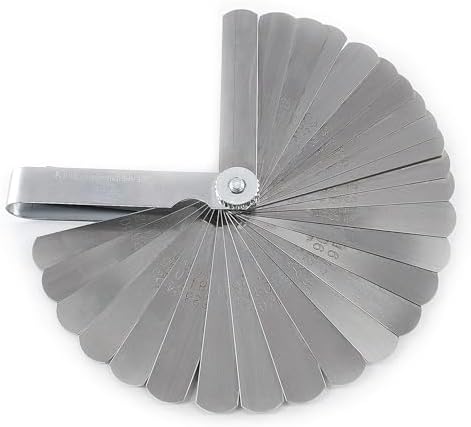
The best feeler gauge set for most people is the GEARWRENCH 161D, because its 32 dual-marked blades cover 0.0015 to 0.035 in. (0.038 to 0.889 mm) in one pack. However, your job decides the rest: choose an offset set for valve lash, a wire-and-blade set for spark plugs, or a go/no-go set for quick checks.
In short: buy the GEARWRENCH 161D for general work, the Lisle 68050 for valve adjustment, and the GEARWRENCH 164 for spark plug gaps.
As an Amazon Associate, Measuring Expert earns from qualifying purchases. Our picks are based on research, specifications and owner feedback, not paid placement.
Best Overall
Best for Valves

Best for Spark Plugs

Quick Answer: Which Best Feeler Gauge Set Fits Your Job?
- All-round pick: the GEARWRENCH 161D with 32 blades from 0.0015 to 0.035 in.
- Valve lash: the Lisle 68050 with 11 offset blades.
- Spark plug gaps: the GEARWRENCH 164 with 6 wire gauges.
- 3D printer bed or tight spots: the OEMTOOLS 25349 offset set.
- Metric service data: the Powerbuilt 648395, 0.06 to 0.70 mm.
- Quick pass/fail checks: the Lisle 68150 go/no-go set.
- Straight plus offset in one box: the YESWELDER two-gauge pack.
On This Page
- Comparison table
- The 8 picks, reviewed
- How we chose
- Feeler gauge types
- Sizes and conversions
- How to measure a gap
- Spark plugs, valves, printers and guitars
- Care and accuracy
- FAQ
- Bottom line
Best Feeler Gauge Set Comparison at a Glance
| # | Product | Best For | Standout Feature | Amazon |
|---|---|---|---|---|
| 1 | GEARWRENCH 161D (32 Blades, SAE and Metric) | All-round shop, engine and hobby work | 32 blades, SAE and metric on every blade | View |
| 2 | CRAFTSMAN CMMT14105 (32 Blades) | A second 32-blade set with stainless blades | Stainless-steel blades, 0.038 to 0.889 mm | View |
| 3 | Lisle 68050 Valve Tappet Blades | Valve tappet and rocker adjustment | 11 offset blades, 0.008 to 0.026 in. | View |
| 4 | OEMTOOLS 25349 (16 Offset Blades) | Reaching under gantries, toolheads and valve covers | 16 offset blades, 0.005 to 0.020 in. | View |
| 5 | GEARWRENCH 164 (12 Blades, 6 Wires) | Setting and checking spark plug gaps | 12 blades plus 6 wire gauges and a gap tool | View |
| 6 | Lisle 68150 Go-No-Go Blades | Fast pass or fail clearance checks | Stainless blades with 0.002 in. steps | View |
| 7 | Powerbuilt 648395 (15 Metric Blades) | Metric-spec engines and motorcycles | 15 carbon steel blades, 0.06 to 0.70 mm | View |
| 8 | YESWELDER 2-Piece (32 Straight, 16 Offset) | One pack with straight and offset gauges | 32 straight plus 16 offset blades, dual marked | View |
The 8 Best Feeler Gauge Set Picks, Reviewed
First, a feeler gauge is a set of thin steel blades with known thicknesses. Next, you slide blades into a gap until one fits with light drag, and that blade tells you the gap. In addition, this list covers straight, offset, go/no-go and wire styles. Also, for measuring thicker or harder-to-reach parts, our best thickness gauge guide covers dial, digital and ultrasonic tools.
Best Overall
1. GEARWRENCH 161D (32 Blades, SAE and Metric)
Best for: owners who want one pack that covers engine work, machine clearances, guitar setup and printer beds.
First, the GEARWRENCH 161D is the most complete single set on this list. According to the GEARWRENCH product page, it holds 32 blades that measure from 0.0015 in. up to 0.035 in., which is 0.038 mm to 0.889 mm. Every blade shows its size in both unit systems, so you never have to convert in your head.
In addition, it includes one brass blade at 0.010 in. (0.254 mm). For instance, the brass blade is meant for electronic ignitions, according to GEARWRENCH. Finally, the thin 0.0015 in. starting blade suits light-contact checks.
- Blades: 32, each marked in SAE and metric
- Range: 0.0015 to 0.035 in. (0.038 to 0.889 mm)
- Blade length: 3-5/16 in. (about 84 mm); blade width 1/2 in.
- One brass blade at 0.010 in. (0.254 mm)
- Full lifetime warranty, per the maker
Pros
- Widest range of any single pack here
- Both unit systems on every blade
- Brass blade for ignition work
- Lifetime warranty
Cons
- Straight blades only, so tight valve covers can be awkward
- The maker page does not state the blade material
- Needs a gentle hand on the thinnest blades
Skip it if: you mainly adjust valves in tight spaces; the offset Lisle below reaches under rocker arms more easily.
Best Stainless Alternative
2. CRAFTSMAN CMMT14105 (32 Blades)

Best for: buyers who want a 32-blade range from a hardware-store brand and prefer corrosion-resistant blades.
For example, the CRAFTSMAN CMMT14105 competes directly with the GEARWRENCH. Specifically, the CRAFTSMAN page lists 32 blades and a metric range of 0.038 mm to 0.889 mm, which matches the 161D at both ends. Also, it describes the blades as stainless steel.
However, one detail needs care. The inch figure on the page reads 0.015 in. at the low end, but 0.038 mm equals 0.0015 in. Therefore, trust the metric range and read the printed blade sizes when the set arrives.
- Blades: 32
- Metric range: 0.038 to 0.889 mm (the page prints the inch low end as 0.015 in.)
- Stainless-steel blades, per the maker
- Folded size: 6.89 by 2.76 in. (175 by 70 mm)
- Full lifetime warranty
Pros
- Stainless blades resist rust
- Same metric span as the 161D
- Lifetime warranty
Cons
- The inch range on the page looks like a typo
- No blade length or marking details on the page
- Straight blades only
Skip it if: you want the clearest published specs; the GEARWRENCH page is more complete.
Best for Valve Lash
3. Lisle 68050 Valve Tappet Blades
Best for: anyone setting valve clearance on small engines, motorcycles or older cars where a straight blade will not fit.
Overall, the Lisle 68050 is built for one job. For instance, a retailer listing describes 11 steel blades that are offset at the proper angle for adjusting valve tappets. As a result, the blade can reach in while your fingers stay clear.
Also, the range is 0.008 to 0.026 in., or 0.20 to 0.66 mm, per the listing. However, it has no blades below 0.008 in. For reference, the Briggs & Stratton figures in a valve adjustment guide list 0.004 to 0.006 in. for most models, so confirm your own spec first.
- Blades: 11 steel, offset
- Range: 0.008 to 0.026 in. (0.20 to 0.66 mm), per a retailer listing
- Blade length: about 4 in., per the listing
- SAE and metric ranges listed
- The listing mentions easy-to-read markings
Pros
- Offset blades reach under rocker arms
- Longer blade keeps fingers away
- Dual-unit range
Cons
- Smallest blade is 0.008 in.
- Only 11 blades
- The offset angle is not given as a number
Skip it if: your engine spec is below 0.008 in. (0.20 mm), such as many small engines at 0.004 to 0.006 in.
Best for Tight Spaces and 3D Printers
4. OEMTOOLS 25349 (16 Offset Blades)

Best for: hobbyists who need a short, offset set for engines or for leveling a printer bed beneath the nozzle.
In short, the OEMTOOLS 25349 has 16 offset blades that measure 0.005 to 0.020 in. (0.127 to 0.508 mm), according to the Amazon listing. The offset geometry helps when something sits above the gap, such as a rocker arm or a printer toolhead. Moreover, a 3D printing retailer review lists it for manual bed leveling.
Next, Prusa notes that a single printed layer is about 0.2 mm (0.0079 in.), and its first layer calibration guide tells you to judge the Z offset by eye. Therefore, use a feeler gauge only as a rough starting point, then check the printed line. For example, a blade near 0.008 in. (0.20 mm) is a natural first try.
- Blades: 16, offset
- Range: 0.005 to 0.020 in. (0.127 to 0.508 mm), per the listing
- Hardened steel blades, per the listing
- The maker page we found does not list blade length or material details
Pros
- Offset shape clears obstructions
- Useful range for valves and printers
- Small, tidy set
Cons
- No blades above 0.020 in.
- Little published detail beyond the range
- Not for thin contact checks
Skip it if: you need blades thicker than 0.020 in. (0.508 mm).
Best for Spark Plug Gaps
5. GEARWRENCH 164 (12 Blades, 6 Wires)
Best for: car, mower and motorcycle owners who gap spark plugs more often than they adjust valves.
In contrast, the GEARWRENCH 164 pairs flat blades with round wire gauges. Specifically, according to the maker page, it holds 12 straight blades and 6 wire gauges covering 0.010 to 0.045 in. (0.254 to 1.143 mm). In addition, it includes a double-ended electrode tool for adjusting the gap.
The wire gauges matter because electrode shape varies. For example, Tomorrow’s Technician advises a wire-type gauge for fine-wire and precious-metal plugs, and a coil-style gauge for copper-core plugs. In short, a round wire sits against a curved electrode more naturally than a flat blade does.
- Blades: 12 straight, plus 6 wire gauges
- Range: 0.010 to 0.045 in. (0.254 to 1.143 mm)
- Blade length: 3-5/16 in.
- SAE and metric marks on the blades
- Full lifetime warranty, per the maker
Pros
- Wire gauges for round electrodes
- Includes a gap adjusting tool
- Covers the usual plug gap range
Cons
- No blades below 0.010 in.
- Material is not stated on the page
- Too coarse for valve work on small engines
Skip it if: you need thin blades for valves or printer beds; the 161D covers those.
Best Go/No-Go Set
6. Lisle 68150 Go-No-Go Blades

Best for: mechanics who repeat the same clearance check and want a quick pass/fail answer.
The Lisle 68150 uses paired blades, so you test one thickness with a pair rather than a single blade. For example, a listing at ToolsID gives a range of 0.004 to 0.027 in. (0.102 to 0.686 mm), stainless steel blades, and a 0.002 in. (0.05 mm) step between blades. However, the listing is inconsistent on the blade count, so check it against the pack.
In other words, go/no-go means the thinner blade should slide into the gap, while the thicker blade should not. As a result, you get a clear answer without guessing how much drag feels right. In particular, that helps new users.
- Range: 0.004 to 0.027 in. (0.102 to 0.686 mm)
- Blades: stainless steel, stepped by 0.002 in. (0.05 mm)
- Blade length: 3-1/4 in.; width 1/2 in.
- SAE and metric listed
- Blade count differs between the SAE and metric lists on the listing
Pros
- Clear pass/fail result
- Stainless blades
- Fine 0.002 in. steps
Cons
- Listing inconsistencies on blade count
- Does not reach 0.0015 in. or 0.035 in.
- Not useful for in-between sizes
Skip it if: you want to stack blades to read in-between values; a standard 32-blade set is more flexible.
Best Metric-Only Set
7. Powerbuilt 648395 (15 Metric Blades)

Best for: owners whose service manuals list valve clearance in millimeters, such as many Honda engines.
Overall, the Powerbuilt 648395 is a simple metric set. Specifically, the Powerbuilt page lists 15 blades from 0.06 mm to 0.70 mm, carbon steel construction and a one-year warranty.
Also, metric specs are common in service data. For example, the Honda GX160 figures in the guide cited above are 0.08 mm intake and 0.10 mm exhaust. However, carbon steel can rust, so wipe each blade after use.
- Blades: 15
- Range: 0.06 to 0.70 mm (about 0.0024 to 0.0276 in.)
- Material: carbon steel
- Warranty: one year, per the maker
- Blade length is not listed on the maker page
Pros
- Matches metric service manuals
- Fine starting size of 0.06 mm
- Simple and compact
Cons
- No inch markings
- Carbon steel needs oiling
- Maker page omits blade length
Skip it if: your service data is in inches or you work on both unit systems.
Best Two-Gauge Value Pack
8. YESWELDER 2-Piece (32 Straight, 16 Offset)

Best for: hobbyists who want both a straight range and an offset set without buying two separate packs.
First, the YESWELDER pack contains two gauges. Specifically, the Amazon listing describes a 32-blade straight set from 0.0015 to 0.035 in. and a 16-blade offset set from 0.005 to 0.020 in., both dual marked. As a result, you get the 161D range plus an offset set for tight places.
Brand detail is thin, however. We found no manufacturer spec sheet, so the figures come from the listing. Therefore, check a few blades with a micrometer when the set arrives. In addition, our best micrometer screw gauge guide shows tools that can do this.
- Straight gauge: 32 blades, 0.0015 to 0.035 in., per the listing
- Offset gauge: 16 blades, 0.005 to 0.020 in., per the listing
- Dual-marked inch and metric
- Stainless steel is claimed on reseller pages, not by a maker spec sheet
Pros
- Straight and offset gauges together
- Wide range
- Dual markings
Cons
- No manufacturer spec sheet found
- Lesser-known brand for this tool
- Check blade accuracy yourself
Skip it if: you want a maker-documented tool with a published warranty.
How We Chose the Best Feeler Gauge Set Picks
However, we did not test these sets by hand. Instead, we compared maker pages and retailer listings, then kept sets with a published thickness range and a clear use. In addition, every number in the reviews comes from a page we opened, and we dropped any spec we could not find.
- Published range: a stated blade range in inches, millimeters or both.
- Blade style: straight, offset, wire or go/no-go, each solving a different problem.
- Documentation: a maker page was preferred over a reseller listing, and we flag the weaker sources.
- Background: for engine practice we followed Tomorrow’s Technician on gapping spark plugs and Fender’s guidance on neck relief.
Best Feeler Gauge Set Types: Straight, Offset, Wire and Go/No-Go
Most sets share the same idea, but the blade shape changes what you can reach. For example, a straight blade and an offset blade solve different problems. In general, feeler gauges measure the width of a gap, and the blades are flexible enough to stack for in-between values, according to Wikipedia’s feeler gauge entry. In addition, the same entry notes that round wires, rather than flat blades, are used to set spark plug gaps.
| Type | Best for | Watch out for | Examples here |
|---|---|---|---|
| Straight blades | General gaps, printer beds, guitar relief | Hard to reach under rockers | GEARWRENCH 161D, CRAFTSMAN, Powerbuilt |
| Offset blades | Valve lash, gaps under obstructions | Narrower range | Lisle 68050, OEMTOOLS 25349 |
| Wire gauges | Spark plug gaps on round electrodes | Not for flat-surface gaps | GEARWRENCH 164 |
| Go/no-go pairs | Fast pass or fail checks | No in-between sizes | Lisle 68150 |
Also, for wider tool types beyond gaps, see our measuring tools guide.
Feeler Gauge Sizes and Conversions: Inches, Mils and Millimeters
Feeler gauge sizes are small, so units matter. For reference, one “thou” or mil equals 0.001 in., which is 0.0254 mm. Also, the table below converts the sizes you see most often in best feeler gauge set listings.
| Inches | Mils | Millimeters |
|---|---|---|
| 0.0015 | 1.5 | 0.038 |
| 0.004 | 4 | 0.102 |
| 0.006 | 6 | 0.152 |
| 0.008 | 8 | 0.203 |
| 0.010 | 10 | 0.254 |
| 0.015 | 15 | 0.381 |
| 0.020 | 20 | 0.508 |
| 0.035 | 35 | 0.889 |
Next, use the converter below for any other size.
However, for readings below a thousandth of an inch, a feeler gauge is the wrong tool. Instead, use a micrometer, as in our best micrometer screw gauge guide.
How to Measure a Gap With the Best Feeler Gauge Set
Overall, the method is the same for any job. First, follow these steps. Then remember that “feel” is the whole skill.
- Clean the gap and the blade. Wipe dirt and oil off both, because grit changes the reading.
- Pick a starting blade. Start with a blade thinner than the spec from your service data.
- Slide the blade in. Push it in straight without forcing it or bending it.
- Add thickness. Step up one blade at a time until you feel a light, even drag.
- Stack if needed. Combine blades for in-between sizes, then add their marked values.
- Record the size. Write down the blade (or stack) that gives a light drag, in inches or millimeters.
Using a Feeler Gauge Set for Spark Plugs, Valves, 3D Printers and Guitars
Four jobs account for most feeler gauge purchases, so each one gets its own short guide.
Spark plugs
First, spark plug gaps are set to the maker’s spec, which you find in service information or on the emissions label. Also, Tomorrow’s Technician says fine-wire plugs (iridium, platinum, palladium) usually come pre-gapped, and you should not measure the gap unless the maker tells you to. However, when you do gap a plug, avoid touching the center electrode. Instead, bend only the ground electrode.
Valve lash
First, valve lash is the small clearance in the valve train. For example, a Briggs & Stratton style procedure first puts the piston at top dead center on the compression stroke. Then you loosen the lock nut, slide the gauge between tappet and cam lobe, and turn the screw until it sits firmly on the gauge. Finally, you tighten the lock nut without over-tightening. In addition, values vary from 0.004 to 0.006 in. on most Briggs models to 0.08 mm intake on a Honda GX160, so use your own manual.
3D printer beds
First, a feeler gauge gives you a quick physical check of nozzle height. However, it is only a starting point. In addition, Prusa advises judging the first layer visually, and it gives about 0.2 mm for a single layer. In practice, use a 0.008 in. (0.20 mm) blade as a rough start, then refine with a test print. Also, a thin, offset set such as the OEMTOOLS helps beneath the toolhead.
Guitar neck relief
In short, Fender describes a method for measuring relief. First, place a capo at the 1st fret. Next, hold the string down at the last fret. Then measure the gap between the string and the 8th fret with a feeler gauge. For example, Fender lists 0.010 in. (0.25 mm) for a 9.5 to 12 in. radius Stratocaster or Telecaster. Other radii and basses differ, so check Fender’s page.
Care and Accuracy for Your Feeler Gauge Set
Feeler gauge blades are thin, so a bent or rusty blade quickly gives a wrong answer. Therefore, keep each blade dry, and never force one into a gap, because a crease changes how it fits.
You can also verify a set. First, measure a few blades with a micrometer or a calibrated caliper, and compare them with the etched size. Also, our measurement tool calibration guide explains how to think about checking tools against a known reference. Most sets state no accuracy, so treat the marked size as nominal, and follow your own service manual for every clearance.
Best Feeler Gauge Set FAQ
What is the best feeler gauge set for most people?
Overall, the GEARWRENCH 161D is the best feeler gauge set for most people. In addition, it has 32 blades from 0.0015 to 0.035 in. (0.038 to 0.889 mm), and each blade shows both unit systems. As a result, it suits engines, machines, printers and guitars.
What is the best feeler gauge set for valve adjustment?
An offset set such as the Lisle 68050 is the best feeler gauge set for valve work in tight spaces. Specifically, its offset blades reach under rocker arms. However, check that its 0.008 to 0.026 in. range covers your engine spec.
What is the best feeler gauge set for spark plugs?
The GEARWRENCH 164 is a good choice because it includes 6 wire gauges and 12 blades. Also, wire gauges seat better on round electrodes. In addition, many fine-wire plugs come pre-gapped, so measure only if the maker says to.
What does a feeler gauge measure?
In short, a feeler gauge measures the width of a small gap, such as a valve clearance, spark plug gap or the clearance between two machine parts. For example, you slide blades of known thickness into the gap until one fits with light drag.
How do I know the right drag?
First, you want a light, even drag without forcing the blade. If the blade slides in freely, then try the next size. If it will not enter, step down instead. Finally, practice on a known gap to train your feel.
Can I use a feeler gauge for 3D printer bed leveling?
Yes, as a rough check. For instance, Prusa says a single layer is about 0.2 mm, so a 0.008 in. (0.20 mm) blade is a common starting point. Still, check the printed first layer by eye, as Prusa recommends.
How do I measure guitar neck relief with a feeler gauge?
First, capo the 1st fret, hold the string at the last fret, and measure the gap above the 8th fret. For example, Fender lists 0.010 in. (0.25 mm) for a 9.5 to 12 in. radius guitar. However, other radii and basses use different values.
Should I buy an inch, metric or dual-marked best feeler gauge set?
Dual-marked sets are safest because service data comes in both systems. A metric-only set such as the Powerbuilt 648395 works if you only use millimeter specs. In contrast, a dual set avoids mistakes when you switch jobs.
How many mils is 0.25 mm?
About 9.8 mils, since 0.25 mm divided by 0.0254 is 9.84. Therefore, use the 0.010 in. (0.254 mm) blade for a 0.25 mm spec.
How do I store a feeler gauge?
First, wipe each blade dry and add a thin film of oil to carbon steel. Also, keep the gauge closed and never crease a blade.
Bottom Line on the Best Feeler Gauge Set
Overall, for most buyers, the best feeler gauge set is the GEARWRENCH 161D. In short, it has the widest range, clear dual markings and a lifetime warranty. Then choose the Lisle 68050 for valve lash, the GEARWRENCH 164 for spark plug gaps, or the OEMTOOLS 25349 for printer beds and tight spaces. Finally, always set your clearance from your own service data.