
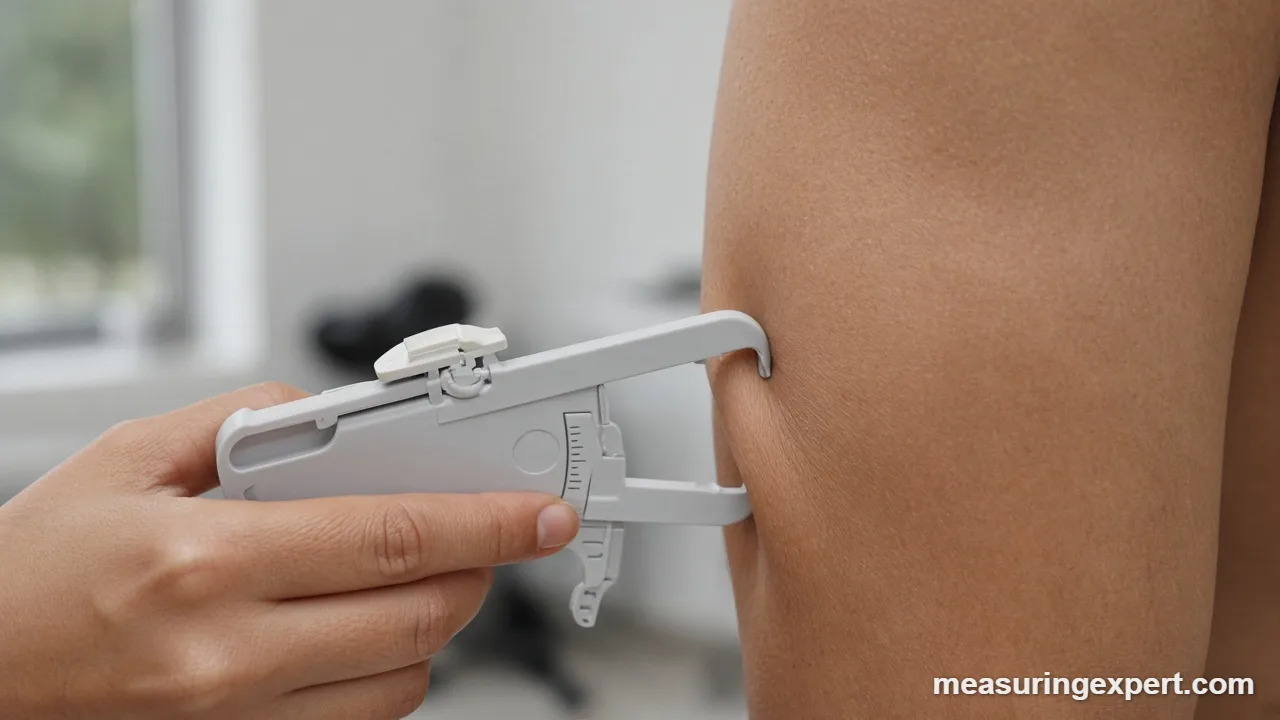
Skinfold calipers are used in the skinfold thickness method, the body composition measurement that estimates body fat from pinched folds of skin and fat. A tester measures 3 or 7 standard sites in millimeters, adds them up, and then plugs the sum into a formula such as Jackson-Pollock.
If you came here from a quiz or a fitness class, the short answer is “skinfold measurement.” A caliper is simply a measuring tool with two jaws, and in body composition work those jaws close on a double layer of skin plus the fat just underneath it. The reading, then, is a thickness in millimeters. On its own, however, one number means little. Instead, several readings added together let you estimate total body fat, because fat under the skin tracks fairly well with fat elsewhere in the body.
In short: skinfold calipers measure thickness, and an equation turns that thickness into a body fat estimate.
This method appears in large public health surveys, not just gyms. For example, the US National Health and Nutrition Examination Survey (NHANES) measures triceps and subscapular skinfolds on the right side of the body and records each one to the nearest 0.1 mm, per the CDC anthropometry manual. That level of care also shows how much technique matters.
Below you will find a converter for your caliper readings, the common 3-site and 7-site protocols, a step-by-step method, and an honest comparison with DEXA and bioelectrical impedance (BIA).
Convert Skinfold Caliper Readings (mm to Inches)
Most skinfold calipers read in millimeters, while some budget models also print inches. Therefore, type your reading below to see it in centimeters and inches. Note that the converter only changes units; it does not calculate body fat.
Recommended Skinfold Calipers and Body Tape Measures
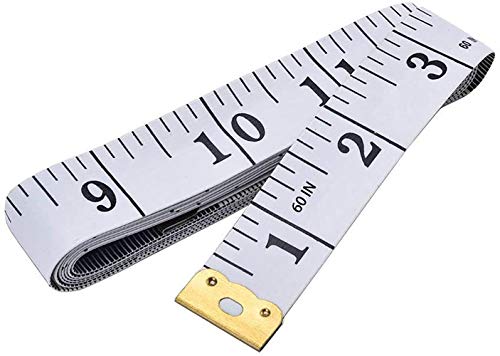
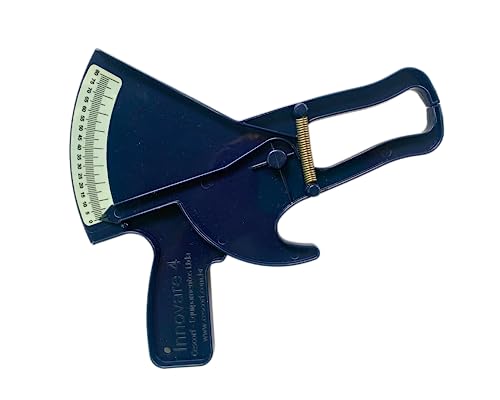
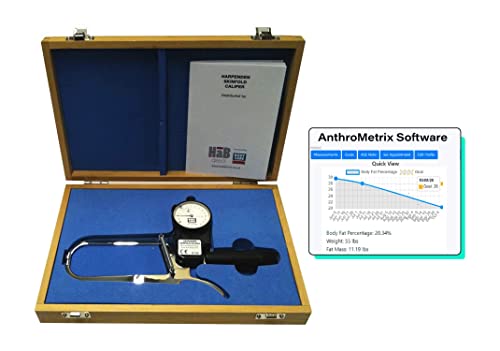
A spring-loaded caliper with a steady jaw pressure gives more repeatable readings than a cheap plastic clip. In addition, look for clear millimeter markings, a smooth jaw that closes fully to zero, and a printed guide to the standard sites. Similarly, a soft tape measure is useful, because many protocols locate sites by measuring halfway between two bony landmarks.


As an Amazon Associate, Measuring Expert earns from qualifying purchases.
What Skinfold Calipers Actually Measure
A large share of the body’s fat sits just under the skin as subcutaneous fat. When you pinch a fold at a set site, you lift two layers of skin plus that fat away from the muscle below. Next, the caliper jaws close on the fold with a spring that applies a near-constant pressure, and the dial or scale shows the fold’s thickness.
Because the measurement is a length, skinfold calipers belong to the same family as any other thickness gauge. The difference, however, is that the “material” is soft and compressible. As a result, timing, pinch size and jaw placement all change the number. For this reason, every serious protocol fixes the site, the side of the body and the moment you read the dial.
| People often confuse | What it really is |
|---|---|
| Skinfold caliper | A spring-loaded pincer that measures a fold of skin and fat in mm |
| Vernier or digital caliper | A rigid shop tool for measuring parts; it has no controlled jaw pressure |
| Body fat percentage | An estimate calculated from skinfold sums, age and sex, not a direct reading |
| Girth (circumference) | A tape measurement around the waist, hips or limbs; see how to take girth measurements |
Common Skinfold Caliper Sites: 3-Site and 7-Site Protocols
The best-known equations come from Andrew Jackson and Michael Pollock, who published a men’s equation in 1978 and a women’s version with Ann Ward in 1980. For example, their 3-site method is quick, while the 7-site method spreads the measurement across more of the body. In addition, both use the right side of the body.
| Protocol | Sites measured | Best suited to |
|---|---|---|
| Jackson-Pollock 3-site (men) | Chest, abdomen, thigh | Quick checks and progress tracking |
| Jackson-Pollock 3-site (women) | Triceps, suprailiac, thigh | Quick checks and progress tracking |
| Jackson-Pollock 7-site (both) | Chest, midaxillary, triceps, subscapular, abdomen, suprailiac, thigh | More detail when fat is unevenly spread |
| NHANES survey | Triceps, subscapular | Population research, not personal body fat |
Here is where each site sits, in plain terms:
- Chest: a diagonal fold halfway between the armpit crease and the nipple (closer to the armpit for women).
- Abdomen: a vertical fold about 2 cm (0.8 in) to the right of the belly button.
- Thigh: a vertical fold on the front of the thigh, halfway between the hip crease and the top of the kneecap.
- Triceps: a vertical fold on the back of the upper arm, halfway between shoulder and elbow.
- Subscapular: a diagonal fold just below the lower tip of the shoulder blade.
- Suprailiac: a diagonal fold just above the front of the hip bone.
- Midaxillary: a vertical fold on the side of the torso, level with the bottom of the breastbone.
How to Take a Reading With Skinfold Calipers
First, note that the steps below follow the common research practice used in survey manuals. Even so, plan on some practice; first attempts by a new tester often differ by several millimeters.
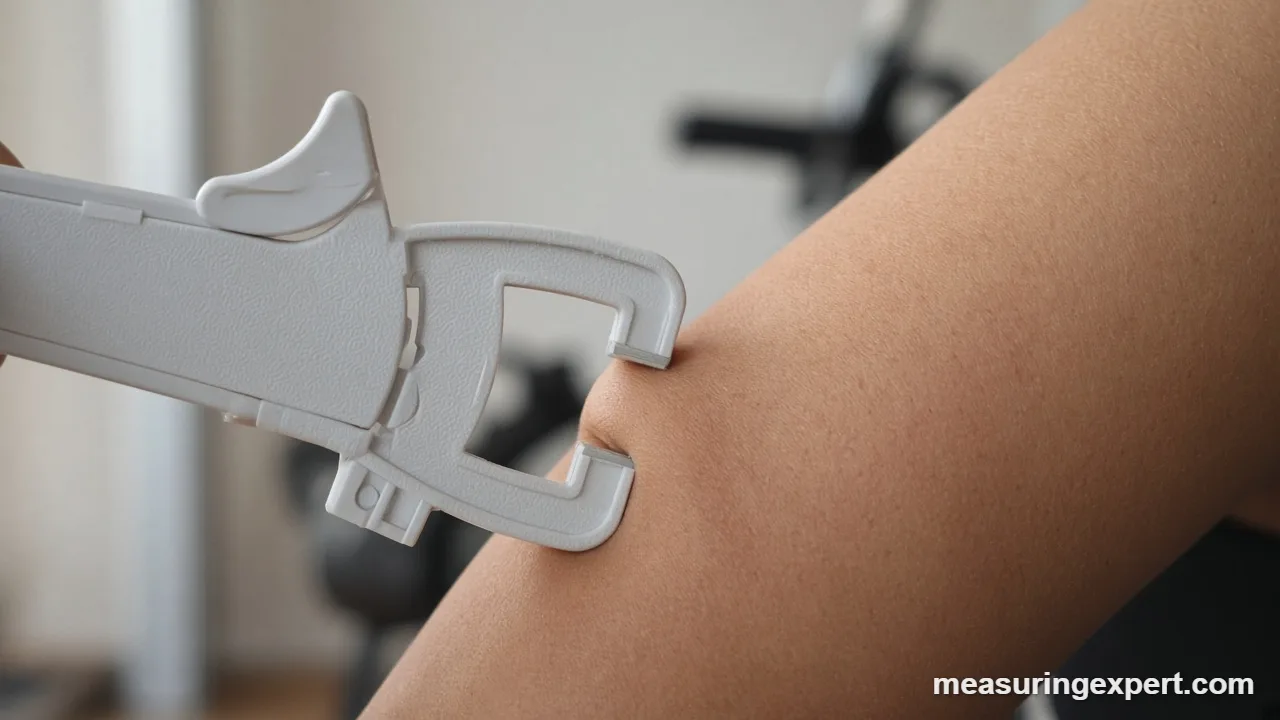
- Prepare the person. Measure dry skin, before exercise, with the person standing relaxed.
- Find and mark the site. Use the bony landmarks and a tape measure, then mark the spot on the right side.
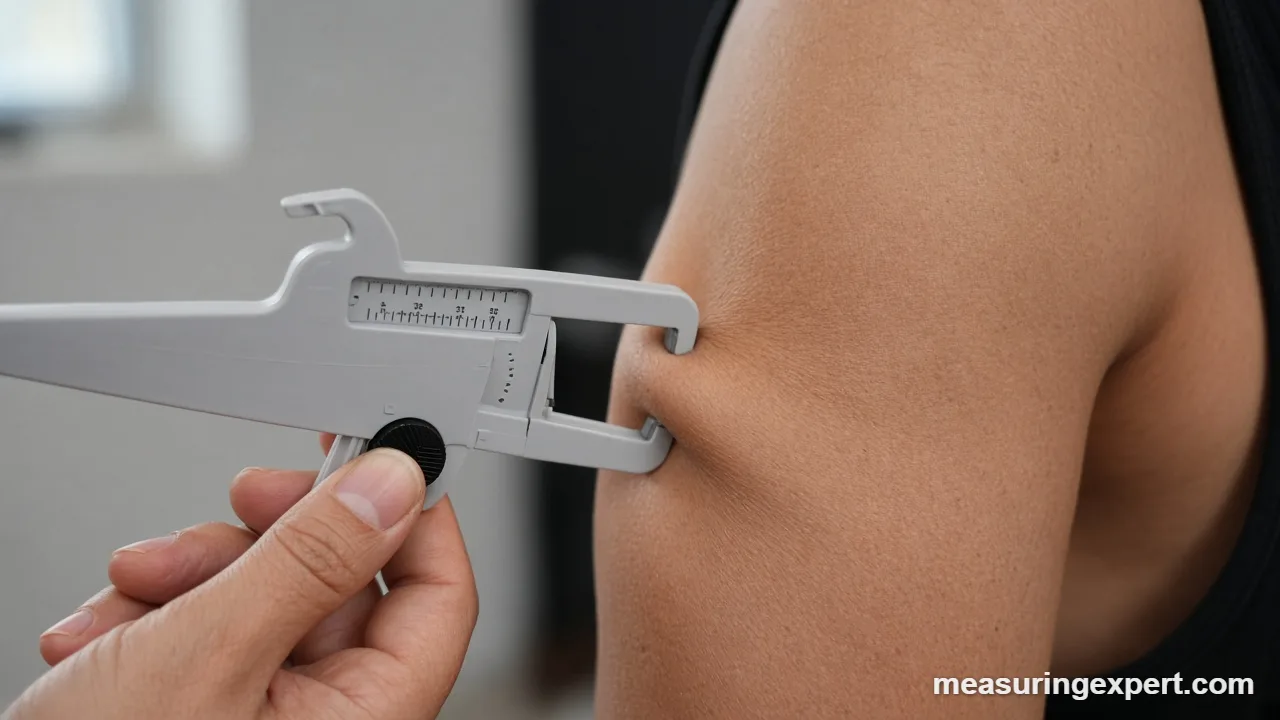
- Lift the fold. Grasp the skin and fat firmly between thumb and index finger, about 1 cm above the mark, and pull it away from the muscle.
- Place the jaws. Put the caliper jaws on the mark, about 1 to 2 cm from your fingers, at right angles to the fold.
- Release and wait. Let go of the caliper trigger while still holding the fold, then read the dial after about 2 to 3 seconds.
- Repeat and average. Take at least two readings per site, rotating through all sites, and average the two closest values.
Survey protocols are specific about tolerances. For instance, the NIH-funded PhenX Toolkit says to take a third reading when the first two differ by more than 2.0 mm, and to wait 3 seconds for the dial to settle.
From Skinfold Caliper Millimeters to Body Fat Percentage
After you have your averages, add the sites together. Next, the Jackson-Pollock equations turn that sum, plus age, into body density. Finally, the Siri equation converts density into percent fat: body fat % = 495 / density – 450.
For example, take a 35-year-old man whose chest, abdomen and thigh add up to 60 mm. His density works out to about 1.0565 g/cm3, so the estimate is about 18.5% body fat. Similarly, a 30-year-old woman with a triceps, suprailiac and thigh sum of 70 mm comes out at about 27.3%.
| Example | Sum of skinfolds | Estimated body fat |
|---|---|---|
| Man, age 35, 3-site | 40 mm / 60 mm / 80 mm | 12.7% / 18.5% / 23.9% |
| Woman, age 30, 3-site | 50 mm / 70 mm / 90 mm | 20.8% / 27.3% / 33.1% |
| Man, age 35, 7-site | 120 mm | 18.0% |
| Woman, age 30, 7-site | 140 mm | 26.7% |
Of course, these figures only show how the math behaves. In the men’s 3-site example, for instance, adding just 2 mm to the sum raises the estimate by about half a percentage point. So small reading errors at several sites can add up quickly.
Skinfold Calipers vs DEXA vs BIA
Calipers are only one way to estimate body composition. In fact, each method measures something different and then infers fat from it, so none of them is a perfect window into the body.
| Method | What it measures | Strengths | Main weaknesses |
|---|---|---|---|
| Skinfold calipers | Thickness of skin plus fat at set sites | Cheap, portable, good for tracking one person over time | Depends heavily on tester skill; ignores deep belly fat |
| DEXA (DXA) scan | X-ray absorption at two energies across the body | Regional fat, lean and bone mass; widely used as a reference | Costly, needs a clinic, small radiation dose; brands differ slightly |
| BIA scale or handheld | Resistance to a tiny electrical current | Fast, no skill needed | Shifts with hydration, meals and exercise |
| Hydrostatic or air displacement | Body density from volume | Strong lab reference | Specialized equipment; assumes average tissue density |
In trained hands, skinfold equations are commonly quoted as landing within about 3 to 4 percentage points of a lab reference for most adults. However, error tends to grow at the extremes, both in very lean athletes and in people with a lot of body fat, because the folds become hard to grasp or exceed the caliper’s jaw opening.
Skinfold Calipers: Do and Don’t
Do
- Use the same caliper, sites and tester each time.
- Measure the right side, before a workout.
- Read the dial at about 2 to 3 seconds.
- Average two or more readings per site.
- Track the skinfold sum in mm, not only the percentage.
Don’t
- Pinch muscle along with the fat.
- Switch equations between check-ins.
- Measure right after a hot shower or a hard session.
- Compare your caliper number directly with a DEXA result.
- Expect accurate readings on very large folds.
Honest Limits of the Skinfold Method
Skinfold calipers measure only subcutaneous fat at a handful of points. Consequently, they miss visceral fat packed around the organs, which is the fat most linked to health risk. Also, the equations were developed on specific groups of adults, so they can drift for older adults, some ethnic groups and very muscular people. In addition, inexpensive plastic calipers often apply less consistent jaw pressure than metal clinical models, which adds noise. Meanwhile, the biggest single factor is still the person holding the caliper. For that reason, the change in your own skinfold sum over weeks is usually more trustworthy than any single percentage.
When to See a Professional
If you need a reliable baseline, first ask a certified exercise professional or a registered dietitian who measures skinfolds regularly. For health questions, such as weight-related risks, a doctor may use waist circumference, blood tests or imaging instead. Meanwhile, waist and hip measurements are easy to take at home; see our guide to ideal girth measurements and healthy ratios.
Frequently Asked Questions
Which body composition measurement utilizes skinfold calipers?
The skinfold thickness method uses calipers. The tester measures folds of skin and fat at set sites, adds them, and estimates body fat with an equation.
What are skinfold calipers measuring?
They measure the thickness of a double layer of skin plus the fat beneath it, usually in millimeters.
How accurate are skinfold calipers?
With a trained tester, estimates are commonly within about 3 to 4 percentage points of a lab method. Accuracy drops with an untrained tester or at the extremes of body fat.
What is the Jackson-Pollock 3-site method?
It is a short skinfold protocol. Men are measured at the chest, abdomen and thigh, while women are measured at the triceps, suprailiac and thigh.
Is the 7-site method better than 3 sites?
The 7-site method covers more of the body, so it can help when fat is unevenly spread. In practice, a consistent tester matters more than the number of sites.
Why do skinfold calipers read in millimeters?
Skinfolds are small, often 5 to 40 mm, so millimeters give useful detail. For reference, 10 mm is about 0.39 inches.
Which side of the body should I measure?
Most protocols, including the NHANES survey, use the right side of the body. Whichever side you choose, keep it the same every time.
How long should I wait before reading the dial?
Read it about 2 to 3 seconds after the jaws close. Waiting longer lets the tissue compress and, as a result, lowers the reading.
Can I use skinfold calipers on myself?
You can reach a few sites, such as the thigh and abdomen, but self-measurement is less repeatable. So a partner or trained tester gives better results.
Are calipers better than a body fat scale?
Calipers are less affected by hydration than a BIA scale but depend more on skill. For tracking, either works if you use the same method under the same conditions.
The Bottom Line
To sum up, the body composition measurement that uses calipers is the skinfold thickness method. Skinfold calipers measure folds of skin and fat in millimeters at 3 or 7 standard sites, and an equation such as Jackson-Pollock turns the sum into a body fat estimate.
In practice, used carefully and consistently, the method is a cheap, practical way to track change over time. Still, it is an estimate with real limits, so treat the trend as more useful than any single number, and leave medical decisions to a professional.