

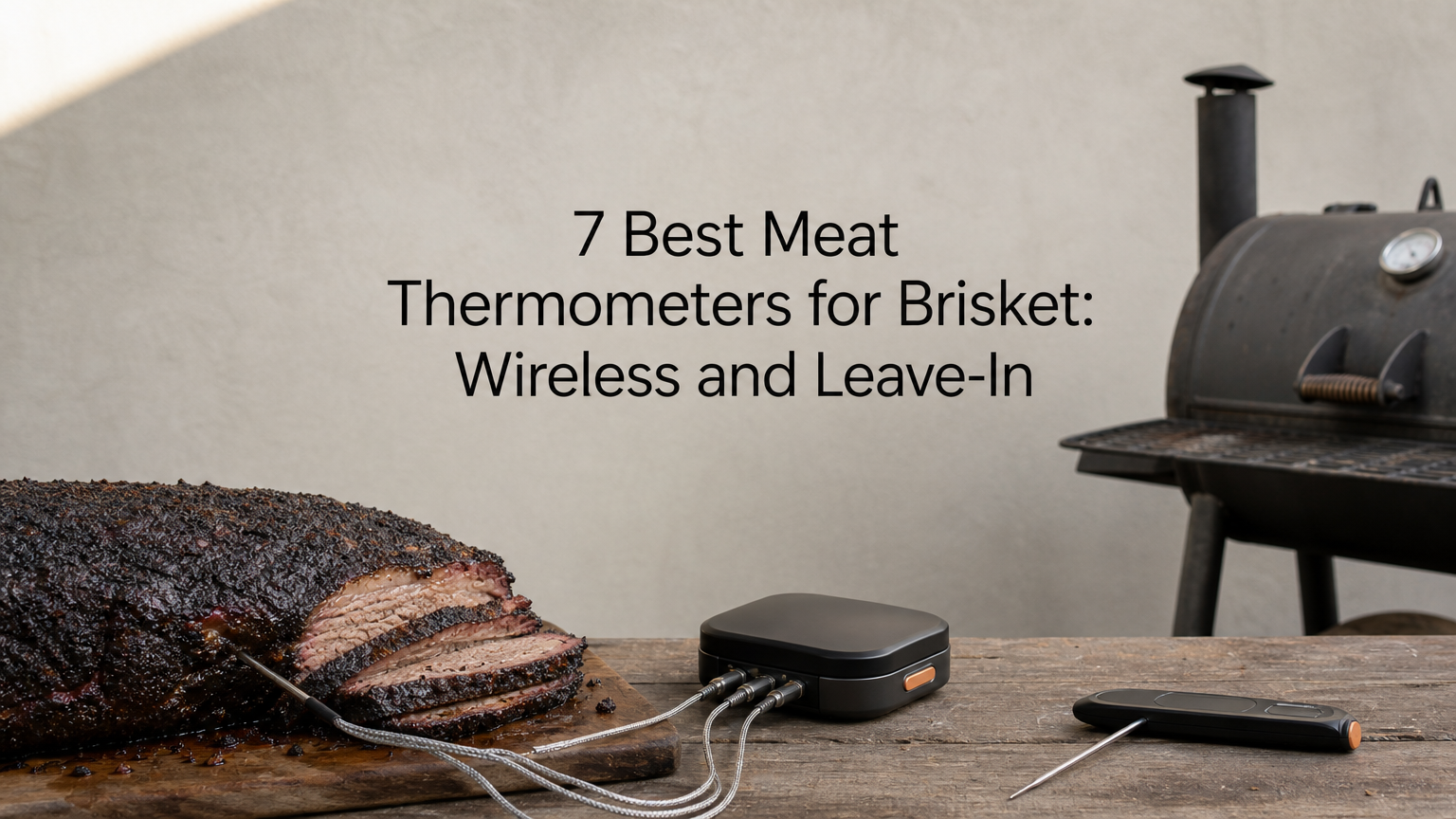
The best meat thermometer for brisket is a multi-probe, leave-in model that tracks the meat and the pit at the same time, so you never open the lid to guess. The FireBoard 2 suits most people who run long smokes. The ThermoWorks Signals suits you if you want four probes and optional fan control. The ThermoWorks Smoke X suits you if you want a setup with no app. If you want the best wireless meat thermometer for a smoker without any cables, look at the ThermoWorks RFX, and add a fast instant-read like the Thermapen ONE to finish the kit.
A packer brisket can sit in a smoker for 10 to 16 hours, stall for hours in the middle, and cost real money if you pull it early or let the pit drift. The dial on your lid is often off by 50°F or more, and poking the meat by feel only gets you so far. A weak thermometer drops its signal behind a steel firebox, runs out of battery at 3 a.m., or fails at the cable.
This guide ranks seven options by how they behave on a long cook: probe count, range, battery life, and build. Measuring Expert focuses on measuring tools and accuracy, so you also get the specs that matter, a side-by-side table, and clear steps for probe placement and doneness.
Add ad-free music to your kitchen or workshop
How to choose a meat thermometer for brisket
Choose a leave-in, multi-probe thermometer as your main tool and add an instant-read for spot checks. That pairing covers everything a brisket asks of you.
Leave-in, wireless and instant-read: what each does
Three tool types matter here. An instant-read gives you a number in a second or two when you touch the meat, but it cannot stay in the cooker. A leave-in probe stays in the meat for the whole cook and sends the reading to a base unit, receiver or phone. A truly wireless probe has no cable at all, because the sensors sit inside the probe.
Searches for a wireless meat thermometer for smoking usually mean either a leave-in system with a wireless link or a fully wireless probe. Both work. Cabled probes cost less and rarely lose their signal, while cable-free probes are tidier to handle and easier to wrap into a foil or paper wrap.
Specs that matter over a 12-hour cook
Use this checklist when you compare any BBQ cooking thermometer:
- Channels: You need at least two, one for the meat and one for the pit. Three or four let you track a flat, a point, or a second cut.
- Connection: RF receivers need no network. Bluetooth is simple but short on range. Wi-Fi lets you check from anywhere. Steel smokers and thick walls block signals, so range figures are best-case.
- Battery: Check the hours against your cook, not the marketing line. Rechargeable units should run while plugged in.
- Build: Look for a water rating of IP65 or better, and heat-rated probes with braided cables.
- Accuracy: Thermistor probes are accurate within a few degrees, which is fine for leave-in use. Thermocouple instant-reads reach about 0.5°F.
Here is a worked example. Say your brisket needs 14 hours plus a rest. A unit with 16 hours of battery leaves only about two hours of margin, so you plug it in or carry spare cells. A unit with 30 hours of battery needs no planning at all. Whatever you buy, check it in ice water (32°F) and boiling water (212°F at sea level) as the USDA describes for calibrating a food thermometer.
Match the battery to your longest cook, not your average one.
The seven picks at a glance
| Pick | Type | Channels | Range or link | Power | Water rating |
|---|---|---|---|---|---|
| FireBoard 2 | Wi-Fi and Bluetooth leave-in | 6 | Bluetooth about 100 ft, Wi-Fi anywhere | Rechargeable, up to 30 hours | Weather-resistant |
| ThermoWorks Signals | Wi-Fi and Bluetooth leave-in | 4 (3 food, 1 ambient) | Bluetooth about 95 ft, Wi-Fi anywhere | Rechargeable, up to 16 hours | IP66 |
| ThermoWorks Smoke X | RF with receiver | 2 or 4 by model | About 300 ft on the original Smoke, no app | AA batteries, up to 1,800 hours | IP65 (original Smoke) |
| ChefsTemp Quad XPro | Wireless base station | 4 (3 food, 1 ambient) | Up to 500 ft, 1,000 ft open | 4 AAA, up to 1,000 hours | IP66 |
| ThermoWorks RFX | Wireless probes with gateway | Up to 4 probes in the kit | About 560 ft through walls, 1,500 ft line of sight | Rechargeable, 10-minute charge for 50+ hours | IP69K |
| Taylor 147821 | Wired leave-in | 1 probe | None, sits near the smoker | 2 AAA | Not rated |
| Thermapen ONE | Instant-read | 1 | None | 1 AAA, about 2,000 hours | IP67 |
1. FireBoard 2 for long, overnight smokes
The FireBoard 2 is the best all-round pick for brisket because it pairs six channels with up to 30 hours of battery.
How it works
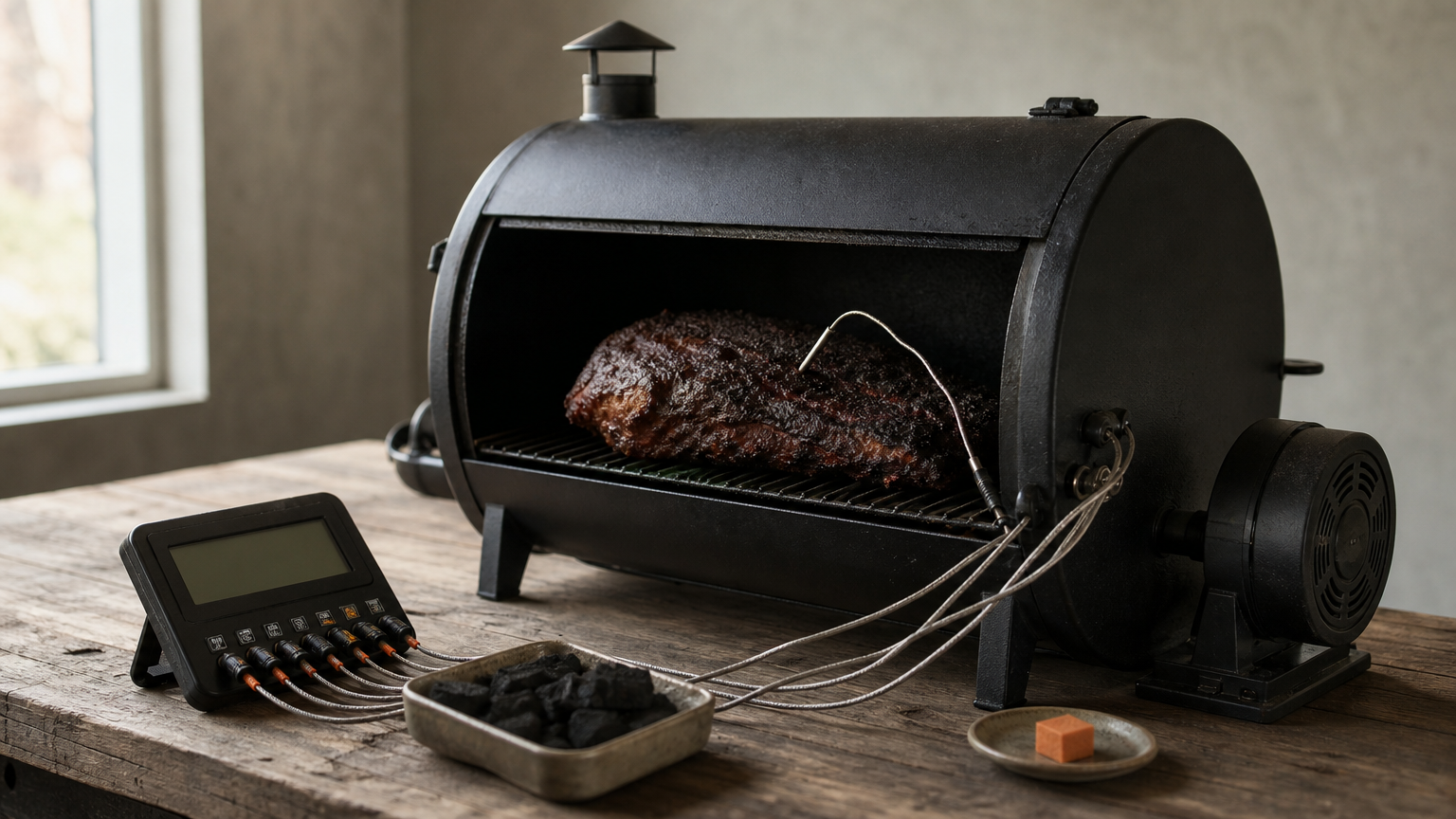
The FireBoard 2 is a leave-in thermometer that connects to your phone over Bluetooth and Wi-Fi. You plug in an ambient probe and up to five food probes, and the app graphs every channel. That graph shows the stall as a flat line, which helps you decide when to wrap.
Its drive port can run an optional blower fan, which turns it into a pit controller on a charcoal smoker. The fan and cable are separate purchases. Fan control suits small charcoal cookers best, since a large offset with good vents is often easy to steer by hand.
A thermometer that logs the whole cook teaches you more than any single brisket will.
Who it suits
Pick it if you smoke overnight, cook several cuts at once, or want to check the pit from the store over Wi-Fi. The logs also help you repeat a good result.
Skip it if you want a thermometer with no phone involved. Skip it too if the unit sits out in heavy rain, because it is only weather-resistant, not fully waterproof.
Specs, price and drawbacks
- Channels: 6
- Connection: Bluetooth up to about 100 ft, plus Wi-Fi
- Power: rechargeable lithium-ion, up to 30 hours, and it can run plugged in
- Price: about $199 at last check, so confirm the current price
- Drawbacks: no magnets or stand, a screen that shows fingerprints, and a fan sold separately
2. ThermoWorks Signals for four-probe Wi-Fi control
The ThermoWorks Signals is the pick if you want rugged build, four channels, and a clean path to fan control.
How it works
Signals gives you one ambient channel and three food channels, with Wi-Fi and Bluetooth feeding the ThermoWorks app. You can also ignore the app, because the large backlit LCD shows every reading on the unit. That makes it forgiving when your phone dies.
The ThermoWorks Billows blower plugs straight into it, so Signals can act as a temperature controller on a charcoal or wood smoker. The probes ship with 47-inch cables and silicone rings, so you can tell which cut is which.
Signals does everything well except run for a full brisket on one charge, so plug it in.
Who it suits
It suits a smoker who wants rugged hardware and may add a fan later. Three food probes let you track a brisket, a pork butt, and a third cut together.
It is less suited to a tight budget. It is also not for you if you will not manage the charging, since the battery is shorter than most rivals.
Specs, price and drawbacks
- Channels: 4 (3 food, 1 ambient)
- Connection: Bluetooth about 95 ft line of sight, plus Wi-Fi
- Water rating: IP66
- Power: rechargeable, up to 16 hours, with a USB power adapter included
- Price: about $239 at last check
- Drawbacks: about 12 hours to fully charge, battery life below similar models, and the highest price here apart from the RFX kit
3. ThermoWorks Smoke X for no-app simplicity
The ThermoWorks Smoke X is the best choice if you want a reliable leave-in system with no phone, no Wi-Fi and no pairing.
How it works
The Smoke X family uses RF signal, the same kind of link as a wireless doorbell. The base unit sits by the smoker with probes plugged in. A second receiver travels with you on a neck strap and sounds the alarms. The two come paired out of the box.
The screen digits are huge and backlit, which helps at 4 a.m. It comes as a two-channel X2 and a four-channel X4, and both can drive the Billows blower. Range depends on the model. The original Smoke is rated about 300 feet line of sight, and newer X units claim more.
An RF receiver fails less often than a phone, because there is no network to drop.
Who it suits
It suits you if you hate app pairing and want a receiver that you can take to bed or into the yard. It also suits anyone cooking in a steel smoker where Bluetooth gets spotty.
Skip it if you want graphs, cloud logs or checks from the store. The original Smoke has no Wi-Fi unless you add a separate gateway.
Specs, price and drawbacks
- Channels: 2 (X2) or 4 (X4)
- Connection: RF receiver, about 300 ft on the original Smoke
- Water rating: IP65 on the original Smoke
- Power: AA batteries, up to 1,800 hours
- Price: entry models have been around $60, so check the current price for your version
- Drawbacks: color rings on the probes get dirty, and every probe needs gentle cleaning because water that enters at the cable end is a common cause of failure
4. ChefsTemp Quad XPro for range and value
The ChefsTemp Quad XPro is the best value, with four channels and long range for about $110.
How it works
A wireless base station shows all four channels on one backlit screen: three food probes and one ambient probe. You set high and low alarms for each channel. The display also records the maximum and minimum temperatures for the session, which is handy for spotting a pit that spiked while you slept.
The base unit is rated for up to 500 feet, or 1,000 feet in open air. Treat those as best-case figures, because walls and metal cut range. It runs on four AAA batteries and no app is needed.
Four channels with a long-range receiver is the sweet spot for most backyard smokers.
Who it suits
It suits a smoker who wants four channels and long range without paying for Wi-Fi features. It also works for beginners who want everything on one screen.
It is not for you if you want phone alerts, graphs or fan control. You also need to test its accuracy before the first big cook, because some users report it needs calibration.
Specs, price and drawbacks
- Channels: 4 (3 food, 1 ambient)
- Range: up to 500 ft, or 1,000 ft in open areas
- Water rating: IP66
- Power: 4 AAA, up to 1,000 hours
- Price: about $109.99 at last check
- Drawbacks: no app or cloud logging, and a possible need for calibration
5. ThermoWorks RFX for wire-free probes
The ThermoWorks RFX is the best truly wireless probe system for smokers, because its range holds up where Bluetooth probes struggle.
How it works
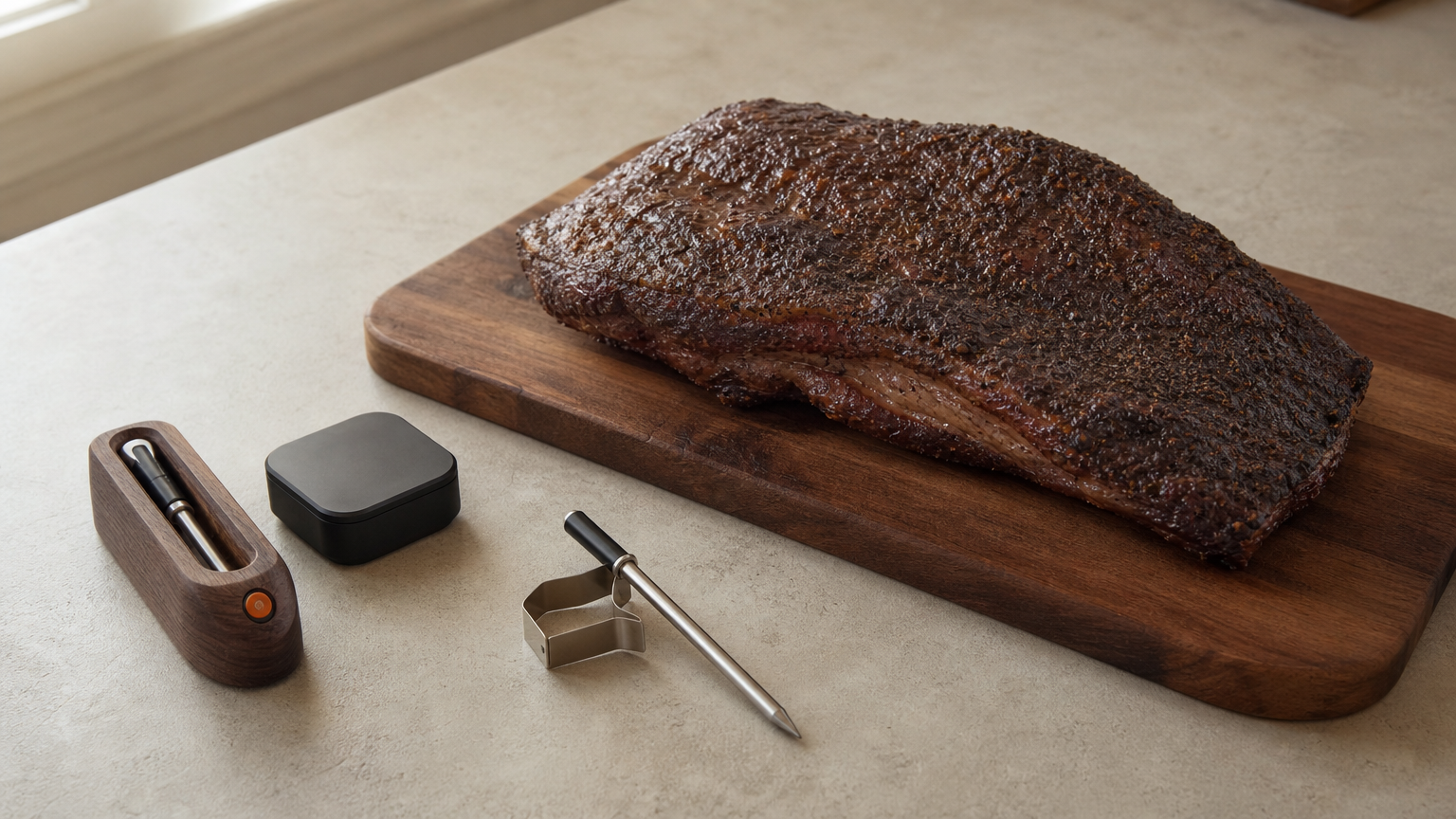
Each RFX probe carries four sensors and a battery, and it sits in its own charging holder between cooks. A gateway receives the signal, and when you connect the gateway to Wi-Fi, range stops mattering because you check from anywhere. Without Wi-Fi, expect about 560 feet through walls and fences and 1,500 feet line of sight.
A 10-minute charge gives more than 50 hours of use, so battery anxiety disappears. The probe is rated IP69K and can be submerged. You only need to insert it about 3.4 inches, which suits a thin flat. It also keeps reporting if you move the brisket into the oven.
A wireless probe only helps if its signal survives your smoker, so range is the spec to check first.
Who it suits
It suits you if you are tired of tangled cables, wrap your briskets, or cook in more than one cooker. The kit includes an air probe for pit temperature.
It does not suit a small budget, since it sits at the premium end. Check the current kit price at ThermoWorks before you buy.
Specs, price and drawbacks
- Type: wireless probes with a rechargeable gateway
- Range: about 560 ft through obstacles, 1,500 ft line of sight, unlimited with Wi-Fi gateway
- Water rating: IP69K
- Power: 10-minute charge for more than 50 hours
- Kit contents: gateway, wireless meat probe, air probe, grate clip, charging block and cables
- Drawbacks: premium price, and a lost probe is a lost channel
6. Taylor 147821 for a tight budget
The Taylor 147821 is the cheapest dependable way to leave a probe in a brisket.
How it works
This is a wired digital thermometer with a single probe on a cable. The unit sits near the smoker, shows the reading on a big LCD, and sounds an alarm at your target. It also has a timer.
For pit temperature, push the probe through a small potato and set it on the grate next to the meat. That gives you a slow, steady ambient reading with one probe. You watch two numbers by swapping the probe, or you buy two units.
A single wired probe will still beat guessing, as long as you keep water out of the cable end.
Who it suits
It suits a beginner, an occasional smoker, or someone who wants a backup that lives in a drawer. The buttons are large and the screen is easy to read.
It does not suit long overnight cooks where you want to sleep, because you must be within hearing range. Probes on this style can fail if water runs into the cable entry, so wipe them, do not soak them.
Specs, price and drawbacks
- Channels: 1 probe
- Connection: wired, no wireless link
- Power: 2 AAA batteries, which last a long time
- Price: the cheapest option in this list
- Drawbacks: not wireless, one probe, and probes wear out faster than the premium units
7. Thermapen ONE for checking tenderness
The Thermapen ONE is the instant-read to buy alongside any leave-in system, because brisket is done when it feels done, not when a number says so.
How it works
The Thermapen ONE reads in about one second, with a backlit display that rotates automatically and wakes when you pick it up. Its probe is thin, so it slides into the meat without leaving a big hole. It reads up to 572°F with ±0.5°F accuracy.
Use it to verify your leave-in probes, which drift over time. Use it again near the end to test for tenderness in several spots of the flat. It also moves chicken, ribs and sides from the grate to the pan and checks frying oil.
Your leave-in probe tells you when to start checking, and the instant-read tells you when to stop.
Who it suits
It suits every smoker who cooks brisket, because no leave-in system replaces a quick second opinion. It also fits cooks who want one tool for steak, roasts, and frying.
Skip it only if you need the lowest price. A cheaper instant-read will do the same job more slowly and less durably.
Specs, price and drawbacks
- Type: instant-read thermocouple
- Speed: about one second
- Water rating: IP67
- Power: 1 AAA battery, about 2,000 hours
- Warranty: 5 years against defects
- Price: about $81.75 at last check
- Drawbacks: the battery runs slightly shorter than other ThermoWorks models, and it cannot stay in the cooker
Where to put the probe and when brisket is done
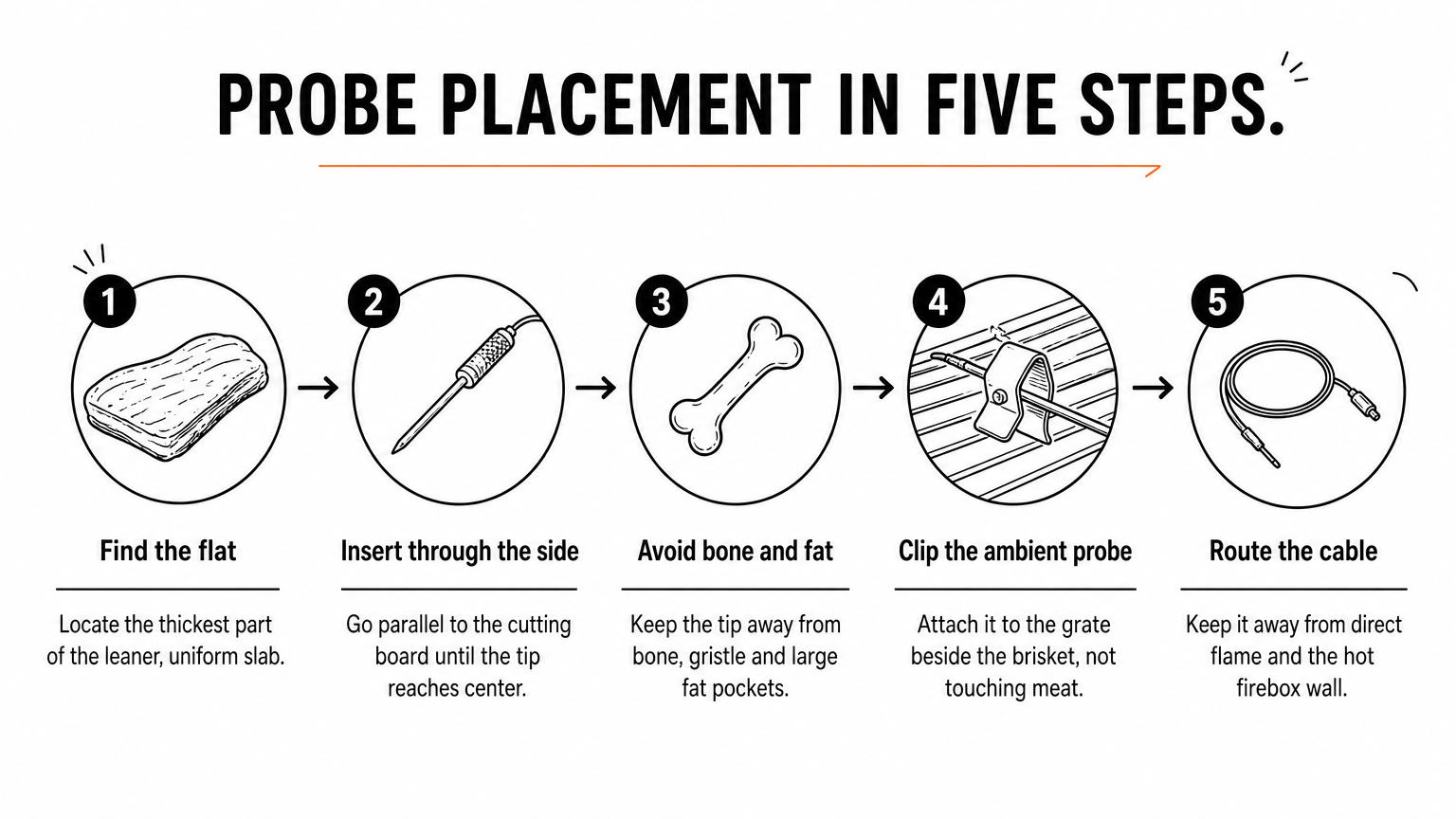
Put the probe in the thickest part of the flat, through the side of the brisket, with the tip in the center and away from bone and large fat pockets.
Probe placement step by step
- Find the thickest part of the flat, the leaner, uniform slab of the brisket.
- Insert the probe through the side, parallel to the cutting board, until the tip reaches the center.
- Keep the tip away from bone, gristle and large pockets of fat, which read differently from the meat.
- Clip the ambient probe to the grate beside the brisket, not touching the meat.
- Route the cable away from direct flame and the hot firebox wall.
Insert instant-read checks in a few places, because the point and the flat finish at different times. If your thermometer has a third probe, put it in the point as well.
The flat finishes first, so place the probe where the brisket is thinnest.
Target temperatures and the stall
| Stage | What you see | What to do |
|---|---|---|
| Pit temperature | Roughly 225 to 275°F | Hold steady, and trust the ambient probe over the lid dial |
| The stall | Meat temperature stops rising for hours | Wait it out, or wrap the brisket |
| Probe tender | Roughly 195 to 205°F | Start testing with an instant-read |
| Rest | Temperature drifts down | Hold wrapped before slicing |
Brisket is safe to eat long before it is tender. The USDA safe temperature for whole cuts of beef is 145°F, but brisket needs a much higher temperature to break down connective tissue. Treat the number as a signal to start testing, not a finish line.
Checking doneness and leaving probes in
To tell if brisket is done without a thermometer, push a skewer or probe into the flat. It should slide in with almost no resistance, like warm butter. A slab that wobbles and bends when lifted with tongs is also close. These methods work for experienced cooks but are less reliable than a thermometer.
Do you leave a meat thermometer in while grilling? Yes, if it is a leave-in probe built for it. These probes are designed to stay in the meat inside the cooker. Never leave a standard instant-read in, because its body and display are not made for the heat.
Pick the probe that fits your pit
For brisket, buy a leave-in thermometer with at least two channels and enough battery for your longest cook. Add an instant-read for the tenderness test. The FireBoard 2 fits most overnight smokers, the Signals fits fan-control fans, the Smoke X fits app-free cooks, the ChefsTemp fits tight budgets, the RFX fits cable haters, and the Taylor covers the basics.
Whichever you choose, check its accuracy in ice water, place the probe in the thickest part of the flat, and let tenderness decide when to pull the meat. If you want more help choosing and testing tools, browse the measuring tool guides at Measuring Expert.
Black Friday is coming: shop the deals with Prime