

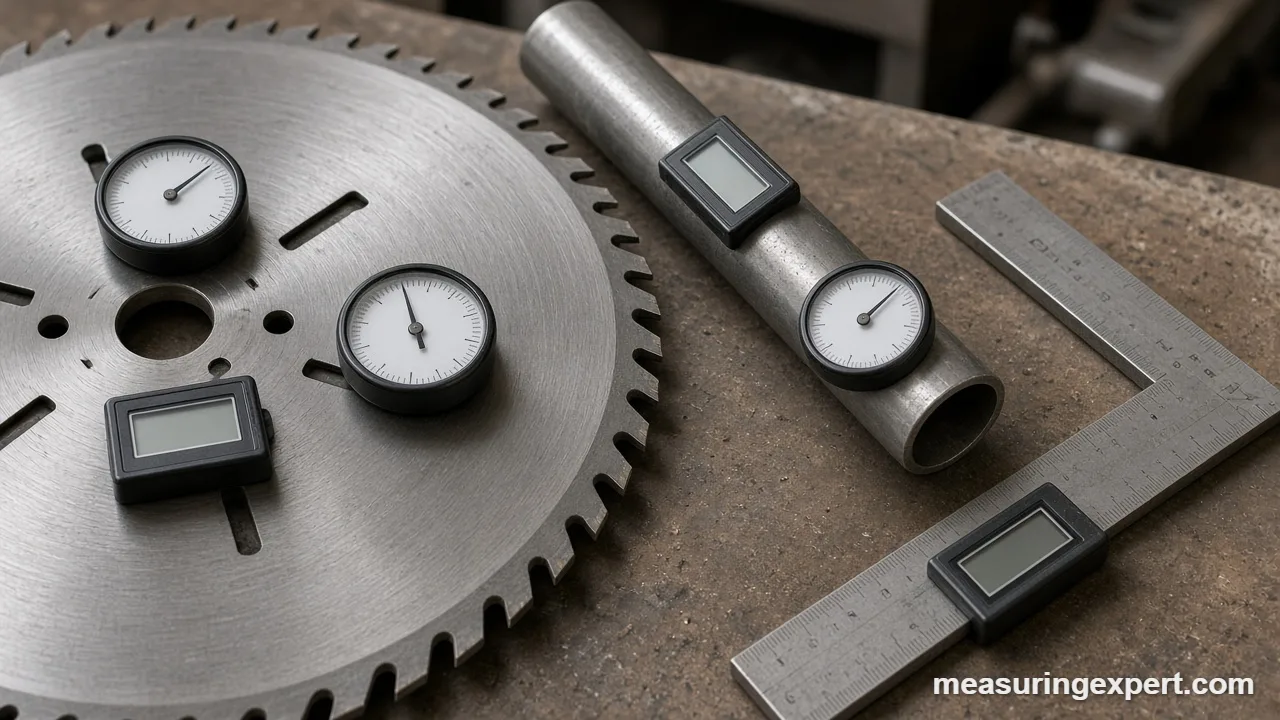
The best magnetic angle finder for most people is the Klein Tools 935DAG, a pocket digital gauge with a rare-earth magnet base and +/-0.1 degree accuracy near level and plumb. However, the right choice depends on the job: saw blades, pipe slope, or battery-free steel work.
In short: buy the Klein 935DAG for all-round use, the Johnson 700 on a budget, and the Johnson 1886-1000 if you read slope in several units.
As an Amazon Associate, Measuring Expert earns from qualifying purchases. Our picks are based on research, specifications and owner feedback, not paid placement.
Best Overall

Best Budget

Best Pro Pick
Quick Answer: The Best Magnetic Angle Finder by Job
- All-round digital gauge: Klein 935DAG, with grooves on every edge.
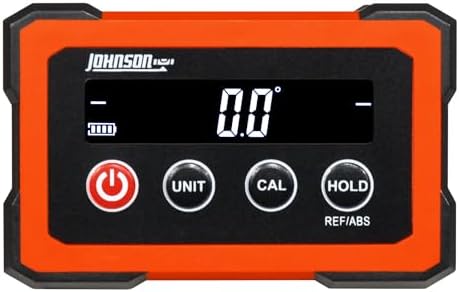
- Several units and two screens: Johnson 1886-1000, which reads degrees, percent, mm/m and in/ft.
- Table saw bevels: Wixey WR300 Type 2, with published repeatability of +/-0.1 degree.
- Lowest cost, no batteries: Johnson 700 analog locator.
- Drain and duct slope: Klein 935DAGL, with 1/8 to 1/2 in/ft presets and an alarm.
- Miter saw and router setup: Trend DLB level box.
- Framing layout: Swanson AF006M, which clips to a carpenter square.
On This Page
- Comparison table
- The 7 picks, reviewed
- How we chose
- Digital vs analog locators
- Specs that decide accuracy
- Pitch, grade and degree converter
- How to set a blade bevel
- Calibration and care
- Do and Don’t
- Honest limits
- FAQ
- Bottom line
Best Magnetic Angle Finder Comparison Table
| # | Product | Best For | Standout Feature | Amazon |
|---|---|---|---|---|
| 1 | Klein 935DAG | Electricians, plumbers and DIYers | Rare-earth magnet base with V-grooves on every edge | View |
| 2 | Johnson 1886-1000 | Pros who read slope in several units | Two backlit screens plus degrees, percent, mm/m and in/ft | View |
| 3 | Wixey WR300 | Woodworkers setting blade bevels | 0.1 degree resolution with published repeatability | View |
| 4 | Johnson 700 | Steel work on a budget | No batteries; four-quadrant dial on an acrylic lens | View |
| 5 | Klein 935DAGL | Plumbers and HVAC installers | Preset 1/8, 1/4, 3/8 and 1/2 in/ft targets with an audible alarm | View |
| 6 | Trend DLB | Shop setup on saws and router tables | Auto-inverting display and five-minute auto shut-off | View |
| 7 | Swanson AF006M | Framers and roofers | Clips to a carpenter square for pitch layout | View |
The 7 Best Magnetic Angle Finder Picks, Reviewed
Every tool below holds to steel on its own, which frees both hands. If you want a gauge without a magnet for wood and plastic, see our LCD digital angle finder picks.
Best Overall
1. Klein Tools 935DAG Digital Angle Gauge and Level
Best for: Anyone who wants one small digital gauge for conduit bends, saw blades, ducts and general leveling.
The Klein 935DAG is our pick for the best magnetic angle finder for most people. In short, it is a pocket-size digital gauge with a permanent rare-earth magnet in the base, so it grabs a saw blade, a steel stud or a run of conduit and stays put while you work. V-grooves around the whole perimeter help it sit square on round pipe.
On the measuring side, Klein rates it at plus or minus 0.1 degree near 0, 90 and 180 degrees, and plus or minus 0.2 degree at other angles. That suits most jobs, which live near level or plumb. Also, you can switch between a 0 to 90 degree range and a 0 to 180 degree range, zero it on any surface for relative angles, and read it upside down because the display rotates.
- Range: 0 to 90 degrees and 0 to 180 degrees
- Accuracy: +/-0.1 degree at 0-1, 89-91 and 179-180 degrees; +/-0.2 degree elsewhere
- Size and weight: about 2.36 x 1.2 x 2.2 in (6 x 3 x 5.6 cm); 3.5 oz (99 g)
- IP42 dust and water resistance; 6.6 ft (2 m) drop protection
- Power: two AAA batteries (included)
Pros
- Strong magnet base, plus grooves on all edges
- Tighter accuracy right where most jobs happen
- Also small enough for a shirt pocket
Cons
- Klein does not list a backlight
- Degrees only, no percent or in/ft readout
- IP42 is only light splash protection
Skip it if: you mostly work in roof pitch or pipe slope units, because it reads in degrees only.
Best Pro Pick
2. Johnson Level 1886-1000 Dual-Screen Digital Angle Gauge
Best for: Tradespeople who switch between degrees, percent grade and inches per foot, and who often read the gauge from above.
Johnson built the 1886-1000 around a simple problem: you cannot always see the front of a gauge. For that reason, it has two reverse-contrast LCDs, one on the front and one on top, and both are backlit and auto-rotate. As a result, you can read a blade bevel from above the saw table or a duct slope from below without moving your head.
It also reads in four units: degrees, percent, mm/m and in/ft. Therefore, a plumber can check pipe fall in inches per foot while a carpenter reads the same tool in degrees. In addition, Johnson lists GripTight rare-earth magnets, V-grooves on all four sides, an IP54 rating and a rechargeable lithium-ion battery that charges over USB-C.
- Accuracy: +/-0.1 degree at 0 and 90 degrees; +/-0.2 degree at other angles
- Units: degrees, percent, mm/m and in/ft; absolute and relative modes
- Displays: front and top LCDs, backlit, auto-rotating, with direction arrows
- IP54 rating; rechargeable Li-ion battery with USB-C cord
Pros
- Top screen solves awkward viewing angles
- Four units, so it covers most trades
- Also, no disposable batteries to buy
Cons
- Johnson does not publish the range or resolution on its page
- Newer model with less owner history
- Besides, it has more features than a basic saw setup needs
Skip it if: you only set table saw bevels, since a simpler gauge such as the Wixey does that job with fewer buttons.
Best for Table Saws
3. Wixey WR300 Type 2 Digital Angle Gauge
Best for: Woodworkers who want a dedicated gauge for table saw, miter saw, jointer and drill press setup.
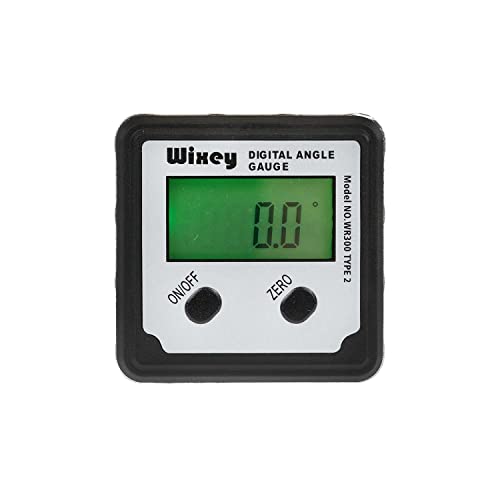
The Wixey WR300 is the classic woodshop gauge, and the Type 2 version adds a backlight. In addition, strong magnets hide in the bottom, so it clings to a saw blade while you crank the bevel wheel. First you set it on the saw table and press ZERO, then you stick it to the blade, and finally you tilt the blade until the screen shows the angle you want.
Wixey publishes a complete spec block, which is rare in this category. For example, it lists a range of plus or minus 180 degrees, 0.1 degree resolution, plus or minus 0.2 degree accuracy and plus or minus 0.1 degree repeatability.
- Range: +/-180 degrees; resolution 0.1 degree
- Accuracy: +/-0.2 degree; repeatability +/-0.1 degree
- Size: 2.3 x 2.3 x 1.1 in (5.8 x 5.8 x 2.8 cm)
- Power: one AAA battery; backlight and auto shut-off
Pros
- Full spec sheet from the maker
- Zero button sets any reference surface
- Backlight also helps under a dim saw table
Cons
- No V-groove for pipe work
- Degrees only
- Also, the plastic body is not rated for rain or dust
Skip it if: you mainly work on pipe or conduit, because the flat base is built for blades and tables.
Best Budget
4. Johnson Level 700 Magnetic Angle Locator
Best for: Welders, fabricators and framers who want a rugged, battery-free locator for beams, trusses and pipe.
If you want the best magnetic angle finder for the least money, start with the Johnson 700. Because it is an analog locator, a weighted needle reads the angle against a 0 to 90 degree scale printed in all four quadrants. Since nothing in it is electronic, it never needs a battery, a reset or a warm-up.
Also, Johnson lists an extra-strong ceramic magnet, a V-groove edge for pipe and conduit, and a high-impact molded body. In addition, the edges carry inch and metric graduations, so you can mark short layout lines. However, a needle on a printed dial is harder to read than a digital screen, so expect to work to about the nearest degree rather than tenths.
- Scale: 0 to 90 degrees in all four quadrants on an acrylic lens
- Magnet: extra-strong ceramic magnet for ferrous metal
- V-groove edge for pipe and conduit; inch and metric edge graduations
- Made in USA badge on the maker page; 1-year warranty
Pros
- Never needs batteries
- Tough body for steel shops
- Also a very low cost of entry
Cons
- Reading is only as fine as the printed scale
- Johnson publishes no accuracy figure
- Also no zero or relative mode
Skip it if: you need tenths of a degree, such as for a saw bevel or crown molding cut.
Best for Pipe Slope
5. Klein Tools 935DAGL Digital Level with Programmable Angles
Best for: Plumbers, HVAC techs and electricians who set the same slopes all day and want the tool to tell them when they hit it.
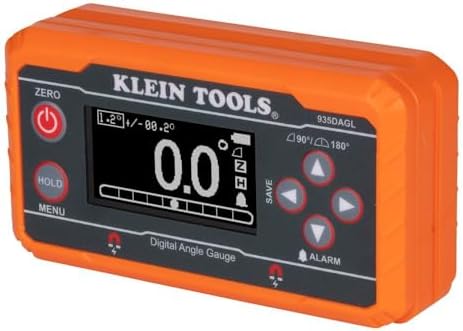
The 935DAGL is the most job-specific tool here. Rather than only reading an angle, it lets you set a target, and then it beeps and changes the screen color when you reach it. Better yet, Klein builds in preset pitches of 1/8, 1/4, 3/8 and 1/2 inch per foot, which are the slopes plumbers and HVAC installers use for drain and condensate lines.
Compared with the 935DAG, it is larger, and it adds a dual-axis bullseye mode for leveling a surface in two directions. However, Klein rates it at plus or minus 0.2 degree in vertical and horizontal use and plus or minus 0.5 degree in bullseye mode, so it is a little less tight than the smaller gauge near level.
- Range: 0 to 90 or 0 to 180 degrees, plus dual-axis bullseye mode
- Accuracy: +/-0.2 degree vertical and horizontal; +/-0.5 degree bullseye
- Presets: 1/8, 1/4, 3/8 and 1/2 in/ft with audible and color alerts
- Size and weight: 4.57 x 2.48 x 1.36 in (11.6 x 6.3 x 3.5 cm); 7 oz (198 g)
- IP42; two AA batteries; English, Spanish and French menus
Pros
- Alarm lets you watch the pipe, not the screen
- Slope presets match common drain specs
- Also has V-grooves on top and bottom
Cons
- Looser accuracy than the 935DAG near level
- Also twice the weight of the small Klein
- Bullseye mode is only +/-0.5 degree
Skip it if: you mostly set saw blades, because the presets and alarm add bulk you will not use.
Best for Miter Saws
6. Trend DLB Digital Level Box
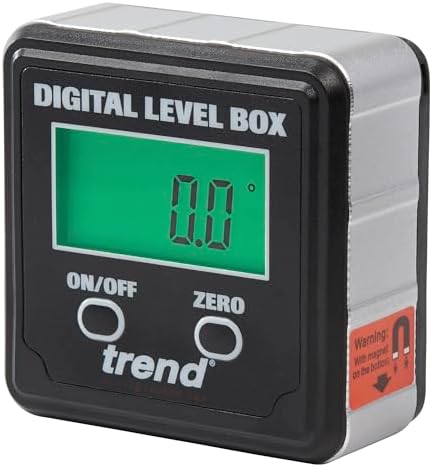
Best for: Woodworkers and joiners who want a magnetic level box from a long-running power tool accessory brand.
The Trend DLB is a level box in the same mold as the Wixey. For example, you set it on the saw table, zero it, then move it to the blade to read the tilt. Also, small arrows on the display show which way to move toward level, and the screen flips when you turn the box upside down to read the underside of a lintel or shelf.
Trend states plus or minus 0.2 degree accuracy for all angles and 0.1 degree resolution. Meanwhile, the magnetic base holds it to any steel surface, and it runs on one AAA battery with a five-minute auto shut-off.
- Accuracy: +/-0.2 degree at all angles; 0.1 degree resolution
- Magnetic base; zero function for relative angles
- Auto-inverting display with direction arrows
- One AAA battery; auto shut-off after five minutes; carry case with belt loop
Pros
- Simple zero-and-read workflow
- Arrows guide you toward level
- Auto shut-off, so batteries last longer
Cons
- Trend does not list the range on its guide
- Flat base only, with no pipe groove
- Also offers fewer units than the Johnson dual-screen gauge
Skip it if: you already own a Wixey WR300, because the two tools cover the same shop jobs.
Best for Framing
7. Swanson AF006M Magnetic Angle Finder
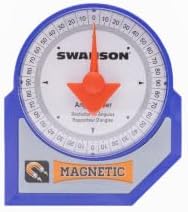
Best for: Framers, roofers and stair builders who want a dial locator that also works with a framing square.
First, a block magnet on the back face pulls it flat to steel for a hands-free reading on pipe, conduit or steel framing. In addition, the bottom edge has a V-groove, so it rides on round stock without rocking.
Above all, what sets it apart is that you can attach it to a carpenter square or straight edge. That way, you can lay out angles on framing, stair stringers and roof pitch with a long reference edge rather than a short gauge body. Like the Johnson 700, it reads a degree dial, so it is a coarse layout tool rather than a precision gauge.
- Degree dial; no batteries
- Block magnet on the back face; V-grooved bottom edge
- Attaches to a carpenter square or straight edge
- Weight: 0.4 lb (181 g); 1-year limited warranty
Pros
- Long reference edge when paired with a square
- Battery-free and job-site tough
- Also has a magnet and V-groove for pipe
Cons
- Swanson does not list a scale range or accuracy
- Dial reading is coarse
- Also not suited to saw blade setup
Skip it if: you need a digital readout or a zero button.
How We Chose the Best Magnetic Angle Finder Picks
To be clear, we did not run hands-on tests for this list. Instead, our picks are research-based. First, we read the maker spec pages and manuals for each tool, including the Wixey WR300 spec sheet, Klein’s product pages and the Trend DLB how-to guide. Next, we compared owner feedback for common failure points, such as weak magnets, drifting zero and screens that are hard to read.
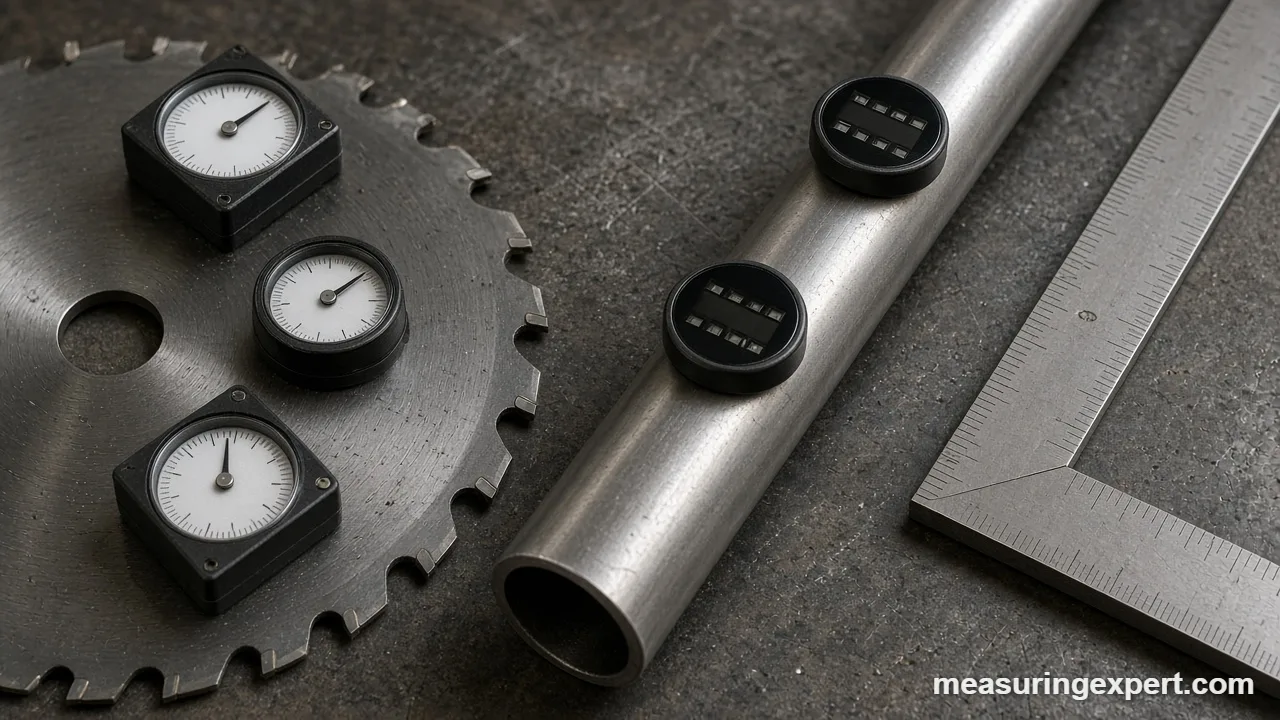
After that, we scored each tool on five points:
- Published accuracy: a maker that states accuracy and repeatability earns trust; vague claims lost points.
- Magnet and base design: rare-earth or strong ceramic magnets, plus V-grooves for pipe and conduit.
- Readability: backlight, reverse contrast, auto-rotate and arrows all count.
- Job fit: each pick had to win a real use case, from saw bevels to drain slope.
- Brand support: established makers with current product pages and stated warranties.
Finally, we cut listings with no brand, near-duplicates and any tool whose maker page we could not open. For that reason, this list has seven tools rather than a padded ten.
Digital vs Analog: Choosing the Best Magnetic Angle Finder Type
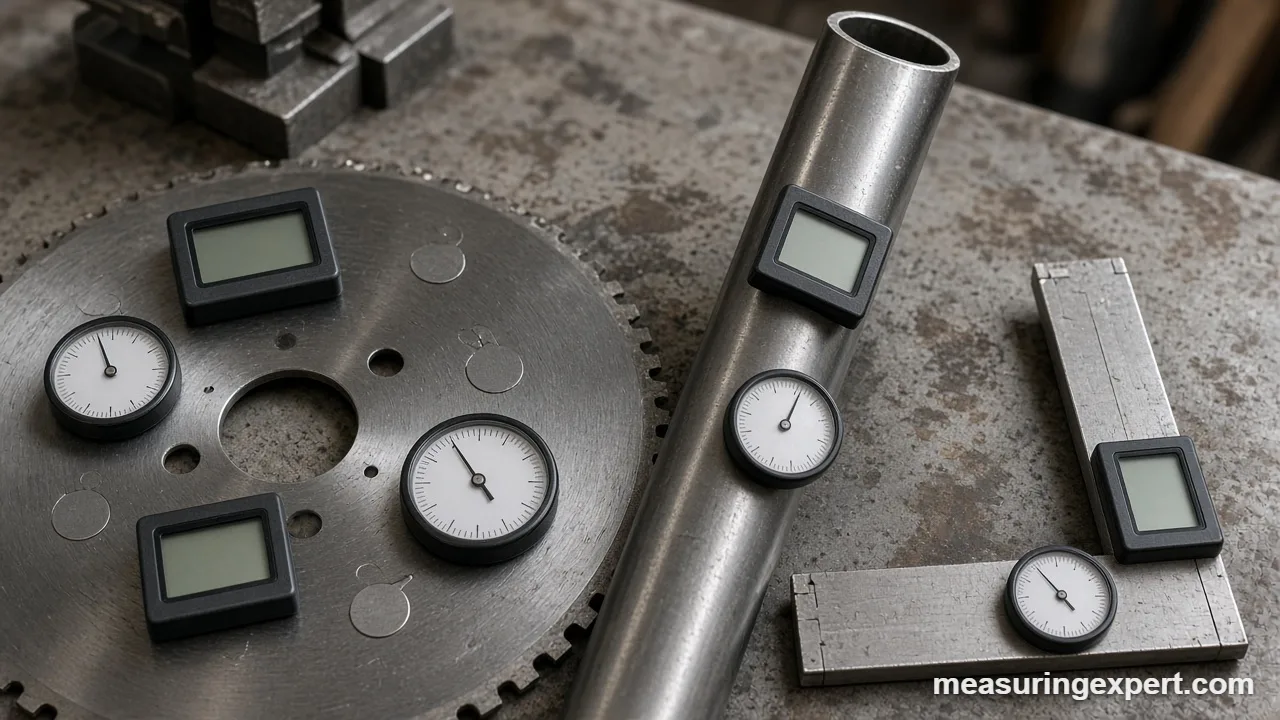
Every magnetic angle finder measures tilt against gravity. For example, an analog locator uses a weighted needle that hangs plumb over a printed scale. A digital gauge, by contrast, uses an electronic tilt sensor and shows the result on a screen. So the real choice is between simplicity and resolution.
| Type | Typical reading | Power | Best jobs | Examples here |
|---|---|---|---|---|
| Analog needle locator | About the nearest degree | None | Beams, trusses, pipe, framing layout | Johnson 700, Swanson AF006M |
| Digital cube gauge | 0.1 degree steps | AAA or AA | Saw blades, conduit, ducts, general leveling | Klein 935DAG, Wixey WR300, Trend DLB |
| Digital gauge with alerts or presets | 0.1 degree steps plus target alarm | AA or rechargeable | Repeated slopes, overhead work, several units | Klein 935DAGL, Johnson 1886-1000 |
As a result, many pros carry both types. If you also lay out angles on paper or wood, a flat protractor fills the gap; our protractor guide covers those.
Specs That Make the Best Magnetic Angle Finder Accurate
Spec sheets in this category look alike at first glance. However, a few numbers tell you most of what you need.
Accuracy vs resolution
Resolution is the smallest step the screen shows, such as 0.1 degree. Accuracy, on the other hand, is how close that reading is to the true angle. Even so, a gauge can show tenths and still be off by two tenths. Notice that Klein and Johnson quote +/-0.1 degree only near 0 and 90 degrees, and +/-0.2 degree elsewhere. In other words, the sensor is at its best near level and plumb.
Repeatability: this tells you how closely the gauge returns the same reading on the same setup. For example, Wixey lists +/-0.1 degree for the WR300. For saw work, this matters more than absolute accuracy, because you zero the gauge on the table first and only care about the change.
Absolute vs relative: An absolute reading compares the tool to true level. In contrast, a relative reading compares it to whatever surface you zeroed on. For instance, a table saw top is rarely perfectly level, so you zero on the table and then read the blade relative to it.
Units: Degrees suit carpentry and metal work. Meanwhile, plumbers think in inches per foot and road or ramp work uses percent grade. A tool such as the Johnson 1886-1000 shows all of these, which saves a conversion step. For quick math, use the converter below.
Magnet type and base shape
In general, rare-earth magnets hold harder for their size than ceramic ones. Still, any magnet only grips ferrous metal: carbon steel and cast iron work, while aluminum, copper, PVC and most austenitic stainless steel do not. Also look for V-grooves, because a flat base rocks on round pipe and gives a false reading.
IP rating: the first digit covers dust and the second covers water. So IP42 means light protection from dripping water, while IP54 adds dust and splash protection. Even so, neither one makes a gauge rainproof.
Pitch, Grade and Degree Converter
Often, a job gives a slope in one unit while your gauge shows another. Therefore, enter a pitch below in inches of rise per 12 inches of run, and the tool returns degrees and percent grade. For example, a 1/4 in per foot drain line is a pitch of 0.25.
In fact, the math is short: degrees equal arctan(rise / run), and grade equals rise / run x 100. As a result, a 1/4 in per foot slope is only about 1.19 degrees. That is why the +/-0.1 degree accuracy near level matters so much for drain work.
How to Set a Blade Bevel With a Magnetic Angle Finder
These steps suit any digital gauge with a zero button.
- Unplug the saw and raise the blade to full height.
- Next, clean the saw table and the blade face so no dust sits under the gauge.
- Set the gauge on the table and press zero to make the table your reference.
- Then stick the gauge to the blade body, clear of the carbide teeth.
- Tilt the blade with the bevel wheel until the screen shows your target angle.
- Lock the bevel, then read the gauge again in case locking moved the blade.
- Finally, make a test cut in scrap and check it with a square or protractor before the real cut.
Calibration and Care
Over time, digital gauges drift a little, especially after a drop. So check yours with a simple reversal test. First, set it on a flat, stable surface and note the reading. Next, turn it 180 degrees end for end on the same spot and read again. Then, if the two readings differ by more than the stated accuracy, run the maker’s calibration routine from the manual. Our guide to calibrating angle tools walks through this check in more detail.
- Wipe steel chips off the magnet before each use; a chip under the base tilts the reading.
- Also, remove batteries before long storage to avoid leaks.
- Then store the gauge in its case, away from other magnets and loose screws.
- Keep it out of extreme heat and cold; for example, Johnson rates its 1886-0000 digital locator for 32 to 122 F (0 to 50 C).
Do and Don’t
Honest Limits of Even the Best Magnetic Angle Finder
A magnetic angle finder measures tilt from gravity, so it cannot measure an angle that lies flat on the table, such as a miter between two boards. For those, you need a protractor or a bevel gauge instead, because the sensor only reads tilt. Similarly, the magnet will not help on aluminum extrusions, copper pipe or PVC, so you must hold the tool or strap it in place.
Also, keep the numbers in perspective. A +/-0.2 degree error is about 0.04 in over 12 in (about 1 mm over 30 cm). Of course, that is fine for framing and conduit, yet it can still show as a small gap on a tight miter. Finally, no-name cubes rarely publish real accuracy data, which is why none made this list.
Best Magnetic Angle Finder FAQ
What is the best magnetic angle finder overall?
For most people, the best magnetic angle finder is the Klein Tools 935DAG. It has a rare-earth magnet base, V-grooves on every edge, two ranges and +/-0.1 degree accuracy near 0, 90 and 180 degrees, per Klein.
How accurate is a digital magnetic angle finder?
Most branded digital gauges in this list are rated at +/-0.1 to +/-0.2 degree. Klein and Johnson quote the tighter figure only near level and plumb, so readings far from 0 or 90 degrees are slightly less exact.
Is an analog or digital magnetic angle finder better?
Digital gauges read to 0.1 degree and can zero on any surface, so they suit saw setup and slope work. On the other hand, analog locators read to about a degree, but they need no batteries and survive rough steel shop use.
Will a magnetic angle finder stick to stainless steel or aluminum?
No for aluminum, copper and PVC, which are not magnetic. Most austenitic stainless steel, such as common 304 grade, also attracts a magnet only weakly or not at all, so hold the tool by hand on those materials.
What is the best magnetic angle finder for a table saw?
The Wixey WR300 Type 2 is our table saw pick. Wixey publishes 0.1 degree resolution, +/-0.2 degree accuracy and +/-0.1 degree repeatability, and its hidden magnets hold it on the blade while you set the bevel.
What is the best magnetic angle finder for pipe slope?
The Klein 935DAGL is our pick for pipe slope. It has 1/8 to 1/2 in/ft presets with an audible alarm, and its V-grooves sit on round pipe. For reference, a 1/4 in per foot slope equals about 1.19 degrees.
How do I calibrate a magnetic angle finder?
Use a reversal test. First, read the gauge on a flat surface, turn it 180 degrees end for end on the same spot and read again. If the two readings differ by more than the rated accuracy, run the calibration steps in the manual.
Can the magnet damage my saw blade or tools?
No, a small gauge magnet will not harm a saw blade. However, it can pick up steel chips, which tilt the gauge and spoil the reading, so wipe the base clean first and never use the gauge on a moving blade.
What does relative angle mode mean?
Relative mode measures from a surface you zeroed on rather than from true level. For example, you zero on a saw table that is slightly out of level, and the gauge then shows the true blade angle relative to that table.
Do magnetic angle finders work on wood?
Yes, they read tilt on any material. However, the magnet only helps on steel, so on wood you set the gauge on top of the surface or hold it in place against a vertical face.
Bottom Line: Our Best Magnetic Angle Finder Pick
For most buyers, the Klein Tools 935DAG Digital Angle Gauge and Level is the best magnetic angle finder to buy. After all, it is small, it grips steel and pipe from any edge, and Klein rates it at +/-0.1 degree near level and plumb, where most work happens. However, pick the Johnson 700 if you want a battery-free tool for steel, or the Klein 935DAGL if you set drain slopes every day.
4 thoughts on “Best Magnetic Angle Finder: 7 Picks for Saws, Pipe and Steel”