

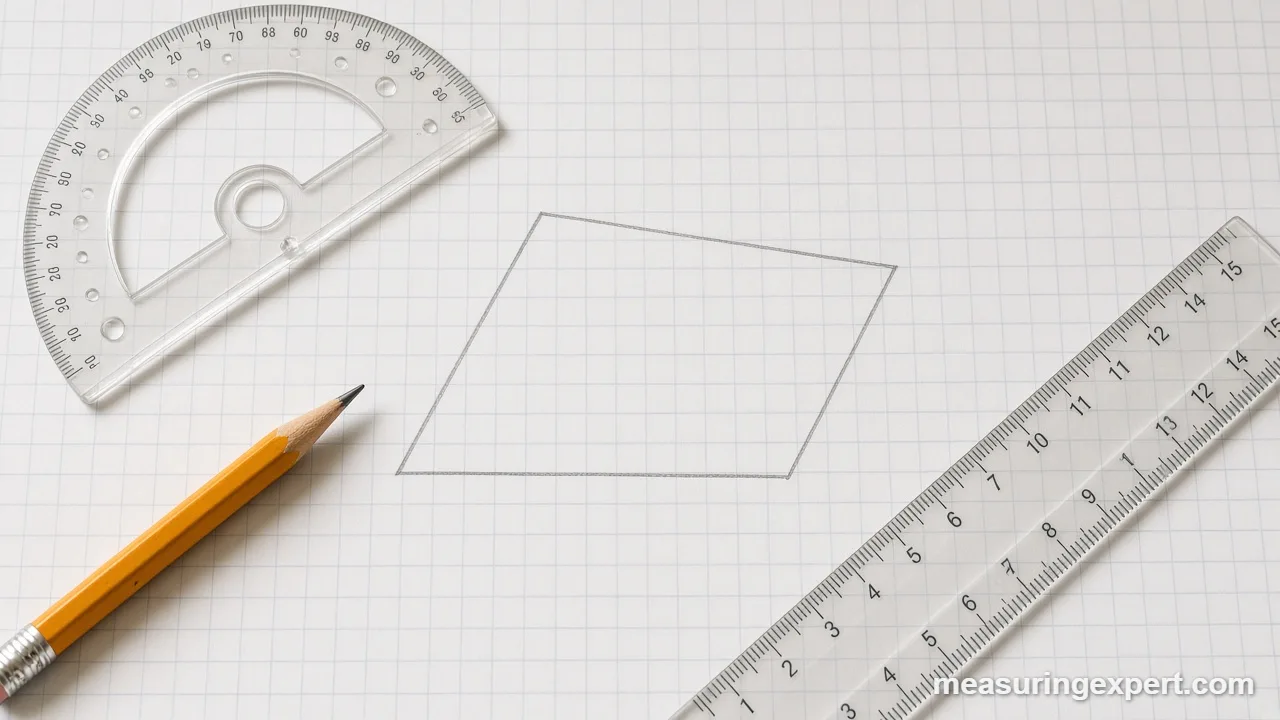
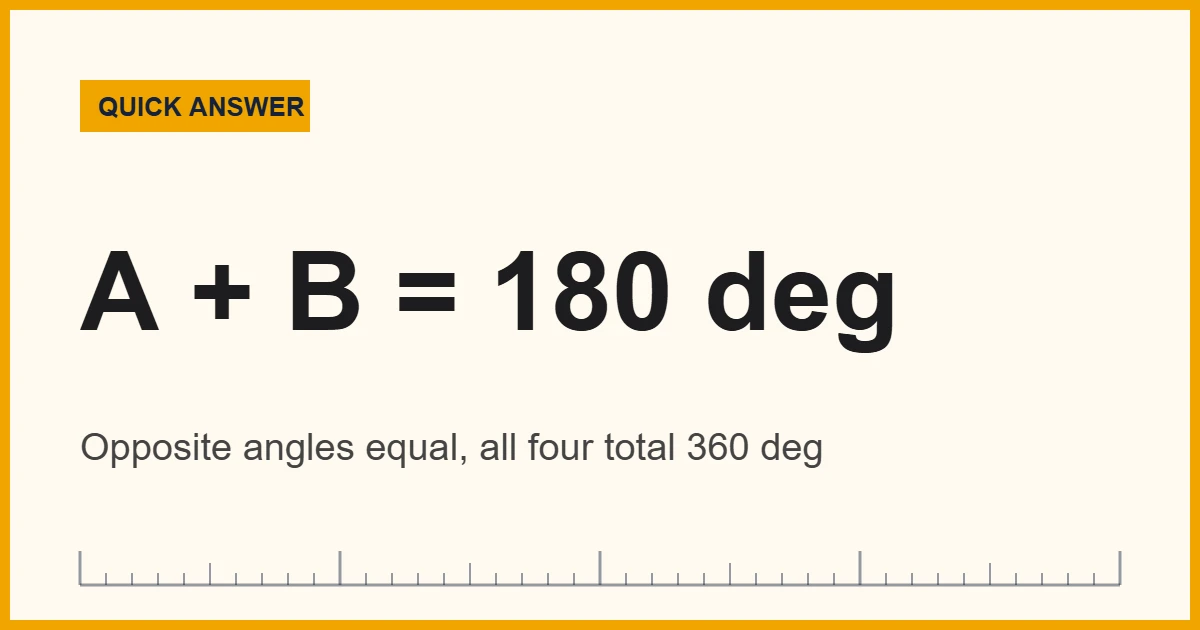
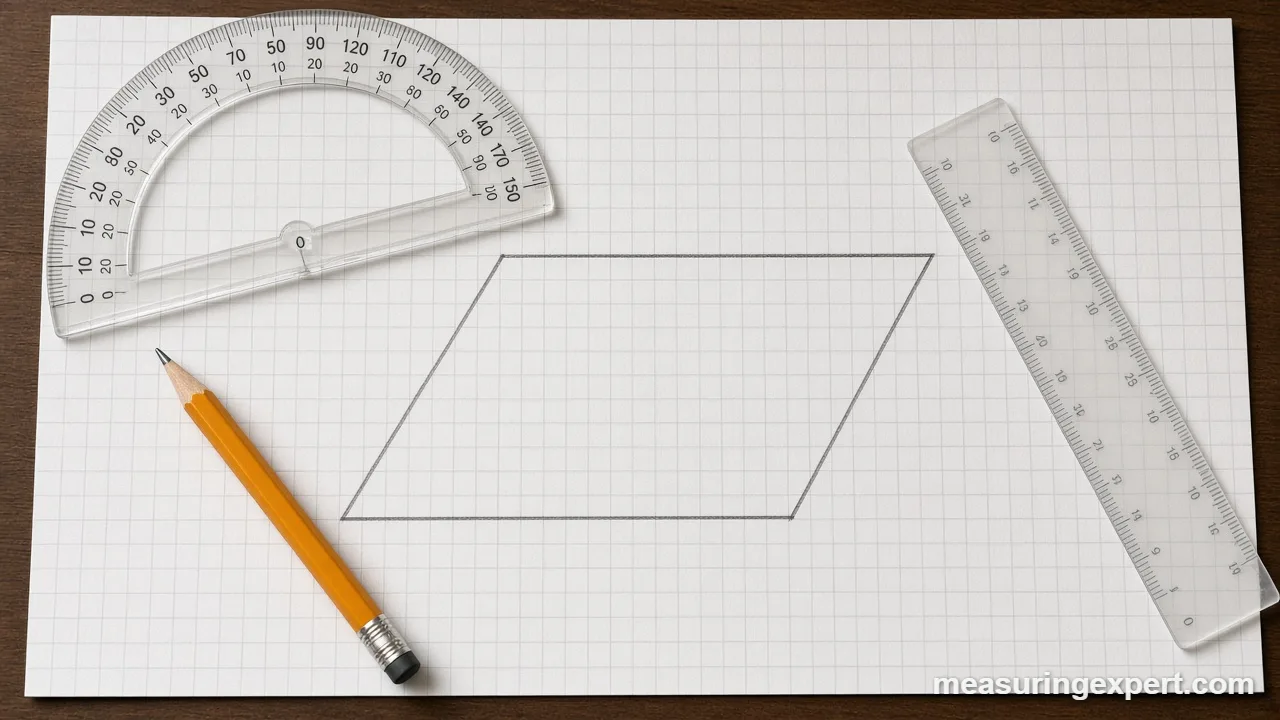
Parallelogram angles follow two simple rules: opposite angles are equal, and any two neighboring angles add up to 180 degrees. As a result, you only need to measure one angle. For example, if one corner reads 65 degrees, the four corners are 65, 115, 65 and 115 degrees, and they total 360 degrees.
To begin with, a parallelogram is a four-sided shape with two pairs of parallel sides. Because of that, its corners are linked by fixed rules, and you can find all four parallelogram angles from a single reading. This guide shows both routes: measuring with a protractor and calculating with the rules.
In short: measure one corner carefully, subtract it from 180 to get its neighbor, and copy each value to the opposite corner. Then add all four to confirm they reach 360 degrees. The geometry is standard, and the Wikipedia article on parallelograms lists the same angle properties, including the area formula that uses an angle.
Below, you will find the rules, a worked example, a step-by-step protractor method, and the special cases of rectangles and rhombuses. In addition, there is an angle converter for turning degrees into grade or pitch when you work with slopes.
The Rules for Parallelogram Angles
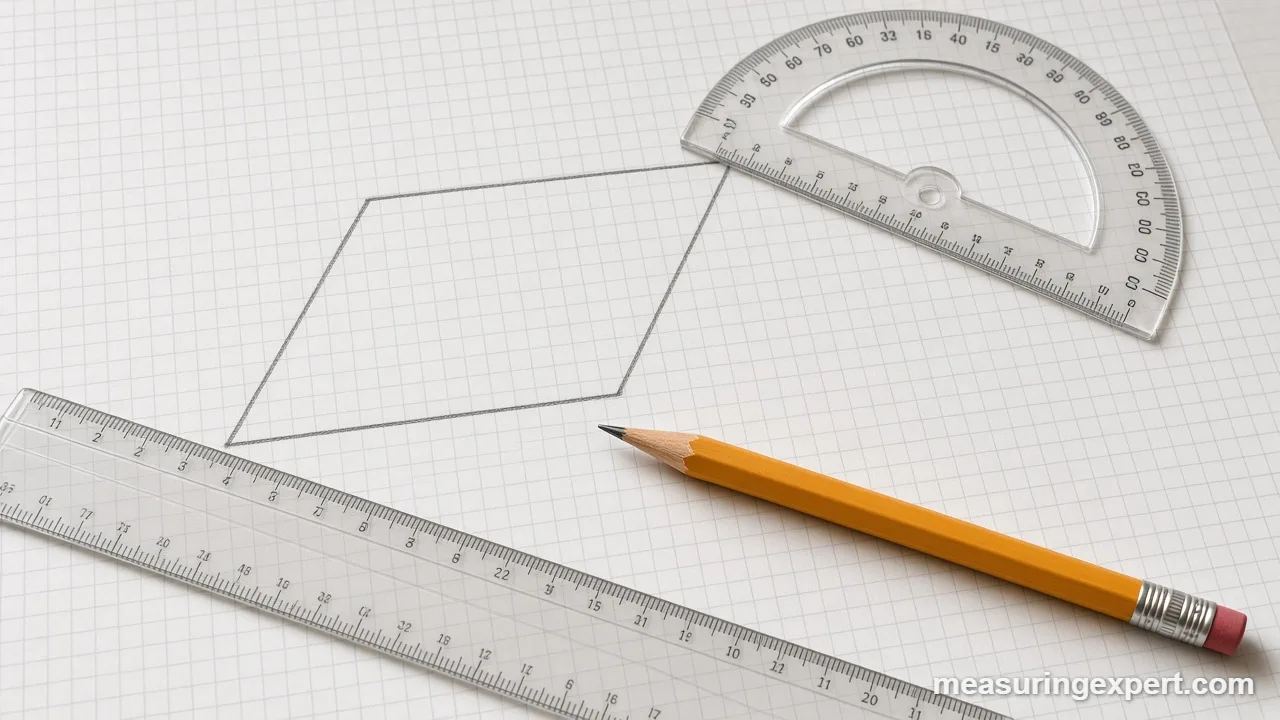
First, every parallelogram has four interior angles, and they always fit the same pattern. Parallel sides are the reason: when a line crosses two parallel lines, it makes matching angles on each side. As a result, one measurement unlocks the rest.
| Rule | What it means | Example (one corner = 65 degrees) |
|---|---|---|
| Opposite angles are equal | Corners across the shape match | The corner opposite 65 degrees is also 65 degrees |
| Neighboring angles add to 180 degrees | Corners that share a side are supplementary | 180 – 65 = 115 degrees |
| All four angles total 360 degrees | 2 x 65 + 2 x 115 = 360 | Use this as a final check |
| The two diagonals cut the shape in two | Each diagonal splits it into two equal triangles | Each triangle’s angles add to 180 degrees |
However, the neighbors do not “form a straight line” inside the shape. They are supplementary because the sides are parallel, which is a slightly different idea. If you want to see the same logic for other shapes, our guide to angles in a polygon explains the general formula, where the interior angles of a four-sided shape total (4 – 2) x 180 = 360 degrees.
Angle Converter for Parallelogram Angles
Enter any angle below to see it in degrees, grade and pitch. This helps when a slanted side of your parallelogram is a roof, ramp or board, and you need its slope instead of its corner angle.
Recommended Tools for Measuring Parallelogram Angles
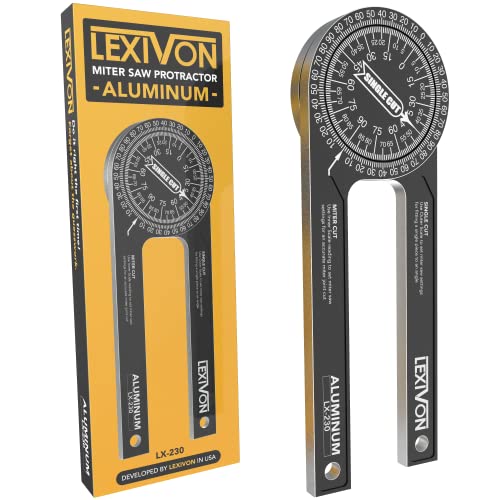
A clear 180-degree protractor is enough for drawings on paper. For physical objects such as boards, frames or tiles, a digital angle gauge or an engraved angle finder reads the corner more directly. Also, look for markings that are engraved or laser-etched rather than printed, because printed scales wear off.



As an Amazon Associate, Measuring Expert earns from qualifying purchases.
Not sure which style fits? Our comparison of a protractor vs bevel gauge explains when each one is the better choice.
Key Takeaways
- Opposite corners of a parallelogram are equal.
- Neighboring corners add up to 180 degrees.
- Therefore, all four interior angles total 360 degrees.
- As a result, one careful measurement gives you all four angles.
- Rectangles and squares are parallelograms with four 90-degree corners.
- A rhombus is a parallelogram with four equal sides, and its diagonals meet at 90 degrees.
- A protractor reads to about the nearest degree, so round your answers sensibly.
How to Measure Parallelogram Angles With a Protractor
- Pick the corner. First, choose the clearest corner, ideally one where both sides are long enough to reach the protractor scale.
- Extend the sides if needed. Use a ruler and a sharp pencil to lengthen short sides, so they cross the protractor’s scale.
- Center the protractor. Next, put the small hole or center mark exactly on the corner point (the vertex).
- Line up the baseline. Then rotate the protractor until its zero line sits on one side of the corner.
- Read the scale. Finally, follow the other side to the number. Use the scale that starts at 0 on the side you aligned.
- Sanity check. An angle that looks wide must read above 90 degrees, and a narrow one must read below 90.
- Find the other three. Afterward, subtract your reading from 180 for the neighbors, and copy values to the opposite corners.
How to Calculate Parallelogram Angles Without Measuring
Sometimes you know one angle from a plan, a label or a problem statement. In that case, you can calculate the rest in two quick steps.
| Known corner A | Neighbor B (180 – A) | Check: 2A + 2B |
|---|---|---|
| 30 degrees | 150 degrees | 360 |
| 45 degrees | 135 degrees | 360 |
| 60 degrees | 120 degrees | 360 |
| 75 degrees | 105 degrees | 360 |
| 110 degrees | 70 degrees | 360 |
Worked Example With Sides and Area
Suppose a parallelogram has sides of 8 cm (3.15 in) and 5 cm (1.97 in), and the corner between them is 60 degrees. Therefore, the neighboring corner is 120 degrees. The area is 8 x 5 x sin 60 degrees, which is about 34.64 square cm (5.37 square in). Furthermore, the short diagonal comes from the law of cosines: the square root of (8 squared + 5 squared – 2 x 8 x 5 x cos 60) equals exactly 7 cm (2.76 in). The long diagonal, using cos 120 instead, is about 11.36 cm (4.47 in).
Reading Parallelogram Angles From a Lean
If a slanted side leans 20 degrees away from vertical, the corner angles are 70 and 110 degrees. The lean itself equals about 36.4 percent grade, so the converter above is useful for ramps or roof edges. Similarly, you can enter 45 degrees to confirm that it equals 100 percent grade.
Special Parallelogram Angles: Rectangle, Rhombus and Square
Some parallelograms follow extra rules. However, all of them still obey the opposite-angle and neighbor rules above.
| Shape | Sides | Angles | Diagonals |
|---|---|---|---|
| General parallelogram | Opposite sides equal | Two pairs: A and 180 – A | Different lengths; bisect each other |
| Rectangle | Opposite sides equal | All four are 90 degrees | Equal length |
| Rhombus | All four sides equal | Two pairs: A and 180 – A | Meet at 90 degrees and bisect the corners |
| Square | All four sides equal | All four are 90 degrees | Equal length, meet at 90 degrees |
So a diamond shape on a playing card is a rhombus, which is a parallelogram, while a rectangle is the special case where the slant disappears.
Checking Your Work With a Compass
A compass offers a second opinion. Put its point on the vertex and draw an arc across both sides. Then measure the straight distance between the two crossing points (the chord). The chord length equals 2 x radius x sin(angle / 2). For instance, with a 5 cm (1.97 in) radius, a 70-degree angle gives a chord of about 5.74 cm (2.26 in). If your chord is far off, re-measure the angle.
Common Mistakes With Parallelogram Angles
Do
- Place the protractor center exactly on the vertex.
- Decide acute or obtuse before reading the scale.
- Add all four angles to confirm they reach 360 degrees.
- Extend short sides with a ruler.
- Round to the precision of your tool.
Don’t
- Read the wrong scale on the protractor.
- Measure from the paper edge instead of the drawn side.
- Assume neighboring corners are equal.
- Mistake a trapezoid for a parallelogram.
- Trust a bent or scratched protractor.
Honest Limits of Measuring Parallelogram Angles
A school protractor reads to about one degree on a good day. For example, thick pencil lines, a slightly off-center vertex and a viewing angle can each add error. As a result, a measured 65 degrees might really be 64 or 66 degrees. Also, calculated values from the rules are exact only when the starting angle is exact. For physical objects, corners are rarely perfect, so the four measured angles may differ slightly from the ideal pattern. In short, treat the rules as a way to cross-check your readings, not to replace them.
For a deeper look at why precision matters, see the importance of angle measurement.
When Parallelogram Angles Need a Professional
Classroom drawings and woodworking projects are fine for a protractor. Land boundaries, building layouts and structural frames, on the other hand, call for a licensed surveyor with instruments built for the job. Surveyors work with angles in degrees, minutes and seconds, as explained in our overview of angle measurement in surveying. The degree itself is an accepted unit alongside the SI, as described in the BIPM SI Brochure.
Frequently Asked Questions About Parallelogram Angles
What are the rules for parallelogram angles?
Opposite angles are equal, and neighboring angles add up to 180 degrees. As a result, all four angles total 360 degrees.
Do the angles of a parallelogram add up to 180 degrees?
Not all four. Any two neighboring angles add up to 180 degrees, but all four interior angles add up to 360 degrees.
What is the formula for parallelogram angles?
If one angle is A, its neighbors are 180 – A and the opposite angle is also A. The total is 2A + 2(180 – A) = 360 degrees.
How do I solve consecutive angles of a parallelogram?
Consecutive angles share a side, so they add up to 180 degrees. Subtract the known angle from 180 to find the other one.
How many degrees is each angle in a parallelogram?
In fact, it depends on the shape. A rectangle has four 90-degree angles, while a slanted parallelogram has two equal acute angles and two equal obtuse angles.
How do I measure parallelogram angles with a protractor?
Center the protractor on the corner, line up the zero line with one side, and read where the other side crosses the scale. Then subtract from 180 for the neighbor.
Can a parallelogram have four equal angles?
Yes. If all four angles are equal, each one is 90 degrees, so the shape is a rectangle (or a square if the sides are equal too).
Can a parallelogram have a 90-degree angle?
Yes. If one angle is 90 degrees, then its neighbors are 90 degrees too, and the shape is a rectangle.
How are parallelogram angles related to the diagonals?
The diagonals bisect each other. In a rhombus they also meet at 90 degrees and split each corner angle in half.
What tool is best for measuring angles on a real object?
A digital angle gauge or angle finder is easiest on physical corners. A clear protractor works well for drawings and paper shapes.
Parallelogram Angles: The Bottom Line
To sum up, parallelogram angles come in two equal pairs that add up to 180 degrees, and all four total 360 degrees. Measure one corner carefully, calculate the rest, and then check your work by adding them up.
Finally, use the converter above when you need a corner or lean as a slope. For anything structural or legal, bring in a professional instead of relying on a classroom protractor.