

To find stopping time, divide your speed by the deceleration: t = v / a. Then add the driver’s reaction time. For example, a car at 60 mph (88 ft/s) braking at about 0.7 g needs roughly 3.8 seconds of braking plus 1.5 seconds of reaction, so about 5.3 seconds in total.
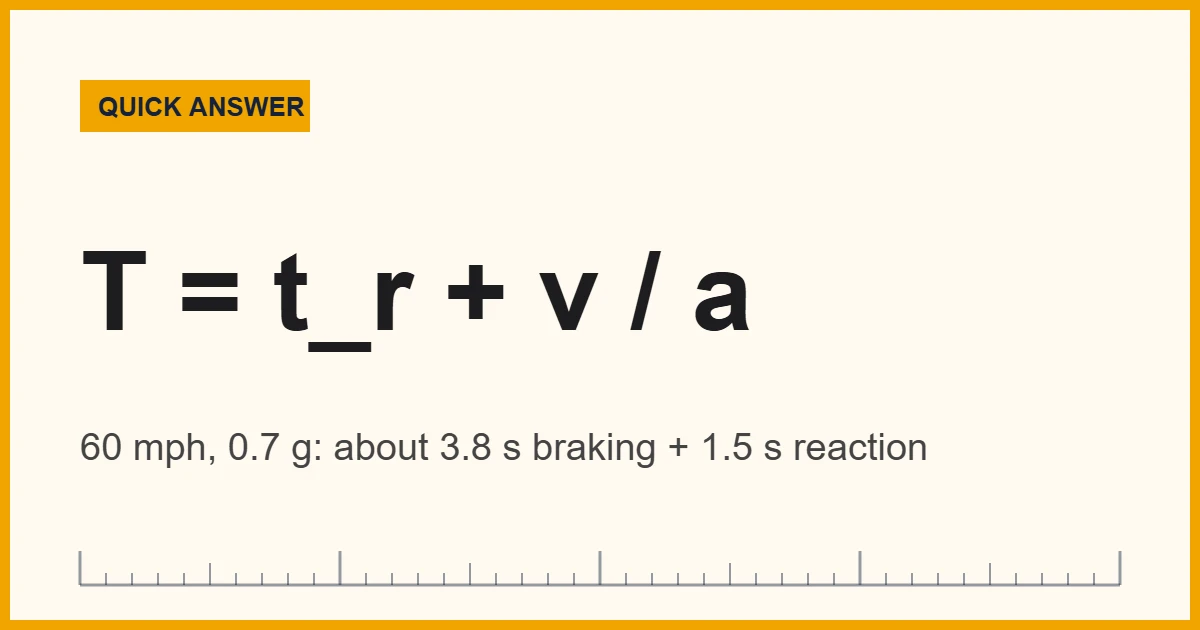
In short, total stopping time has two parts. First comes reaction time, the gap between seeing a hazard and pressing the brake, while the car keeps rolling at full speed. Next comes braking time, which equals speed divided by deceleration once the brakes bite. Because both parts grow with speed, a faster car always needs more time to stop. The matching distance formula is d = v x t_r + v^2 / (2a), so the braking part of the distance grows with the square of speed. Finally, keep your units consistent: use feet per second with ft/s^2, or meters per second with m/s^2.
This guide walks through both formulas, then shows worked examples in mph and km/h. After that, you will find quick charts, a comparison of the terms people mix up, and the real-world factors that change the result. In the end, you should be able to calculate stopping time for any speed with a pencil or the converter below.
Where the Stopping Time Formulas Come From
These are not new or exotic formulas. In fact, they come straight from the constant-acceleration equations taught in every first physics course. The free OpenStax University Physics textbook uses them in a braking example: a car at 30 m/s needs 64.3 m to stop on dry concrete, and a half-second reaction adds another 15 m.
Road engineers use the same math, too. For instance, the Texas Department of Transportation road design manual, which follows national AASHTO practice, assumes a 2.5-second brake reaction time and a deceleration of 11.2 ft/s^2 when it decides how far ahead drivers must be able to see.
Convert Your Speed Before You Calculate Stopping Time
The formulas only work, however, when speed and deceleration share the same units. So start by turning your speedometer reading into feet per second or meters per second. Then type a speed below, and the converter shows mph, km/h, m/s and ft/s side by side.
Two shortcuts help here. First, 1 mph is exactly 0.44704 m/s, or about 1.467 ft/s, so 60 mph is exactly 88 ft/s. Second, to turn km/h into m/s, simply divide by 3.6.
Recommended Tools for Shorter, Safer Stops
Your tires decide how hard the car can decelerate, so the most useful measuring tools here are the ones that check them. For example, a tread depth gauge shows when grip is running out. Similarly, an accurate pressure gauge keeps each tire at the pressure printed on the door jamb label. Below are a few options from established brands, based on manufacturer specs and buyer reports.
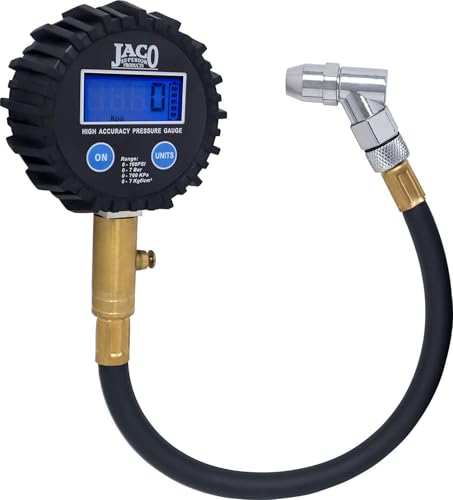
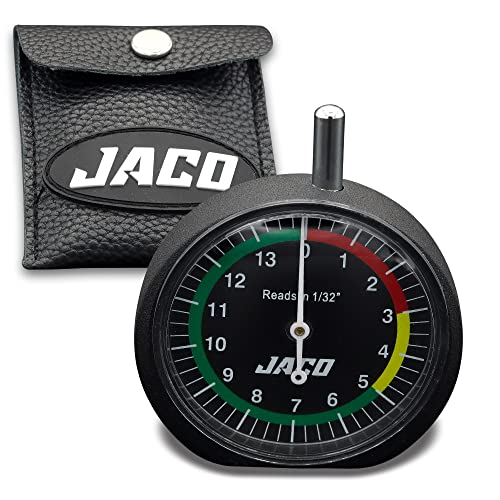

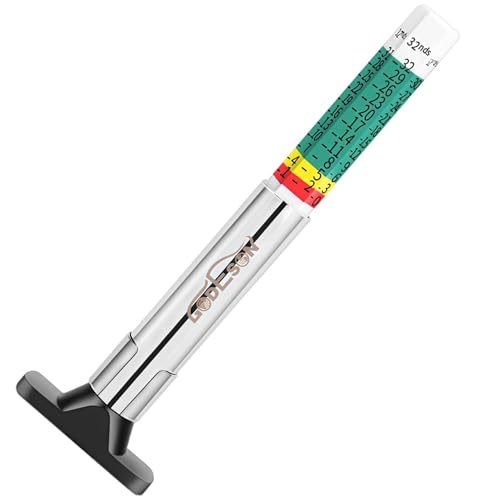
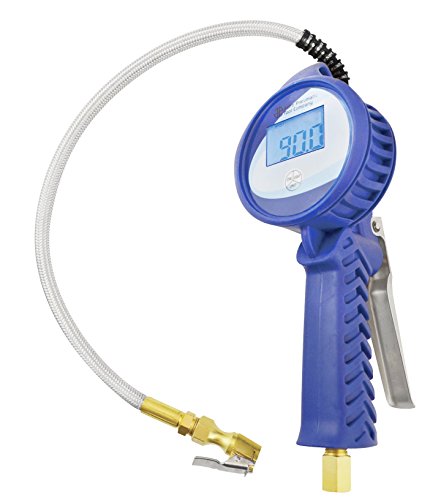
As an Amazon Associate, Measuring Expert earns from qualifying purchases.
Key Takeaways
- Braking time equals speed divided by deceleration: t = v / a.
- Then add reaction time, usually 1 to 2.5 seconds, to get the total.
- At 60 mph and 0.7 g, braking alone takes about 3.8 seconds.
- Doubling speed doubles braking time but quadruples braking distance.
- Wet roads lower deceleration; as a result, every stop takes longer.
- Use matching units: ft/s with ft/s^2, or m/s with m/s^2.
- Finally, real stops vary with tires, brakes, load and road surface.
The Stopping Time Formula: t = v / a
Deceleration tells you how much speed a vehicle loses every second. So if you know how much speed there is to lose, you simply divide. That gives the braking part of stopping time:
braking time t_b = v / aIn this formula, v is the speed when the brakes start working and a is the deceleration. For example, a car at 88 ft/s that loses 22 ft/s every second needs 88 / 22 = 4 seconds to stop. In fact, this comes from the textbook equation v = v0 + at, with the final speed set to zero.
Deceleration is also often quoted in g, the acceleration of gravity. One g is 9.80665 m/s^2, or about 32.17 ft/s^2. Typically, a firm emergency stop on dry pavement is around 0.7 g, which is about 7 m/s^2 or 23 ft/s^2. By contrast, the 11.2 ft/s^2 that road designers use is a gentler, controlled stop that most drivers can manage on wet pavement.
Total Stopping Time = Reaction Time + Braking Time
The formula above starts the clock when the brakes are already working. In real driving, however, there is a delay first. First, the driver has to notice the hazard, decide to stop and move a foot to the pedal. Meanwhile, the car still travels at full speed.
Reaction time varies a lot. For instance, an alert driver who expects to brake may react in under a second. In contrast, a surprised or distracted driver can take two seconds or more. That is why road designers use a cautious 2.5 seconds, while many textbook problems use 0.5 to 1.5 seconds.
Similarly, the distance formula follows the same split. During reaction, the car covers v x t_r. Then, during braking, it covers v^2 / (2a). Add them, and you get the total stopping distance:
stopping distance d = v x t_r + v^2 / (2a)Still, notice the difference between the two results. Stopping time grows in a straight line with speed, but the braking distance grows with speed squared. As a result, going from 30 mph to 60 mph doubles the braking time but makes the braking distance four times longer.
How to Calculate Stopping Time Step by Step
- Convert the speed. Change mph to ft/s (multiply by 1.467) or km/h to m/s (divide by 3.6).
- Pick a deceleration. Use a measured value if you have one; otherwise, about 7 m/s^2 (23 ft/s^2) suits a hard stop on dry pavement.
- Divide speed by deceleration. As a result, you get the braking time in seconds.
- Choose a reaction time. Use 1.5 seconds for a typical alert driver, or 2.5 seconds for a cautious design value.
- Add the two times. Altogether, the sum is the total stopping time.
- Find the distance if you need it. Multiply speed by reaction time, then add speed squared divided by twice the deceleration.
Worked Examples in mph and km/h
Each example below uses the same method. That way, you can follow along with your own numbers. Also, all values were rounded only at the final step.
Example 1: Stopping time at 60 mph on a dry road
First, convert the speed: 60 mph is exactly 88 ft/s. Next, take a hard stop of 7 m/s^2, which is 22.97 ft/s^2. As a result, the braking time is 88 / 22.97 = 3.83 seconds. Adding a 1.5-second reaction gives a total stopping time of about 5.33 seconds.
For distance, the reaction part is 88 x 1.5 = 132 ft. Next, the braking part is 88^2 / (2 x 22.97) = 168.6 ft. So the car needs about 301 ft (91.6 m) to stop completely.
Example 2: Stopping time at 100 km/h
To begin, 100 km/h divided by 3.6 is 27.78 m/s. With the same 7 m/s^2 deceleration, braking takes 27.78 / 7 = 3.97 seconds. Then add 1.5 seconds of reaction, and the total is about 5.47 seconds.
Meanwhile, the car covers 41.7 m while the driver reacts and 55.1 m while braking. In total, that is about 96.8 m, or roughly 318 ft.
Example 3: The road-design value at 60 mph
Now use the cautious design numbers: 2.5 seconds of reaction and 11.2 ft/s^2 of deceleration. Braking takes 88 / 11.2 = 7.86 seconds, so the total is about 10.4 seconds. Likewise, the distance is 220 ft plus 345.7 ft, or about 566 ft. That matches the 570 ft TxDOT lists for 60 mph after rounding.
Example 4: Working backward from a braking test
Suppose a car stops from 60 mph in 120 ft once the brakes are applied. Using t_b = 2d / v, the braking time is 2 x 120 / 88 = 2.73 seconds. Therefore, the deceleration is 88 / 2.73 = 32.3 ft/s^2, which is about 1.0 g.
Stopping Time and Distance Charts
The charts below use 1.5 seconds of reaction and 7 m/s^2 (about 0.71 g) of braking on dry pavement. Therefore, treat them as a good-conditions estimate, not a promise.
| Speed | Braking time | Total stopping time | Total stopping distance |
|---|---|---|---|
| 20 mph (29.3 ft/s) | 1.28 s | 2.78 s | 63 ft (19.1 m) |
| 30 mph (44.0 ft/s) | 1.92 s | 3.42 s | 108 ft (33.0 m) |
| 40 mph (58.7 ft/s) | 2.55 s | 4.05 s | 163 ft (49.7 m) |
| 50 mph (73.3 ft/s) | 3.19 s | 4.69 s | 227 ft (69.2 m) |
| 60 mph (88.0 ft/s) | 3.83 s | 5.33 s | 301 ft (91.6 m) |
| 70 mph (102.7 ft/s) | 4.47 s | 5.97 s | 383 ft (116.9 m) |
| 80 mph (117.3 ft/s) | 5.11 s | 6.61 s | 476 ft (145.0 m) |
| Speed | Braking time | Total stopping time | Reaction distance | Braking distance | Total distance |
|---|---|---|---|---|---|
| 30 km/h | 1.19 s | 2.69 s | 12.5 m | 5.0 m | 17.5 m |
| 50 km/h | 1.98 s | 3.48 s | 20.8 m | 13.8 m | 34.6 m |
| 80 km/h | 3.17 s | 4.67 s | 33.3 m | 35.3 m | 68.6 m |
| 100 km/h | 3.97 s | 5.47 s | 41.7 m | 55.1 m | 96.8 m |
| 120 km/h | 4.76 s | 6.26 s | 50.0 m | 79.4 m | 129.4 m |
Look at the low speeds first. At 30 km/h, for example, the driver’s reaction uses more road than the brakes do. At highway speed, however, braking distance takes over. Accurate speed matters as well, so it helps to know how speedometers measure speed and why they may read slightly high.
Stopping Time vs Stopping Distance vs Braking Distance
These terms sound alike; however, they answer different questions. In fact, mixing them up is the most common error in homework problems and online calculators.
| Term | What it measures | Formula | Unit |
|---|---|---|---|
| Reaction time | Delay before the brakes are applied | Measured or assumed | seconds |
| Braking time | Time from brake application to standstill | v / a | seconds |
| Total stopping time | Reaction time plus braking time | t_r + v / a | seconds |
| Braking distance | Distance covered while braking | v^2 / (2a) | ft or m |
| Stopping distance | Reaction distance plus braking distance | v x t_r + v^2 / (2a) | ft or m |
What Changes Your Deceleration
Speed and reaction time are fairly easy to plug in. Deceleration, on the other hand, depends on the whole system of driver, car and road. These factors matter most:
- Road surface. Wet pavement may cut deceleration to around 5 m/s^2. At 60 mph, braking time then rises from 3.83 to 5.36 seconds, and total distance grows to about 368 ft.
- Tire condition. Similarly, worn tread and low pressure reduce grip, especially on wet roads.
- Load and slope. A heavy trailer or a downhill grade means the brakes must work harder, so stops take longer.
- Brake condition. Likewise, worn pads, overheated brakes or air in the lines all weaken stopping power.
- Driver state. Finally, fatigue, alcohol and phone use lengthen reaction time, which adds distance at full speed.
When a stop fails, though, the physics of momentum takes over. For that side of the story, see how investigators work out speed and direction after a collision.
Do and Don’t When Estimating Stopping Time
Do:
- Convert mph or km/h before you divide.
- State which reaction time you assumed.
- Use a lower deceleration for wet, icy or loose roads.
- Round only at the end of the calculation.
Don’t:
- Mix ft/s with m/s^2 in one formula.
- Forget the reaction phase in real-world estimates, because it adds distance.
- Assume braking distance grows in a straight line with speed.
- Treat a chart value as a guaranteed stopping point.
Honest Limits of the Formula
First of all, the formulas assume steady deceleration from the first instant to the last. For one thing, real brakes take a fraction of a second to build full pressure, and deceleration can fade as brakes heat up. Moreover, ABS systems pulse the brakes, so the slowing rate is not perfectly smooth. In short, the math gives a clean estimate, while a real stop may run a little longer. So for safety planning, use cautious inputs: a longer reaction time and a lower deceleration.
When to Call a Professional
Generally, a simple estimate is fine for homework, driver education or curiosity. However, some situations need expert work. For example, crash reconstruction relies on skid marks, vehicle data recorders and road friction tests, so leave it to an accredited reconstructionist. Likewise, if your car pulls, shudders or feels soft when you brake, a qualified mechanic should inspect the brakes right away.
Stopping Time FAQs
How do you calculate stopping time?
Divide speed by deceleration to get braking time, then add reaction time. For example, 88 ft/s divided by 23 ft/s^2 is about 3.8 seconds, plus 1.5 seconds of reaction.
What is the formula for stopping time with reaction time?
Total stopping time T = t_r + v / a, where t_r is reaction time, v is speed and a is deceleration in matching units.
What reaction time should I use?
Textbooks often use 0.5 to 1.5 seconds. However, road designers use a cautious 2.5 seconds to cover slower and surprised drivers.
How long does it take to stop from 60 mph?
With a hard stop on dry pavement and a 1.5-second reaction, about 5.3 seconds and 301 ft. Using road-design values, it is about 10.4 seconds and 566 ft.
How long does it take to stop from 100 km/h?
At 7 m/s^2 with a 1.5-second reaction, it takes about 5.5 seconds and 97 m.
Does doubling speed double the stopping time?
No. Braking time doubles; however, braking distance becomes four times longer because it depends on speed squared.
How do I find deceleration from a stopping distance?
Use a = v^2 / (2d) with the braking distance only. A car stopping from 88 ft/s in 120 ft decelerates at about 32.3 ft/s^2, or 1.0 g.
Why convert mph to feet per second?
Deceleration is given per second, so speed must be per second too. For example, one mph is about 1.467 ft/s, and 60 mph is exactly 88 ft/s.
How much longer is stopping time on a wet road?
At 60 mph, dropping deceleration from 7 to 5 m/s^2 raises braking time from 3.83 to 5.36 seconds.
Does ABS shorten stopping time?
ABS mainly stops the wheels from locking so you can steer while braking. On loose gravel or fresh snow, a stop with ABS can even take longer.
Stopping Time: The Bottom Line
To sum up, braking time is speed divided by deceleration, and total stopping time adds the driver’s reaction on top. At 60 mph on a dry road, that is roughly 5.3 seconds and about 300 ft, and the figures climb quickly with speed or on wet pavement.
So convert your speed first, pick honest inputs, and use the charts as a guide rather than a guarantee. Above all, leave enough following distance that your stopping time never decides the outcome.
2 thoughts on “How Do You Calculate Stopping Time? Formula, Reaction Time and Examples”