

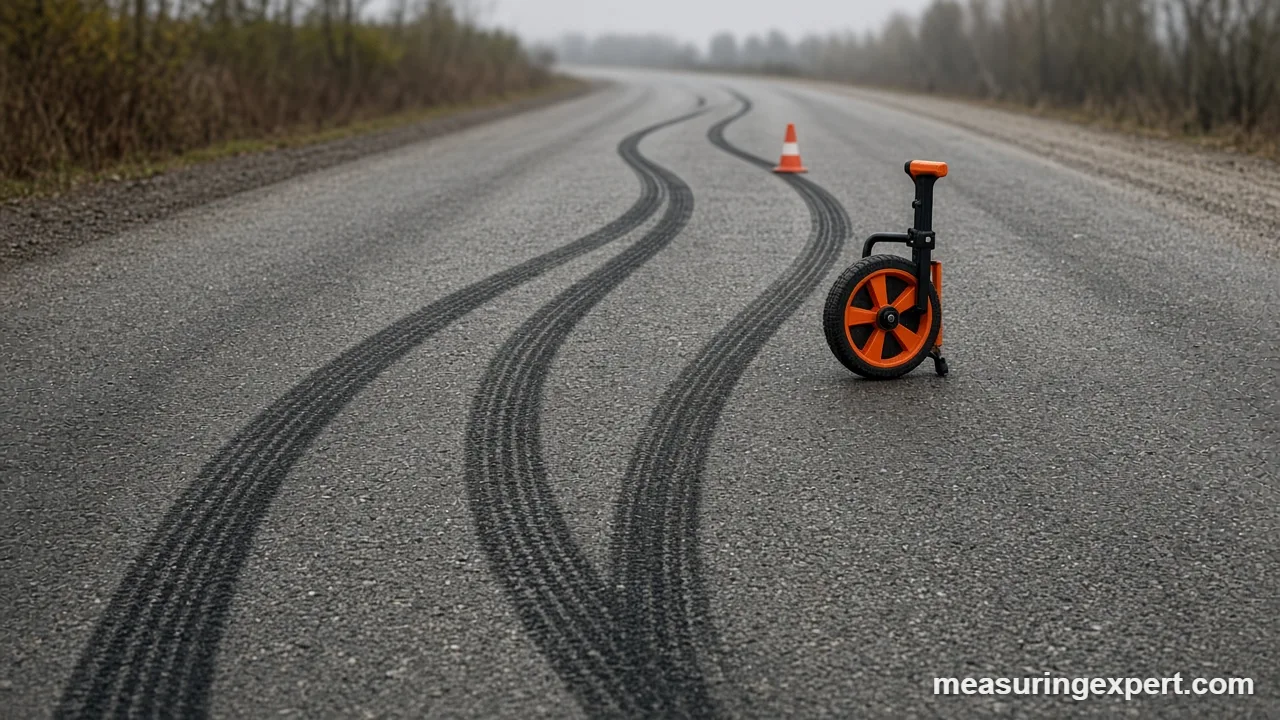
To estimate speed from stopping distance, use v = sqrt(2 x mu x g x d) in metric units, or the US skid formula S = sqrt(30 x d x f), with d in feet and S in mph. For example, 100 ft of skid marks on dry asphalt (drag factor 0.7) points to about 46 mph (74 km/h).
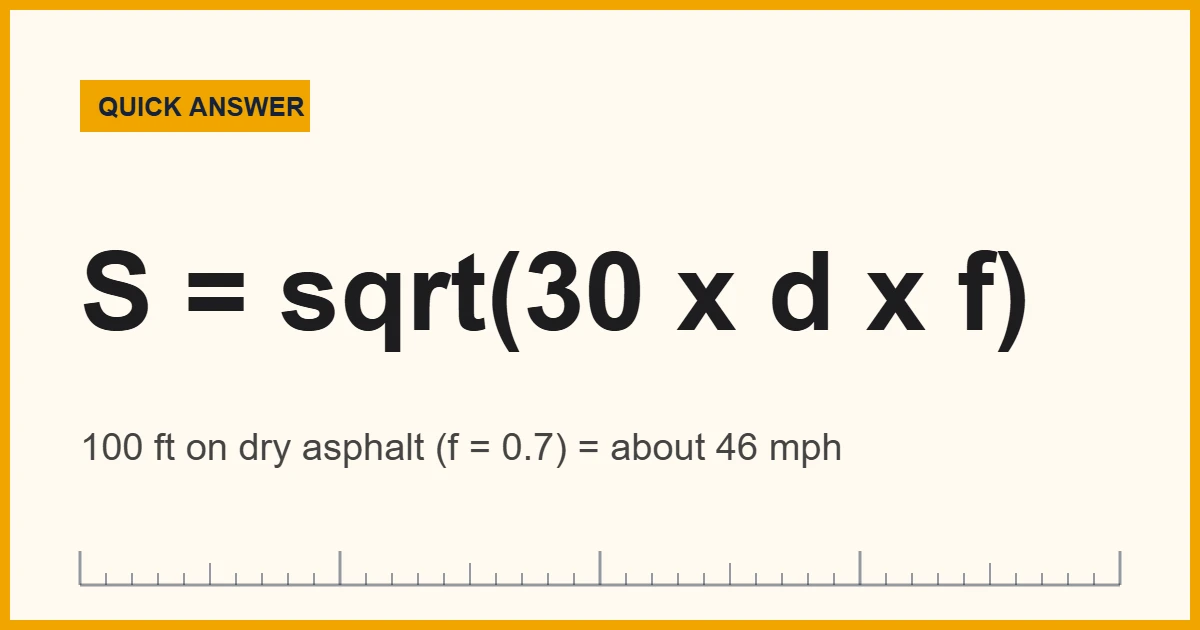
A car that locks its wheels and slides to a stop turns all of its motion energy into heat at the tires. Because friction does that work at a fairly steady rate, the length of the slide tells you how fast the car was going when the skid began. As a result, that simple idea sits behind every skid-mark estimate, from a physics homework problem to a police crash report.
In short: speed grows with the square root of distance. So doubling the skid length does not double the speed; instead, it raises it by about 41 percent. Meanwhile, the second input, the drag factor, describes how hard the tires can grip the road surface. For example, dry asphalt grips far better than wet asphalt, and ice grips worst of all.
Georgia State University’s HyperPhysics site shows the same physics in its auto stopping distance page: stopping distance equals v squared over 2 mu g, and it does not depend on the vehicle’s mass. Similarly, crash reconstruction courses for engineers, such as this PDH Online course by Peter Chen, P.E., use the US form S = sqrt(30Df).
Below, you will find both formulas, a drag factor table, worked examples and a step-by-step method. Finally, you will also see where these estimates stop being reliable, because a skid-mark calculation gives a reasonable range, not a court-ready number.
Convert Your Speed from Stopping Distance Result
Once you have a speed in mph, enter it below to see it in km/h, meters per second, feet per second and knots. For example, the default of 46 mph matches the 100 ft dry-asphalt example above. Also, the table under the converter shows skid lengths and speeds if JavaScript is off.
The converter handles units only. Therefore, work out the speed itself with the formulas in the next sections, or with the quick table in the worked examples.
Recommended Tools for Measuring Skid and Stopping Distance
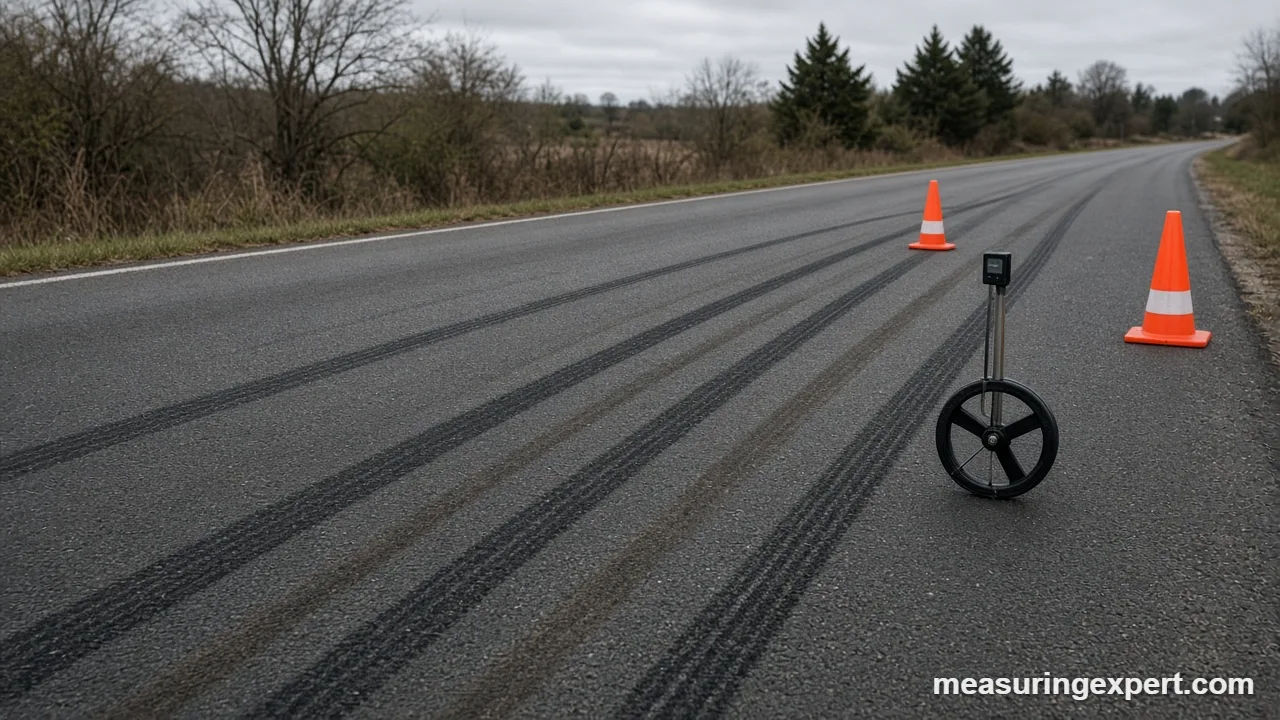
In short, a good estimate starts with a good distance. First, a measuring wheel reads long skid marks in feet and tenths quickly. Next, a laser distance measure helps for shorter marks or for checking a wheel reading. Also, both tools are common in road and site work, and they are far more accurate than pacing.



As an Amazon Associate, Measuring Expert earns from qualifying purchases.
- Metric formula: v = sqrt(2 x mu x g x d), with g = 9.80665 m/s2 and d in meters.
- US formula: S = sqrt(30 x d x f), with d in feet and S in mph.
- Typical drag factors: about 0.65 to 0.9 on dry asphalt and about 0.45 to 0.65 on wet asphalt.
- Because speed rises with the square root of distance, four times the skid means twice the speed.
- Distance divided by stopping time gives the average speed, which is only half the starting speed.
- A skid estimate is a minimum speed, because any energy lost in a crash adds to it.
- Above all, real crash work needs measured drag factors and a trained reconstructionist.
The Formula for Speed from Stopping Distance
When a car brakes to a stop, its kinetic energy (half of m v squared) equals the friction work done by the tires (mu x m x g x d). As a result, the mass cancels out, so a heavy car and a light car with the same grip stop in the same distance. Solving for speed gives:
v = sqrt(2 x mu x g x d)Here, v is the speed in meters per second, mu is the tire-road friction coefficient, g is 9.80665 m/s2 (standard gravity), and d is the braking or skid distance in meters. Then multiply v by 3.6 for km/h, or divide it by 0.44704 for mph.
For example, a 30 m (98 ft) skid with mu = 0.7 gives v = sqrt(2 x 0.7 x 9.80665 x 30) = 20.3 m/s. In other units, that is about 73 km/h, or 45.4 mph. Note that this is the speed from stopping distance for the braking part of the stop only.
The US Skid Formula: S = sqrt(30 x d x f)
US police reports and textbooks use a version already set up for feet and miles per hour:
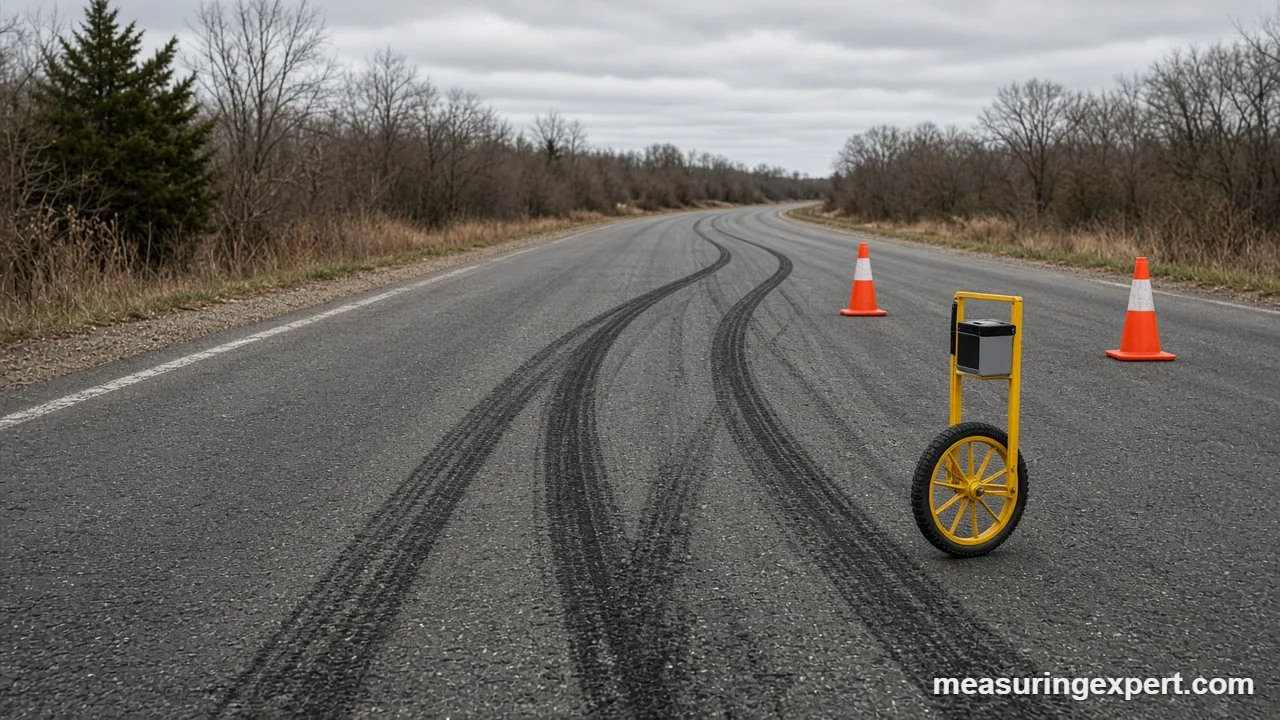
S is the speed in mph, d is the skid distance in feet, and f is the drag factor. In fact, the 30 is a rounded unit constant. More precisely, it is 2 x 32.174 ft/s2 x (3600/5280) squared, which works out to 29.91. As a result, the rounded formula reads about 0.15 percent high, which is far smaller than any drag factor uncertainty.
Two adjustments come up often. First, on a grade, add the slope as a decimal for uphill skids and subtract it for downhill skids (a 5 percent uphill grade turns f = 0.70 into 0.75). Second, if only some wheels were braking, multiply f by a braking efficiency. For instance, a car skidding on its rear wheels alone might get only part of the full drag factor.
Drag Factors for Dry and Wet Asphalt
The drag factor is the biggest source of error in any skid estimate. Engineering course material citing Limpert’s crash reconstruction text gives about 0.65 to 0.9 for cars on dry roads and about 0.3 on ice. Meanwhile, a discussion of Fricke’s widely used Traffic Accident Reconstruction table on the Traffic Accident Reconstruction Origin notes that wet asphalt ranges from about 0.25 to 0.75, depending on age, traffic wear and tar content.
| Road surface | Typical drag factor (f) | Notes |
|---|---|---|
| Dry asphalt, new or normal | 0.65 – 0.90 | 0.70 – 0.75 is a common working value |
| Dry asphalt, polished or tar-rich | 0.50 – 0.70 | Shiny wheel tracks grip less |
| Wet asphalt, normal | 0.45 – 0.65 | Full published range is about 0.25 – 0.75 |
| Dry concrete | 0.60 – 0.85 | Similar to dry asphalt |
| Gravel | 0.40 – 0.70 | Loose stones roll under the tire |
| Packed snow | 0.20 – 0.50 | Varies with temperature |
| Ice | 0.10 – 0.30 | Wet ice sits at the low end |
Therefore, treat every range as a starting point. In practice, reconstructionists measure the actual road with test skids or a drag sled, because two “dry asphalt” roads can differ by 0.2 or more.
Braking Distance vs Total Stopping Distance
First of all, people often mix up these two terms, and the difference changes the answer. In particular, the skid formulas only work with the braking (sliding) part of the stop.
| Term | What it covers | Formula | Example at 60 mph, dry (f = 0.7) |
|---|---|---|---|
| Reaction distance | Travel while the driver sees the hazard and moves to the brake | speed x reaction time | 132 ft (40.2 m) at 1.5 s |
| Braking distance | Travel from brake application to stop | v squared / (2 x mu x g) | 171 ft (52.2 m) |
| Total stopping distance | Reaction distance plus braking distance | sum of the two | 303 ft (92.5 m) |
In other words, skid marks only record the braking part. On the other hand, a “the car stopped 300 ft after the light changed” measurement includes reaction travel, so you need the method in the reaction-time section below. For the time side of the same problem, see our guide on how to calculate stopping time from speed and reaction time.
How to Calculate Speed from Stopping Distance, Step by Step
Use this method for a straight skid on a level or gently sloped road. Also, it assumes the vehicle came to rest without hitting anything.
- Measure the skid. Run a measuring wheel along the longest mark from the first visible tire mark to the tire’s resting spot.
- Use the right length. If front and rear tire marks overlap, subtract the wheelbase from the longest mark to avoid double counting.
- Choose a drag factor. Pick a value from the surface table, or better, a range such as 0.65 to 0.80 for dry asphalt.
- Adjust for slope. Add the grade for uphill skids and subtract it for downhill skids.
- Apply the formula. Calculate S = sqrt(30 x d x f) in mph, or v = sqrt(2 x mu x g x d) in m/s.
- Report a range. Repeat with the low and high drag factor, then state the speed as “at least X to Y mph”.
- Convert units. Enter the result in the converter above for km/h, m/s or knots.
Worked Examples of Speed from Stopping Distance
For clarity, each example uses the formulas above, with results rounded to one decimal place.
Example 1, dry asphalt. A car leaves 100 ft of skid marks, and f = 0.7. Then S = sqrt(30 x 100 x 0.7) = sqrt(2,100) = 45.8 mph, or about 73.8 km/h.
Example 2, wet asphalt. The same 100 ft skid on wet asphalt with f = 0.5 gives sqrt(1,500) = 38.7 mph (62.3 km/h). In other words, the wet road implies a lower speed for the same mark, because less grip stops the car more slowly.
Example 3, a range. With 100 ft and f from 0.65 to 0.90, the speed runs from 44.2 to 52.0 mph (71.1 to 83.6 km/h). So a careful report would say “at least about 44 mph”.
Example 4, metric. A 20 m skid with mu = 0.75 gives v = sqrt(2 x 0.75 x 9.80665 x 20) = 17.2 m/s, or 61.7 km/h (38.4 mph).
Example 5, uphill. A 100 ft skid up a 5 percent grade with f = 0.70 uses 0.75 instead. As a result, S = sqrt(2,250) = 47.4 mph rather than 45.8 mph.
| Skid length | Dry, f = 0.7 | Wet, f = 0.5 | Ice, f = 0.2 |
|---|---|---|---|
| 25 ft (7.6 m) | 22.9 mph | 19.4 mph | 12.2 mph |
| 50 ft (15.2 m) | 32.4 mph | 27.4 mph | 17.3 mph |
| 100 ft (30.5 m) | 45.8 mph | 38.7 mph | 24.5 mph |
| 150 ft (45.7 m) | 56.1 mph | 47.4 mph | 30.0 mph |
| 200 ft (61.0 m) | 64.8 mph | 54.8 mph | 34.6 mph |
Speed from Stopping Distance When Reaction Time Is Included
Sometimes you know the total stopping distance instead of the skid length. In that case, the distance has two parts: reaction travel (v x t) and braking travel (v squared over 2 f g). Together, they therefore form a quadratic equation in v:
d_total = v x t_r + v^2 / (2 x f x g)For example, suppose a car stops in 200 ft total, the driver’s reaction time is 1.5 s, and f = 0.7. With g = 32.174 ft/s2, solving the quadratic gives v = 67.0 ft/s, or 45.7 mph (73.5 km/h). In other words, that splits into about 100 ft of reaction travel and 100 ft of braking. Ignoring the reaction part would instead give 64.8 mph, which is badly wrong.
Because reaction time varies a lot between drivers and situations, try 1.0, 1.5 and 2.5 seconds to see how much the answer moves.
Why Distance Divided by Time Gives the Wrong Answer
A common shortcut says speed equals stopping distance divided by stopping time. However, that gives the average speed during the stop, not the speed when braking began. With steady braking, the car slows evenly from its starting speed to zero, so the average is exactly half the starting speed.
Take a car that stops in 50 m over 5 s. Then 50 / 5 = 10 m/s is the average. So the starting speed is twice that, 20 m/s, which is 72 km/h or 44.7 mph. In addition, that stop implies a deceleration of 4 m/s2, about 0.41 g, which fits a wet road or moderate braking. Therefore, use v = 2d / t if you know the time, and v = sqrt(2 mu g d) if you know the grip.
Do and Don’t for Skid-Mark Estimates
Do
- Measure the longest continuous skid mark with a wheel or tape.
- Use a range of drag factors, not a single guess.
- Correct for uphill or downhill grade.
- Report the result as a minimum speed.
- Keep units consistent: feet with mph, meters with m/s.
Don’t
- Plug total stopping distance into a skid formula.
- Divide distance by time and call it the starting speed.
- Assume ABS cars leave the same marks as locked wheels.
- Ignore a collision at the end of the skid.
- Stand in traffic to take measurements.
Honest Limits of Speed from Stopping Distance Estimates
In short, these formulas give estimates only. First, the drag factor is rarely known exactly unless someone tested that road, with similar tires, in similar weather. Second, most modern cars have anti-lock brakes (ABS), which keep the wheels turning. As a result, ABS stops often leave faint, broken marks or none at all, and the measurable length may understate the braking distance.
Also, if the car hit something before it stopped, the skid only accounts for part of its energy. In that case, the formula gives a minimum speed, and the true speed was higher. Working out the rest needs momentum analysis, which our guide to finding speed and direction after a collision explains. Finally, yaw marks from a sliding turn, heavy trucks, motorcycles and trailers all need different methods.
When to Call an Accident Reconstruction Professional
Simply put, accident reconstruction is a professional job. If a crash involves injuries, insurance claims, lawsuits or criminal charges, a trained reconstructionist should handle it. For example, they measure the real drag factor, read event data recorder (“black box”) downloads, map the scene, and account for ABS, yaw and impact energy. Meanwhile, a home calculation like the ones on this page can help you understand a report, but it cannot replace one.
Frequently Asked Questions
What is the formula for speed from stopping distance?
Use v = sqrt(2 x mu x g x d) with meters and m/s, or S = sqrt(30 x d x f) with feet and mph. Both assume steady braking to a full stop.
What does the 30 mean in S = sqrt(30 x d x f)?
It is a unit constant that combines gravity in ft/s2 with the conversion from feet per second to mph. The exact value is about 29.91, rounded to 30.
What drag factor should I use for dry asphalt?
In general, typical values run from about 0.65 to 0.90. Many simple estimates use 0.7, but a range gives a more honest answer.
What drag factor should I use for wet asphalt?
Wet asphalt usually falls between about 0.45 and 0.65, and worn or tar-rich surfaces can drop much lower.
How fast was a car going with 100 feet of skid marks?
On dry asphalt with f = 0.7, about 46 mph (74 km/h). On wet asphalt with f = 0.5, about 39 mph (62 km/h).
Can I get speed from stopping distance and time alone?
Yes, if braking was steady. The starting speed is 2 x distance / time, because distance / time gives only the average speed.
Does vehicle weight change speed from stopping distance?
In the basic formula, no. That is because mass cancels out, so drag factor and distance set the result, although heavy trucks brake differently in practice.
Does reaction time matter for speed from stopping distance?
Only when your distance includes reaction travel. Skid marks cover braking alone, while a total stopping distance needs the quadratic method.
Do cars with ABS leave skid marks?
Often only faint or broken marks, because ABS keeps the wheels from locking. As a result, skid-length estimates are less reliable.
Is a skid-mark speed estimate accurate enough for court?
Not on its own. Instead, courts rely on trained reconstructionists who measure the road’s drag factor and use vehicle data.
Speed from Stopping Distance: The Bottom Line
To sum up, braking distance grows with the square of speed, so speed grows with the square root of distance. So use v = sqrt(2 mu g d) in metric units or S = sqrt(30 x d x f) in feet and mph, and then pick a drag factor range that fits the road.
Above all, treat the answer as an estimate and a minimum, never a final verdict. For homework, curiosity or reading a crash report, the formulas therefore work well. For any real collision, however, leave the job to a professional reconstructionist.