
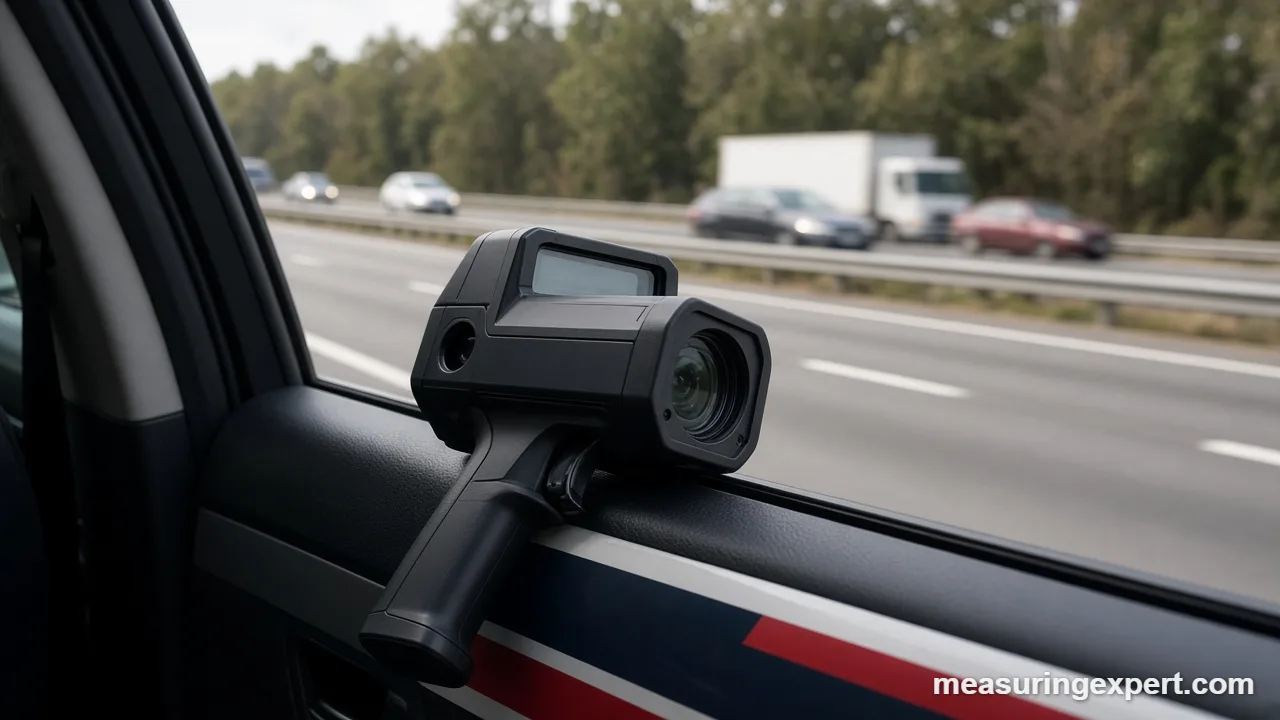
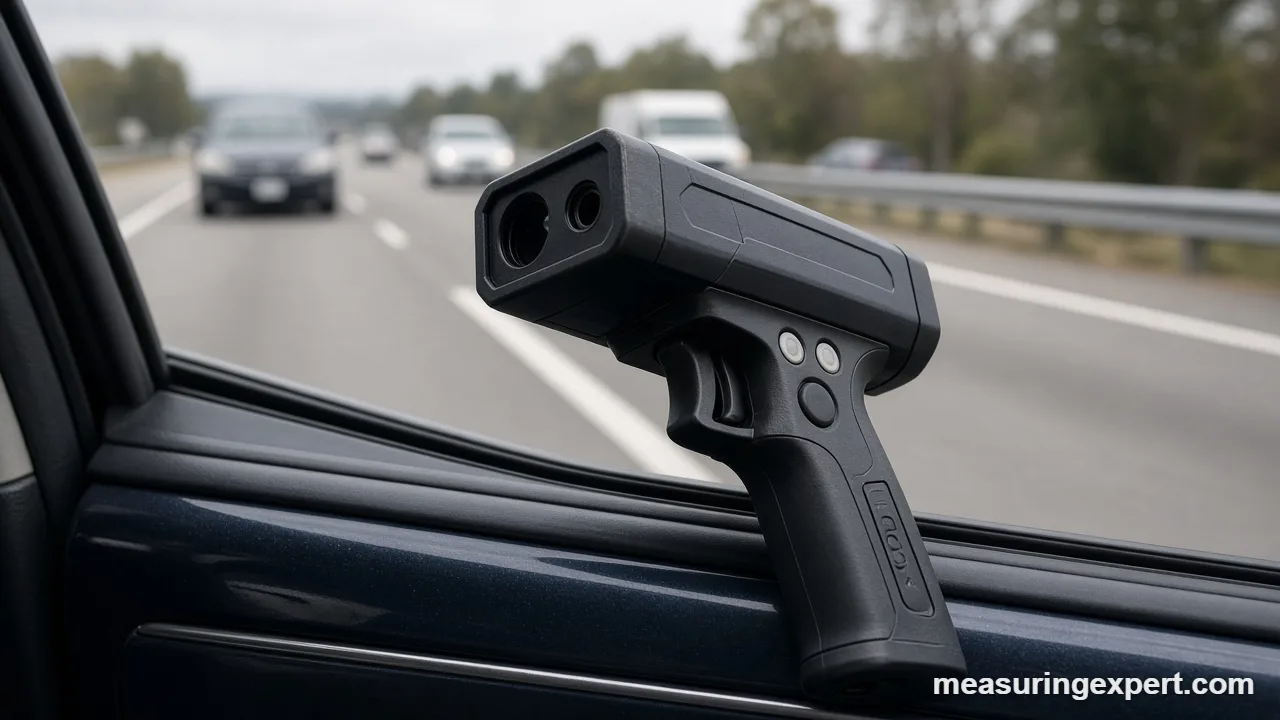
Cops measure speed mainly with radar guns, which read the Doppler shift of radio waves bouncing off a car, and lidar guns, which time laser pulses. They also pace cars with a calibrated speedometer, time them between fixed points (VASCAR, aircraft, average-speed cameras), and check every device with tuning forks or distance tests.
Every method police use comes down to one formula: speed equals distance divided by time. However, the tools differ in how they get those two numbers. For example, a radar gun lets physics do the math in a fraction of a second, while an officer in an airplane uses painted road lines and a stopwatch. As a result, some methods give an instant reading of one car, and others give an average over a quarter mile or several miles.
In short: radar and lidar give instant speeds, while pacing, VASCAR, aircraft timing and average-speed cameras give average speeds over a known distance. Either way, all of them are only as good as their calibration and the person running them.
In the US, the National Highway Traffic Safety Administration (NHTSA) publishes performance specifications for police radar and lidar. Then independent labs test devices against them, and models that pass go on the NHTSA Conforming Product List, which the International Association of Chiefs of Police (IACP) manages under an agreement with NHTSA. In addition, agencies buying devices with federal highway safety grants must pick from that list.
This guide explains how each method works, why the angle of the beam matters, and how departments prove their devices are accurate. In other words, it is a plain explanation of the measurement science; it does not cover ways to avoid detection.
Convert Speed Readings Between mph, km/h and m/s
Police devices in the US display miles per hour, but many sources, labs and other countries use kilometers per hour or meters per second. So enter a reading below to see it in every common unit. For instance, 60 mph is exactly 96.56064 km/h, 26.8224 m/s or 88 feet per second.
To get a speed from your own distance and time, divide distance by time. For example, a car that covers a quarter mile in 13 seconds is traveling 0.25 / 13 x 3,600 = about 69.2 mph.
Recommended Speed Measuring Tools to Try at Home
You cannot buy a police-grade unit on Amazon, but consumer devices use the same physics. First, sports radar guns read the Doppler shift of a moving ball or car, just like a traffic radar. Next, a laser rangefinder fires infrared pulses and times their return, which is the core of how lidar guns work. As a result, both make good teaching tools for students and curious drivers. These picks are based on manufacturer specs and buyer reports, not our own tests.


As an Amazon Associate, Measuring Expert earns from qualifying purchases.
Key Takeaways
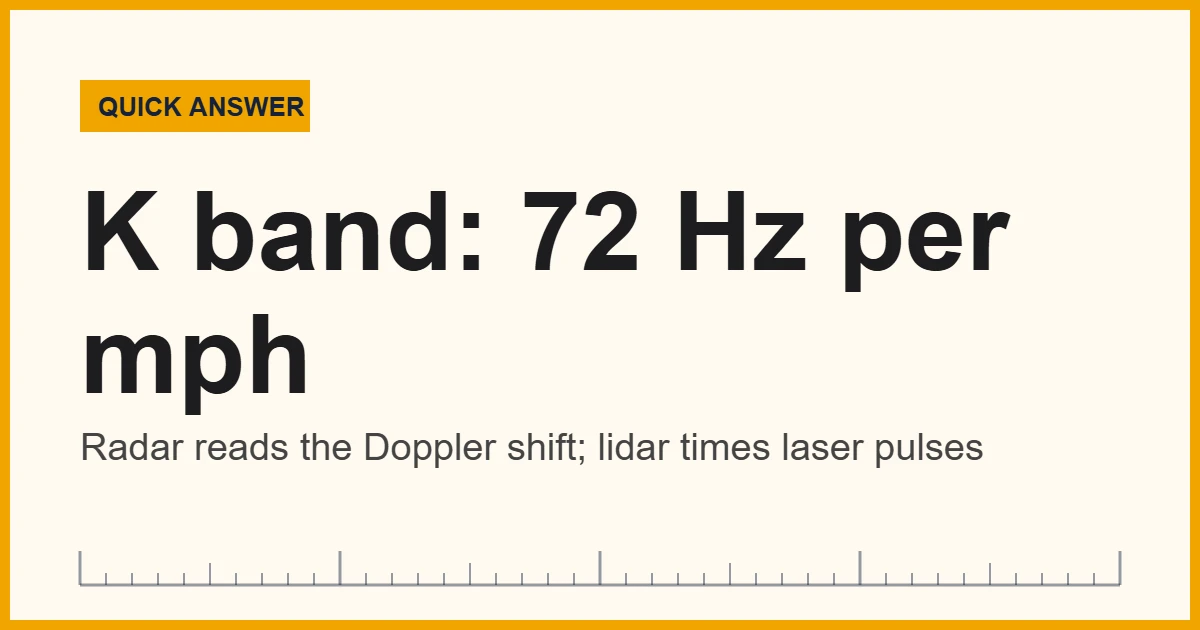
- Radar reads speed from the Doppler shift: at K band, each 1 mph adds about 72 Hz to the returned signal.
- Lidar fires 100 to 500 infrared pulses per second and calculates speed from the change in distance.
- Pacing, VASCAR, aircraft timing and average-speed cameras all divide a known distance by a measured time.
- The cosine effect makes radar and lidar read lower than true speed, never higher, when the beam is at an angle.
- Radar is checked with tuning forks; lidar is checked with fixed-distance and sight-alignment tests.
- NHTSA sets performance specs, and certified labs test devices for the Conforming Product List.
- Most states require a certified shop to check radar and its forks once or twice a year.
How Cops Measure Speed: Every Method at a Glance
Police agencies rarely rely on one tool. Instead, they mix methods depending on the road, the weather and the budget. For comparison, this table shows them side by side.
| Method | What it measures | How it works | Reading type |
|---|---|---|---|
| Radar (X, K, Ka band) | Frequency shift of radio waves | Doppler effect | Instant |
| Lidar (laser) | Round-trip time of light pulses | Time of flight, then change in range over time | Near-instant (0.3 to 0.7 s) |
| Pacing | Patrol car’s own calibrated speedometer | Officer matches the target’s speed and distance | Average over the pace |
| VASCAR | Time between two landmarks | Computer divides distance by time | Average |
| Aircraft timing | Time between painted road markings | Stopwatch over a measured distance | Average |
| Average-speed cameras | Time between two camera sites | Plate recognition at entry and exit | Average over miles |
The first two are true speed sensors. The other four, however, are timing methods. That difference matters because an average speed hides short bursts above or below it.
How Cops Measure Speed With Radar
A police radar gun sends out a continuous radio wave at a fixed frequency. Then, when the wave hits a moving car, it bounces back at a slightly different frequency. An approaching car squeezes the waves together, so the returned frequency rises; a car moving away stretches them, so it falls. In fact, this is the Doppler effect, the same thing you hear when a siren changes pitch as it passes.
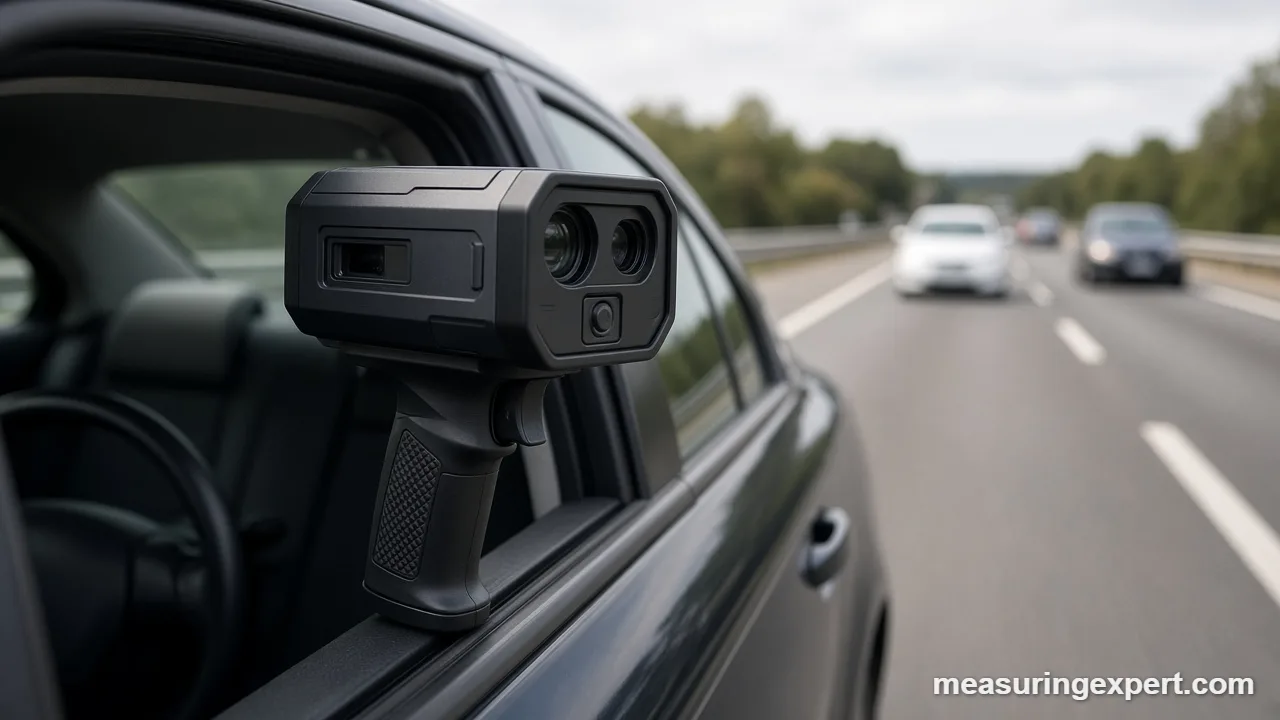
Next, the radar compares the outgoing and returned frequencies. The difference is directly proportional to speed, so the math is simple:
Doppler shift = 2 x speed x transmit frequency / speed of light
The factor of 2 appears because the wave travels to the car and back. Therefore, the shift per mph depends on the band the radar uses:
| Band | Transmit frequency | Shift per 1 mph | Shift at 60 mph |
|---|---|---|---|
| X band | 10.525 GHz | about 31.4 Hz | about 1,883 Hz |
| K band | 24.150 GHz | about 72.0 Hz | about 4,321 Hz |
| Ka band | 33.4 to 36.0 GHz | about 99.6 to 107.4 Hz | about 5,977 to 6,442 Hz |
Those shifts are tiny compared with a carrier of billions of cycles per second. Even so, modern digital signal processing picks them out reliably. Today, X band is rare in new equipment, and most current units use K or Ka band.
Stationary vs moving radar
In stationary mode, the patrol car is parked, so the radar reads the target’s speed directly. In moving mode, however, the radar has to separate two speeds. First, it tracks the strong, low-frequency return from the road ahead to find the patrol car’s own speed. Then it uses the target’s return to find the closing speed and subtracts (or adds) the patrol speed. Also, officers are trained to compare the radar’s patrol-speed figure with their speedometer as a cross-check.
Radar beams also spread out. A beam about 11 degrees wide, for example, is roughly 50 feet across at 250 feet and 200 feet across at 1,000 feet. That is why officers learn to pair a radar reading with their own visual estimate of which car is fastest.
How Cops Measure Speed With Lidar
Lidar stands for light detection and ranging. A police lidar gun fires short pulses of infrared light, usually at a wavelength of about 904 nanometers, which is invisible to the eye. Then each pulse hits the car and reflects back. Because light travels at a known speed, the gun can turn the round-trip time into a distance:
Distance = speed of light x round-trip time / 2
For reference, light covers about 0.98 feet per nanosecond. So a car 1,000 feet away sends a pulse back in roughly 2,033 nanoseconds. Next, the gun repeats this hundreds of times. Typical units send 100 to 500 pulses per second and use tens to hundreds of them for one reading, which takes about 0.3 to 0.7 seconds.
Speed is simply the change in distance divided by the time between measurements. At 60 mph, for instance, a car closes about 26.4 feet (8.05 m) in 0.3 seconds. The gun fits a line through all its distance samples and rejects readings that do not agree, so a single bad pulse cannot produce a speed.
The big practical difference from radar is beam size. A lidar beam is only about 3 to 4 milliradians wide, so it is roughly 3 to 4 feet across at 1,000 feet. As a result, an officer can single out one car in heavy traffic, something a wide radar beam cannot do on its own.
How Cops Measure Speed by Pacing and VASCAR
Before radar was common, and still today, officers often pace a car. To do this, they follow at a steady distance, match its speed, and read their own speedometer. Because a car’s speedometer can drift with tire size and wear, departments calibrate patrol car speedometers on a regular schedule and keep the certificates. In addition, many require the pace to last a set distance or time before an officer can rely on it.
VASCAR, short for Visual Average Speed Computer and Recorder, takes a different approach. The officer presses a switch when a target car passes a landmark, such as a bridge shadow or a road sign, and presses again when it passes a second landmark. Meanwhile, the device knows the distance between the two points, either measured beforehand or logged by the patrol car’s calibrated odometer. It then divides distance by time.
For example, if the two points are a quarter mile apart and the car takes 13.0 seconds, VASCAR shows 0.25 / 13.0 x 3,600 = 69.2 mph. Since VASCAR does not send any signal toward the car, it works from a parked or moving patrol car and from any angle. On the other hand, its accuracy depends on the officer’s reaction time at each switch press, so longer distances reduce the error. Finally, some states allow it, while others do not.
How Cops Measure Speed From Aircraft and Average-Speed Cameras
Some state patrols watch highways from small planes or helicopters. In Minnesota, for example, road crews paint white marks across the shoulder at quarter-mile intervals. The pilot starts a stopwatch as a vehicle passes the first marker, times it over the zone, and then radios a trooper on the ground to make the stop. This timing table shows how quickly the numbers add up:
| Speed | Time to cover 1/4 mile | Metric equivalent |
|---|---|---|
| 55 mph | 16.36 s | 88.5 km/h |
| 60 mph | 15.00 s | 96.6 km/h |
| 65 mph | 13.85 s | 104.6 km/h |
| 70 mph | 12.86 s | 112.7 km/h |
| 75 mph | 12.00 s | 120.7 km/h |
| 80 mph | 11.25 s | 128.7 km/h |
Average-speed cameras, also called point-to-point cameras, scale the same idea up to miles. First, cameras at an entry and an exit site read each license plate with automatic number plate recognition. Next, the system divides the known distance by the time between the two reads. According to National Highways in England, data for vehicles under the limit is deleted automatically. These systems are common in the UK, Australia and parts of Europe, but they are still uncommon in the US.
Why the Cosine Effect Lowers Readings
Radar and lidar measure only the part of a car’s motion that is directly toward or away from the device. When the beam meets the car at an angle, the measured speed is the true speed times the cosine of that angle. So a reading at an angle is always lower than the true speed, never higher.
| Angle between beam and car’s path | Reading for a car doing 60 mph | Reading drops by |
|---|---|---|
| 0 degrees (straight on) | 60.0 mph | 0% |
| 5 degrees | 59.8 mph | 0.4% |
| 10 degrees | 59.1 mph | 1.5% |
| 15 degrees | 58.0 mph | 3.4% |
| 20 degrees | 56.4 mph | 6.0% |
| 30 degrees | 52.0 mph | 13.4% |
| 45 degrees | 42.4 mph | 29.3% |
| 90 degrees (crossing) | 0 mph | 100% |
In practice, officers set up close to the road and aim down it, so the angle stays small and the error stays under a mile per hour or two. However, there is one well-known exception. In moving mode, if the radar reads the patrol car’s own speed too low because of an angle to the road, it can add too much to the target. For this reason, training covers it, which is why officers compare the patrol-speed display with the speedometer.
How Cops Measure Speed Accurately: The Radar Check Routine
Agencies follow a set routine so a radar reading can be trusted. Details vary by state and by department policy, but a typical shift looks like this:
- Run the internal circuit test. The radar’s self-test checks its electronics and display, usually when the unit is switched on.
- Check the light segments. The officer confirms every digit of the display lights up, so a broken segment cannot turn a 3 into a 9.
- Strike the first tuning fork. A vibrating fork held in front of the antenna should make the radar read the speed stamped on the fork.
- Do the two-fork moving test. For moving mode, one fork stands in for patrol speed and the second for the target, and the radar must show the right difference or sum.
- Log the results. The officer records the time, the readings and the fork serial numbers.
- Repeat at the end of the shift. A matching check afterward shows the unit stayed accurate the whole time.
For lidar, the routine is different because there are no forks. Instead, officers measure a known distance (a fixed-distance test), compare two known distances (a delta-distance test), and confirm the aiming sight lines up with the beam.
Calibration Standards: Tuning Forks, NHTSA and IACP
A tuning fork for radar is cut to vibrate at the exact Doppler frequency a car at a set speed would produce for one band. For example, a K-band fork marked 55 mph vibrates near 55 x 72.0 = about 3,961 Hz. In addition, each fork is labeled with its speed, its band and a serial number, and every radar normally ships with two forks at different speeds. Most states require a certified shop to test the radar and its forks once or twice a year, and departments keep those certificates for court.
Above the department level sit the national standards. Specifically, NHTSA writes model performance specifications for down-the-road radar, across-the-road radar and lidar. Since 2015, independent test facilities have checked devices against those specs; the IACP lists them as the Institute of Police Technology and Management in Florida and San Diego State University in California. In addition, state laws and court rulings decide what records an officer must show, such as fork certificates, training and the daily check log.
| Device | Daily or shift check | Periodic check |
|---|---|---|
| Radar | Internal test, light test, tuning forks | Certified shop test of unit and forks |
| Lidar | Fixed-distance, delta-distance, sight alignment | Manufacturer or certified lab check |
| Patrol speedometer (pacing) | Cross-check against radar patrol speed | Speedometer calibration certificate |
| VASCAR | Distance verified with calibrated odometer | Odometer and unit calibration |
Do and Don’t for Understanding a Speed Reading
Do
- Remember that radar and lidar read lower, not higher, at an angle.
- Note which method was used: instant or average.
- Ask whether the device was checked before and after the shift.
- Convert units with care when reading foreign sources.
- Drive at a speed that suits the road and the conditions.
Don’t
- Assume your own speedometer is perfectly accurate.
- Confuse radar (radio waves) with lidar (light pulses).
- Treat an average-speed reading as your top speed.
- Rely on internet myths about “beating” a device.
- Forget that speed changes your stopping distance.
Honest Limits of Police Speed Measurement
No method is perfect. Radar beams are wide, so in dense traffic the strongest return may come from a large truck rather than the fastest car; that is why officers must also estimate speed by eye. Lidar is precise, but heavy rain, fog or a shaky hand at long range can block a reading. Meanwhile, timing methods depend on human reaction time and on accurately measured distances. Finally, every device needs correct setup and a trained operator. NHTSA itself notes that its specs describe performance when a device is properly operated and maintained, which is the reason for all the logs and certificates.
In short, the numbers on this page come from physics and published specs. Real devices add their own tolerances, so a manufacturer’s spec sheet and your state’s rules are the final word.
When to Ask a Professional
If you have received a speeding ticket and have questions about how your speed was measured, talk to a licensed traffic attorney in your state. After all, rules on calibration records, VASCAR and aircraft evidence differ from state to state. Similarly, if you run a fleet or a school safety program and want to measure traffic speeds, a calibration lab can certify your equipment.
Frequently Asked Questions
What do cops use to measure speed most often?
Most US agencies use radar guns, often mounted in patrol cars, and handheld lidar guns. They also pace cars with a calibrated speedometer, and some use VASCAR or aircraft timing.
How do cops measure speed with radar?
A radar gun sends a radio wave at the car and measures how much the returned frequency has shifted. That Doppler shift is proportional to speed, about 72 Hz per mph at K band.
How do cops measure speed with a laser?
A lidar gun fires hundreds of infrared pulses, times how long each takes to return, and turns those times into distances. The change in distance over time gives the speed in under a second.
Is lidar more accurate than radar?
Both meet NHTSA specs when used correctly. Lidar’s main advantage is its narrow beam, which lets an officer target one car in traffic.
What is the cosine effect?
It is the drop in a radar or lidar reading when the beam meets the car at an angle. The reading equals true speed times the cosine of the angle, so it is always lower than the true speed.
How are police radar guns calibrated?
Officers check them with tuning forks that vibrate at the Doppler frequency of a set speed, plus internal and display tests. Certified shops also test the radar and forks, typically once or twice a year.
What is VASCAR?
VASCAR stands for Visual Average Speed Computer and Recorder. The officer times a car between two landmarks, and the device divides the known distance by the time.
How do cops measure speed from an airplane?
A pilot times a vehicle between white marks painted on the road at known intervals, often a quarter mile apart. The pilot then radios a ground unit to make the stop.
How do average-speed cameras work?
Two cameras read your license plate at an entry and an exit point. The system divides the distance between them by the time you took, giving your average speed.
How far off can a patrol car speedometer be?
Tire size and wear can change any speedometer reading. That is why departments calibrate patrol car speedometers on a schedule and keep certificates when officers use pacing.
The Bottom Line on How Cops Measure Speed
To sum up, police measure speed with two kinds of tools. Radar and lidar give an instant reading by using the Doppler shift of radio waves or the travel time of light pulses. Pacing, VASCAR, aircraft timing and average-speed cameras, by contrast, divide a known distance by a measured time to get an average.
Behind every reading sits a chain of checks: tuning forks and distance tests on each shift, certified shop tests every year, and NHTSA performance specs tested by independent labs. So the simplest way to stay on the right side of all of them is to watch your own speed. Use the converter above if you need a reading in km/h or m/s.