

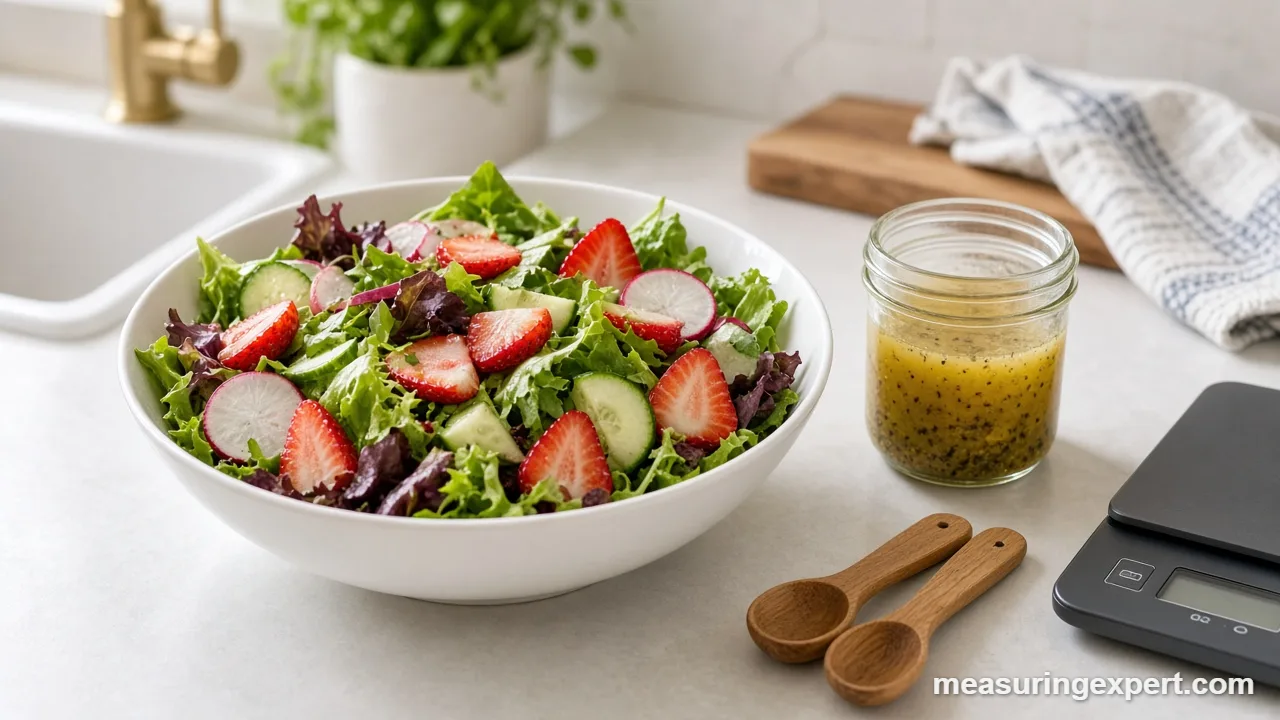
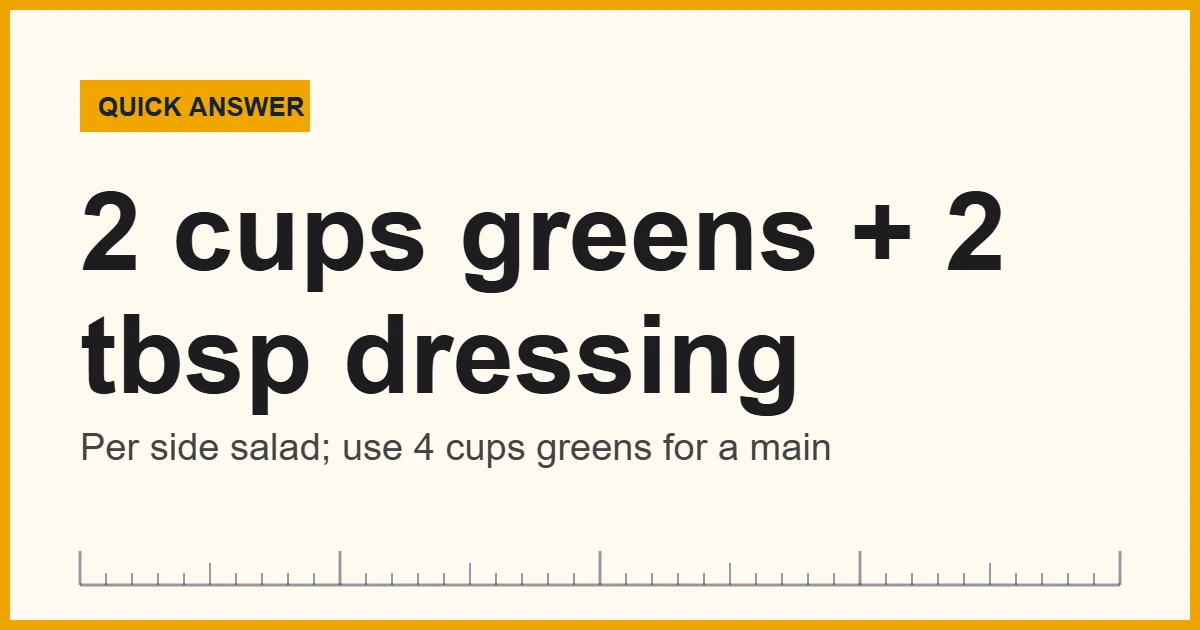
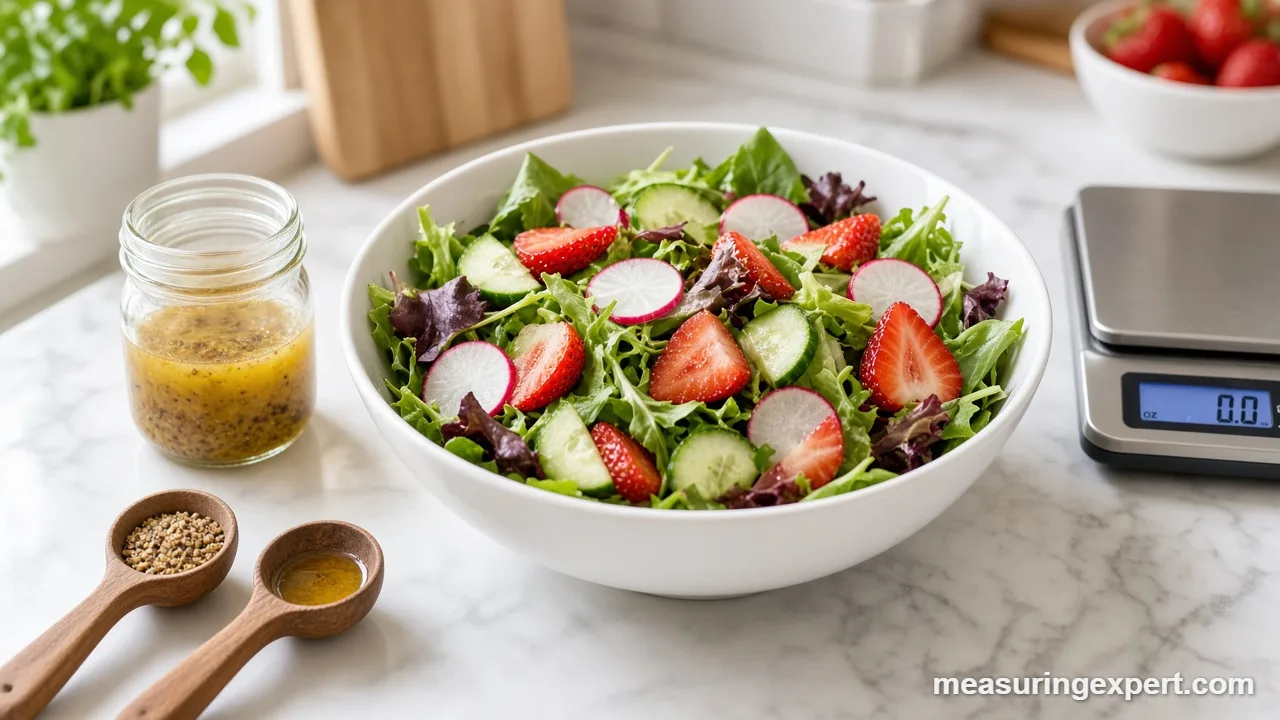
Spring salad measurements start with 2 cups of loosely packed greens for a side salad or 4 cups for a main dish. Add 2 tablespoons (30 mL) of dressing per side serving, plus about 1/4 cup of chopped vegetables. For repeatable results, weigh heavier toppings such as nuts, cheese and dried fruit on a kitchen scale.
Spring Salad Measurements Converter
Dressing recipes switch between tablespoons, fluid ounces and milliliters, and so do many salad bowls. Enter an amount below, choose the unit you have, and the converter shows the rest using exact US definitions.
A spring salad looks forgiving, yet the numbers matter more than you might expect. Too little dressing leaves the leaves dry, while too much turns them soggy within minutes. Likewise, a handful of nuts can be 15 grams or 60 grams, depending on the hand. As a result, a few fixed amounts make every bowl taste the same.
This guide covers greens, vegetables and fruit, dressing and toppings. In addition, it shows how to scale a bowl for two people or twelve. The USDA’s MyPlate vegetable guidance counts 2 cups of raw leafy greens as 1 cup of vegetables, and that single rule drives most of the portions below.
- Greens: 2 cups loosely packed per side salad, 4 cups per main-dish salad.
- Dressing: 2 tablespoons (30 mL) per side serving, about 3 tablespoons for a main dish.
- Vinaigrette: 3 parts oil to 1 part vinegar is a common starting ratio.
- Toppings: weigh nuts, cheese and dried fruit instead of scooping.
- Dress the salad just before serving, and keep the dressing in a separate container until then.
Recommended Tools for Spring Salad Measurements
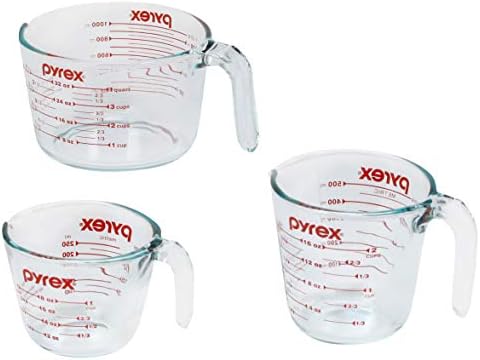
In fact, salad needs few tools. First, a salad spinner dries the leaves, which matters because wet greens weigh more and dilute the dressing. Next, a marked dressing jar shows tablespoons and ounces while you shake. Finally, a small scale and a set of measuring spoons handle the toppings and the oil.



As an Amazon Associate, Measuring Expert earns from qualifying purchases.
Spring Salad Measurements Per Serving
The table below gives a starting point for one person. A side salad sits next to a meal, whereas a main-dish salad carries the meal on its own. These amounts are practical guidelines, not strict rules, so adjust them to your appetite.
| Component | Side salad | Main-dish salad |
|---|---|---|
| Loosely packed greens | 2 cups | 4 cups |
| Chopped vegetables | 1/4 cup | 1/2 cup |
| Sliced fruit or berries | 2 tbsp | 1/4 cup |
| Nuts or seeds | 1 tbsp | 2 tbsp |
| Grated or crumbled cheese | 1 tbsp | 2 tbsp |
| Dressing | 2 tbsp (30 mL) | 3 tbsp (44 mL) |
According to MyPlate, 2 cups of raw spinach or lettuce count as 1 cup of vegetables. Therefore, a main-dish salad with 4 cups of greens supplies 2 cup-equivalents before you add any other vegetables. If you track servings for a health reason, ask a doctor or dietitian what amounts suit you.
Spring Salad Measurements for Fresh Greens
Greens are light and airy, so volume is a loose measure. A cup of tightly pressed spinach holds far more leaf than a cup of loosely tossed leaves. USDA data, as listed on this nutrient page, puts 1 cup of raw spinach at about 30 g. Other greens differ, so weigh your own bowl of greens once and write the number down.
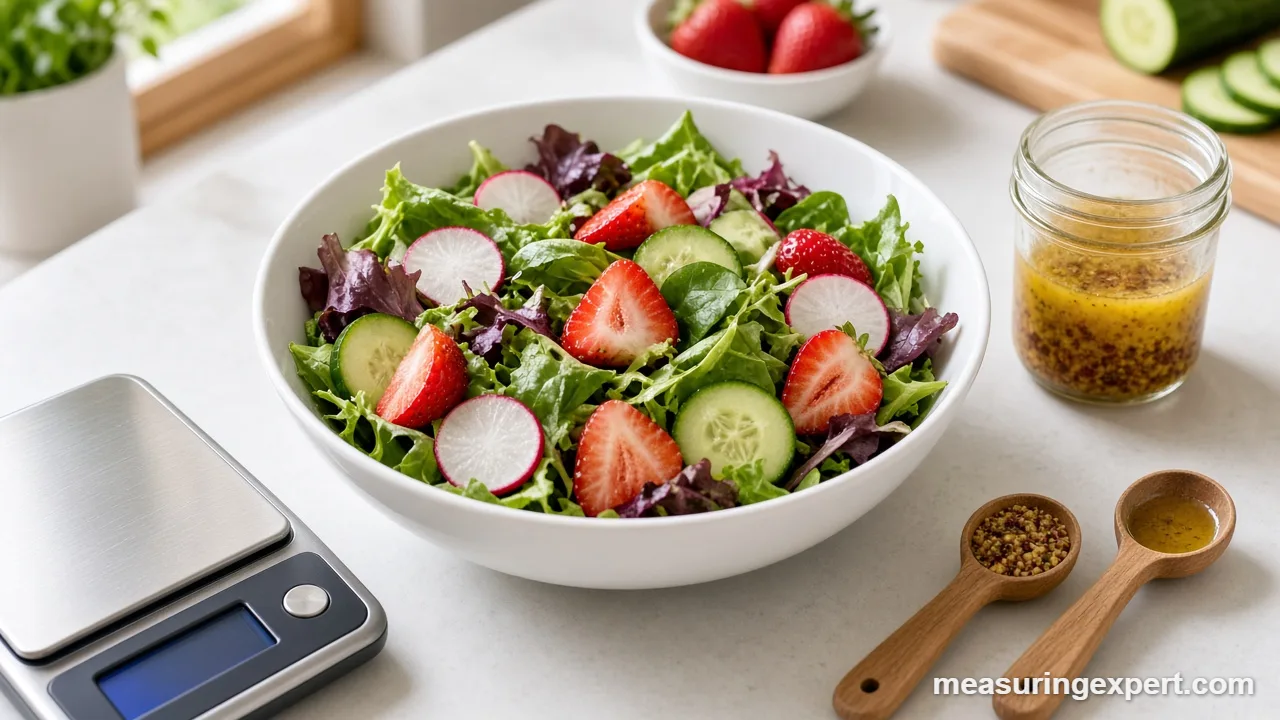
- Wash and dry the greens. Use a salad spinner or clean towel, because water adds weight.
- Tear large leaves. As a result, torn pieces settle evenly in the cup.
- Pile them in loosely. Next, fill a large cup or bowl without pressing down.
- Note the weight once. Then put the bowl on a scale, record the grams, and use that number next time.
- Add herbs last. Chop them first and measure by the teaspoon or tablespoon, because they are strong.
Vegetables and Fruit in Spring Salad Measurements
First, cut vegetables to a similar size before you measure them. Uniform pieces pack the same way every time, so a cup becomes reliable. Then fill the cup lightly, shake it once to settle the pieces, and level the top.
Sliced fruit is trickier, since juicy slices leak. Measure strawberries, oranges or apples last, and keep them in a separate bowl until you build the salad. For berries, count a loose 1/4 cup per main-dish serving, and use fewer if the berries are large.
For example, radishes, cucumbers, snap peas and green onions are typical spring picks. Because they are crisp and watery, slice them thinly so that a small amount covers the bowl.
Spring Salad Measurements for Dressing
The U.S. Food and Drug Administration lists a reference amount of 30 g for dressings in 21 CFR 101.12, which is why many labels show a serving of about 2 tablespoons. In practice, that is a handy default for a side salad.
For example, a basic vinaigrette uses 3 parts oil to 1 part vinegar. For a half-cup batch, combine 6 tablespoons of olive oil with 2 tablespoons of vinegar, 1 teaspoon of Dijon mustard and a pinch of salt. The batch measures 4 fluid ounces (118 mL), so it dresses four side salads at 2 tablespoons each. King Arthur Baking’s ingredient weight chart lists olive oil at 50 g per 1/4 cup, which makes 6 tablespoons about 75 g.
| Servings (side salads) | Oil | Vinegar | Total dressing |
|---|---|---|---|
| 2 | 3 tbsp | 1 tbsp | 1/4 cup (59 mL) |
| 4 | 6 tbsp | 2 tbsp | 1/2 cup (118 mL) |
| 8 | 3/4 cup | 1/4 cup | 1 cup (237 mL) |
| 12 | 1 1/8 cups | 6 tbsp | 1 1/2 cups (355 mL) |
Also, lemon juice can replace some of the vinegar. If you juice your own lemons, our lemon measuring guide explains how many tablespoons one lemon gives. Pickled or brined add-ins follow similar rules, and the post on measuring ingredients for pickling covers vinegar ratios in more depth.
Spring Salad Measurements for Toppings by Weight
Toppings are small, yet they add up quickly. Because scooping varies a lot, a scale gives better results. The numbers below come from King Arthur Baking’s chart, scaled with simple arithmetic.
| Topping | Chart weight | 2 tablespoons weighs about |
|---|---|---|
| Chopped walnuts | 113 g per cup | 14 g |
| Sliced almonds | 43 g per 1/2 cup | 11 g |
| Sunflower seeds | 35 g per 1/4 cup | 18 g |
| Dried cranberries | 57 g per 1/2 cup | 14 g |
| Grated Parmesan | 50 g per 1/2 cup | 13 g |
Meanwhile, fluid ounces and weight ounces are different things. If you need a refresher, read how much an ounce is before you convert toppings between the two. Likewise, if a recipe lists dressing in milliliters, 30 mL is about 2 tablespoons.
Scaling Spring Salad Measurements for a Crowd
Scaling is simple multiplication, but bowls and tongs set the limits. Greens take up a lot of room, so check your largest bowl before you multiply.
| Side servings | Greens | Chopped vegetables | Dressing |
|---|---|---|---|
| 2 | 4 cups | 1/2 cup | 1/4 cup |
| 4 | 8 cups | 1 cup | 1/2 cup |
| 8 | 16 cups (1 gallon) | 2 cups | 1 cup |
| 12 | 24 cups (1 1/2 gallons) | 3 cups | 1 1/2 cups |
For a large party, dress half the bowl and keep the rest plain. In that case, guests who want more can add it, and the leftover greens stay crisp.
How to Build a Spring Salad With Exact Measurements
- Pick a serving size. Choose side or main dish from the portion table.
- Measure the dressing. Shake the oil, vinegar and seasonings in a marked jar.
- Prepare the greens. Wash, dry and tear them, then measure them loosely.
- Weigh the toppings. Use the scale for nuts, cheese and dried fruit.
- Combine in a large bowl. Add the vegetables first and the delicate fruit last.
- Dress just before serving. Pour in about two-thirds of the dressing, toss, and taste.
- Adjust. Add the rest only if the leaves still look dry.
Common Mistakes With Spring Salad Measurements
- Packing the greens. Pressed leaves hold much more than a loose cup.
- Measuring wet leaves. Also, water adds weight and dilutes the dressing.
- Pouring dressing by eye. A glug is often 3 or 4 tablespoons, so use a spoon or marked jar.
- Dressing too early. Acid wilts tender leaves quickly, so dress late.
- Forgetting the toppings. Nuts and cheese add up fast, so weigh them.
Storing Pre-Measured Salad Ingredients
The U.S. Food and Drug Administration advises keeping perishable produce at 40 degrees F or below and drying produce after washing. In its produce safety guidance, it also says to wash produce under running water, not soap. In addition, store dry greens in a container lined with a paper towel, and keep dressing, wet fruit and toppings in separate containers. That way, each part stays fresh until you combine them.
Do and Don’t for Spring Salad Measurements
Do
- Dry the greens before you measure them.
- Weigh nuts, cheese and dried fruit.
- Use a marked jar or spoon for dressing.
- Keep dressing separate until serving.
- Write down the amounts you like.
Don’t
- Press leaves into the cup.
- Pour dressing straight from the bottle.
- Mix wet fruit in early.
- Trust a handful as a measure.
- Skip tasting before you add more.
Honest Limits of Salad Measurements
In general, salad ingredients are bulky and variable. Leaf size, moisture and how you pack the cup all shift the numbers, so the portions here are guides rather than exact values. Moreover, store-bought dressings differ in thickness, which changes how far 2 tablespoons goes. In short, treat the table as a starting point, then adjust to your bowl and your taste. A scale narrows the error, but it cannot remove it.
When Accuracy Really Matters
Usually, home salads need no special precision. However, three cases deserve care. First, someone managing a diet or a health condition may need to know portion sizes, and weighing toppings gives a more honest count. Second, people with food allergies should check labels on dressings and toppings instead of measuring by eye. Finally, a cook who feeds a crowd saves money by measuring dressing and toppings.
Frequently Asked Questions
How do you measure a serving of salad?
Use 2 cups of loosely packed greens for a side salad and 4 cups for a main dish. Add about 1/4 cup of chopped vegetables and 2 tablespoons of dressing for a side.
How do you measure 1 cup of leafy greens?
Fill a dry measuring cup loosely without pressing the leaves down, then level the top. A cup of raw spinach weighs about 30 g.
What are the right spring salad measurements for dressing?
Plan on 2 tablespoons (30 mL) of dressing per side salad and about 3 tablespoons for a main dish. Start with less and add more after you taste.
How many cups of greens make one cup of vegetables?
MyPlate counts 2 cups of raw leafy greens, such as spinach, as 1 cup of vegetables.
What is the best ratio for vinaigrette?
A common starting ratio is 3 parts oil to 1 part vinegar. For 1/2 cup, use 6 tablespoons of oil and 2 tablespoons of vinegar.
How much dressing do I need for 8 side salads?
You need 1 cup (237 mL), which is 2 tablespoons per serving. That is 3/4 cup of oil and 1/4 cup of vinegar.
Should I weigh salad toppings?
Yes. Nuts, cheese and dried fruit vary a lot when scooped. For example, 2 tablespoons of chopped walnuts weigh about 14 g.
How many tablespoons are in 1/4 cup of dressing?
There are 4 tablespoons in 1/4 cup, enough for two side salads at 2 tablespoons each.
Can I measure salad ingredients ahead of time?
Yes. Keep greens dry, dressing separate and wet fruit in its own container, all refrigerated at 40 degrees F or below.
How many cups of greens do I need for 12 people?
For 12 side salads you need about 24 cups of loosely packed greens, which is roughly 1 1/2 gallons.
Spring Salad Measurements: The Bottom Line
To sum up, use 2 cups of loose greens for a side salad, 4 cups for a main, and 2 tablespoons of dressing per side serving. Mix vinaigrette at 3 parts oil to 1 part vinegar, and weigh the toppings. Then dress the salad just before it goes to the table.
Finally, keep notes on the amounts you like. When the guest list changes, the converter at the top of this page scales the dressing, and the batch table scales everything else.