

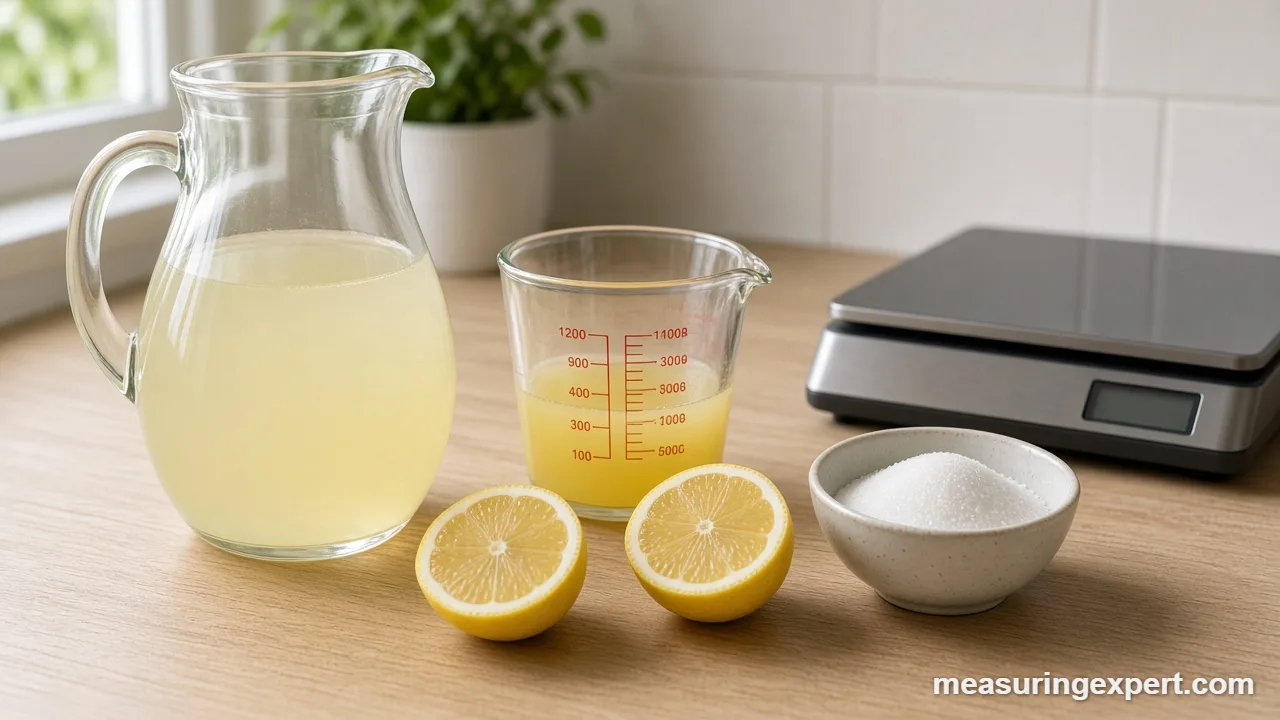
To measure lemonade ingredients, start with 1 cup (237 mL) of fresh lemon juice, 1/2 cup (99 g) of sugar and 3 cups (710 mL) of cold water. Together they make 1 quart (946 mL), or four 8-ounce glasses. Because lemons vary, plan on 5 to 8 lemons for that cup of juice, then taste and adjust the sugar.
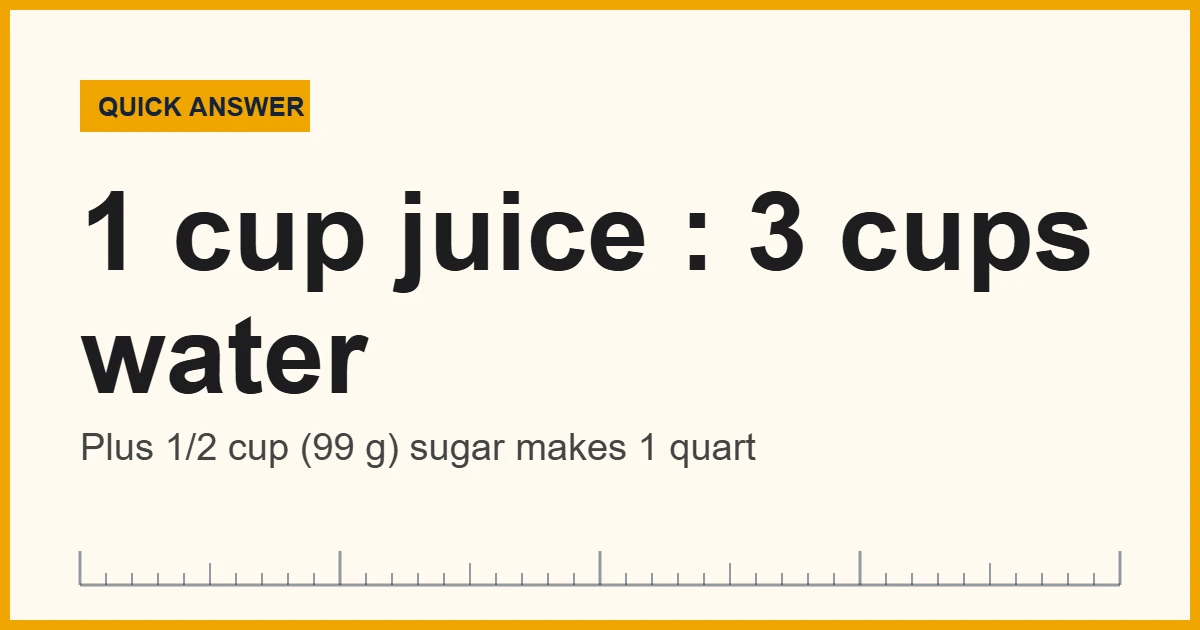
Measure Lemonade Ingredients With This Converter
Most lemonade recipes mix cups, tablespoons and milliliters. Enter an amount below, pick the unit you have, and the converter shows the other common kitchen units. It uses the exact US definitions, so it works for juice, water and syrup.
Homemade lemonade has only three main ingredients, so small errors show up fast. For instance, a little too much sugar tastes syrupy, and a little too much juice makes your face pucker. Therefore, a few clear ratios and a handful of weights will save you more time than any fancy technique.
This guide explains how to turn lemons into juice, how to set the sugar, and how to scale a single glass up to a gallon. In addition, it compares measuring by volume with measuring by weight. The US National Institute of Standards and Technology (NIST) publishes a metric kitchen table that rounds a cup to 240 mL and a tablespoon to 15 mL, and the exact US cup is 236.59 mL. This page uses the exact values and notes the rounded ones.
Recommended Tools to Measure Lemonade Ingredients
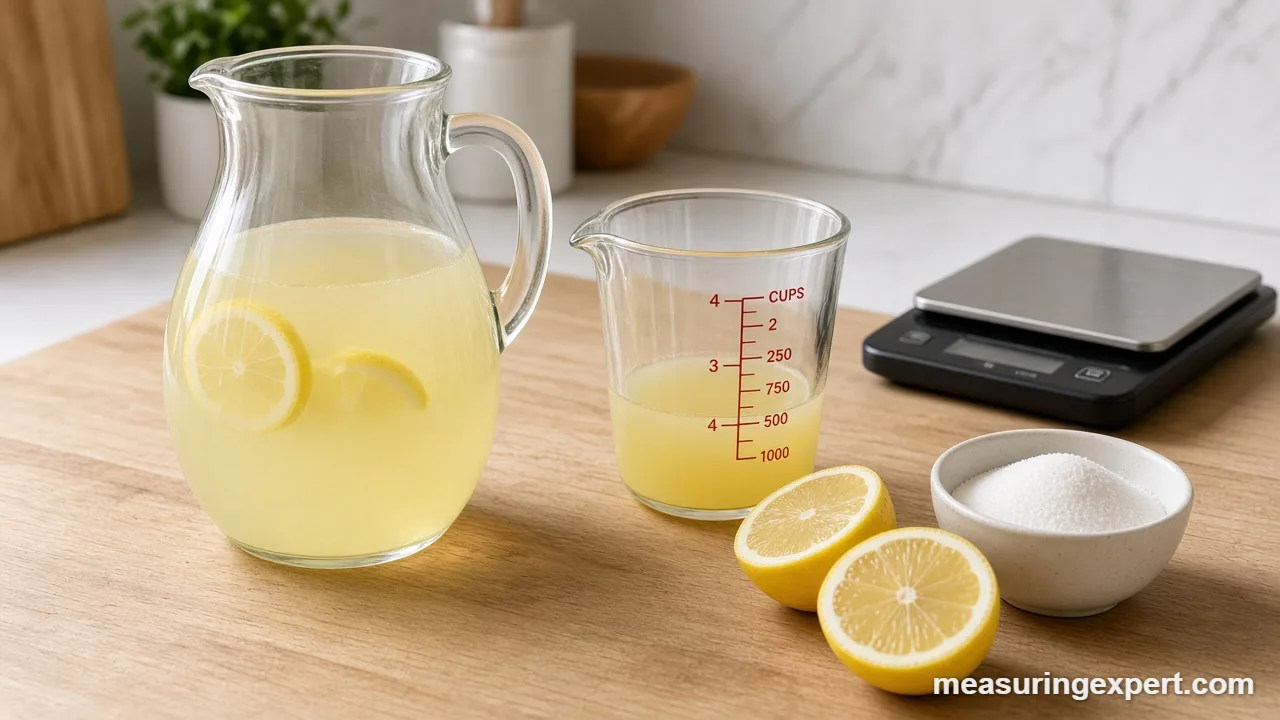
In fact, you do not need much equipment. First, a clear liquid measuring cup lets you read juice and water at eye level. Next, a set of measuring spoons helps with small sugar or salt adjustments. Also, a digital scale that reads in grams turns sugar into a repeatable number, and a hand squeezer keeps seeds out of the pitcher.

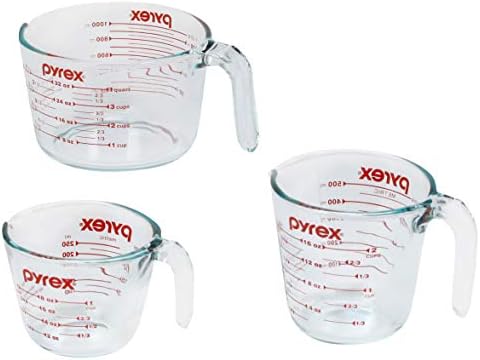


As an Amazon Associate, Measuring Expert earns from qualifying purchases.
Lemons to Juice When You Measure Lemonade Ingredients
In fact, lemon size and ripeness change the yield more than any other factor. Many cooks plan for roughly 2 to 3 tablespoons (30 to 45 mL) of juice per medium lemon. Treat that as an estimate, because a thin-skinned, heavy lemon gives more than a dry, hard one.
| Juice you need | Tablespoons | Milliliters | Lemons (estimate) |
|---|---|---|---|
| 1/4 cup | 4 | 59 mL | 1 1/2 to 2 |
| 1/2 cup | 8 | 118 mL | 3 to 4 |
| 1 cup | 16 | 237 mL | 5 to 8 |
| 2 cups | 32 | 473 mL | 11 to 16 |
| 4 cups | 64 | 946 mL | 22 to 32 |
Specifically, the lemon counts come from dividing the tablespoons by 3 and by 2. For example, 16 tablespoons divided by 3 is about 5.3, and divided by 2 is 8. As a result, it is safest to buy one or two extra lemons than the low end suggests.
Also, pulp is optional. If you strain it out, measure the juice after straining, because pulp takes up room in the cup and fools the markings.
Measure Lemonade Ingredients by Weight or Volume
Cups are quick, but weights are more repeatable. King Arthur Baking’s ingredient weight chart lists granulated sugar at 198 g per cup and lemon juice at 14 g per tablespoon. Using those figures, one cup of lemon juice is about 224 g (16 x 14 g). Water is simpler, since 1 mL weighs about 1 g, so a cup is close to 237 g.
| Ingredient | Volume | Weight | Source |
|---|---|---|---|
| Granulated sugar | 1 cup | 198 g (7 oz) | King Arthur chart |
| Superfine sugar | 1 cup | 190 g (6 3/4 oz) | King Arthur chart |
| Lemon juice | 1 tbsp | 14 g (1/2 oz) | King Arthur chart |
| Lemon juice | 1 cup | about 224 g | 16 x 14 g |
| Honey | 1 tbsp | 21 g (3/4 oz) | King Arthur chart |
| Water | 1 cup | about 237 g | 1 mL is about 1 g |
In addition, the table clears up a common mix-up. A fluid ounce measures space, while an ounce on a scale measures weight, so 8 fluid ounces of juice does not weigh 8 ounces. If that distinction is new to you, read how much an ounce is before you switch between the two.
Batch Sizes: Measure Lemonade Ingredients for a Glass or a Gallon
The balanced ratio is 1 part juice, 3 parts water and 1/2 part sugar by volume. The juice and water add up to 4 parts, and the sugar dissolves into that liquid. In other words, 1 cup of juice makes about 1 quart. The table below scales that ratio.
| Batch | Lemon juice | Sugar | Cold water | Makes |
|---|---|---|---|---|
| 1 glass | 1/4 cup (59 mL) | 2 tbsp (about 25 g) | 3/4 cup (177 mL) | 8 fl oz (237 mL) |
| 1 quart | 1 cup (237 mL) | 1/2 cup (99 g) | 3 cups (710 mL) | 4 cups (946 mL) |
| Half gallon | 2 cups (473 mL) | 1 cup (198 g) | 6 cups (1.42 L) | 8 cups (1.89 L) |
| 1 gallon | 4 cups (946 mL) | 2 cups (396 g) | 12 cups (2.84 L) | 16 cups (3.79 L) |
However, this is a starting recipe, not a tested standard. Some people want a tarter drink, so they cut the sugar to 1/3 cup (66 g) per quart. Others prefer a sweeter one and raise it to 3/4 cup (149 g). Therefore, change the sugar first and leave the juice and water alone.
Ice changes the math as well. As it melts, it adds water, so a drink poured over ice tastes weaker with each minute. Therefore, if you plan to serve over plenty of ice, mix the batch a little strong, or chill the pitcher and use less ice.
Planning drinks for a crowd? The same scaling idea works for other beverages, and our guide to measuring ingredients for cocktails covers jiggers and ounces, while the one on measuring ingredients for milkshakes covers scoops and cups.
How to Measure Lemonade Ingredients Step by Step
- Choose your batch. Pick a row from the batch table, or use the converter above to scale to your pitcher size.
- Roll and juice the lemons. First, press each lemon firmly on the counter, cut it in half and squeeze it into a bowl.
- Strain and measure the juice. Pour it through a strainer into a liquid measuring cup, set the cup on a flat surface, and read the line at eye level.
- Weigh or scoop the sugar. Next, place the pitcher on a scale and zero it. Add the sugar by weight, or spoon it into a dry cup and level it with a knife.
- Dissolve the sugar. Stir the sugar into the juice first, or make a simple syrup, until no grains remain.
- Add cold water. Measure the water in the same liquid cup, then stir well.
- Taste and adjust. Add sugar one tablespoon at a time, or add water, and write down the final amounts for next time.
Sugar, Simple Syrup and Honey
Granulated sugar works in cold lemonade, but it dissolves slowly. In contrast, superfine sugar dissolves faster. Meanwhile, simple syrup, made from equal volumes of sugar and water, blends in instantly. For instance, 1 cup of sugar (198 g) with 1 cup of water makes a syrup you can pour straight into the pitcher. Next, warm the water just enough to dissolve the sugar, and let it cool before you mix.
However, honey is stickier. Spray the measuring spoon with a little oil, or warm the jar in a bowl of warm water, so the honey slides out. Since 1 tablespoon of honey weighs about 21 g, weighing it on a scale avoids the sticky mess entirely. Taste before you add more, because honey brings its own flavor.
In addition, a tiny pinch of salt can round off the flavor. Add it only after you taste, because too much is hard to hide. Our post on how much 30 mL is is handy when you add small amounts of liquid sweetener, since 30 mL is about 2 tablespoons.
Common Mistakes When You Measure Lemonade Ingredients
- Measuring juice in a dry cup. Dry cups are filled to the rim, so spills make the reading unreliable. Instead, use a liquid cup with a spout.
- Forgetting that lemons vary. As a result, counting lemons instead of measuring juice gives uneven batches.
- Adding all the sugar at once. You cannot take sugar back out, so add it in steps.
- Mixing up cups. A US cup is 237 mL, but a metric cup is 250 mL. A UK recipe may therefore taste different from a US one.
- Skipping the chill. For example, warm water makes lemonade taste sweeter at first and flat later.
Do and Don’t for Lemonade Measuring
Do
- Measure the juice after you strain it.
- Weigh sugar when you want the same taste every time.
- Level dry measures with a straight edge.
- Read liquid cups at eye level.
- Write down your final recipe.
Don’t
- Trust the lemon count alone.
- Pour in the whole batch of sugar without tasting.
- Use a cup with worn markings.
- Pack sugar into the cup.
- Mix US and metric cups in one batch.
Honest Limits of Lemonade Measurements
In short, every number on this page is a guide. For example, lemon yields are estimates, and the ratio table is a starting recipe rather than a tested standard. Also, sugar weights depend on how finely it is ground and how it was handled, so your cup may hold a few grams more or less than 198 g. As a result, a scale is the better check when you want to repeat a batch. For a party, however, the rounded cup values work fine.
When Accuracy Really Matters
For a family pitcher, a slightly sweeter batch is no problem. However, precision matters more in three cases. First, if you sell lemonade at a stand or event, consistent batches keep customers happy. Second, if you are cutting sugar for a health reason, weighing it shows the real amount in each glass; a balanced quart has about 99 g of sugar, or roughly 25 g per 8-ounce glass before ice. Finally, if someone in your home follows a diet plan, ask a doctor or dietitian what fits.
Frequently Asked Questions
What are the measurements for lemonade?
A balanced quart uses 1 cup (237 mL) of lemon juice, 1/2 cup (99 g) of sugar and 3 cups (710 mL) of cold water. Scale the same parts up or down for other sizes.
How do I measure lemonade ingredients without a scale?
Use a liquid measuring cup for the juice and water, and a level dry cup or spoons for the sugar. One cup of sugar is 16 tablespoons, so 1/2 cup is 8 tablespoons.
How many lemons do I need for 1 gallon of lemonade?
A gallon needs 4 cups (946 mL) of juice, which is roughly 22 to 32 medium lemons. The exact number depends on how juicy they are.
How many lemons make 2 cups of juice?
Two cups is 32 tablespoons. At 2 to 3 tablespoons per lemon, that is about 11 to 16 lemons.
How much juice does one lemon give?
A medium lemon often gives about 2 to 3 tablespoons (30 to 45 mL), though size and ripeness change the result.
How much sugar should I measure for lemonade?
Start with 1/2 cup (99 g) of sugar per quart, then adjust. Use 1/3 cup (66 g) for tart lemonade or 3/4 cup (149 g) for sweet.
Should I measure lemonade ingredients by weight?
Weight is more repeatable for sugar and honey. A cup of granulated sugar is about 198 g, and a tablespoon of honey is about 21 g.
How do I make simple syrup for lemonade?
Combine equal volumes of sugar and water, such as 1 cup of each, warm until the sugar dissolves, and let it cool before you add it to the juice.
Why does my lemonade taste weak over ice?
Melting ice adds water. Mix the batch slightly stronger, or chill the pitcher and the glasses first.
How much lemonade does a quart make?
A quart is 4 cups, or 946 mL. That serves four 8-fluid-ounce glasses, before ice.
Measure Lemonade Ingredients: The Bottom Line
To sum up, a balanced quart of lemonade needs 1 cup of strained juice, 1/2 cup (99 g) of sugar and 3 cups of cold water. Lemons give about 2 to 3 tablespoons each, so measure the juice rather than counting fruit. Then taste and adjust the sugar in small steps.
Finally, write down the recipe you like. When you want a bigger or smaller batch, the converter at the top of this page does the scaling for you, and a kitchen scale makes the next pitcher taste just like this one.