

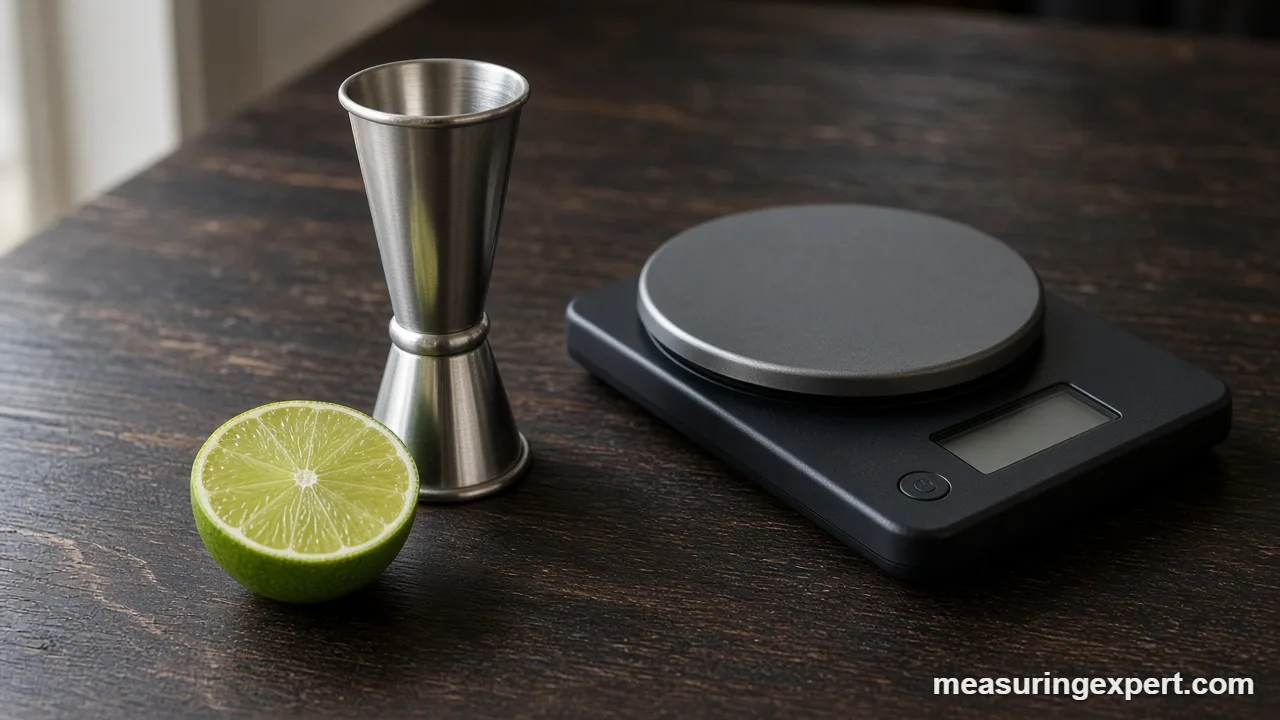
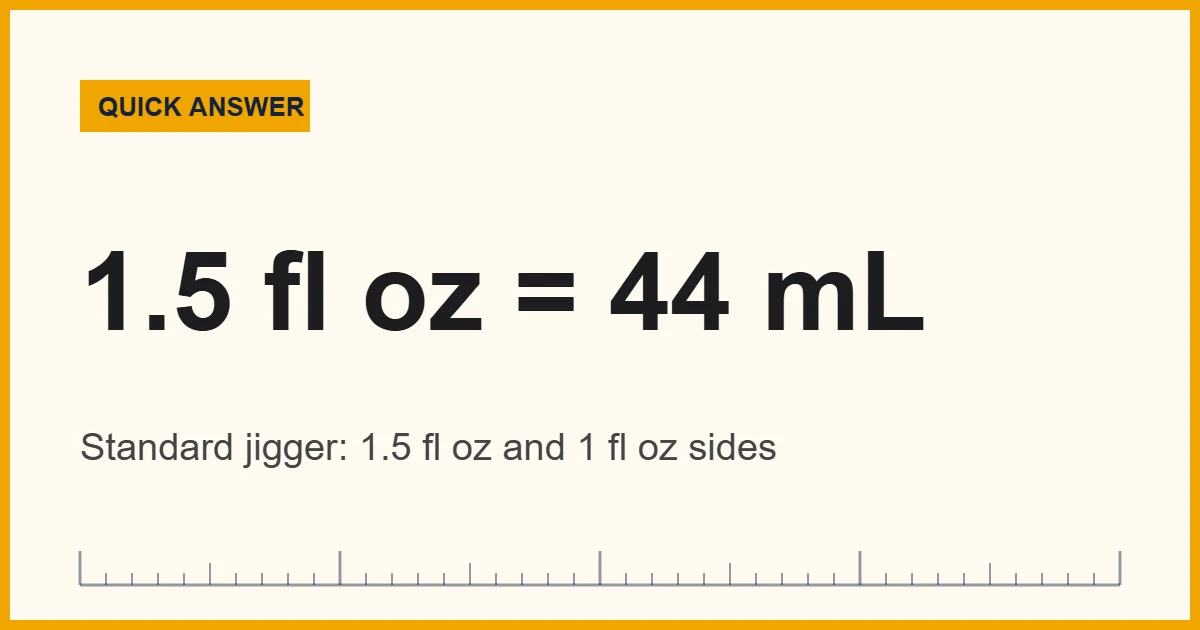
The best way to measure ingredients for cocktails is a two-sided jigger for liquids, a bar spoon or measuring spoons for small amounts, and a kitchen scale for syrups and juice batches. A standard jigger pours 1.5 fl oz (44 mL) on the large side and 1 fl oz (30 mL) on the small side.
Convert Bar Pours in Ounces, mL and Spoons
First, type a pour below and pick the unit on your jigger. The converter uses the exact US definitions, so a 1.5 fl oz pour shows as 44.36 mL, 3 tablespoons and 9 teaspoons. Adults 21 and older can use the same numbers for spirits, and anyone can use them for mocktails.
Cocktails are small recipes, so a splash too much changes the balance fast. Because most drinks contain only three or four ingredients, each pour carries a lot of weight. For example, an extra half ounce of lime juice in a 4-ounce drink adds more than 12 percent to the total volume.
Overall, the tools are simple. In short, a jigger handles most pours, a bar spoon or measuring spoon handles the small ones, and a scale is the most consistent option for syrups. This page covers jigger sizes, ratios written as “parts”, the right steps, and the mistakes that throw drinks off. It also explains how measuring helps you know how much alcohol goes into each glass.
Measurement units are the same ones used in baking. The US National Institute of Standards and Technology (NIST) lists 1 tablespoon as 15 mL, half a fluid ounce in its metric kitchen table, which is why bar tools and kitchen spoons convert so neatly.
Jigger Sizes in Ounces and Milliliters
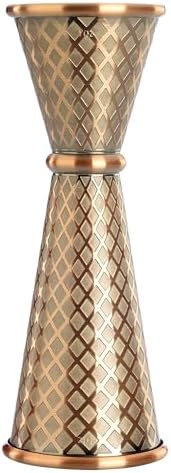
A jigger is a double-ended metal cup with one measure on each side. However, the two sides are not always the same pair of sizes, so check the engraving before you pour. Most American recipes assume a 1.5 fl oz large side and a 1 fl oz small side, but other pairings exist.
| Jigger or measure | US fluid ounces | Milliliters | Tablespoons |
|---|---|---|---|
| Pony (small side) | 1 | 29.57 | 2 |
| Standard large side | 1.5 | 44.36 | 3 |
| Japanese-style double (large side) | 2 | 59.15 | 4 |
| Half-ounce marking | 0.5 | 14.79 | 1 |
| Three-quarter-ounce marking | 0.75 | 22.18 | 1 1/2 |
| Quarter-ounce marking | 0.25 | 7.39 | 1/2 |
Some jiggers are engraved in metric instead, such as 30 mL and 60 mL. A 30 mL pour is about 1.5 percent larger than 1 fl oz (29.57 mL). Likewise, a 60 mL pour is about 1.4 percent larger than 2 fl oz. As a result, mixing metric and US jiggers in one recipe slightly shifts the balance. For more small-volume conversions, see our guide to how much 30 mL is and the older unit explained in what a gill measurement is.
Recommended Tools to Measure Ingredients for Cocktails
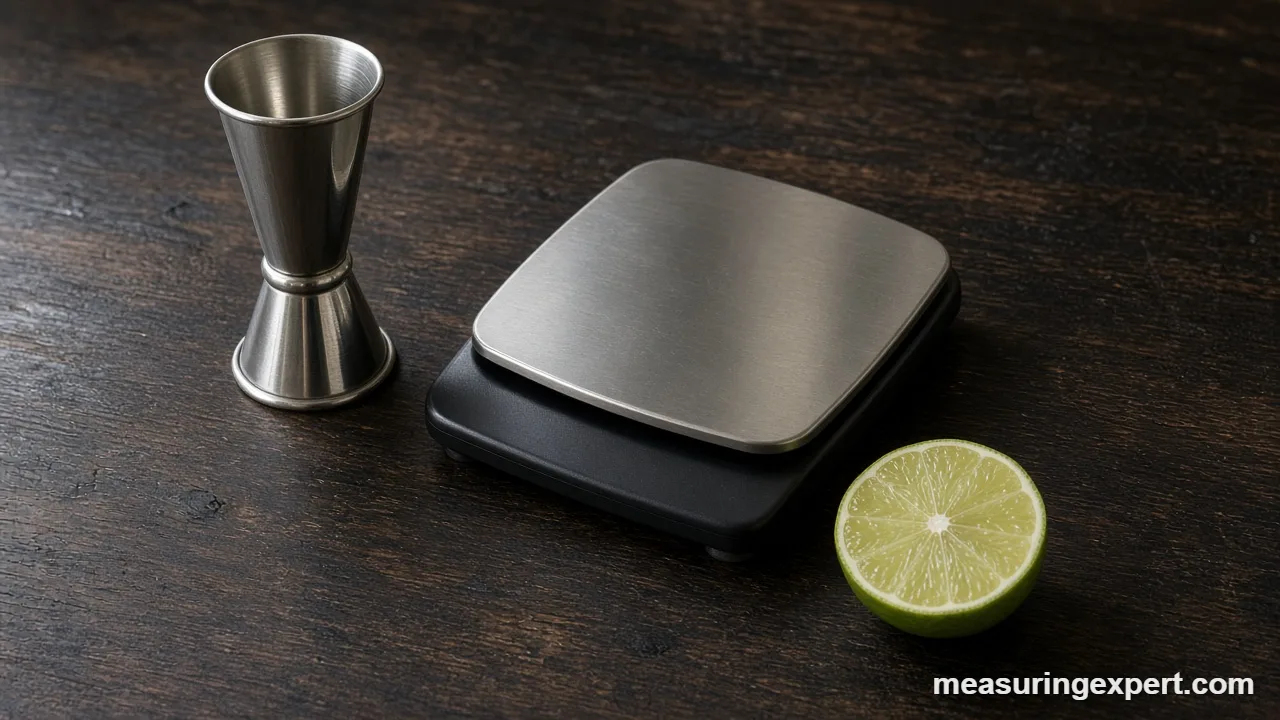
Fortunately, you do not need a full bar kit. First, pick a jigger with clear markings inside the cup, because lines you can see at eye level are easier to read than lines on the outside. Next, add measuring spoons for small amounts such as bitters, syrups and a spoonful of liqueur. Finally, a digital kitchen scale with a tare button lets you build drinks by weight in a mixing glass.




As an Amazon Associate, Measuring Expert earns from qualifying purchases.
Key Takeaways
- A standard jigger holds 1.5 fl oz (44.36 mL) on one side and 1 fl oz (29.57 mL) on the other.
- 1 fl oz equals 2 tablespoons, or 6 teaspoons.
- A ratio such as 2:1:1 uses “parts”, and a part can be any unit as long as you keep it the same.
- Pour at eye level and fill to the brim for the most repeatable result.
- Syrups are denser than water, so a scale reads higher than the volume suggests.
- Ice adds water, so the finished drink is larger than the pours alone.
- Drinks are for adults 21 and older, and measuring is also a way to know what is in the glass.
Cocktail Ratios and Parts Explained
Instead of ounces, many recipes use ratios. A “part” is a placeholder for whatever unit you choose, so 2:1:1 means two parts of one ingredient and one part each of the other two. Therefore, you can use a 1 fl oz part for a single drink or a 4 fl oz part for a pitcher, and the balance stays the same.
| Ratio | With a 1 fl oz part | With a 30 mL part | Total before ice |
|---|---|---|---|
| 2:1:1 | 2 + 1 + 1 fl oz | 60 + 30 + 30 mL | 4 fl oz (118.29 mL) |
| 3:1 | 3 + 1 fl oz | 90 + 30 mL | 4 fl oz (118.29 mL) |
| 2:1 | 2 + 1 fl oz | 60 + 30 mL | 3 fl oz (88.72 mL) |
| 1:1:1 | 1 + 1 + 1 fl oz | 30 + 30 + 30 mL | 3 fl oz (88.72 mL) |
Keep one point in mind: a ratio tells you proportion, not strength. Two drinks built on the same ratio can differ a lot in alcohol content if they use different spirits or liqueurs. In addition, a “part” must stay the same unit for the whole recipe. If you pour one ingredient in ounces and another in milliliters, the ratio no longer holds.
How to Measure Ingredients for Cocktails Step by Step
- Read the recipe units. Check whether it uses ounces, milliliters or parts, and pick a jigger that matches.
- Set the jigger on a flat surface or hold it level. A tilted jigger gives a short pour.
- Pour smallest first. Measure the juice and syrup before the spirit, so a mistake costs you less.
- Fill to the brim. Look at the jigger from the side at eye level instead of from above.
- Tip it straight into the shaker or mixing glass. Let the last drops fall before you move on.
- Use spoons for small amounts. A bar spoon is commonly treated as one teaspoon, about 5 mL, but check yours against a measuring spoon.
- Rinse between sticky ingredients. Syrup that clings to the cup throws off the next pour.
Measuring by Weight Instead of Volume
A scale removes the guesswork about brim lines and sticky syrups. For example, water weighs about 1 g per mL, so 30 mL of lime juice is close to 30 g. Spirits are lighter than water because alcohol is less dense. An 80-proof spirit is about 0.95 g per mL, so a 1.5 fl oz pour weighs roughly 42 g.
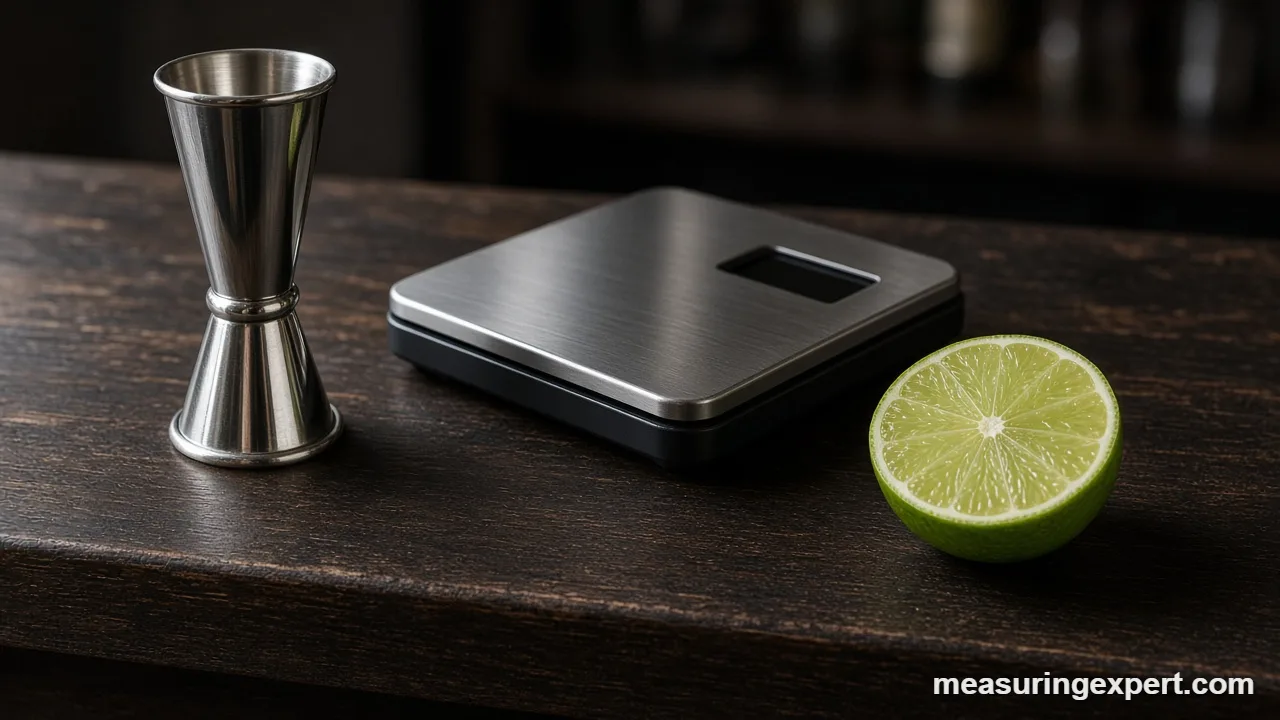
Sugar syrups go the other way. A 1:1 syrup made by weight is roughly 1.23 g per mL, so 3/4 fl oz (22.18 mL) weighs about 27 g. As a result, a recipe that says “27 g of syrup” and one that says “3/4 oz of syrup” match only if you use that density. Our guide to dry and liquid measurements explains why weight and volume are not interchangeable.
| Ingredient | Approximate density | 1 fl oz weighs about |
|---|---|---|
| Water, lime or lemon juice | about 1.0 g/mL | 30 g |
| 80-proof spirit | about 0.95 g/mL | 28 g |
| 1:1 simple syrup (by weight) | about 1.23 g/mL | 36 g |
The weights above are estimates, so treat them as a guide and tare your own glass instead of trusting a printed number.
Common Measuring Mistakes
- Free pouring by count. Counting “one, two, three” varies with bottle, spout and mood, so the pour size changes from drink to drink.
- Mixing US and metric jiggers. The roughly 1.5 percent gap adds up when you batch drinks.
- Reading the jigger from above. You see the rim, not the line, so you overfill or underfill.
- Ignoring dilution. Shaking or stirring with ice adds meltwater, so the drink in the glass is larger and weaker than the pours suggest.
- Treating a dash as a unit. Bottle designs differ, so a dash is a rough idea and not a defined volume.
- Using a coffee mug or a shot glass. Shot glasses are sold in several sizes, and the line is not always marked.
Do and Don’t at the Bar Cart
Do
- Check your jigger’s engraving in ounces or milliliters.
- Measure juice and syrup before spirits.
- Write down the pour sizes of drinks you like.
- Level spoonfuls of sugar or salt rims.
- Offer a measured mocktail version.
Don’t
- Pour by eye when making several drinks.
- Swap ounces and milliliters mid-recipe.
- Count the ice as part of the volume.
- Assume every shot glass holds 1.5 fl oz.
- Use a measuring cup meant for baking when you need a 1/2 oz pour.
Honest Limits of Bar Measurements
Overall, jiggers are accurate to the line, not to the milliliter. Wall thickness, the angle of your hand, and the surface tension of a full cup all move the result by a few percent. In practice, this is fine for a single drink. However, for a large batch, errors repeat, so weigh the ingredients or measure the batch in a marked pitcher.
Also, ice changes everything after the pour. The amount of water added depends on ice size, shaking time and how warm the glass was. For that reason, two cocktails built from identical pours can still differ in the glass. Measurements make a drink repeatable, but they cannot control everything.
Measure Ingredients for Cocktails and Know What You Pour
Measuring also tells you how much alcohol is in a drink. The National Institute on Alcohol Abuse and Alcoholism (NIAAA) defines a standard drink in the United States as 0.6 fl oz or 14 grams of pure alcohol. That equals a 1.5 fl oz shot of 80-proof spirits, 5 fl oz of table wine at about 12 percent alcohol by volume, or 12 fl oz of regular beer at about 5 percent.
Many cocktails contain more than one shot. For instance, a drink with 3 fl oz of 80-proof spirit holds about two standard drinks before any mixer. Moreover, a pour from a large glass or a heavy hand can go well past the recipe. A jigger keeps the amount visible, which helps adults decide how much they want to drink, if they drink at all.
Finally, moderation is a personal and medical question. If you have a health condition, take medicine or are pregnant, ask your doctor about alcohol. For a drink with the same flavor but no alcohol, use the same measures and swap the spirit for a non-alcoholic alternative.
Frequently Asked Questions
How do I measure ingredients for cocktails at home?
Use a two-sided jigger for liquids, measuring spoons for small amounts, and a scale for syrups. Fill to the brim, hold the jigger level, and keep one unit system for the whole recipe.
Is a jigger 1 oz or 2 oz?
Both exist. The most common US jigger holds 1.5 fl oz on the large side and 1 fl oz on the small side, while Japanese-style jiggers often pair 1 fl oz with 2 fl oz. Check the engraving.
How many mL are in a standard jigger?
A 1.5 fl oz jigger holds about 44.36 mL, and the 1 fl oz side holds about 29.57 mL. Metric jiggers are often 30 mL or 45 mL.
What is the 2:1:1 rule for cocktails?
The 2:1:1 rule uses two parts spirit, one part sweet and one part sour. With a 1 fl oz part, that is 2 fl oz, 1 fl oz and 1 fl oz.
What does 3 parts to 1 part mean in a cocktail?
It means three equal units of one ingredient for each unit of another. With a 1 fl oz part, 3:1 is 3 fl oz of one and 1 fl oz of the other.
Can I measure ingredients for cocktails without a jigger?
Yes. Use tablespoons, because 1 fl oz is 2 tablespoons and 1.5 fl oz is 3 tablespoons. A marked measuring cup or an oral syringe in mL also works.
How many tablespoons are in 1.5 oz of liquid?
There are 3 tablespoons in 1.5 US fluid ounces, which equals 9 teaspoons or about 44.36 mL.
How big is a bar spoon?
A bar spoon is commonly treated as one teaspoon, about 5 mL, though the bowl size varies by brand. Compare yours with a measuring teaspoon before relying on it.
Should I measure ingredients for cocktails by weight?
Weight is more consistent for syrups and batches. Remember that syrups and spirits have different densities than water, so use grams from a recipe written in grams.
How much alcohol is in one standard drink?
In the United States, one standard drink contains 0.6 fl oz or 14 grams of pure alcohol. That is about a 1.5 fl oz shot of 80-proof spirits. Adults must be 21 or older to drink.
Measure Ingredients for Cocktails: The Bottom Line
To sum up, a jigger, a set of spoons and a scale cover almost every pour. Remember 1 fl oz is 29.57 mL or 2 tablespoons, and a standard jigger holds 1.5 fl oz. Keep one unit for the whole recipe, and expect ice to add water.
Finally, use the converter at the top whenever a recipe gives you a different unit. Measure for flavor and consistency, drink responsibly if you are 21 or older, and never drink and drive.