

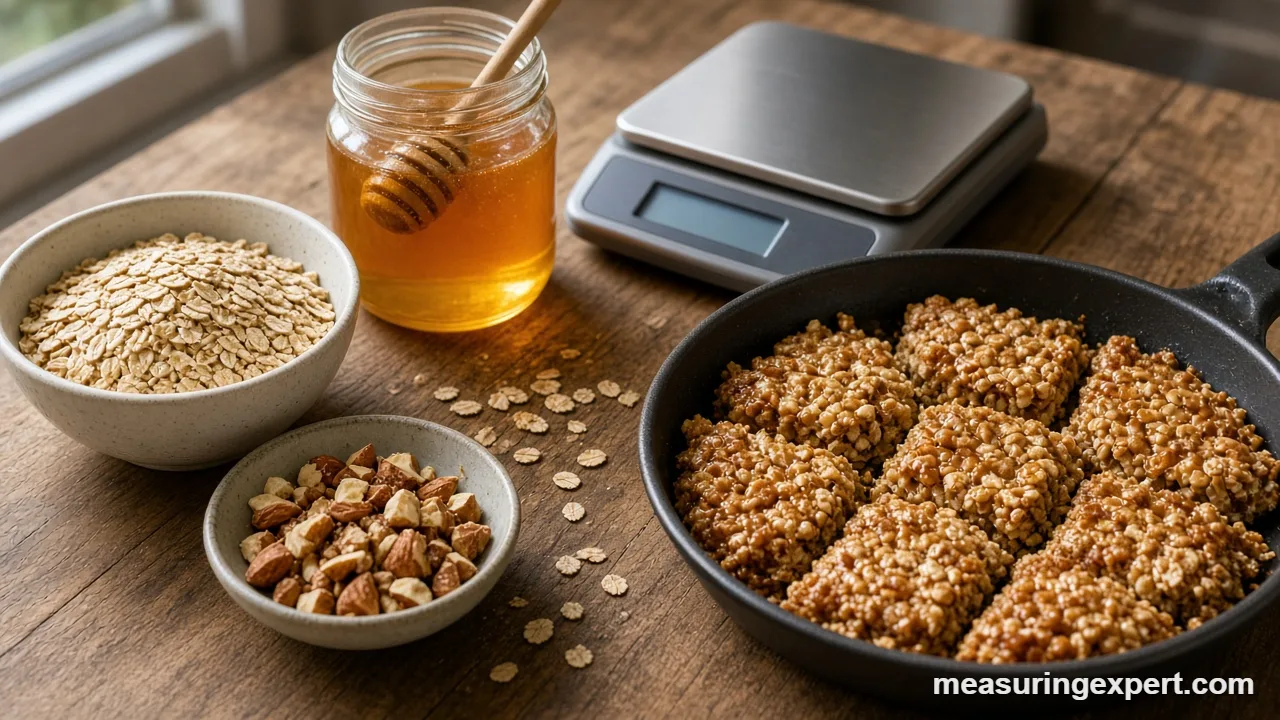
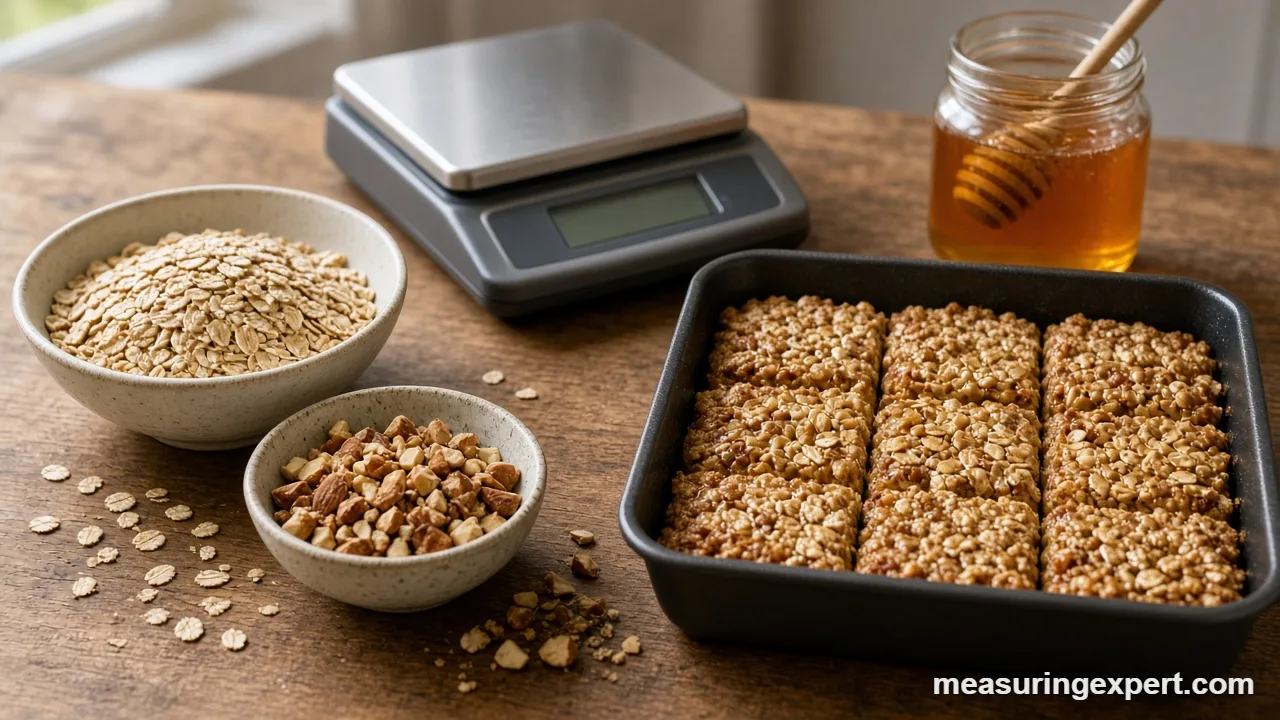
To measure granola bar ingredients accurately, weigh them on a digital kitchen scale instead of scooping. One cup of rolled oats is about 113 g (4 oz), a cup of packed brown sugar is about 213 g, and a tablespoon of honey is about 21 g. Weights stay the same however you pack the cup, so every batch turns out alike.
Convert Grams and Ounces for Your Granola Bars
First, enter an amount from your recipe below. The converter then shows the same weight in grams, ounces and pounds, so you can follow a recipe written in either system.
Homemade granola bars are simple on paper: oats, nuts, a sticky binder and a few add-ins. In practice, however, the bars either crumble apart or turn into a sticky slab when the proportions drift. Because oats, nuts and chips are bulky, a cup of each can hold very different amounts depending on how you fill it.
This guide explains how to measure granola bar ingredients with cups, spoons and a scale. First, you will see typical weights for the usual ingredients. Next, you will get a worked example, a scaling table for bigger pans, and a list of mistakes that cause crumbly bars. The weights come from the King Arthur ingredient weight chart, and the volume equivalents follow the NIST metric kitchen table.
- A scale is the most reliable way to measure granola bar ingredients, because weight does not change with packing.
- Typical weights per US cup: rolled oats 113 g, chopped nuts 113 g, chocolate chips 170 g, packed brown sugar 213 g.
- Honey weighs about 21 g per tablespoon, so a half cup is roughly 168 g.
- Bars hold together when the sticky binders weigh roughly two thirds as much as the dry mix.
- Scale a recipe by pan area: a 9×13-inch pan is about 1.8 times an 8×8-inch pan.
- Oats need to be labeled gluten-free if the bars must be gluten-free.
Why Weigh Instead of Scoop When You Measure Granola Bar Ingredients
First, a cup measures volume, not amount. Rolled oats are light and fluffy, so a cup that is shaken down holds noticeably more than a cup that is spooned in loosely. Nuts behave the same way, since big pieces leave air gaps while chopped ones pack tight. As a result, two cooks following the same cup-based recipe can end up with bars that differ by 10 percent or more in dry content.
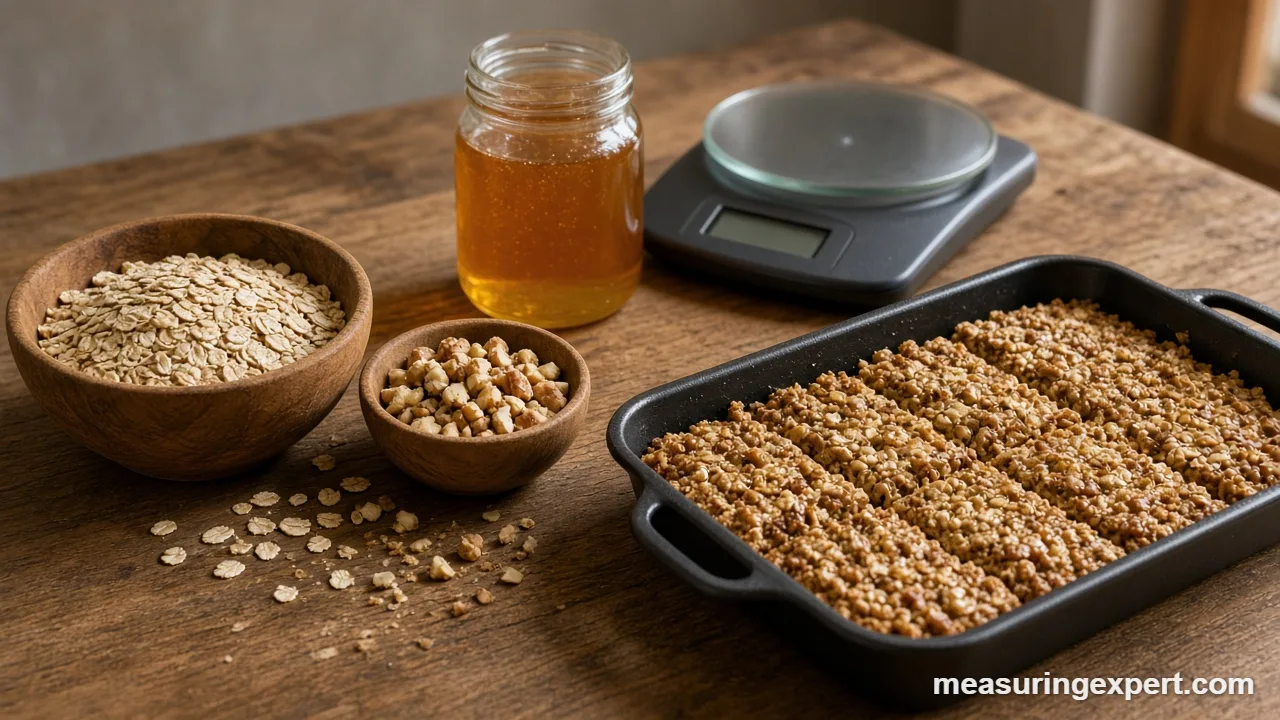
In addition, sticky ingredients add a second problem. Honey and peanut butter cling to the cup, so some of what you measured never reaches the bowl. Therefore, weighing solves both issues. In addition, you can place the bowl on the scale and add each ingredient in turn, which means fewer cups to wash.
| Method | Best for | Main weakness |
|---|---|---|
| Kitchen scale (grams) | Every ingredient, especially oats, nuts and binders | Needs a scale with a tare button |
| Dry measuring cups | Oats, nuts, chips when you level them | Packing changes the amount |
| Liquid measuring cup | Water, milk, melted butter | Honey and syrup stick to the sides |
| Measuring spoons | Vanilla, salt, cinnamon, baking soda | Heaping versus level changes the amount |
Recommended Tools to Measure Granola Bar Ingredients
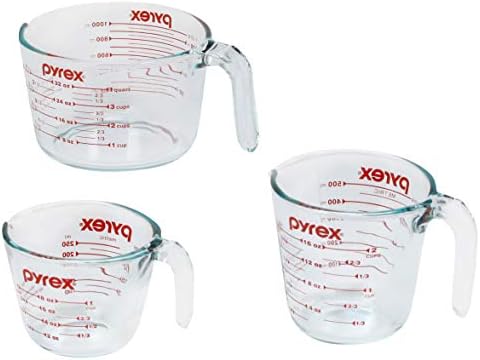
In fact, you do not need much equipment. First, a digital scale with a tare function and gram readout covers most jobs. Next, a set of metal measuring spoons handles salt and vanilla. Finally, a clear liquid measuring cup is useful when a recipe lists water or melted butter by volume.




As an Amazon Associate, Measuring Expert earns from qualifying purchases.
Granola Bar Ingredient Weights Chart
First, use these weights as a starting point. They are averages from published charts, so your own oats or nuts may differ a little.
| Ingredient | Per 1 US cup | Per 1/2 cup | Notes |
|---|---|---|---|
| Rolled oats | 113 g (4 oz) | 57 g | Old-fashioned oats; quick oats pack differently |
| Chopped nuts | 113 g (4 oz) | 57 g | Walnuts or cashews |
| Chocolate chips | 170 g (6 oz) | 85 g | Standard semisweet |
| Sweetened shredded coconut | 85 g (3 oz) | 43 g | Unsweetened is lighter, about 53 g per cup |
| Packed brown sugar | 213 g (7 1/2 oz) | 107 g | Press it into the cup |
| Peanut butter | 270 g (9 1/2 oz) | 135 g | Smooth, stirred well |
| Honey | 336 g (about 12 oz) | 168 g | 21 g per tablespoon |
| Maple syrup | 312 g (11 oz) | 156 g | Thinner than honey |
For small amounts, use the NIST kitchen rounding: 1 teaspoon is about 5 mL, 1 tablespoon is about 15 mL, and 1 cup is about 240 mL. If you need the exact definitions, our guide to how much 30 mL is lists them.
How to Measure Granola Bar Ingredients Step by Step
- Set up the scale. Place a large mixing bowl on it and press the tare button so the display reads zero.
- Weigh the oats and nuts. Add rolled oats, then tare again and add the chopped nuts.
- Add the small dry items. Next, use level measuring spoons for salt and cinnamon, and weigh seeds or coconut.
- Weigh the binder in a second bowl. Tare the scale, add honey or syrup, then peanut butter, then brown sugar.
- Warm the binder gently. A few seconds in the microwave or a minute in a pan makes it pour freely, and it also mixes in evenly.
- Combine and press. Stir the binder into the dry mix, then press it firmly into a lined pan with a flat-bottomed cup.
- Add chips last. Weigh the chocolate chips and fold them in once the mix has cooled slightly, so they do not melt completely.
A Worked Example for a Chewy 8×8-Inch Pan
The table below shows one way to plan a batch of 12 bars. It is a planning example built from the weights above, not a tested recipe, so adjust it to your own taste.
| Ingredient | Cups and spoons | Weight |
|---|---|---|
| Rolled oats | 3 cups | 339 g |
| Chopped nuts | 1 cup | 113 g |
| Chocolate chips | 1/2 cup | 85 g |
| Honey | 1/2 cup | 168 g |
| Peanut butter | 1/2 cup | 135 g |
| Packed brown sugar | 1/4 cup | 53 g |
| Salt and vanilla | 1/4 tsp and 1 tsp | by spoon |
In this example the dry mix weighs 537 g and the three binders weigh 356 g. In other words, that is a dry-to-binder ratio of about 1.5 to 1. Likewise, a mix with more binder gives chewier bars, while a mix with less gives crunchier ones that may crumble. For this reason, change the binder by 20 to 30 g at a time and write down what you did.
Meanwhile, many recipes quote a simple ratio of 2 to 1 for oats to honey. The example above uses about 2 g of oats per gram of honey, which fits that rule. However, nut butter and sugar also act as binders, so the total binder weight is the better number to track.
Scaling Granola Bar Ingredients for a Bigger Pan
First, scale by the pan’s area, not by its width. An 8×8-inch pan covers 64 square inches (about 413 cm2), while a 9×13-inch pan covers 117 square inches (about 755 cm2). Therefore the larger pan needs about 1.8 times as much mix to keep bars the same thickness. However, if you round that to 2 times, the bars come out slightly thicker, which is usually fine.
| Ingredient | 8×8 pan (1x) | 1.5x | 9×13 pan (about 2x) |
|---|---|---|---|
| Rolled oats | 339 g | 508 g | 678 g |
| Chopped nuts | 113 g | 170 g | 226 g |
| Honey | 168 g | 252 g | 336 g |
| Peanut butter | 135 g | 202 g | 270 g |
| Packed brown sugar | 53 g | 80 g | 106 g |
| Chocolate chips | 85 g | 128 g | 170 g |
Scaling is where weighing pays off most. For example, multiplying grams is easy, whereas multiplying 3/4 cup by 1.5 is not. Salt and spices need extra care, though, because they do not always scale in a straight line. Instead, start with the scaled amount, then taste the mix before pressing it into the pan.
Common Mistakes When You Measure Granola Bar Ingredients
In fact, most failed batches trace back to a few habits. Fortunately, each one is easy to fix.
- Scooping oats straight from the bag. This compacts them and adds extra weight. Spoon them into the cup or, better, weigh them.
- Using a liquid cup for dry ingredients. Because of the headspace, level measuring is impossible.
- Leaving honey in the cup. Some of it stays behind, so the bars end up too dry.
- Mixing up quick and old-fashioned oats. Quick oats are cut finer and absorb more binder, which changes the texture.
- Skipping the press. Bars that are not packed firmly fall apart, even with the right ratio.
- Heaping the measuring spoons. A heaping spoonful holds more than a level one, so salt and baking soda end up too strong.
Swaps for Gluten-Free and Lower-Sugar Bars
Substituting changes both the weight and the stickiness, so weigh the replacement instead of copying the cup measure. For gluten-free bars, choose oats labeled gluten-free. The FDA sets the limit for that claim at less than 20 parts per million of gluten. Regular oats can pick up wheat in the field or at the mill, so they do not qualify unless the package says so.
To cut sugar, reduce the brown sugar first, since honey and nut butter do most of the binding. Next, replace each 10 g of sugar you remove with about 10 g of extra nut butter or a spoonful of mashed banana, then check the texture. In contrast, swapping honey for maple syrup makes the mix thinner, so expect softer bars unless you add a few more oats.
Do and Don’t for Accurate Granola Bars
Do
- Tare the scale between ingredients.
- Write down your grams once a batch works.
- Weigh sticky binders directly into the bowl.
- Level spoonfuls of salt and spices.
- Press the mix firmly into the pan.
Don’t
- Shake or pack oats into the cup.
- Swap quick oats for rolled oats one for one without checking.
- Scale salt exactly when doubling a recipe.
- Rely on a cup of honey leaving the cup clean.
- Cut the bars while they are still warm.
Honest Limits of These Numbers
However, every weight on this page is an average. For example, brands of oats differ in flake thickness, nuts differ in chop size, and honey density shifts with moisture. In short, a cup of oats from one bag may weigh 5 to 10 g more or less than a cup from another. The chart is therefore a guide for planning, and your own scale is the final check. Oven temperature, pan material and bar size also affect the result, so a batch may need small changes the first time you try a new recipe.
When Accuracy Really Matters
For a casual snack, a little variation does no harm. However, precision matters more in three situations. First, if you sell or share bars, consistent weights keep each bar the same size. Second, if you count nutrition for a diet, grams are far more reliable than cups. Third, if you cook for someone with an allergy, you need to know exactly which ingredients went in.
Frequently Asked Questions
How do I measure granola bar ingredients without a scale?
First, use dry measuring cups for oats, nuts and chips, and level each one with a straight edge. Also, spoon ingredients in rather than scooping, and oil the cup before measuring honey so it slides out.
How much does a cup of rolled oats weigh?
A cup of rolled oats weighs about 113 g, or 4 oz, according to the King Arthur ingredient weight chart. In addition, packing the cup tightly can add several grams.
What ratio of dry to wet ingredients works for granola bars?
A good starting point is about 1.5 to 2 parts dry mix to 1 part sticky binders by weight. More binder makes chewy bars, and less makes crunchy ones.
How many grams is a cup of honey?
A cup of honey is about 336 g, based on 21 g per tablespoon and 16 tablespoons per cup. Half a cup is about 168 g.
Should I measure granola bar ingredients by weight or volume?
Weight is better because a scale removes the effect of packing and sticky residue, and it makes scaling a recipe much easier.
What helps homemade granola bars stick together?
A balanced binder of honey or syrup plus nut butter, a firm press into the pan, and enough cooling time. Too little binder is the most common cause of crumbling.
Should I soak oats before making granola bars?
No. Rolled oats absorb moisture from the binder as the bars set, and soaking would make the mix too wet. Toasting them briefly instead adds flavor.
How do I measure granola bar ingredients for a double batch?
Multiply each gram weight by 2, then taste the salt and spices before adding all of them. A 9×13-inch pan needs about 1.8 times the mix of an 8×8-inch pan.
Can I use quick oats instead of rolled oats?
You can, but quick oats are cut finer and absorb more binder. As a result, the bars come out denser and softer, so weigh the oats and add binder slowly.
Is it cheaper to make granola bars at home?
Often yes, especially when you buy oats and nuts in bulk. Prices vary by store and season, so compare your own ingredient costs per batch.
Measure Granola Bar Ingredients Once, Repeat Every Time
In short, a scale makes homemade bars repeatable. Weigh the oats, nuts and binders, keep the dry-to-binder ratio near 1.5 to 1 for chewy bars, and scale by pan area.
Finally, write your final grams on the recipe card. Next time, you can skip the guesswork and put the bars together in minutes.
1 thought on “How to Measure Granola Bar Ingredients: Weights, Ratios and Scaling”