

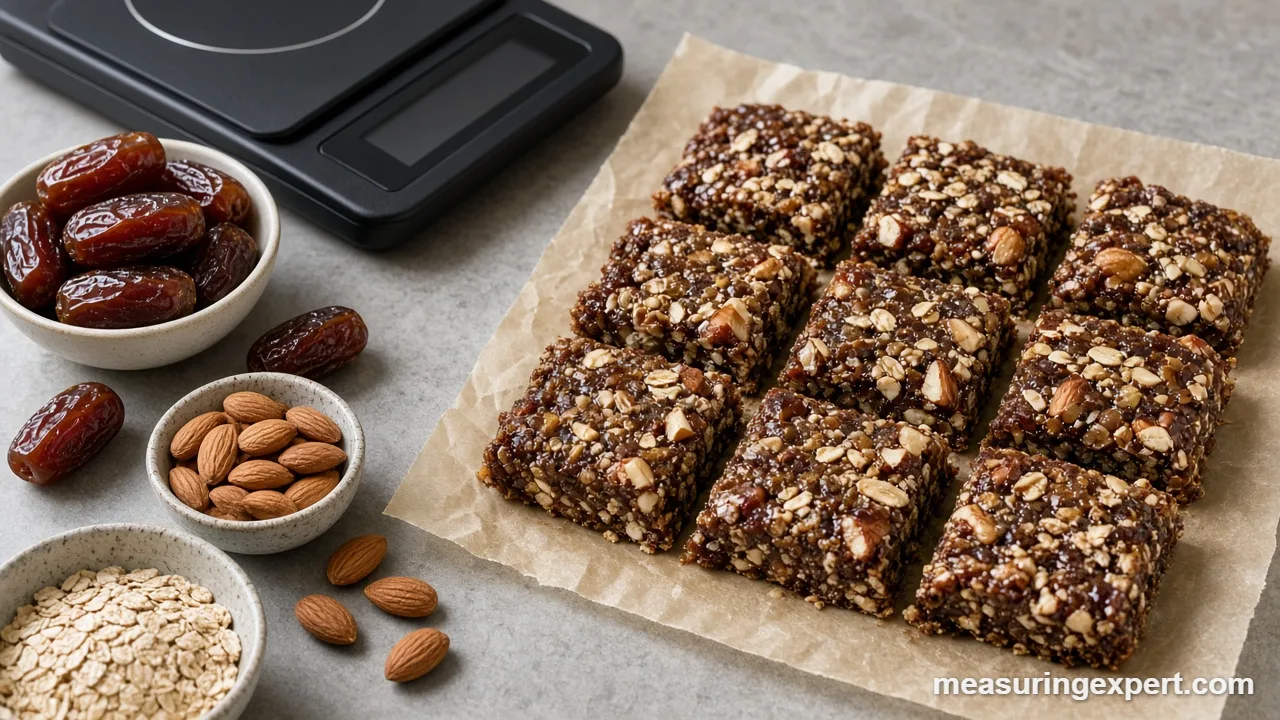
To measure ingredients for energy bars, weigh them. One no-bake recipe for an 8-inch square pan uses about 224 g of chopped dates, 203 g of peanut butter, 142 g of almonds and 67 g of oats. That is roughly 635 g, or 12 bars of about 53 g each.
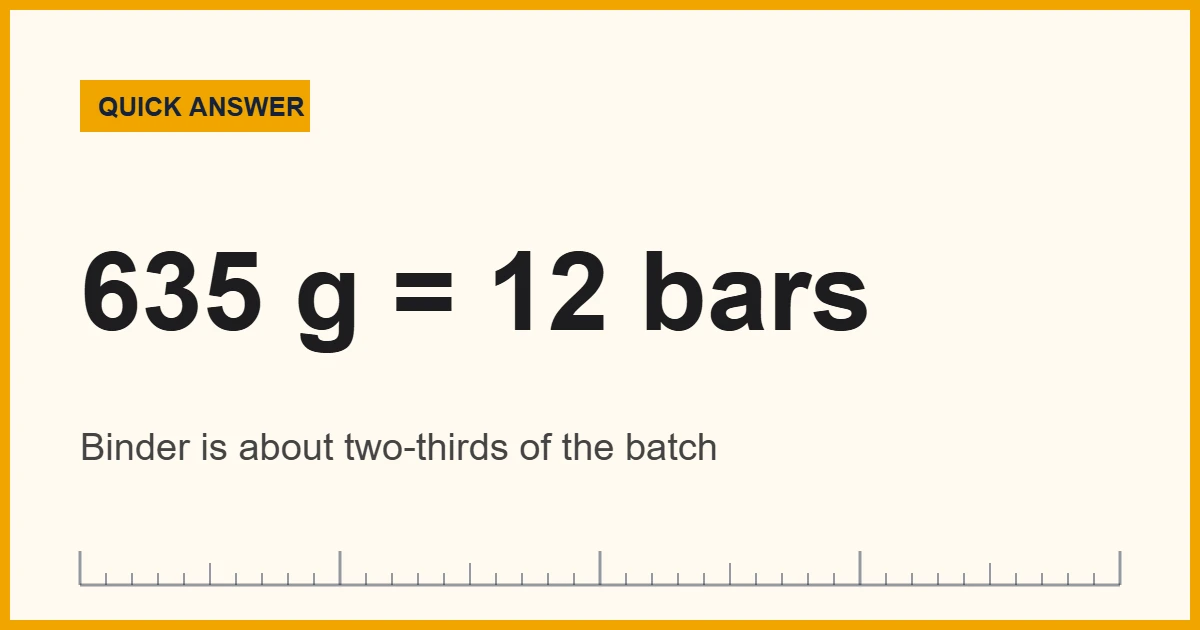
Convert Bar Weight From Grams to Ounces
First, type the weight of one bar or one batch in grams. The converter then shows ounces, pounds and kilograms, so you can portion with a scale that reads either unit.
No-bake bars have no oven to rescue them. Therefore, the mix itself has to hold together, and that depends on the balance between sticky and dry ingredients. A scale gives you that balance every time, while cups give you a different bar each time. For example, dates, nut butter and nuts all pack differently, so one “cup” of each can vary a lot.
Overall, this guide focuses on three things: binder ratios by weight, weights for nuts, seeds and dates, and portion sizes. For numbers, it uses the King Arthur ingredient weight chart for cup weights and a published no-bake oats and dates bar recipe as the worked example. If you bake granola bars instead, see how to measure granola bar ingredients.
Measure Ingredients for Energy Bars: Weight Chart
Use this chart to convert common bar ingredients from cups to grams. In addition, the ounce column helps if your scale reads ounces. Also, all gram values come from the King Arthur chart. However, we calculated the 1-cup peanut butter value by doubling the 1/2-cup figure.
| Ingredient | Measure | Grams | Ounces |
|---|---|---|---|
| Dates, chopped | 1 cup | 149 g | 5.3 oz |
| Peanut butter | 1/2 cup | 135 g | 4.8 oz |
| Honey | 1 tablespoon | 21 g | 0.7 oz |
| Maple syrup | 1/2 cup | 156 g | 5.5 oz |
| Rolled oats (old-fashioned) | 1 cup | 89 g | 3.1 oz |
| Almonds, whole | 1 cup | 142 g | 5.0 oz |
| Walnuts, chopped | 1 cup | 113 g | 4.0 oz |
| Pecans, whole | 1 cup | 105 g | 3.7 oz |
| Chia seeds | 1/4 cup | 37 g | 1.3 oz |
| Flaxseed | 1/4 cup | 35 g | 1.2 oz |
| Pumpkin seeds | 1/4 cup | 40 g | 1.4 oz |
| Sunflower seeds | 1/4 cup | 35 g | 1.2 oz |
| Dried cranberries | 1/2 cup | 57 g | 2.0 oz |
| Raisins, loose | 1 cup | 149 g | 5.3 oz |
| Chocolate chips | 1 cup | 170 g | 6.0 oz |
| Coconut, unsweetened shredded | 1 cup | 53 g | 1.9 oz |
Notice, however, how light seeds are by volume. A quarter cup of chia is only 37 g, so a “cup” of mixed seeds can weigh far less than a cup of nuts. For the difference between ounces by weight and fluid ounces, see how much is an ounce.
No-Bake Binder Ratios by Weight
First, a binder is the sticky part that glues the dry part together. In most no-bake bars, that means dates, nut butter, or a syrup such as honey. In fact, the ratio of binder to dry ingredients decides whether the slab slices cleanly or turns to crumbs.
Next, here is the worked example. The recipe uses 1 1/2 cups of chopped dates, 3/4 cup of peanut butter, 1 cup of almonds and 3/4 cup of oats. In grams, that is about 224 g, 203 g, 142 g and 67 g. As a result, the binder (dates plus peanut butter) is about 427 g of a 635 g mix, or 67 percent.
| Part of the mix | Ingredients | Weight | Share |
|---|---|---|---|
| Binder | Dates and peanut butter | about 427 g | about 67% |
| Dry | Almonds and oats | about 209 g | about 33% |
| Total (without chocolate chips) | about 635 g | 100% |
Overall, that gives a binder to dry ratio of about 2 to 1 by weight. However, this is one recipe, not a law. Meanwhile, other recipes use syrup as part of the binder. The Tasting Table version, for instance, mixes 15 Medjool dates with 1/4 cup of almond butter and 1/4 cup of maple syrup alongside 1 1/2 cups of oats and 1 cup of almonds. Use the 2 to 1 figure as a starting point, then adjust in small steps of 10 to 20 g.
Recommended Tools to Measure Ingredients for Energy Bars
In short, a scale is the one essential tool. First, pick one with a tare button so you can add ingredients to the same bowl. Next, a food processor chops dates and nuts evenly. In addition, a square pan and parchment paper give you a fixed shape, which makes portioning easy.



As an Amazon Associate, Measuring Expert earns from qualifying purchases.
Pan Size and Portion Weights
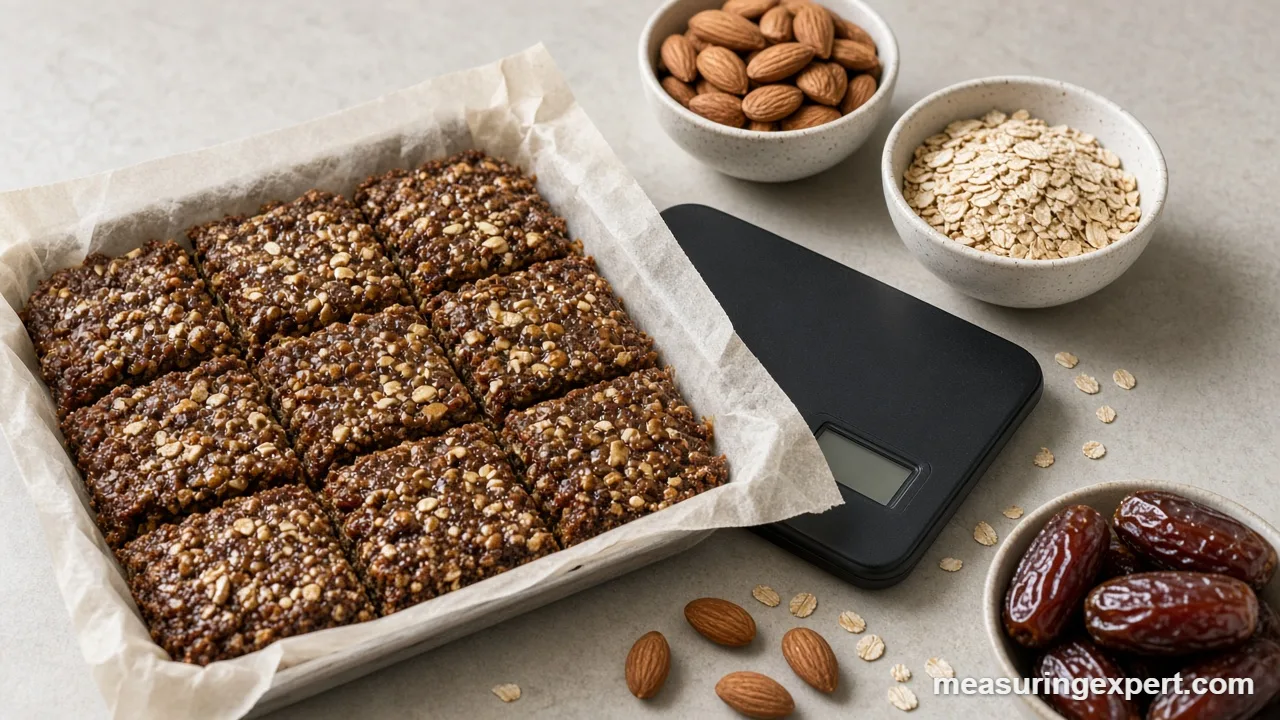
In fact, once you know the batch weight, the portion size is simple division. For instance, the example batch weighs about 635 g, so a larger bar means fewer pieces. Meanwhile, the pan only decides the thickness.
| Bar weight | Ounces | Bars from a 635 g batch |
|---|---|---|
| 30 g | 1.06 oz | about 21 |
| 40 g | 1.41 oz | about 16 |
| 50 g | 1.76 oz | about 13 |
| 53 g | 1.87 oz | 12 |
| 60 g | 2.12 oz | about 11 |
Likewise, to change the pan, scale by area. An 8 x 8-inch pan covers 64 square inches, a 9 x 9-inch pan covers 81, and a 9 x 13-inch pan covers 117. Similarly, the same area rule works for cheesecake pans. Therefore, the table below keeps the bars the same thickness.
| Pan | Scale factor | Dates | Peanut butter | Almonds | Oats | Total |
|---|---|---|---|---|---|---|
| 8 x 8 in | 1.00 | 224 g | 203 g | 142 g | 67 g | 635 g |
| 9 x 9 in | 1.27 | 283 g | 256 g | 180 g | 84 g | 803 g |
| 9 x 13 in | 1.83 | 409 g | 370 g | 260 g | 122 g | 1,161 g |
Key Takeaways
- In short, weigh every ingredient: 1 cup of chopped dates is 149 g.
- In addition, the example binder (dates plus peanut butter) is about two-thirds of the batch by weight.
- Also, a 635 g batch makes 12 bars of about 53 g each.
- Scale a new pan by area, so a 9 x 13-inch pan needs about 1.83 times the 8 x 8-inch amounts.
- Finally, chill the slab for at least 2 hours before you cut it.
- Last, keep the bars up to 5 days in the refrigerator, or up to 3 months in the freezer.
How to Measure Ingredients for Energy Bars Step by Step
- Set up the scale. First, place a large bowl on the scale and press tare. Also, line an 8 x 8-inch pan with parchment paper.
- Weigh the dates. Then add about 224 g of pitted, chopped dates. Soft dates blend into a better binder, so soak dry ones in warm water for a few minutes first, then drain them.
- Weigh the nut butter. Next, tare again, then add about 203 g of peanut butter. Instead, weigh it straight from the jar of scooping it into cups.
- Weigh the dry ingredients. Next, add about 142 g of almonds and about 67 g of oats. Tare between each ingredient so the numbers stay clean.
- Mix until sticky. After that, pulse or stir the mixture until it holds together when you squeeze a handful.
- Press and chill. Press the mix firmly into the pan, then chill it in the freezer for at least 2 hours, as the example recipe directs.
- Cut and weigh the bars. Finally, lift out the slab and cut 12 bars. As a result, each should weigh about 53 g.
Storage: Refrigerator and Freezer
No-bake bars contain no preservatives unless you add them, and they stay soft because of the dates and nut butter. The example recipe stores them in an airtight container in the refrigerator for up to 5 days, or in a freezer-safe container for up to 3 months. Because the bars are sticky, separate the layers with parchment paper so they do not fuse together.
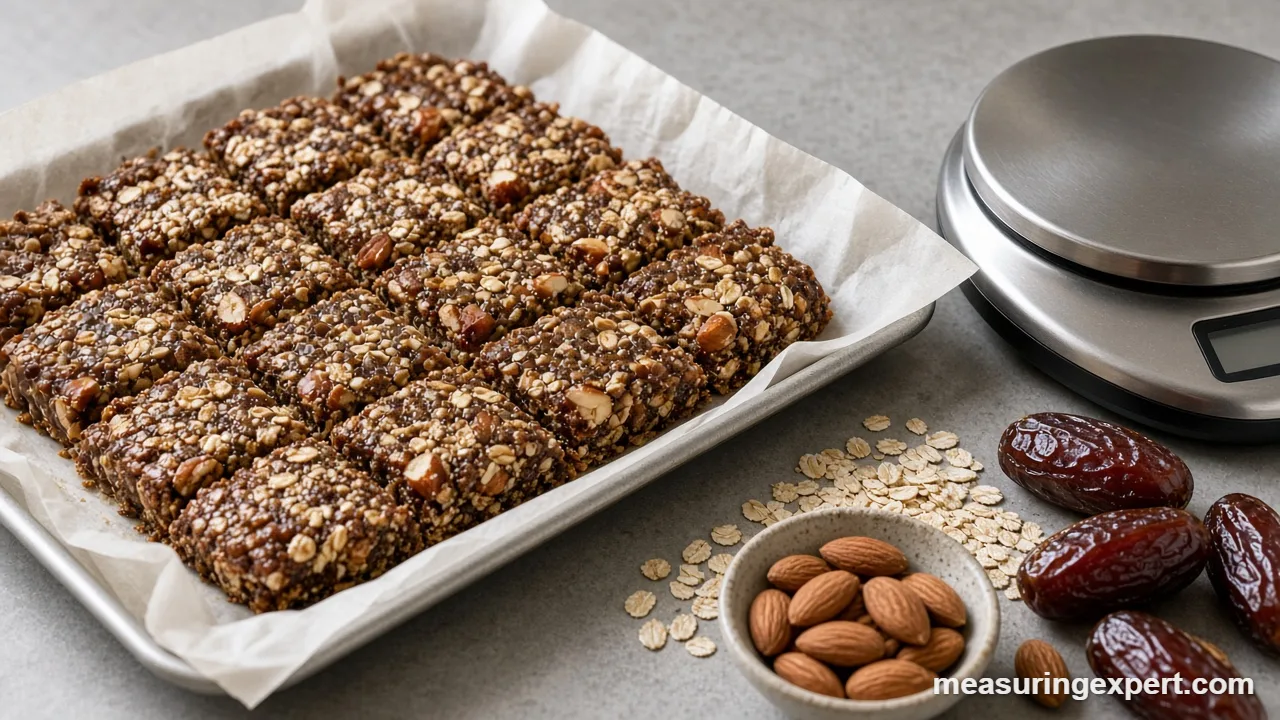
However, chill time varies by recipe. The example calls for at least 2 hours in the freezer. By contrast, the Tasting Table recipe chills its 8 bars for just 30 minutes. Therefore, check the firmness of your own slab before you cut it.
Common Mistakes With Ingredients for Energy Bars
- Measuring dates by count. However, date sizes vary a lot, so weigh them instead.
- Packing nut butter into cups. Oil and air make the weight inconsistent, so weigh it from the jar.
- Mixing up oat types. Charts list different weights per cup for different oats, so weigh them.
- Cutting too soon. Because a warm slab smears and crumbles, chill it first.
- Ignoring allergens. Swapping nuts or seeds changes what is in the bar, so check labels.
Do and Don’t
Do
- First, weigh the binder.
- Line the pan with parchment.
- Then press the mix firmly.
- Cut bars of equal weight.
- Label stored bars with the date.
Don’t
- Scoop nut butter into cups.
- Count dates instead of weighing.
- Cut a slab that is still soft.
- Leave the bars out for days.
- Swap nuts without checking allergens.
Honest Limits of These Weights
In general, cup weights depend on the brand and the way you fill the cup. The King Arthur chart itself shows this, for example: it lists 1 cup of its own rolled oats at 113 g and 1 cup of old-fashioned oats at 89 g. Also, date moisture changes the binder strength, and nut butters differ in oil content. In addition, the 2 to 1 ratio comes from a single published recipe. In short, treat the numbers here as a starting point, and trust the feel of the mix when you press it together.
Also, these bars are not a nutrition plan. Calories and nutrients depend on the exact products you use, so read the labels on your own ingredients.
Frequently Asked Questions
How much binder do I need when I measure ingredients for energy bars?
In the example recipe, the sticky part (dates plus peanut butter) is about two-thirds of the batch by weight. As a result, use that share as a starting point. If the mix crumbles, add a little more date or nut butter; if it smears, add oats or nuts.
How do I measure ingredients for energy bars without a scale?
First, use the cup weights in the chart: 1 cup of chopped dates is about 149 g, and 1/2 cup of peanut butter is about 135 g. Next, press sticky items firmly into the cup and level them. However, a scale is more consistent because sticky foods leave air gaps.
How many dates equal 1 cup?
In short, one cup of chopped pitted dates weighs about 149 g. The example recipe lists about 18 Medjool dates for 1 1/2 cups chopped, which works out to roughly 12 dates per cup.
How many grams is 1/2 cup of peanut butter?
King Arthur lists 1/2 cup of peanut butter at 135 g, so 1 cup is about 270 g. As a result, 1 tablespoon is about 17 g.
How heavy should an energy bar be?
In fact, there is no standard. The example batch yields 12 bars of about 53 g each. For small snack squares, cut the same pan into bars of about 30 g; for larger bars, aim for about 60 g.
Why are my no-bake bars crumbly?
The usual reasons are too little binder, dates that are too dry, or a mix that was not pressed firmly. In addition, bars cut before they chill fully will fall apart. Weigh the binder and press the mixture hard into a lined pan.
How long do no-bake energy bars last?
The example recipe says the bars keep for up to 5 days in an airtight container in the refrigerator, or up to 3 months in the freezer. Also, label the container with the date.
Can I swap nuts for seeds?
Yes, but swap by weight, not by cup. For example, 1/4 cup of sunflower seeds is about 35 g, while 1/4 cup of pumpkin seeds is about 40 g. Also check for allergies before you change nuts or seeds.
Can I make a 9 x 13-inch batch of energy bars?
Yes. In fact, a 9 x 13-inch pan has about 1.83 times the area of an 8 x 8-inch pan, so multiply every weight by about 1.8 to keep the bars the same thickness.
Should I measure ingredients for energy bars before or after chopping?
Weigh each ingredient in the form the recipe lists, such as pitted dates or chopped nuts. However, chopping changes how much fits in a cup, but it does not change the weight.
Measure Ingredients for Energy Bars: The Bottom Line
To sum up, weigh the dates, nut butter, nuts and oats, keep the binder near two-thirds of the batch, and cut bars of equal weight. As a result, that small routine turns a loose recipe into one you can repeat.
Finally, use the converter at the top of the page for any bar or batch weight, and keep the weight chart handy for cup-based recipes.