

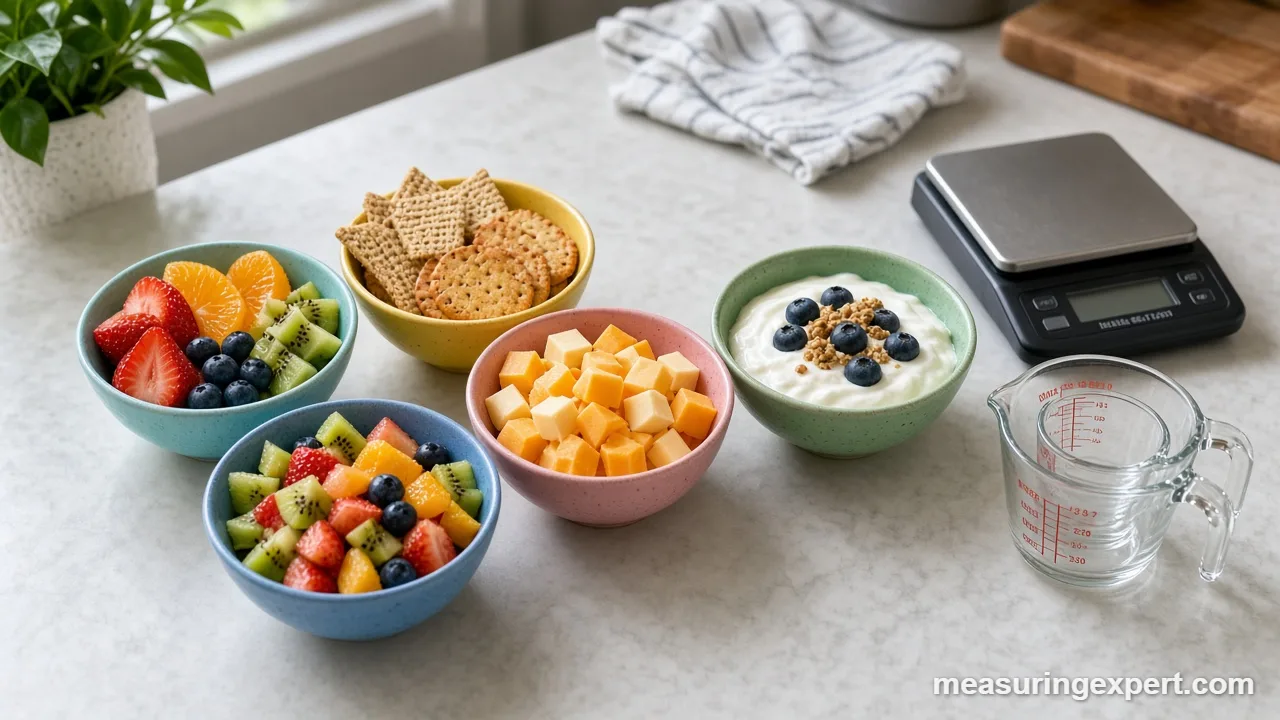
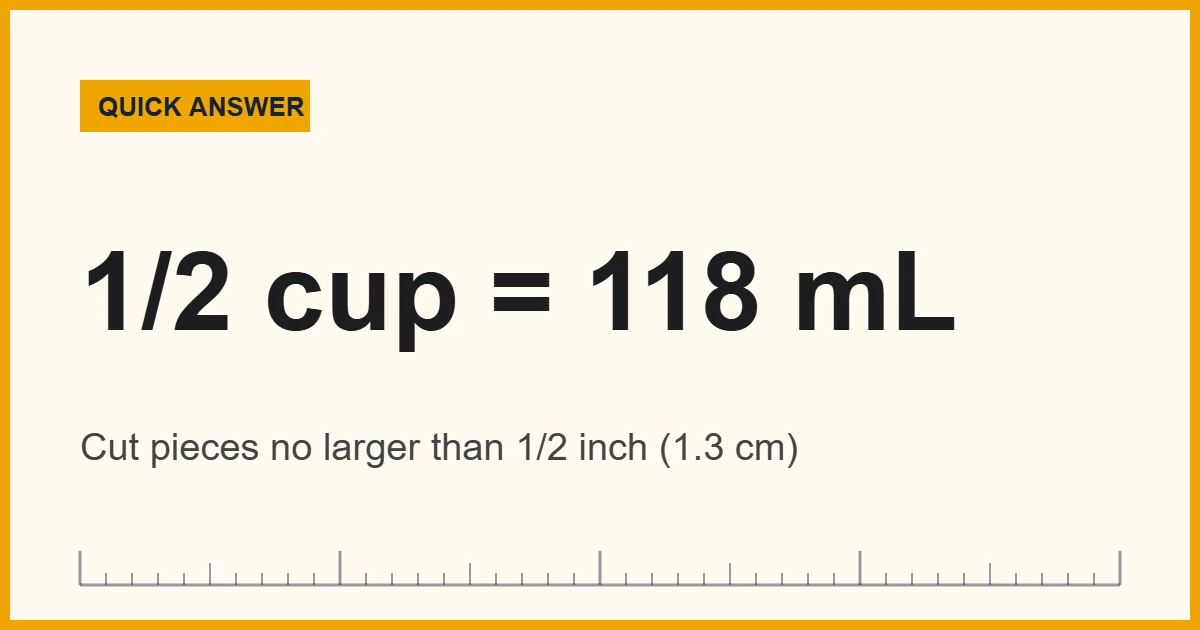
Kid-friendly snacks work best when you measure them. Start with about 1/2 cup (120 mL) of fruit or yogurt, or 1 slice of bread (1 oz, 28 g), then compare it with the MyPlate daily amounts for your child’s age. For young children, the AAP advises cutting food into pieces no larger than 1/2 inch (1.3 cm).
Measure Kid-Friendly Snacks in Cups, Spoons and Milliliters
First, enter an amount in cups to see tablespoons, milliliters and fluid ounces. For example, type 0.5 to check a half-cup snack of yogurt or applesauce. The converter uses the exact US definitions, so the numbers match your measuring cups.
Overall, snacks are easy to over-pour and easy to under-serve. For instance, a handful of crackers looks small in an adult hand and huge in a toddler’s. As a result, a measuring cup or a scale gives you a repeatable starting point, and you can adjust from there.
In this guide, you will see how much a snack counts for in each food group, how portions fit daily amounts at ages 2 to 13, and how to size pieces for safe eating. Finally, you will find batch math for classrooms and parties. For packed lunches, our guide to measuring school lunch ingredients covers the rest of the box.
Daily Food Group Amounts by Age
A snack is one piece of a day, so it helps to know the whole day first. The table below shows the ranges from the 2020-2025 Dietary Guidelines for Americans, as summarized by Mayo Clinic. Each range runs from the lowest girls’ value to the highest boys’ value, because needs depend on growth and activity.
| Food group | Ages 2 to 4 | Ages 5 to 8 | Ages 9 to 13 |
|---|---|---|---|
| Fruits | 1 to 1.5 cups (237 to 355 mL) | 1 to 2 cups (237 to 473 mL) | 1.5 to 2 cups (355 to 473 mL) |
| Vegetables | 1 to 2 cups (237 to 473 mL) | 1.5 to 2.5 cups (355 to 591 mL) | 1.5 to 3.5 cups (355 to 828 mL) |
| Grains | 3 to 5 oz (85 to 142 g) | 4 to 6 oz (113 to 170 g) | 5 to 9 oz (142 to 255 g) |
| Protein foods | 2 to 5 oz (57 to 142 g) | 3 to 5.5 oz (85 to 156 g) | 4 to 6.5 oz (113 to 184 g) |
| Dairy | 2 to 2.5 cups | 2.5 cups | 3 cups |
Keep in mind, however, that the grain and protein numbers are ounce-equivalents, not weights of the food on the plate. One slice of bread counts as 1 ounce-equivalent, for example, but the slice itself may weigh a different amount.
What One Snack Counts As
MyPlate defines what counts as one serving in each group. According to the MyPlate Plan for ages 2 to 3, 1 cup of fruit or vegetables, 1 ounce of grains (such as 1 slice of bread or 1/2 cup of cooked rice or pasta), and 1 cup of milk or yogurt each count as one unit. A tablespoon of peanut butter, 1 egg or 1/4 cup of cooked beans each count as 1 ounce of protein, while 1 1/2 ounces of natural cheese counts as 1 cup of dairy.
How Much of the Day a Kid-Friendly Snack Uses
In other words, with those definitions, you can see how much of a day one snack uses. The shares below are our own arithmetic from the daily ranges above. They show what part of the low-to-high daily range a single snack fills, not an official snack limit.
| Example snack | Ages 2 to 4 | Ages 5 to 8 | Ages 9 to 13 |
|---|---|---|---|
| 1/2 cup (118 mL) fruit | 33% to 50% of the fruit range | 25% to 50% | 25% to 33% |
| 1/2 cup (118 mL) vegetables | 25% to 50% | 20% to 33% | 14% to 33% |
| 1/2 cup (118 mL) yogurt or milk | 20% to 25% of the dairy range | 20% | 17% |
| 1 slice (28 g) bread | 20% to 33% of the grain range | 17% to 25% | 11% to 20% |
| 1 tbsp (15 mL) peanut butter | 20% to 50% of the protein range | 18% to 33% | 15% to 25% |
Likewise, the table makes the trade-offs easy to see. A toddler who eats a full cup of yogurt at snack time has already used about 40% to 50% of the day’s dairy. A 12-year-old, by contrast, would use about a third of the day’s dairy with the same cup.
Recommended Tools to Measure Kid-Friendly Snacks
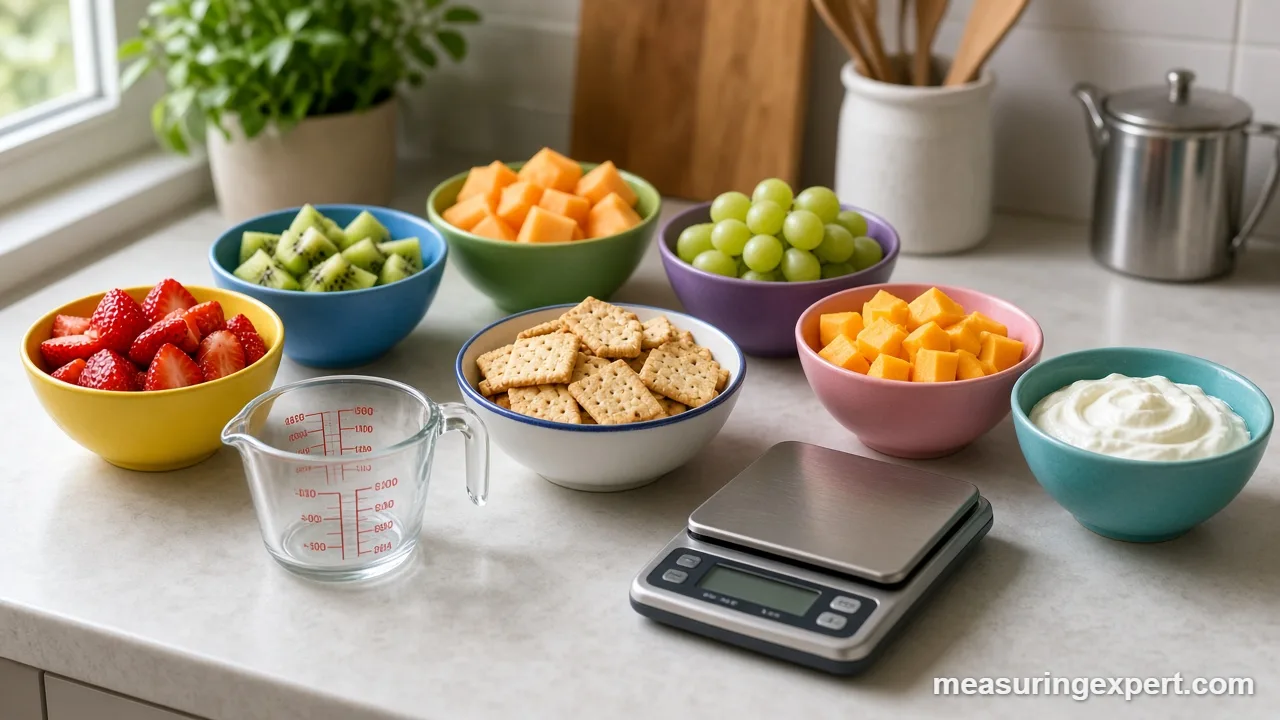
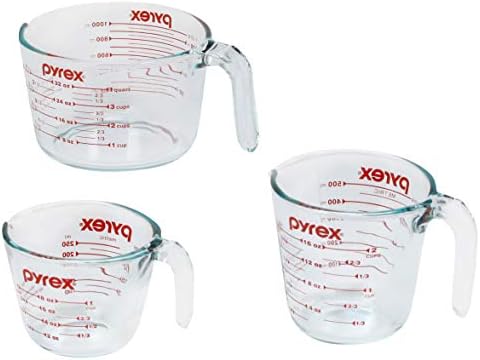
In fact, a few simple tools make portions repeatable. First, nested measuring cups and spoons handle yogurt, applesauce, cereal and nut butter. Next, a digital scale with a tare button weighs crackers, cheese and bread by the ounce. In addition, small lidded containers let you pre-portion a week of snacks at once, which saves time on busy mornings.



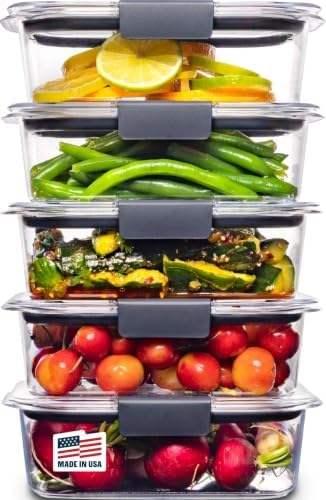
As an Amazon Associate, Measuring Expert earns from qualifying purchases.
- Start kid-friendly snacks at about 1/2 cup of fruit or yogurt, or 1 slice of bread.
- Compare each snack with the MyPlate daily amounts for your child’s age.
- The AAP says to cut food for young children into pieces no larger than 1/2 inch (1.3 cm).
- The CDC lists whole grapes, hot dogs, chunks of cheese, popcorn and nut butter spoonfuls as choking hazards.
- Perishable snacks get 2 hours out of the cooler, or 1 hour above 90 F (32 C).
- For batches, multiply the per-child portion by the headcount, then add a small buffer.
Cut Sizes and Choking Safety for Kid-Friendly Snacks
However, size and shape matter as much as the amount. The American Academy of Pediatrics says to cut food for infants and young children into pieces no larger than one-half inch. For round, firm foods such as hot dogs and grapes, it says they should be served only when completely chopped into tiny pieces. It also advises keeping the riskiest foods away until age 4 or older, depending on each child’s development.
What the CDC Adds About Kid-Friendly Snacks
The CDC takes a similar approach. Its choking hazards page says that cutting food into smaller pieces and mashing food can help prevent choking. Moreover, it lists uncut grapes, berries and cherry tomatoes, hard raw fruit and vegetable pieces, hot dogs, large cheese chunks, popcorn, chips, pretzels, nuts, spoonfuls of nut butter, hard candy and marshmallows among the hazards. The CDC gives no exact piece sizes, so the 1/2 inch figure here comes from the AAP.
Common Snacks and Safer Serving
| Snack | What the AAP and CDC say |
|---|---|
| Grapes, cherry tomatoes, berries | The CDC lists them uncut as hazards. The AAP says to chop firm, round foods completely into tiny pieces. |
| Hot dogs and sausages | The AAP says to serve them only when completely chopped into tiny pieces. |
| Cheese | The CDC lists large chunks and the AAP lists chunks and string cheese, so keep pieces small, at 1/2 inch or less. |
| Raw carrots and apples | The AAP lists raw carrot sticks and apple chunks as risky for young children. Ask your pediatrician when to introduce them. |
| Peanut butter | The CDC lists spoonfuls and the AAP lists thick nut butter, so spread a thin layer instead of serving thick globs. |
| Popcorn, nuts, hard candy | Both the CDC and the AAP list them as hazards for young children. |
Batch Math for Classrooms and Parties
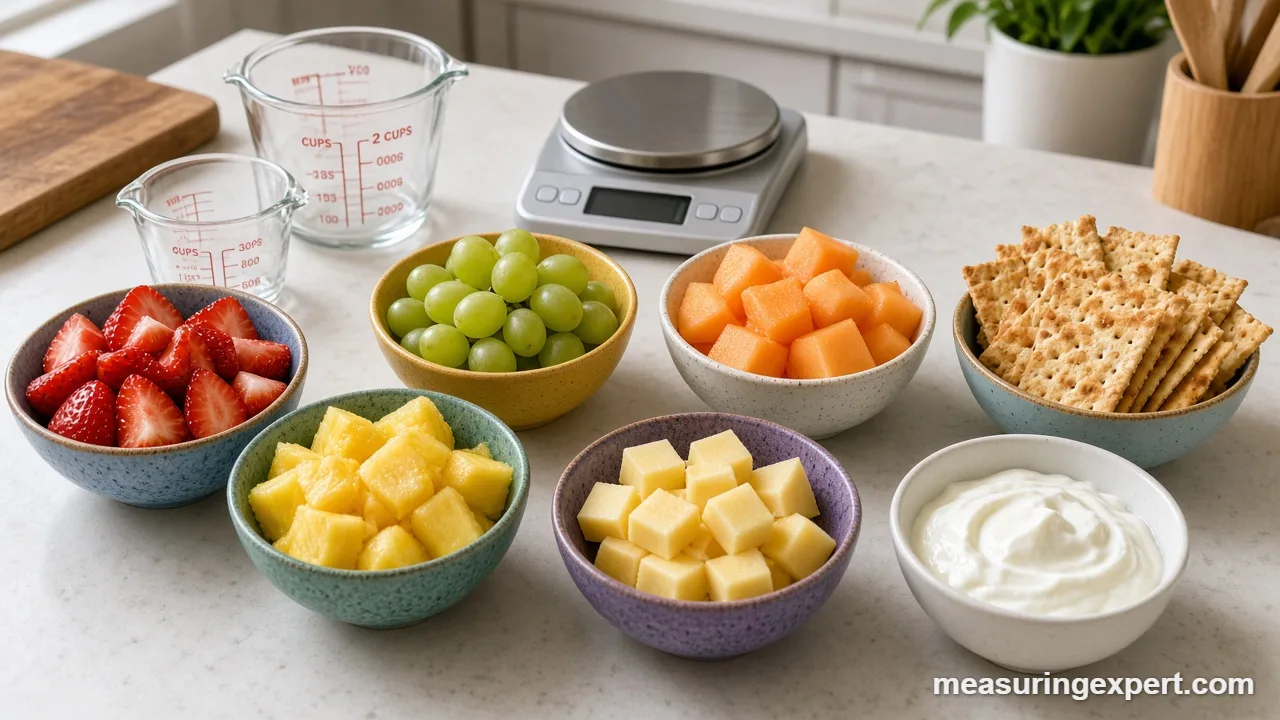
In short, scaling a snack for a group is plain multiplication. Multiply the per-child portion by the number of children, then add a small buffer for spills and second helpings. As an example, the table below uses 1/2 cup of fruit or yogurt and 1 slice of bread per child.
| Children | Fruit or yogurt, 1/2 cup each | Bread, 1 slice each |
|---|---|---|
| 12 | 6 cups (1.42 L) | 12 slices (340 g) |
| 20 | 10 cups (2.37 L) | 20 slices (567 g) |
| 30 | 15 cups (3.55 L) | 30 slices (850 g) |
Because yogurt, applesauce and fruit cups come in odd container sizes, convert first and then buy. For small liquid amounts such as dips, our guide to how much 30 mL is helps, and the explainer on how much an ounce is separates weight from fluid ounces. For bigger events, see measuring ingredients for a buffet.
How to Measure and Portion Kid-Friendly Snacks, Step by Step
- Find your child’s age range. Use the daily table above, and note the group you want to fill with this snack.
- Pick the portion. Start with 1/2 cup for fruit, vegetables or yogurt, or 1 slice of bread, then adjust to appetite.
- Measure it. Level dry foods in a cup, or place the bowl on a scale and press tare before adding food.
- Cut for safety. Chop round and firm foods into pieces no larger than 1/2 inch for young children.
- Portion into containers. Fill small lidded containers so every child gets the same amount.
- Keep cold snacks cold. Hold yogurt, cheese and cut fruit at 40 F (4 C) or below until serving.
- Watch the clock. Serve or discard perishable snacks within 2 hours, or within 1 hour above 90 F (32 C).
Keeping Packed Kid-Friendly Snacks Safe
Snacks that travel need the same temperature care as meals. The USDA says cold foods should stay at 40 F (4 C) or below and that perishable food can sit out for up to 2 hours, or 1 hour when the temperature is above 90 F (USDA potluck guidance). As a result, an ice pack beside the yogurt matters on a hot afternoon. Meanwhile, shelf-stable items such as crackers and dry cereal need no cooling.
Do and Don’t When You Measure Kid-Friendly Snacks
Do
- Check portions against the daily amounts for your child’s age.
- Chop round, firm foods small.
- Let children sit while they eat.
- Use a scale for crackers, cheese and bread.
- Keep yogurt and cut fruit cold.
Don’t
- Serve whole grapes or hot dog rounds to young children.
- Offer thick spoonfuls of nut butter.
- Treat the example shares as official snack limits.
- Leave perishable snacks out past the time limit.
- Force a child to finish a portion.
Honest Limits of Snack Portion Numbers
Overall, every number here is a planning aid. The daily ranges are wide because children grow at different rates, and a very active child may need more than the top of the range. In short, the snack shares in the table are our own arithmetic and are not an official rule. Moreover, ounce-equivalents describe how foods count toward a group, not how much a food weighs. Finally, a child’s appetite changes from day to day, so treat each portion as a starting point rather than a target.
When to Talk to a Professional
Finally, some children need individual guidance. For example, a child with food allergies, feeding difficulties, slow growth or a medical condition may need a different plan. In that case, a pediatrician or registered dietitian can set amounts and textures that fit.
Frequently Asked Questions
How big should kid-friendly snacks be?
A common starting point is about 1/2 cup (120 mL) of fruit, vegetables or yogurt, or 1 slice of bread. Compare it with the MyPlate daily amounts for your child’s age, then adjust for appetite.
How much fruit does a child need each day?
Daily fruit ranges from about 1 to 1.5 cups at ages 2 to 4, 1 to 2 cups at ages 5 to 8, and 1.5 to 2 cups at ages 9 to 13, according to Mayo Clinic’s summary of the Dietary Guidelines.
How small should I cut food for young children?
The American Academy of Pediatrics says to cut food for infants and young children into pieces no larger than one-half inch (about 1.3 cm).
Are grapes safe for toddlers?
Not whole. The CDC lists uncut grapes as a choking hazard, and the AAP says round, firm foods like grapes should be served only when completely chopped into tiny pieces.
How many kid-friendly snacks do I need for 20 children?
Multiply the portion by 20. For example, 1/2 cup of fruit each needs 10 cups (2.37 L), and 1 slice of bread each needs 20 slices, which is about 567 g.
Is a tablespoon of peanut butter a serving?
MyPlate counts 1 tablespoon of peanut butter as 1 ounce of protein foods. However, the CDC lists spoonfuls of nut butter as a choking hazard, so spread it thinly.
How much cheese counts as a dairy serving?
MyPlate counts 1 1/2 ounces (about 43 g) of natural cheese as 1 cup of dairy. Cut it small, because the CDC lists large cheese chunks as a hazard.
How long can a perishable snack sit out?
Up to 2 hours, or 1 hour when the temperature is above 90 F (32 C), according to the USDA. Keep cold snacks at 40 F (4 C) or below until serving.
Should I weigh or scoop kid-friendly snacks?
Weighing is more repeatable for crackers, cheese and bread. Cups work well for yogurt, applesauce and cut fruit, where small differences do not matter.
Do older children need bigger snacks?
Often, yes, because daily amounts rise with age. A 1/2 cup of fruit fills about 25% to 50% of the daily fruit range at ages 5 to 8, but only 25% to 33% at ages 9 to 13.
Kid-Friendly Snacks: The Bottom Line
To sum up, start small, measure it, and compare it with the daily amounts for your child’s age. About 1/2 cup of fruit or yogurt, or 1 slice of bread, is a practical starting point. For safety, cut round and firm foods into pieces no larger than 1/2 inch and keep an adult close.
Finally, use the converter at the top to move between cups, tablespoons and milliliters, and use the batch table when you are feeding a group. With a cup, a scale and a sharp knife, snack time gets easier to plan.