

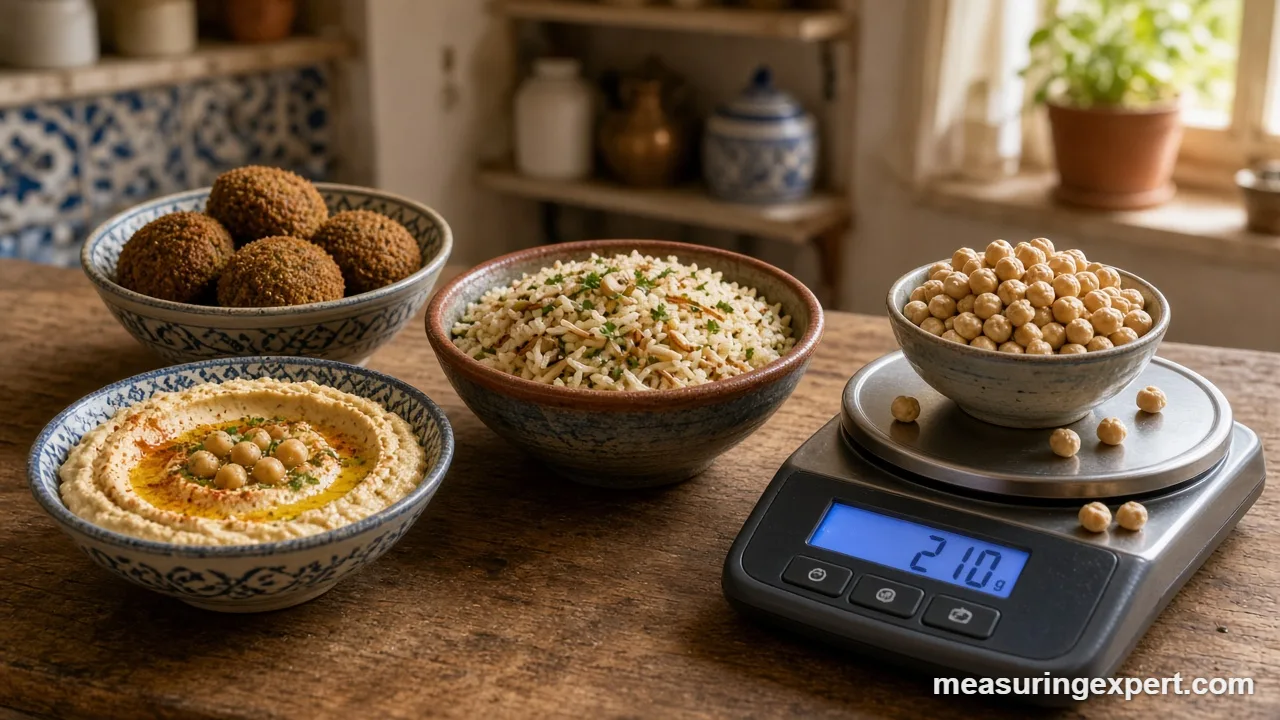
For Middle Eastern dishes, weigh the heavy ingredients in grams and keep spoons for spices. For example, hummus uses about 200 g of chickpeas to 50 mL of tahini, and rice pilaf uses 1 cup of rice to 1.5 cups of water. Kibbeh is the dish where a scale matters most.
Convert Ingredient Weights for Middle Eastern Dishes
First, type a weight below to switch between grams, ounces, pounds and kilograms. This helps, for example, when a recipe lists 250 g of dried chickpeas and your scale only shows ounces.
Cooks who grew up with hummus, falafel and rice pilaf often cook by feel. That works when the same hands make the same dish every week, because habit fills the gaps. However, it breaks down the moment you scale a recipe, cook for a crowd or follow a written version from another kitchen.
Fortunately, most Middle Eastern dishes follow simple ratios. For instance, hummus is mostly chickpeas with a little tahini. Similarly, pilaf is rice and water in a fixed proportion. Likewise, kibbeh is meat and bulgur in a stable balance. As a result, a kitchen scale and a few ratios cover most of what you need.
Below, we cover four classic dishes with weights taken from published recipes and the King Arthur Baking ingredient weight chart. If you are mainly interested in how regional units such as the tea glass compare with a US cup, see our guide to Middle Eastern cooking measurements.
Key Takeaways
- Weigh chickpeas, bulgur, rice and meat; measure spices and rose water by the spoon.
- Hummus: about 200 g of chickpeas to 50 mL of tahini and 100 mL of water.
- Falafel: start with dried chickpeas, about 250 g, because canned ones are too wet.
- Rice pilaf: 1 part rice to 1.5 parts water by volume.
- Kibbeh: about 2 cups of fine bulgur for 2 pounds (907 g) of lean meat.
- Cook ground meat dishes to 160 F (71 C).
Middle Eastern Dishes at a Glance: Weights and Ratios
This table gives the quantities used in the sections below. Because each row comes from a named recipe, the ratios are real working proportions, not guesses.
| Dish | Main ingredient | Key ratio | Notes |
|---|---|---|---|
| Hummus | 200 g (7.05 oz) chickpeas | 50 mL tahini, 100 mL water | Add the water gradually |
| Falafel | 250 g (8.82 oz) dried chickpeas | 150 g (5.29 oz) onion, 2 garlic cloves | Fry at 350 F (177 C) |
| Rice pilaf | 1 1/2 cups rice (about 297 g) | 2 1/4 cups water (about 532 mL) | 1 : 1.5 by volume |
| Kibbeh | 2 lb (907 g) lean meat | 2 cups fine bulgur | Knead with about 1/4 cup ice water |
Measuring Four Classic Middle Eastern Dishes
First, each dish has a different weak point. Hummus depends on the water, falafel on the soak, pilaf on the pot and kibbeh on the kneading.
Hummus
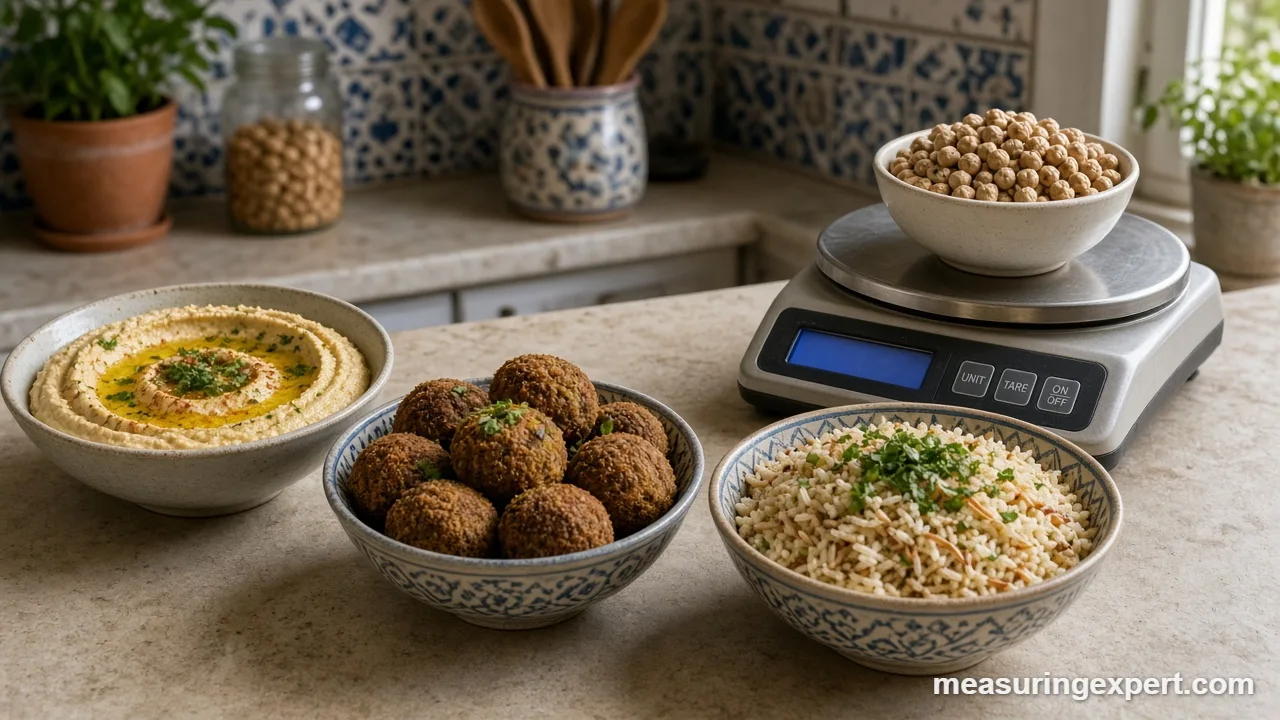
The safefood hummus recipe uses 200 g (7 oz) of chickpeas, 50 mL (1.7 fl oz) of tahini, 100 mL (3.4 fl oz) of water, 2 teaspoons of lemon juice and 1 clove of garlic. That is a lean version. However, many cooks add more tahini, so raise it by the tablespoon.
One tablespoon of tahini weighs about 16 g, based on the King Arthur figure of 128 g per half cup. In addition, the 50 mL in the recipe is roughly 54 g. Therefore the chickpeas outweigh the tahini by close to 4 to 1.
The water is the part that varies. For that reason, add it a spoonful at a time while the blender runs, because chickpeas differ in moisture. Leftover hummus keeps about three days in the fridge, according to the same source.
Falafel
A falafel recipe from Labna serves four with 250 g (8.8 oz) of dried chickpeas, one onion or 150 g (5.3 oz) of chopped onion, 2 garlic cloves, a small bunch of parsley, 1 teaspoon of cumin and a pinch of baking soda. The recipe calls for dried chickpeas that are soaked overnight, not canned or pre-cooked ones.
Soaking changes the weight. In fact, according to the same recipe, 500 g of soaked chickpeas equals 250 g dried, so the beans double. Therefore, always note whether a recipe means dry or soaked weight. Otherwise you will use half or double the amount.
Next, fry in about 2 inches (5 cm) of oil at 350 F (177 C). A thermometer helps here, because oil that is too cool makes greasy falafel and oil that is too hot browns the outside before the center cooks.
Rice Pilaf
America’s Test Kitchen’s basic rice pilaf uses 1 1/2 cups of long-grain or basmati rice, 2 1/4 cups of water, 3 tablespoons of butter, a small minced onion and 1 1/2 teaspoons of table salt. The ratio is 1 part rice to 1.5 parts water by volume. If you soak the rice overnight, the recipe drops the water to 2 cups.
By weight, for example, King Arthur lists 99 g for half a cup of long-grain rice. As a result, 1 1/2 cups is about 297 g, and 2 1/4 cups of water is about 532 mL. In addition, three tablespoons of butter is about 43 g.
The method matters as much as the ratio. First, rinse the rice, toast it in the butter for about 3 minutes, then simmer it covered for 16 to 18 minutes. Finally, rest it off the heat for 10 minutes. Lifting the lid early lets steam escape, so it throws off the ratio.
Kibbeh
Maureen Abood’s kibbeh nayeh uses 2 cups of fine (#1) bulgur, soaked, with 2 pounds (907 g) of lean leg of lamb or beef, one pureed medium onion, 2 teaspoons of cinnamon and 1/4 teaspoon of cayenne. First, the bulgur is soaked about 30 minutes and squeezed dry.
If you measure bulgur dry, 2 cups is about 304 g by the King Arthur chart, which is roughly 1 part bulgur to 3 parts meat by weight. However, soaked bulgur weighs more, so state which one your recipe means before you scale it.
Water is the other number to watch. Specifically, the recipe kneads with about 1/4 cup (59 mL) of ice water in total, and warns that too much makes the kibbeh mushy. In short, measure the water instead of splashing it in.
Weights of Common Middle Eastern Dishes Ingredients
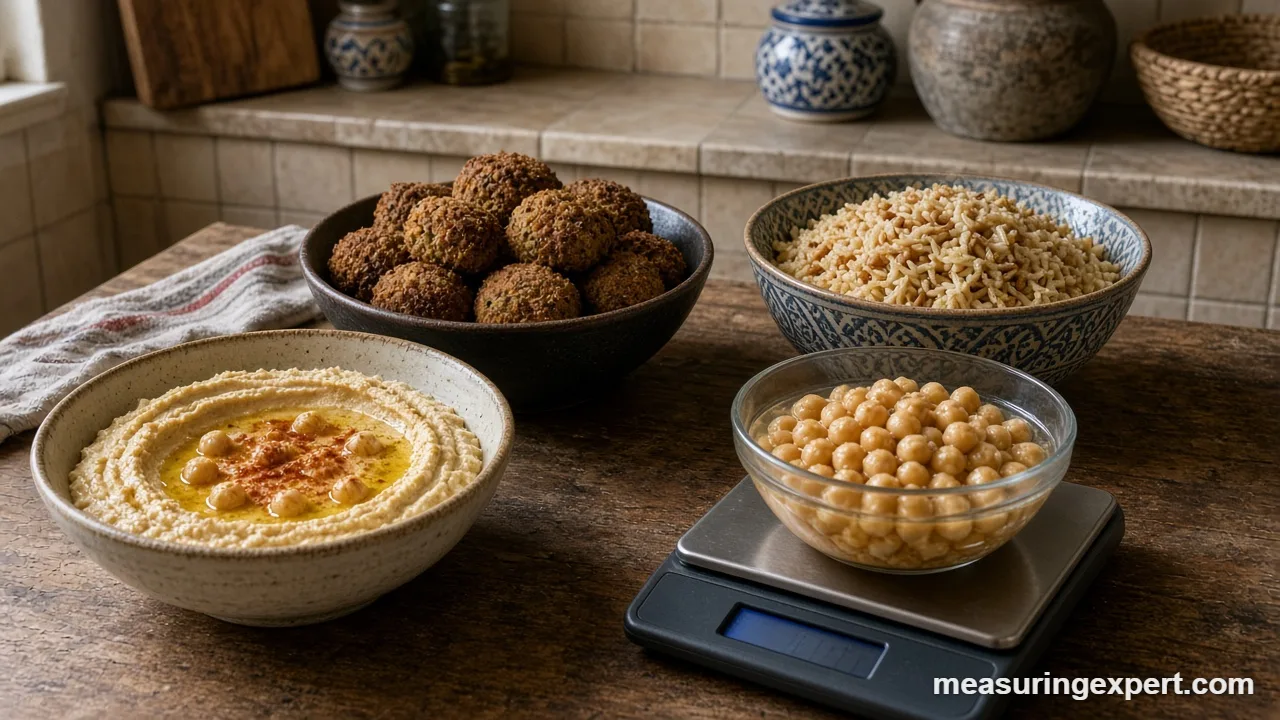
These figures come from the King Arthur ingredient weight chart. Because packing and brand change them, treat them as typical values.
| Ingredient | Volume | Weight |
|---|---|---|
| Bulgur | 1 cup | 152 g (5.36 oz) |
| Long-grain rice, dry | 1/2 cup | 99 g (3.49 oz) |
| Tahini | 1/2 cup | 128 g (4.52 oz) |
| Sesame seeds | 1/2 cup | 71 g (2.50 oz) |
| Chickpea flour | 1 cup | 85 g (3.00 oz) |
| Semolina flour | 1 cup | 163 g (5.75 oz) |
| Whole almonds | 1 cup | 142 g (5.01 oz) |
| Chopped walnuts | 1 cup | 113 g (3.99 oz) |
| Shelled pistachios | 1/2 cup | 60 g (2.12 oz) |
| Honey | 1 tablespoon | 21 g (0.74 oz) |
For instance, a cup of bulgur and a cup of semolina differ by 11 g, while a cup of chickpea flour is about half the weight of a cup of semolina. In other words, swapping flours by volume changes a dessert or batter noticeably. To convert a volume yourself, see how much an ounce is and how much 30 mL is.
Recommended Tools for Middle Eastern Dishes
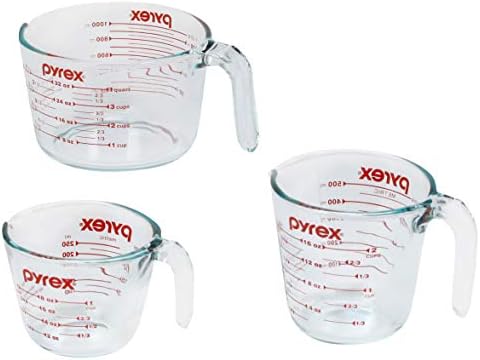
A scale does most of the work for these recipes. First, look for a tare button and a 1 g display. Next, add a set of measuring spoons for cumin, cinnamon and baking soda, a liquid measuring cup for water and tahini, and an instant-read thermometer for frying oil and meat.




As an Amazon Associate, Measuring Expert earns from qualifying purchases.
How to Measure Ingredients for Middle Eastern Dishes
- Check what the weight refers to. Look for words like dried, soaked, cooked or raw before you start.
- Put the bowl on the scale and press tare. The display returns to zero, so you only weigh the ingredient.
- Weigh the bulk ingredients in grams. That includes chickpeas, bulgur, rice, meat and onion.
- Measure liquids in a marked cup. Read the level at eye height, or weigh water at 1 g per mL.
- Use level spoons for spices. Cumin, cinnamon and baking soda are strong, so heaping spoons add too much.
- Write down what you used. Next time you can adjust one number instead of starting over.
Also, when scaling, multiply every ingredient by the same factor. For example, doubling the pilaf means 3 cups of rice and 4 1/2 cups of water. Cooking times, however, change less than you expect, so check the pot instead of doubling the clock.
Do and Don’t for Middle Eastern Dishes
Do
- Weigh dried and soaked chickpeas separately.
- Add hummus water a spoonful at a time.
- Rinse and rest rice so the ratio holds.
- Keep ice water measured for kibbeh.
- Check frying oil with a thermometer.
Don’t
- Swap canned chickpeas into falafel without adjusting.
- Assume all salt weighs the same per spoon.
- Pack flour or bulgur into the cup.
- Lift the pilaf lid while it simmers.
- Use eating spoons as measuring spoons.
Honest Limits of Middle Eastern Dishes Measurements
Recipes are written for one cook’s ingredients. For example, chickpeas vary in age and moisture, bulgur comes in several grinds, and rice absorbs water differently by variety. Moreover, the weights in the table above are averages from one published chart. In short, a ratio gets you close, and tasting gets you the rest.
Regional cooking also relies on handfuls, glasses and judgment that no ratio fully captures. Therefore this page converts the written versions of the dishes. It cannot reproduce what a family recipe means by “enough”.
Food Safety and Accuracy With Middle Eastern Dishes
Temperature is the one measurement where being close is not enough. For example, the U.S. government’s safe minimum internal temperature chart lists 160 F (71 C) for ground beef, pork and lamb, and 165 F (74 C) for ground poultry. Therefore the same limits apply to kibbeh, kofta and meat-filled pastries.
Frequently Asked Questions
What is the best way to measure ingredients for Middle Eastern dishes?
Use a digital scale for chickpeas, bulgur, rice, meat and nuts, and level spoons for spices. Weighing is more consistent than scooping, especially for dense or coarse ingredients.
How much tahini goes into hummus?
One published lean recipe uses 50 mL of tahini for 200 g of chickpeas. That is about 54 g of tahini. Many cooks use more, so add it by the tablespoon, which weighs about 16 g.
How many dried chickpeas do I need for falafel?
One recipe for four people uses 250 g (about 8.8 oz) of dried chickpeas. After soaking, that weighs about 500 g.
What is the rice to water ratio for pilaf?
Use 1 part rice to 1.5 parts water by volume, such as 1 1/2 cups of rice to 2 1/4 cups of water. If you soak the rice first, reduce the water slightly.
How many grams of bulgur are in a cup?
King Arthur lists 152 g (5.36 oz) for 1 cup of dry bulgur. Soaked bulgur weighs more.
Can I use canned chickpeas for Middle Eastern dishes like falafel?
Canned chickpeas work well for hummus. For falafel, however, the recipe above specifies dried chickpeas because canned ones are too wet and soft to hold together.
How hot should oil be for frying falafel?
The recipe above fries at 350 F, which is about 177 C, in roughly 2 inches of oil. Check it with a thermometer.
What temperature should kibbeh be cooked to?
Cooked kibbeh made with beef or lamb should reach 160 F (71 C), the safe minimum for ground meat.
Why do Middle Eastern dishes recipes use grams?
Many use grams because weight stays the same however an ingredient is packed. A cup of packed bulgur and a cup of loose bulgur differ, but 152 g is always 152 g.
Does a tablespoon of salt weigh the same in every recipe?
No. Kosher salt brands differ in crystal size, so a tablespoon of one can be noticeably saltier than another. Weigh salt if the recipe gives grams.
Middle Eastern Dishes: The Bottom Line
To sum up, a scale and four ratios cover the core of this cooking: chickpeas to tahini in hummus, dried to soaked weight in falafel, rice to water in pilaf and bulgur to meat in kibbeh. So weigh the bulk, measure the liquids and spoon the spices.
Finally, use the converter at the top when a weight is in the wrong unit. For another cuisine with its own measuring habits, see our guide to Thai curry measurements.