

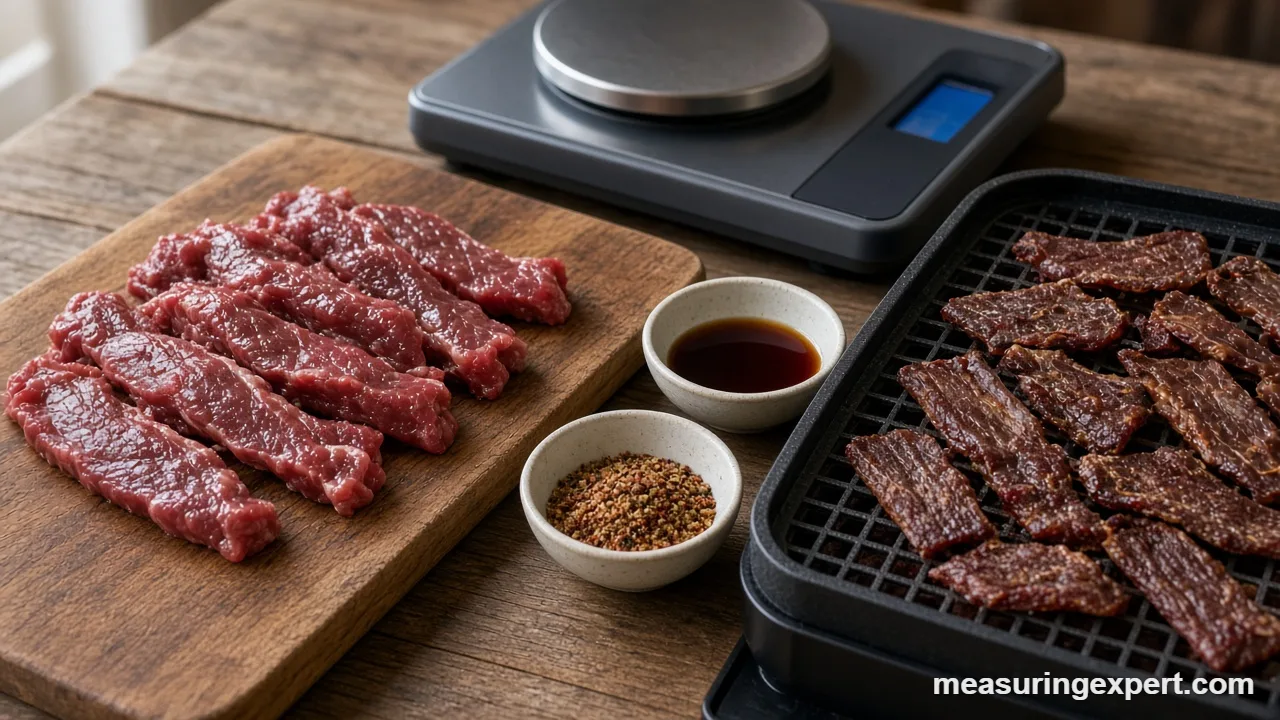
To measure ingredients for jerky, weigh the raw meat first, then scale every seasoning per pound. Slice strips no thicker than 1/4 inch (6.35 mm), marinate in the refrigerator, heat beef to 160 F (71 C) or poultry to 165 F (74 C), and dry at 130 to 140 F, following USDA and extension guidance.
Convert Your Raw Meat Weight in Pounds, Ounces and Grams
First, every jerky recipe starts with the weight of the raw meat. Enter your amount below, and the converter shows it in pounds, ounces, grams and kilograms. Then use that number to scale the seasoning table further down.
In fact, jerky leaves little room for guesswork. The strips lose most of their water, so salt and spice that seemed mild in the marinade taste much stronger once the meat is dry. In addition, the safety steps depend on numbers: slice thickness, internal temperature, drying temperature and storage time. As a result, a scale and a thermometer matter more here than a full set of measuring cups.
Also, the sources used for this page are all public and checkable. The USDA Food Safety and Inspection Service explains the temperatures for making jerky safely, and a University of Kentucky extension sheet, FCS3-594, covers yield and storage. Meanwhile, a University of California extension document gives a sample marinade by weight of meat, which the tables below scale for you.
Measure Ingredients for Jerky Per Pound of Meat
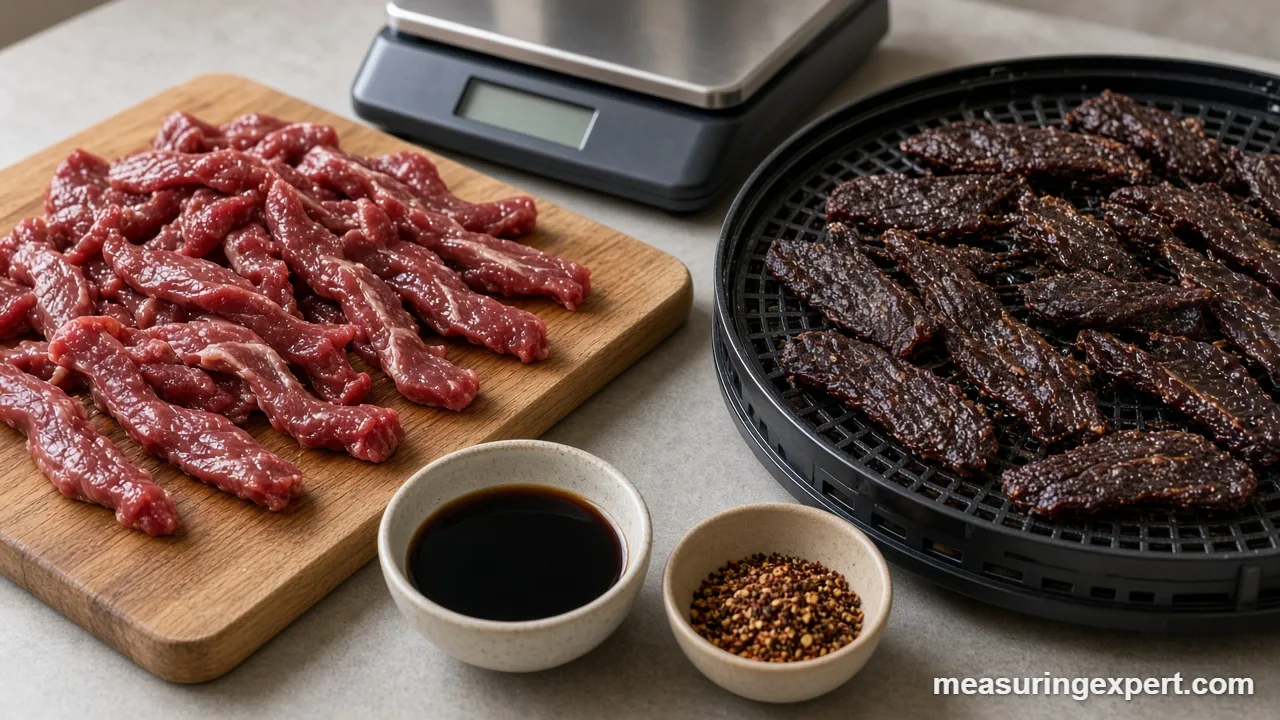
The University of California extension sample marinade is written for 1 1/2 to 2 pounds of lean meat. Specifically, it calls for 1/4 cup soy sauce, 1 tablespoon Worcestershire sauce, 1/4 teaspoon each of black pepper and garlic powder, 1/2 teaspoon onion powder and 1 teaspoon hickory smoke-flavored salt. The table below divides that recipe by 2, which matches the 2-pound end of the range, and then multiplies it for bigger batches.
| Raw meat | Soy sauce | Worcestershire | Pepper and garlic powder (each) | Onion powder | Smoke-flavored salt |
|---|---|---|---|---|---|
| 1 lb (454 g) | 2 tbsp (29.6 mL) | 1 1/2 tsp | 1/8 tsp | 1/4 tsp | 1/2 tsp |
| 2 lb (907 g) | 4 tbsp (59.1 mL) | 1 tbsp | 1/4 tsp | 1/2 tsp | 1 tsp |
| 3 lb (1,361 g) | 6 tbsp (88.7 mL) | 1 tbsp + 1 1/2 tsp | 3/8 tsp | 3/4 tsp | 1 1/2 tsp |
| 5 lb (2,268 g) | 10 tbsp (147.9 mL) | 2 tbsp + 1 1/2 tsp | 5/8 tsp | 1 1/4 tsp | 2 1/2 tsp |
In other words, these are scaled values, not a new recipe. Therefore, treat them as a starting point and adjust to taste in later batches. Our guide to measuring salt, rubs and temperatures for smoking meat shows how the same per-pound thinking works for rubs.
Recommended Tools to Measure Ingredients for Jerky
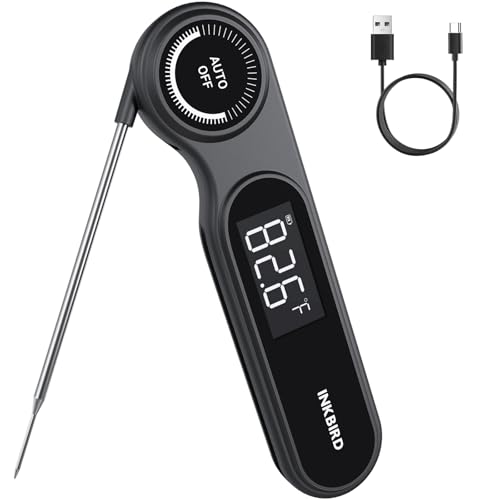
In practice, three tools do most of the work. First, a digital scale with a tare button weighs the meat and any dry cure. Next, level measuring spoons handle the marinade. Finally, an instant-read thermometer confirms that the meat reaches the safe temperature before drying.


As an Amazon Associate, Measuring Expert earns from qualifying purchases.
Key Takeaways
- Weigh raw meat first, because every seasoning amount scales from that number.
- Slice strips no thicker than 1/4 inch (6.35 mm), according to University of California extension guidance.
- USDA guidance says to heat meat to 160 F (71 C) and poultry to 165 F (74 C) before drying.
- Keep the dehydrator at 130 to 140 F (54 to 60 C) for the whole drying time.
- Marinate in the refrigerator and discard the used marinade.
- One retailer’s curing salt label says 1 level teaspoon per 5 pounds of meat.
- Home-dried jerky keeps about 1 to 2 months, so label each batch with a date.
Jerky Safety Temperatures You Need to Measure
Overall, USDA guidance uses four temperature numbers. First, raw meat stays at 40 F (4 C) or below until it goes into the marinade. After that, the meat is heated to a safe internal temperature, and finally the dehydrator holds a steady drying temperature.
| Step | Temperature | Celsius | Why it matters |
|---|---|---|---|
| Raw meat storage | 40 F or below | 4 C | Keeps raw meat cold before and during marinating |
| Heat beef or other red meat | 160 F | 71 C | Safe internal temperature before drying |
| Heat poultry | 165 F | 74 C | Safe internal temperature before drying |
| Dehydrator drying | 130 to 140 F | 54 to 60 C | Keeps the strips drying at a steady, warm temperature |
For instance, the USDA page recommends steaming or roasting the meat to reach 160 F, or 165 F for poultry, and checking it with a food thermometer. Likewise, the Kentucky sheet adds that a dehydrator is preferred over an oven because it holds temperature better. For help reading a probe, see our meat thermometer doneness chart.
How to Measure Curing Salt Without Guessing
Curing salt is a different product from table salt, so never swap one for the other. One retailer’s product page for a sodium nitrite cure states that it contains 6.25% sodium nitrite and says to use 1 level teaspoon per 5 pounds of meat, or 1 ounce per 25 pounds. Similarly, that works out to 0.2 teaspoon per pound.
| Raw meat | Curing salt by that label | In grams |
|---|---|---|
| 1 lb | 0.2 tsp (hard to measure) | about 1.13 g |
| 2 lb | 0.4 tsp | about 2.27 g |
| 3 lb | 0.6 tsp | about 3.40 g |
| 5 lb | 1 level tsp | about 5.67 g |
In addition, the gram values come from dividing 1 ounce (28.35 g) by 25 pounds. At 6.25% nitrite, that ratio works out to roughly 156 parts per million of nitrite in the meat. However, fractions of a teaspoon are unreliable, so a small gram scale is the safer way to weigh such a tiny amount. Always follow the directions printed on the cure you actually bought, because brands and blends differ.
How to Measure Ingredients for Jerky Step by Step
- Weigh the raw meat. Place a bowl on the scale, press tare, and add the trimmed meat. Write the weight down in pounds or grams.
- Scale the seasonings. Then use the converter and the per-pound table above to find each amount for your weight.
- Slice evenly. Cut strips no thicker than 1/4 inch (6.35 mm) so they heat and dry at the same rate.
- Measure the marinade. Use a liquid cup for larger amounts of soy sauce and level spoons for small ones. Next, mix it in a bowl before it touches the meat.
- Marinate in the refrigerator. Keep the meat at 40 F or below, and discard the used marinade afterward.
- Heat the meat. Steam or roast it until a thermometer reads 160 F (beef) or 165 F (poultry).
- Dry at a steady temperature. Hold the dehydrator at 130 to 140 F until a test strip cracks but does not break when bent.
- Record the batch. Note the raw weight, finished weight and the date, so the next batch is easier to adjust.
Meat Weight, Slice Thickness and Yield
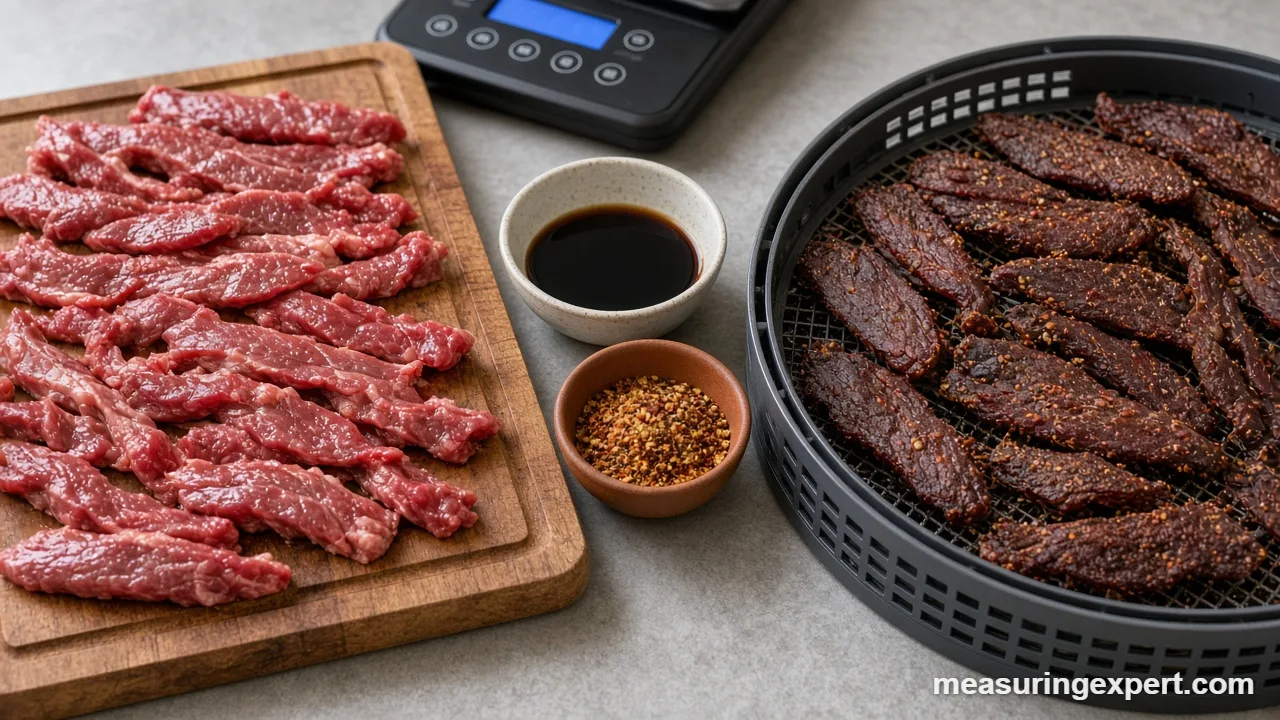
In general, raw meat loses most of its weight as it dries. The Kentucky sheet says a pound of raw meat or poultry yields about 4 ounces of jerky, which is 25 percent. By contrast, the North Dakota State publication says 5 pounds of fresh meat yields about 2 pounds after drying or smoking, which is 40 percent.
| Raw meat | Finished jerky at 25% | Finished jerky at 40% |
|---|---|---|
| 1 lb (454 g) | 4 oz (113 g) | 6.4 oz (181 g) |
| 2 lb (907 g) | 8 oz (227 g) | 12.8 oz (363 g) |
| 5 lb (2,268 g) | 20 oz (567 g) | 2 lb (907 g) |
Because the two sources differ, plan on a range. Also, cut size, fat content and how dry you like the strips all change the result. In short, weigh a finished batch once and use that number for future planning.
Do and Don’t When You Measure Ingredients for Jerky
Do
- Weigh raw meat and write the number down.
- Level every spoon with a straight edge.
- Keep curing salt in a labeled container, away from table salt.
- Check meat temperature with a food thermometer.
- Date each finished batch.
Don’t
- Reuse marinade that touched raw meat.
- Guess curing salt by the pinch.
- Marinate on the counter.
- Skip the heating step before drying.
- Trust a dehydrator dial without checking it.
Honest Limits of Jerky Measurements
Per-pound tables are convenient, but they are only estimates. For one thing, the sample marinade came from a document written for lean meat, and fatty cuts or ground meat may need different handling. Moreover, volume measures of dry spices vary with how finely they are ground and how firmly they are packed. In addition, home dehydrators can run hotter or cooler than their dials show. Therefore, a thermometer reading beats a dial setting, and a gram scale beats a spoon for anything that affects safety.
When to Ask an Expert About Jerky Safety
If you plan to make jerky from game meat, sell it, or use a cure and smoke process that this page does not cover, a trained source is the better guide. For example, local extension offices and the USDA Meat and Poultry Hotline can answer specific questions. Similarly, a food safety professional can review a recipe before you share or sell it.
Frequently Asked Questions
How much seasoning per pound of meat for jerky?
Scaling the University of California sample marinade to the 2-pound end of its range gives, per pound, 2 tablespoons soy sauce, 1 1/2 teaspoons Worcestershire sauce, 1/8 teaspoon each of pepper and garlic powder, 1/4 teaspoon onion powder and 1/2 teaspoon smoke-flavored salt.
How many pounds of meat does it take to make 1 pound of jerky?
In general, plan on roughly 2.5 to 4 pounds of raw meat. The Kentucky sheet gives about 4 ounces of jerky per raw pound, and the North Dakota State publication gives about 2 pounds from 5 pounds.
Should I measure ingredients for jerky by weight or by volume?
As a rule, use weight for the meat and for anything where precision affects safety, such as curing salt. Volume is fine for liquid marinade parts like soy sauce.
How much curing salt per pound for jerky?
One retailer’s label for a 6.25% sodium nitrite cure says 1 level teaspoon per 5 pounds of meat, which is about 0.2 teaspoon or 1.13 g per pound. Also, follow the label on the product you buy.
What temperature should meat reach before drying jerky?
USDA guidance says to heat beef to 160 F (71 C) and poultry to 165 F (74 C), checked with a food thermometer.
What dehydrator temperature is safe for jerky?
USDA guidance says to keep the dehydrator at 130 to 140 F (54 to 60 C) throughout the drying process.
How thick should I slice meat to measure ingredients for jerky evenly?
Slice strips no thicker than 1/4 inch (6.35 mm). Because even slices heat and dry at the same rate, one seasoning amount suits the whole batch.
Can I reuse jerky marinade?
No, because USDA guidance says not to save marinade for reuse after it has touched raw meat.
How long does homemade jerky last?
USDA guidance says home-dried jerky keeps about 1 to 2 months. By contrast, commercially packaged jerky can last up to 12 months.
What is the easiest way to measure ingredients for jerky in small batches?
First, weigh the meat, scale the table above, and mix the marinade in a separate bowl. For tiny amounts, a gram scale is more reliable than fractions of a teaspoon.
Measure Ingredients for Jerky: The Bottom Line
To sum up, weigh the raw meat, scale every seasoning per pound, and keep the safety numbers in view: 1/4 inch slices, 40 F storage, 160 F or 165 F heating and 130 to 140 F drying. Curing salt deserves the most care, so weigh it and follow the label.
Finally, write down each batch. As a result, over a few rounds, those notes turn a scaled sample recipe into your own tuned one. For related drying work, see our guide to measuring ingredients for dehydrating.