

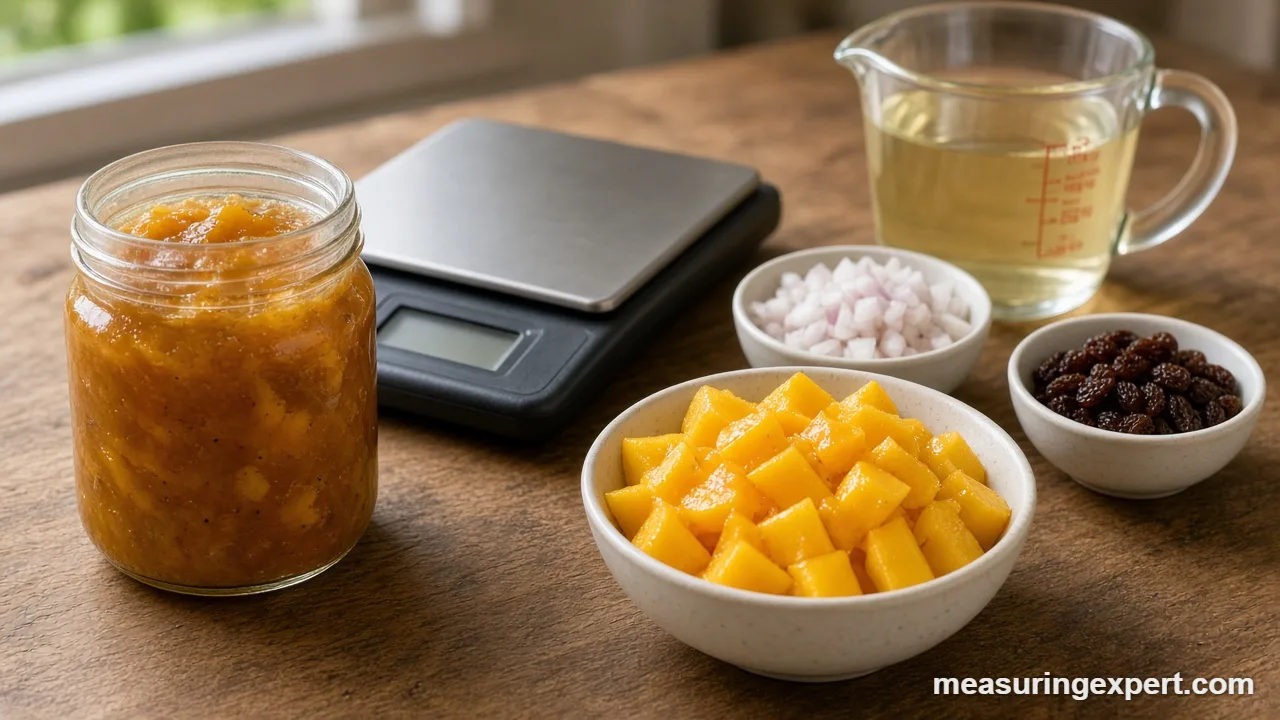
To measure chutney ingredients, weigh the fruit, onion and sugar, and measure the vinegar by volume. For example, the NCHFP mango chutney uses 4 lb (1,814 g) of chopped mango, 4 1/2 cups (891 g) of sugar and 3 cups (710 mL) of 5% vinegar. For canning, follow a tested recipe exactly.
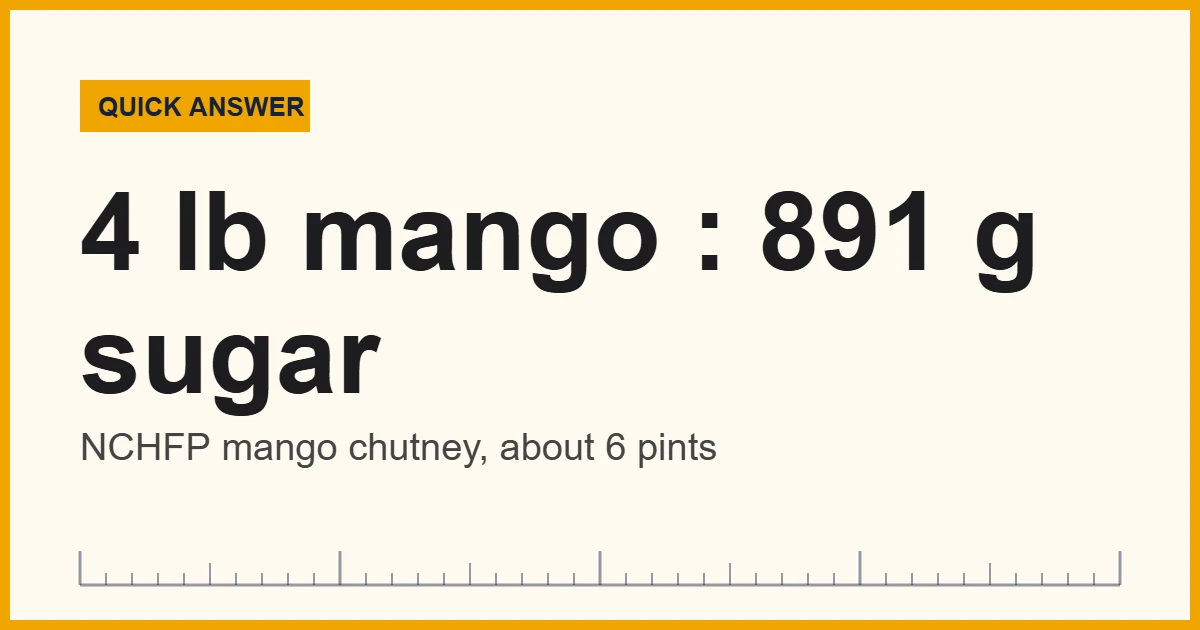
Chutney looks forgiving, because it is a thick mix of fruit, onion, sugar, vinegar and spice. However, a jar that will sit on a shelf is a different matter. The balance of sugar, vinegar and fruit in a tested recipe is part of what makes it safe to can, so the numbers matter more than they seem to.
This page shows how to measure chutney ingredients by weight and by volume, using two tested recipes from the National Center for Home Food Preservation (NCHFP). In addition, it covers prep, scaling, headspace and the mistakes that most often throw a batch off. If you plan to can, read the guide to measuring ingredients for canning first.
Chutney Weight Converter
Recipes list fruit in pounds and sugar in cups, so a quick converter helps. Enter a weight below and pick the unit you have. The tool then shows pounds, ounces, grams and kilograms.
Measure Chutney Ingredients by Weight, Not Cups
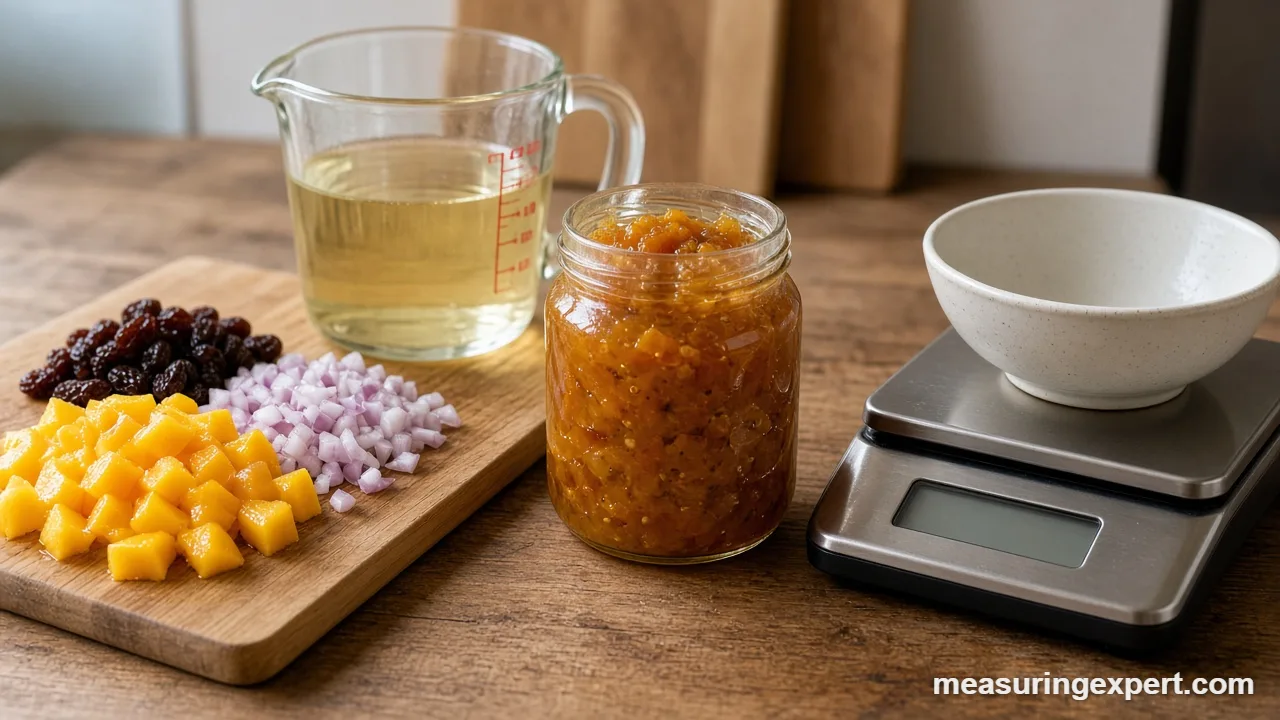
However, cups of chopped fruit vary with the size of the pieces and how tightly you pack them. In contrast, weight does not. Therefore, a scale gives the same batch every time. The NCHFP mango chutney is a good example, because it lists a weight next to the volume for the fruit and onion.
| Ingredient (NCHFP mango chutney) | Volume or count | Weight or metric |
|---|---|---|
| Chopped unripe mango | 11 cups | 4 lb (1,814 g) |
| Finely chopped yellow onion | 2 1/2 cups | 3/4 lb (340 g) |
| Granulated sugar | 4 1/2 cups | 891 g (31.5 oz) |
| White distilled vinegar, 5% | 3 cups | 710 mL |
| Golden raisins | 2 1/2 cups | about 373 g |
| Grated fresh ginger | 2 1/2 tbsp | about 37 mL |
| Canning salt | 1 1/2 tsp | about 7.4 mL |
The sugar and raisin weights come from the King Arthur ingredient weight chart, which lists 1 cup of granulated sugar at 198 g and 1 cup of loose raisins at 149 g. In addition, a US cup is 236.6 mL, so 3 cups of vinegar is 710 mL. As a result, the sugar is about 49% of the mango by weight.
Recommended Tools to Measure Chutney Ingredients
In short, a chutney batch needs a scale, a way to fill jars cleanly and a way to check headspace. First, a digital scale with a tare button handles the fruit, onion and sugar. Next, a wide-mouth funnel keeps the rims clean, and a bubble tool checks the 1/2 inch of headspace.


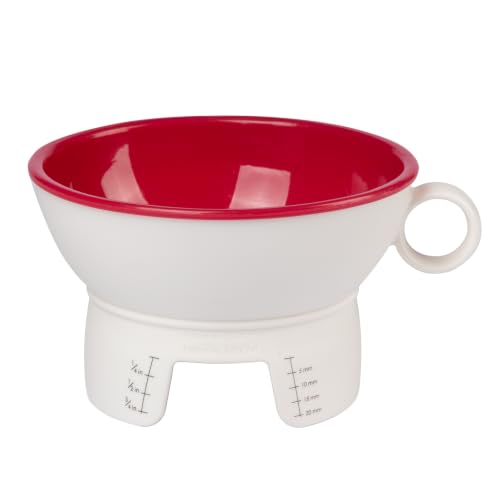


As an Amazon Associate, Measuring Expert earns from qualifying purchases.
- Weigh fruit, onion and sugar, and measure vinegar by volume.
- NCHFP mango chutney uses 4 lb of mango, 891 g of sugar and 3 cups of 5% vinegar.
- Use only a tested recipe for jars that will be stored on a shelf.
- Leave 1/2 inch (1.3 cm) of headspace, as both NCHFP recipes direct.
- Process pints 10, 15 or 20 minutes, depending on your altitude.
- Wear gloves when handling green mango or hot peppers.
What Two Tested Chutney Recipes Measure
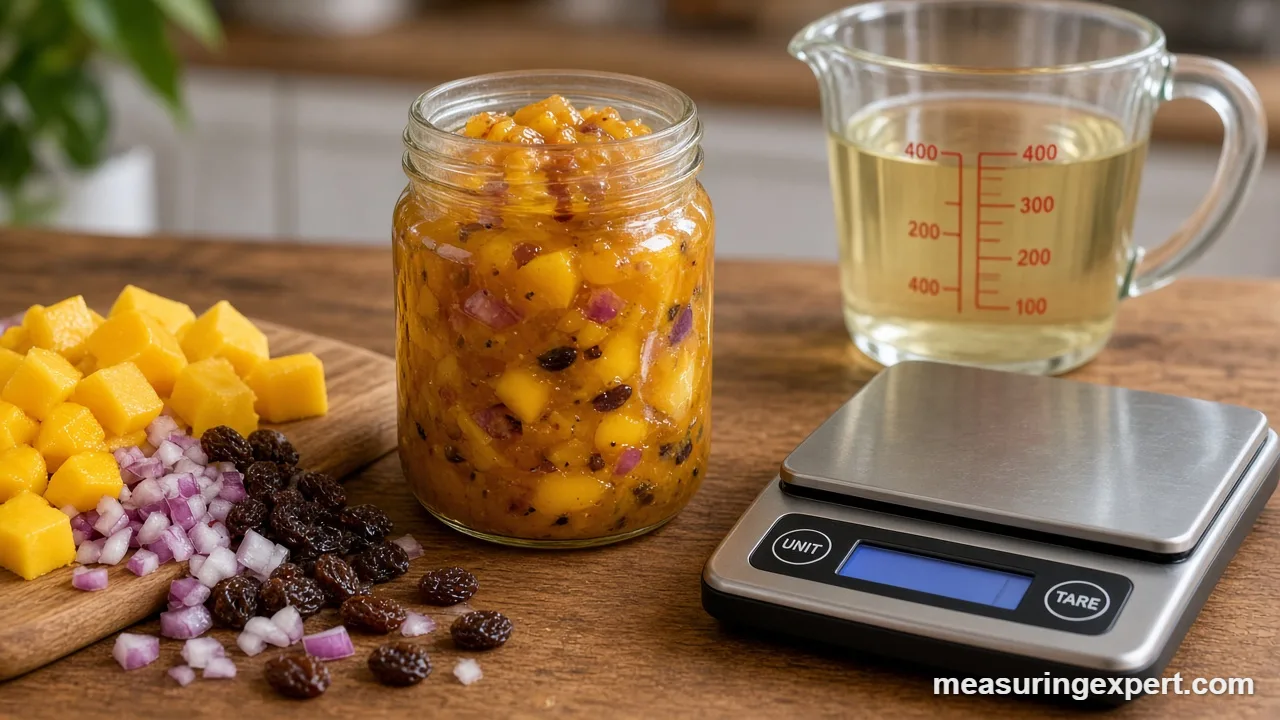
NCHFP publishes tested chutney recipes that make about 6 pints each. For instance, the apple chutney below uses brown sugar and cider vinegar, while the mango chutney uses white sugar and distilled vinegar. Notice that both put the sugar and vinegar in the same range, close to a one-to-one ratio.
| Ingredient | Mango chutney | Apple chutney |
|---|---|---|
| Main fruit | 11 cups chopped unripe mango (4 lb) | 16 cups pared, cored, chopped tart apples (about 10 medium) |
| Onion | 2 1/2 cups (3/4 lb) | 1 cup |
| Sugar | 4 1/2 cups white (891 g) | 4 cups light brown (852 g) |
| Vinegar (5%) | 3 cups white distilled (710 mL) | 4 cups apple cider (946 mL) |
| Raisins | 2 1/2 cups golden | 12 oz (340 g) golden |
| Cooking time | 5 minutes sugar and vinegar, then 25 minutes | About 45 minutes, until thick |
| Yield | About 6 pints | About 6 pints |
The brown sugar weight uses the King Arthur figure of 213 g per packed cup. Meanwhile, the apple recipe lists the rest of its seasoning by spoon, including 3 tablespoons of mustard seed and 2 tablespoons of ground ginger. Also, both recipes are on the NCHFP site, so open them for the full method.
How to Measure Chutney Ingredients, Step by Step
- Pick a tested recipe. Use an NCHFP or other tested canning recipe if the jars will sit on a shelf.
- Prep before you measure. First, wash, peel, core and chop the fruit and onion as the recipe directs.
- Weigh the fruit and onion. Next, put a bowl on the scale, press tare, and add chopped pieces up to the listed weight.
- Weigh the sugar. Then add the sugar by weight, or level each cup with a knife.
- Measure the vinegar. Pour 5% vinegar into a liquid measuring cup, and read the line at eye level.
- Add spices by the spoon. Level each teaspoon and tablespoon, because spices are strong.
- Cook, fill and process. Finally, simmer as directed, leave 1/2 inch of headspace, and process for your altitude.
Instead, measure the vinegar in a clear liquid cup, not a dry cup. A dry cup filled to the brim holds slightly more than its mark, while a liquid cup lets you read the line exactly.
Why the Sugar, Vinegar and Fruit Balance Matters
In a canned chutney, vinegar supplies the acid and sugar helps with texture and flavor. Because of this, the tested recipes call for 5% acidity vinegar, which is the strength of ordinary white distilled or cider vinegar. Using a vinegar of unknown strength, or adding extra low-acid vegetables, changes the batch in ways nobody has tested.
Scaling a Chutney Recipe Up or Down
Scaling is simple for chutney you plan to eat soon, because you can multiply every ingredient by the same factor. For example, halving the mango recipe gives 2 lb (907 g) of mango, 2 1/4 cups (446 g) of sugar and 1 1/2 cups (355 mL) of vinegar. However, a larger batch cooks longer, and a wider pot evaporates faster.
For canning, the safer choice is to make the recipe as written. Instead of doubling, cook two separate batches. As a result, this keeps the cooking time and thickness the same as the tested version. For more on this idea, see how measuring ingredients for pickling works, since pickles follow the same acid rules.
Headspace, Jars and Processing Time
Both NCHFP recipes call for 1/2 inch (about 1.3 cm) of headspace and a boiling water canner. The processing time depends on your altitude, so check it before you start.
| Jar size | 0-1,000 ft (0-305 m) | 1,001-6,000 ft (305-1,829 m) | Above 6,000 ft (1,829 m) |
|---|---|---|---|
| Pints (hot pack) | 10 minutes | 15 minutes | 20 minutes |
After processing, let the jars cool undisturbed for 12 to 24 hours, then check the seals. Also, refrigerate any chutney left over after filling the jars. For a related fruit preserve, see how to measure ingredients for making jam.
Common Mistakes When You Measure Chutney Ingredients
| Mistake | What happens | Fix |
|---|---|---|
| Measuring fruit before chopping | Wrong amount of fruit in the pot | Chop first, then weigh or measure |
| Packing cups of chopped fruit | Too much fruit, thin vinegar balance | Weigh the fruit instead |
| Using vinegar of unknown strength | Untested acidity | Use 5% vinegar as listed |
| Doubling a canning recipe | Different cooking time and thickness | Cook two separate batches |
| Swapping tablespoons and teaspoons | Very salty or hot chutney | Level each spoon and read the label |
| Skipping the headspace check | Poor seal or siphoning | Measure 1/2 inch from the rim |
Likewise, a heaping spoon of chili powder or cayenne can turn a mild batch hot. Therefore, level every spoon with a knife.
Do and Don’t for Chutney Measuring
Do
- Use a tested recipe for canning.
- Weigh the fruit, onion and sugar.
- Read liquid at eye level.
- Wear gloves for green mango and hot peppers.
- Write down the altitude time.
Don’t
- Change the vinegar or fruit amounts.
- Double a canning batch.
- Use vinegar of unknown strength.
- Can a refrigerator recipe.
- Skip the processing time.
Honest Limits of Chutney Measurements
Fruit varies in size, water content and ripeness, so a cup of chopped mango is never exactly the same twice. As a result, the weights above come from the tested recipes, while the gram figures for sugar and raisins come from a baking chart. They are close, but not lab values. In addition, this page does not replace the full NCHFP method, and it does not give a safe way to alter a canning recipe. Recipes meant for the refrigerator or freezer follow different rules, so keep them cold and use the storage time your recipe gives.
Frequently Asked Questions
How do I measure chutney ingredients for canning?
Follow a tested recipe exactly. For example, NCHFP’s mango chutney calls for 11 cups (4 lb) of chopped mango, 4 1/2 cups of sugar and 3 cups of 5% vinegar.
What is the ratio of vinegar to sugar in chutney?
It depends on the recipe. The NCHFP mango chutney uses 3 cups of vinegar to 4 1/2 cups of sugar, while the apple chutney uses 4 cups of each.
Do I need a scale to measure chutney ingredients?
Not strictly, because NCHFP lists cups. However, a scale helps, because chopped fruit packs differently each time. Therefore, weigh the fruit and onion when the recipe gives a weight.
How many mangoes make 11 cups of chopped mango?
NCHFP says about 9 to 10 large mangoes, or around 6 lb as purchased, give 11 cups (4 lb) chopped. The recipe calls for unripe, hard mangoes.
Can I reduce the sugar in canned chutney?
Changes are untested, so use a recipe written for less sugar instead. Otherwise, make a small refrigerator batch and keep it cold.
How much headspace does chutney need?
Both NCHFP recipes call for 1/2 inch (about 1.3 cm). Remove air bubbles, then adjust the headspace if needed before you wipe the rim.
How long do I process chutney?
Process pints in a boiling water canner for 10 minutes at 0 to 1,000 ft, 15 minutes at 1,001 to 6,000 ft, and 20 minutes above 6,000 ft.
Should I measure chutney ingredients before or after chopping?
After, when the recipe says chopped. NCHFP lists the mango as chopped and the apples as pared, cored and chopped. So prep first, then measure.
Can I use a different vinegar?
Use the type and strength the recipe names. The NCHFP recipes call for 5% white distilled or apple cider vinegar, so do not substitute a vinegar of unknown acidity.
How do I know when chutney is thick enough?
Follow the recipe’s cooking time and stir often. NCHFP’s apple chutney simmers about 45 minutes until thickened, while the mango chutney simmers 25 minutes.
Measure Chutney Ingredients: The Bottom Line
In short, weigh the fruit, onion and sugar, measure the vinegar in a liquid cup, and level every spoon. Then, for any jar that will be stored on a shelf, keep to a tested recipe and its processing time.
Finally, sources for this page are the NCHFP mango chutney and apple chutney recipes, and the King Arthur ingredient weight chart. For ounce and pound conversions, see how much an ounce is.