

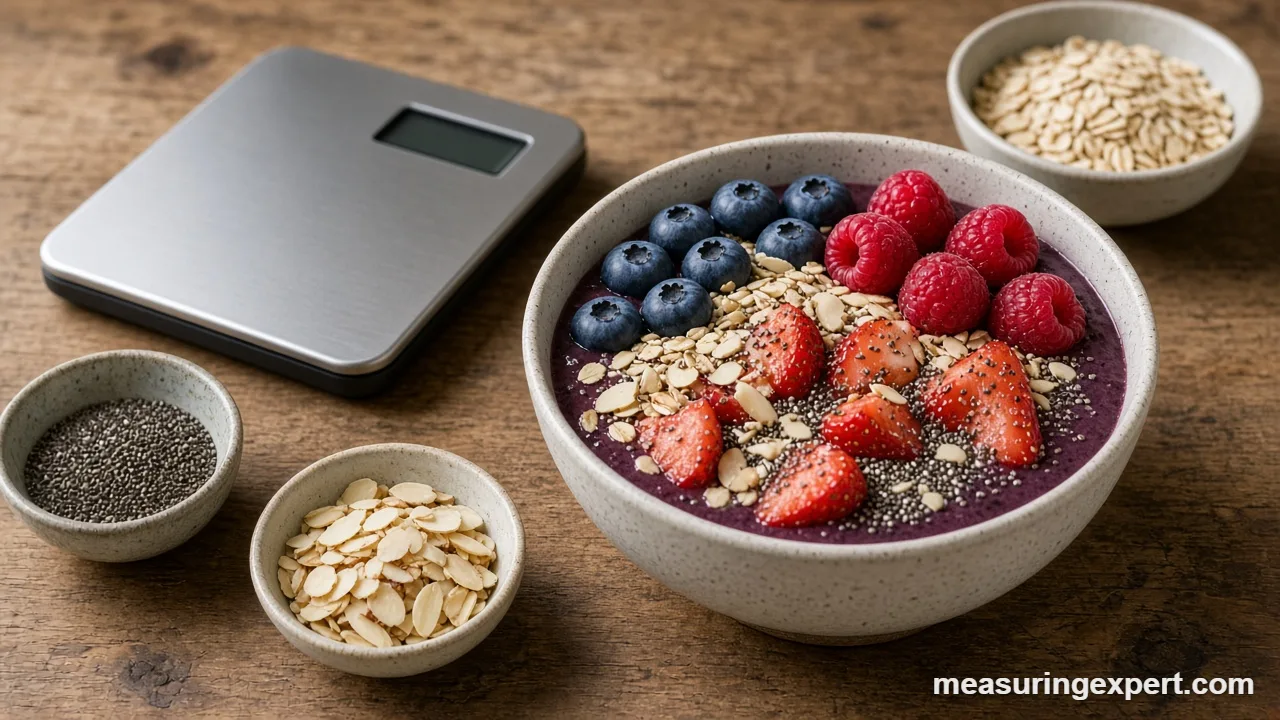
To measure superfood bowl ingredients, weigh the dense and small items on a gram scale: oats, quinoa, seeds, nuts, nut butter and honey. Use cups for fruit and leafy greens. Weight avoids the packing and cut-size differences that make cups unreliable, so every bowl comes out the same.
Convert Bowl Weights in Grams, Ounces and Pounds
Recipes for bowls often list grams, while many US scales default to ounces. Enter a weight below. As a result, the converter shows the other units using the exact definitions (1 oz = 28.349523125 g).
In general, a superfood bowl is a stack of small amounts: a scoop of oats, a spoon of seeds, a drizzle of honey. Because each amount is small, a few grams of error on every layer adds up. In other words, two bowls made from the “same” recipe can look and taste quite different. This guide shows how to measure superfood bowl ingredients so a bowl you like is a bowl you can repeat.
The weights below come from the King Arthur ingredient weight chart, and the fruit and vegetable equivalents come from USDA MyPlate. In short, this page covers measuring only. It does not make nutrition or health claims about any ingredient.
- Weigh oats, grains, seeds, nuts, nut butter and honey; use cups for fruit and greens.
- One cup of rolled oats can weigh 89 g or 113 g, depending on the type.
- One tablespoon of chia seeds is roughly 9 g, and one tablespoon of honey is about 21 g.
- Sliced and slivered almonds fill a cup differently, by about 33%.
- Press tare between layers so each ingredient shows its own weight.
Why Weight Beats Cups When You Measure Superfood Bowl Ingredients
A cup measures space, so it depends on how an ingredient is packed. For instance, oats settle, seeds slide into gaps, and frozen fruit leaves air pockets. However, a gram scale ignores all of that. For example, 40 g of oats is always 40 g, whether you scoop it loosely or tap the cup.
| Ingredient | Better by weight or by cup? | Reason |
|---|---|---|
| Oats, quinoa, other grains | Weight | Type and cut change the weight per cup |
| Chia, flax, hemp and other seeds | Weight | Small amounts, and spoon fill varies |
| Nuts and nut butter | Weight | Cut size and stickiness change the fill |
| Honey and maple syrup | Weight | Much of it clings to the spoon |
| Fresh fruit | Cup is fine | MyPlate defines cup equivalents for most fruit |
| Leafy greens | Cup is fine | Volume is large and precision matters little |
In addition, our guide to measuring ingredients by weight explains the tare button and why bakers prefer grams.
Common Weights When You Measure Superfood Bowl Ingredients
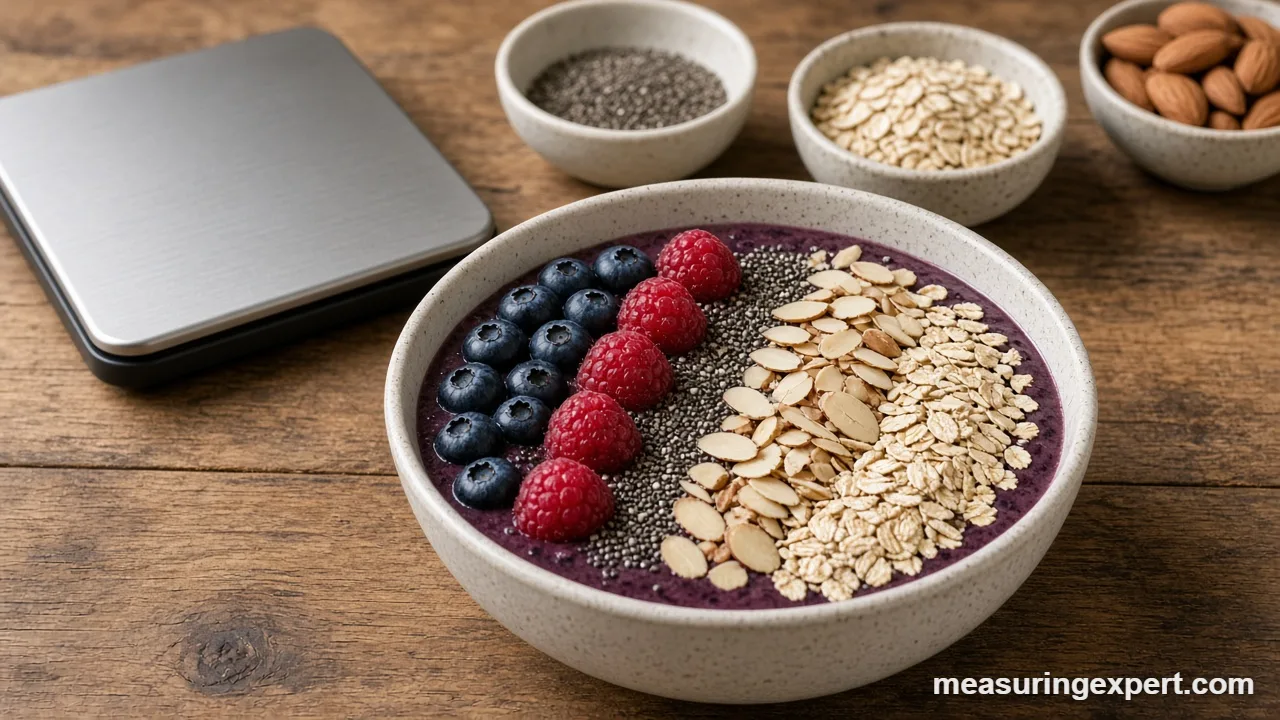
First, the table below lists published weights for the most common bowl ingredients. Also, ounces are converted from grams. In addition, per-tablespoon and per-half-cup figures are simple division of the chart value.
| Ingredient | Volume | Grams | Ounces |
|---|---|---|---|
| Rolled oats (King Arthur) | 1 cup | 113 g | 3.99 oz |
| Old-fashioned or quick-cooking oats | 1 cup | 89 g | 3.14 oz |
| Quinoa, dry | 1 cup | 177 g | 6.24 oz |
| Quinoa, cooked | 1 cup | 184 g | 6.49 oz |
| Chia seeds | 1/4 cup | 37 g | 1.31 oz |
| Flaxseed | 1/4 cup | 35 g | 1.23 oz |
| Sliced almonds | 1/2 cup | 43 g | 1.52 oz |
| Slivered almonds | 1/2 cup | 57 g | 2.01 oz |
| Almond butter | 1/4 cup | 68 g | 2.40 oz |
| Peanut butter | 1/2 cup | 135 g | 4.76 oz |
| Honey | 1 tablespoon | 21 g | 0.74 oz |
| Maple syrup | 1/2 cup | 156 g | 5.50 oz |
As a result, “1 cup of oats” is a vague instruction. Therefore, when a recipe gives grams, follow the grams. Otherwise, if it only gives cups, weigh your own cup once and write the weight on the recipe.
What Counts as a Cup of Fruit or Greens
Toppings are the colorful part of a bowl, so USDA MyPlate defines their cup equivalents. In addition, these figures are useful when a bowl recipe says “a cup of fruit”.
| Food | Counts as 1 cup |
|---|---|
| Banana | 1 large banana or 1 cup sliced |
| Strawberries | About 8 large, or 1 cup whole, halved or sliced |
| Pineapple | 1 cup of chunks, slices or crushed fruit |
| Dried fruit | 1/2 cup (so 1/4 cup counts as 1/2 cup) |
| Raw spinach or other leafy greens | 2 cups raw counts as 1 cup of vegetables |
| Cooked spinach | 1 cup |
| Cucumber, raw | About 1 cup |
| Carrots | About 1 cup chopped, or 2 medium carrots |
However, dried fruit is the surprise. Half a cup counts as a full cup of fruit, so scoop it sparingly. For tiny volumes such as a few tablespoons, a quick check at how much 30 mL is helps convert between spoons and milliliters.
Recommended Tools to Measure Superfood Bowl Ingredients
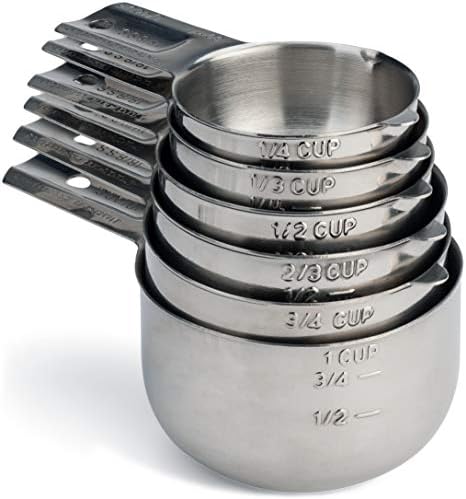
You need a scale first, since it handles most of the bowl. Next, a set of measuring cups covers fruit and greens, and level measuring spoons handle spices, seeds and drizzles when you do use volume. Also, look for a scale with a tare button and a flat top that fits a wide bowl.



As an Amazon Associate, Measuring Expert earns from qualifying purchases.
How to Measure Superfood Bowl Ingredients Step by Step
- Pick the bowl type. Decide whether you are building a smoothie bowl, a grain bowl or a breakfast oat bowl, and set a target weight for each layer.
- Tare the bowl. Place the empty bowl on the scale and press tare so the display shows zero.
- Weigh the base. Add the base (frozen fruit blend, oats or cooked grain) until the scale reaches your target in grams.
- Tare again and add the next layer. Press tare after each layer so every ingredient shows its own weight.
- Weigh seeds, nuts and nut butter. Add chia, flax, nuts and nut butter by weight instead of by heaping spoon.
- Finish with fruit and a drizzle. Add fresh fruit by the cup or by weight, then measure honey or syrup last so it does not stick to the bowl.
- Write it down. Record each weight so the next bowl matches this one.
Example Plan to Measure Superfood Bowl Ingredients in Grams
In short, the plan below is an illustration of how to write down a bowl, not a nutrition plan. Also, it uses the King Arthur weights above, with per-tablespoon and per-half-cup values from simple division.
| Layer | Amount by volume | Weight to aim for |
|---|---|---|
| Old-fashioned oats | 1/2 cup | about 44.5 g |
| Chia seeds | 1 tablespoon | about 9 g |
| Almond butter | 2 tablespoons | 34 g |
| Sliced almonds | 1/4 cup | about 21.5 g |
| Honey | 1 tablespoon | 21 g |
| Fresh strawberries | 1 cup | Use the cup (MyPlate equivalent) |
Overall, the weighed layers come to about 130 g. Write the totals on your recipe, and adjust one layer at a time if you want a different bowl.
Scaling a Bowl for More People
In practice, scaling is easy with a scale. First, multiply each weight by the number of bowls. Then weigh the whole batch of each ingredient into its own container. Finally, divide it among the bowls, or weigh each bowl as you build it. For example, four bowls with the plan above need about 178 g of oats and 36 g of chia.
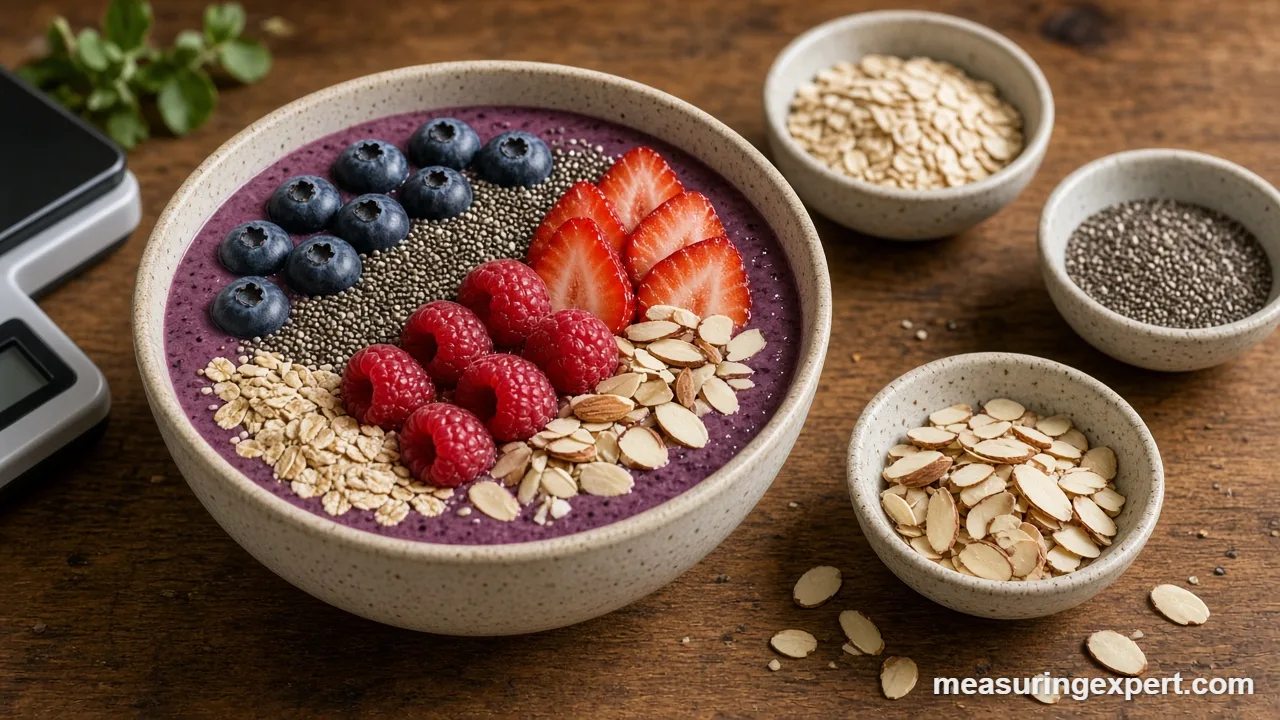
Likewise, the same approach works for meal prep. Because the weights are fixed, the bowls you assemble on Sunday match the ones you assemble on Wednesday.
Common Mistakes When You Measure Superfood Bowl Ingredients
- Treating all oats as equal. For example, rolled and old-fashioned oats differ by about 27% per cup.
- Using heaping spoons. In fact, a heaping spoon of seeds can hold well over a level one.
- Packing frozen fruit. As a result, pressing the fruit into the cup adds weight that the recipe did not plan for.
- Forgetting to tare. Otherwise, the bowl’s own weight sneaks into the first layer.
- Ignoring dried fruit. A half cup counts as a full cup of fruit.
- Measuring honey in a dry spoon. Therefore, most of it stays behind on the spoon.
Do and Don’t for Superfood Bowls
- Weigh dense and sticky ingredients.
- Tare between layers.
- Note whether oats are rolled or old-fashioned.
- Use level spoons for small amounts.
- Record the final weights.
- Trust “1 cup of oats” without a weight.
- Pack fruit into the cup.
- Swap sliced and slivered nuts by volume.
- Scoop seeds with heaping spoons.
- Count calories from volume alone.
Honest Limits of Bowl Measurements
The weights on this page are published reference values, but real products vary. For example, a different brand of oats, a drier batch of quinoa or a thicker nut butter will weigh differently from the chart. In addition, scales have a limit of their own: a home scale that reads to 1 g cannot resolve a 0.5 g pinch. In short, treat the table as a good starting point and weigh your own favorite ingredients once.
When You Need More Than Measuring
Bowls are often built around a health goal, such as a set calorie or protein target. Measuring gives you consistent portions, but it cannot tell you what portions suit you. Instead, nutrition labels, USDA FoodData Central and a registered dietitian are the right tools for that part. For a related example of measuring for a specific eating plan, see our post on measuring ingredients for diabetic recipes.
Frequently Asked Questions
What is the best way to measure superfood bowl ingredients?
Weigh the dense, sticky or small items (oats, quinoa, seeds, nut butter, honey) in grams, and use cups for fruit and greens. In short, a scale removes the packing and cut-size differences that make cups inconsistent.
How many grams is a tablespoon of chia seeds?
About 9 g. The King Arthur ingredient weight chart lists 1/4 cup of chia seeds at 37 g, and a quarter cup holds 4 tablespoons, so one tablespoon is roughly 9.25 g.
How much does a cup of oats weigh?
It depends on the oat. For example, King Arthur lists 1 cup of its rolled oats at 113 g and 1 cup of old-fashioned or quick-cooking oats at 89 g, a gap of about 27%. Therefore, check which oat your recipe means.
How much cooked quinoa goes in a bowl?
Recipes vary, so choose a weight and stay with it. One cup of cooked quinoa weighs about 184 g, per the King Arthur chart, so a half cup is about 92 g.
How many grams is a tablespoon of honey?
About 21 g. The King Arthur chart lists 1 tablespoon of honey at 21 g, which is roughly 1.42 g per milliliter.
Do sliced and slivered almonds weigh the same?
No. For example, King Arthur lists 1/2 cup of sliced almonds at 43 g and 1/2 cup of slivered almonds at 57 g. As a result, the cut changes how much fits in the cup.
What counts as a cup of fruit on a bowl?
The USDA MyPlate guide counts 1 cup of sliced banana, strawberries or chopped fruit as 1 cup of fruit. Dried fruit is more concentrated, so 1/2 cup of dried fruit counts as 1 cup.
How much spinach equals a cup of vegetables?
For example, MyPlate counts 2 cups of raw spinach or other raw leafy greens as 1 cup of vegetables. One cup of cooked spinach also counts as 1 cup.
Should I measure frozen fruit by weight or by cup?
Weight is steadier. For example, frozen pieces leave air gaps, and a cup of whole berries holds less fruit than a cup of chopped chunks. As a result, a scale ignores the gaps.
Can I use this guide for nutrition or diet goals?
In short, use it for consistent portions only. This page gives weights and volumes, not calorie counts or medical advice. For specific nutrition goals, ask a registered dietitian or your doctor.
Measure Superfood Bowl Ingredients: The Bottom Line
To sum up, weigh the oats, grains, seeds, nuts and honey, and let cups handle the fruit and greens. A single cup of oats can weigh 89 g or 113 g, so the unit alone does not tell you much.
Finally, write your weights down after the first good bowl. That one habit turns a lucky result into a recipe, and so the converter above makes it easy to switch between grams and ounces.