

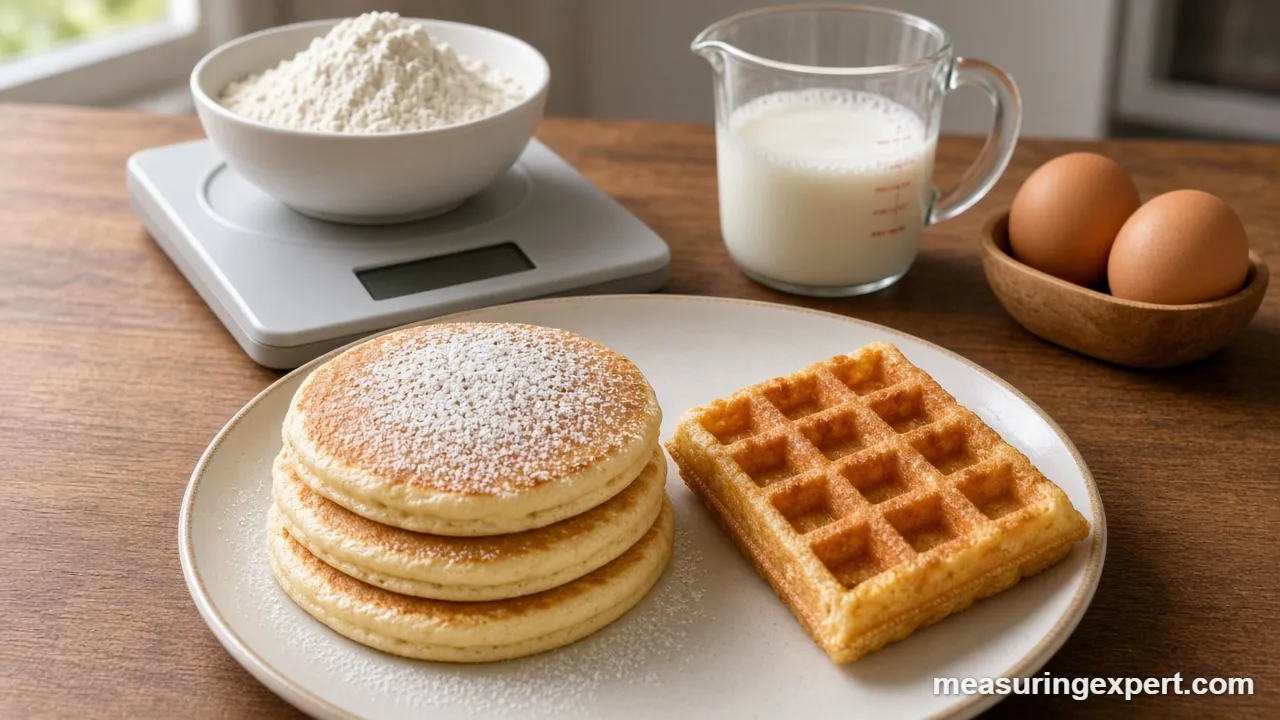
To measure pancakes and waffles batter well, weigh the flour: 1 cup of all-purpose flour is about 120 g (4 1/4 oz). Then use roughly 2 parts liquid to 1 part flour by weight, 1 egg per cup of flour, and 1 teaspoon of baking powder per cup. So 240 g of flour pairs with about 500 g of milk, eggs and butter.
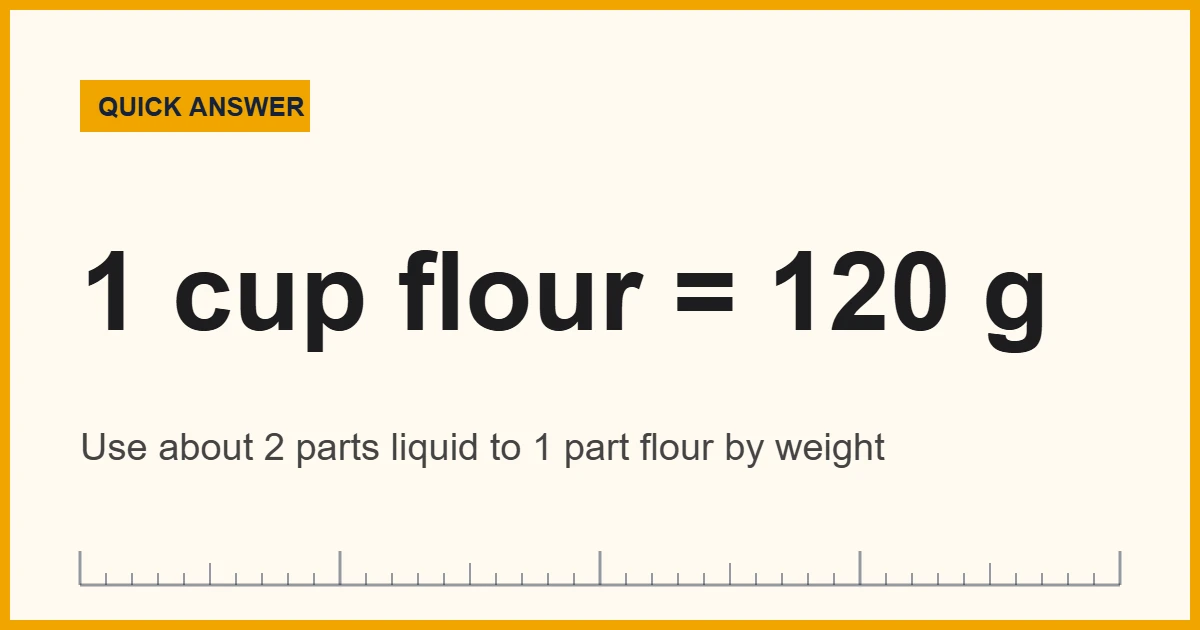
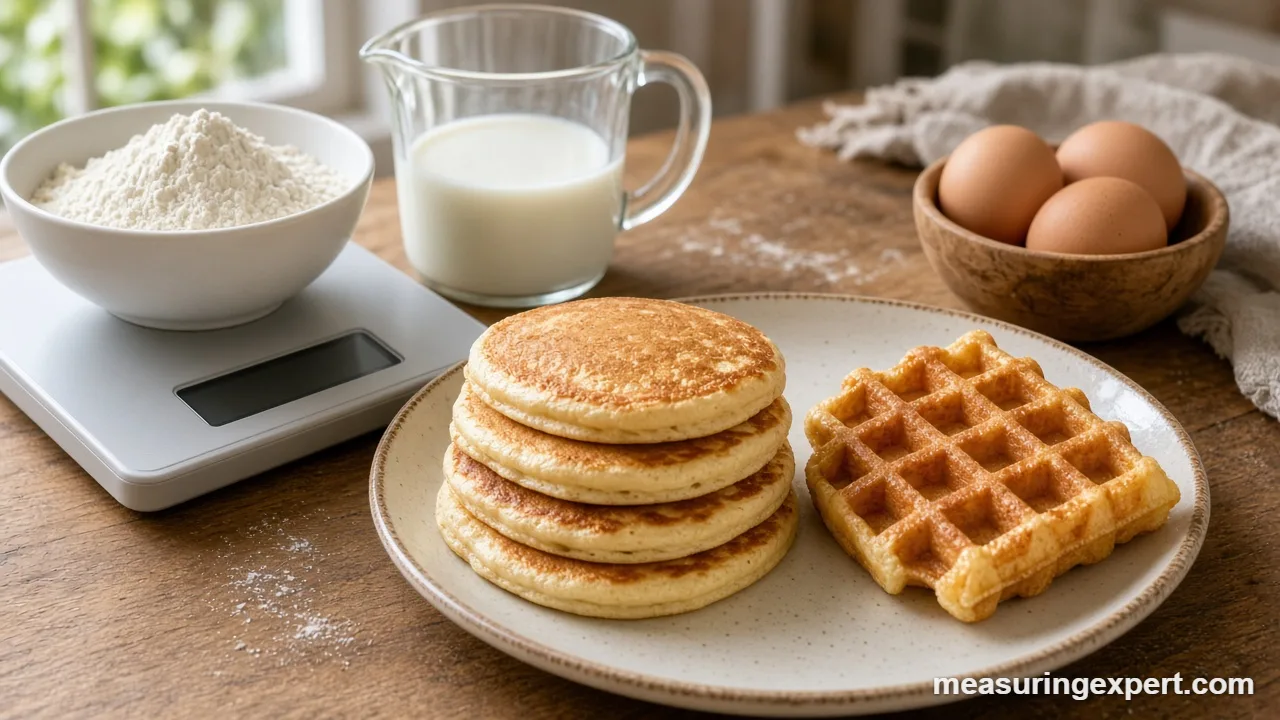
A Batter Formula for Pancakes and Waffles by Weight
In fact, most flat, tough or gummy breakfasts trace back to one problem: the flour. For example, a cup scooped straight from the bag can hold far more flour than a cup that was spooned and leveled. Therefore, the formula below uses grams first, with cups and spoons beside them for cooks without a scale.
| Ingredient | By volume | By weight | Role in the batter |
|---|---|---|---|
| All-purpose flour | 2 cups | 240 g (8 1/2 oz) | Structure |
| Baking powder | 2 teaspoons | 8 g (1/4 oz) | Lift |
| Granulated sugar | 2 tablespoons | about 25 g (7/8 oz) | Flavor and browning |
| Salt | 1/2 teaspoon | – | Flavor |
| Milk | 1 1/2 cups | about 340 g (12 oz) | Moisture |
| Large eggs | 2 eggs | 100 g (3 1/2 oz) | Richness and set |
| Melted butter | 4 tablespoons | about 57 g (2 oz) | Tenderness |
Overall, these weights come from the King Arthur Baking ingredient weight chart. For instance, it lists all-purpose flour at 120 g per cup, baking powder at 4 g per teaspoon, milk at 227 g per cup, and a large egg at 50 g. Its butter figure of 113 g for 8 tablespoons gives about 14 g per tablespoon.
In addition, King Arthur’s pancake guide suggests about twice as much liquid as flour by weight, and about 1 egg per cup of flour. As a result, the formula above sits close to that rule. Add the egg and butter to the liquid side, and the total wet weight is roughly 497 g against 240 g of flour.
Convert Flour and Batter Weights for Pancakes and Waffles
To start, type a weight in grams below to see it in ounces and pounds. This helps when a recipe lists ounces but your scale shows grams, or the other way around. For example, 240 g of flour is 8.47 oz.
Be careful, because ounces by weight and fluid ounces are different units. Our page on how much an ounce is explains the difference.
How to Measure Ingredients for Pancakes and Waffles Step by Step
- Set up the scale. First, place a large mixing bowl on it and press tare so the display reads zero.
- Weigh the flour. Add 240 g of all-purpose flour. Alternatively, if you use cups, fluff the flour, spoon it in, and level it with a knife.
- Add the leavening and salt. Level the baking powder spoon, and then whisk everything together.
- Measure the wet ingredients. In a second bowl, weigh the milk and eggs, then add the cooled melted butter.
- Combine briefly. Next, pour the wet mix into the dry mix and stir only until a few lumps remain.
- Check the thickness. The batter should fall from a spoon in a thick ribbon. However, add a tablespoon of milk if it is too stiff.
- Portion the batter. Pour about 1/4 cup per pancake, or follow your waffle iron’s manual for the right amount.
Dry Ingredients: Flour, Sugar and Leavening
First, flour is the biggest source of error. The same cup can hold noticeably different amounts depending on whether you scoop, spoon or sift. Because of this, a scale gives the most repeatable result.
| Dry ingredient | Measure | Weight |
|---|---|---|
| All-purpose flour | 1 cup | 120 g (4 1/4 oz) |
| Granulated sugar | 1 cup | 198 g (7 oz) |
| Brown sugar, packed | 1 cup | 213 g (7 1/2 oz) |
| Baking powder | 1 teaspoon | 4 g (1/8 oz) |
| Baking soda | 1/2 teaspoon | 3 g (1/10 oz) |
| Cornstarch | 1/4 cup | 28 g (1 oz) |
Baking powder and baking soda, in particular, deserve extra care. For instance, too little leaves the pancakes flat. However, too much leaves a bitter, soapy taste and can make waffles collapse. So always use a level spoon, never a heaped one. Meanwhile, if you only own spoons, see our guides to converting tablespoons to teaspoons and the difference between a teaspoon and a tablespoon.
Liquid Ingredients: Milk, Eggs and Butter
Liquids behave differently from flour, so use a clear measuring cup with a spout. Next, set it on a flat counter and read the mark at eye level. In contrast, dry cups are made for leveling, not for accurate pours.
Milk and buttermilk both weigh 227 g per cup in the King Arthur chart, so you can swap them in the same amount. Also, vegetable oil is lighter, at 198 g per cup. Vanilla extract is listed at 14 g per tablespoon, so a teaspoon is a little under 5 g. Melted butter is easiest to portion by tablespoon marks on the wrapper, and then it can cool slightly before it meets the eggs.
Finally, eggs are the one item you cannot level. In addition, a large egg is about 50 g without the shell. Consequently, if a recipe calls for half an egg, beat one egg and weigh out 25 g.
Recommended Tools for Pancakes and Waffles
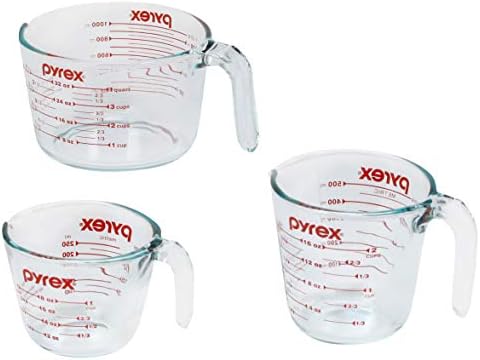
In practice, you need only a few items. First, a digital scale with tare handles the flour and liquids in one bowl. Next, a clear liquid measuring cup keeps milk accurate. Finally, a sturdy set of measuring spoons covers baking powder, salt and vanilla. Our guide to measuring ingredients with a kitchen scale shows how tare and unit switching work.




As an Amazon Associate, Measuring Expert earns from qualifying purchases.
Pancakes and Waffles: What Changes in the Measurements
In general, the two share most ingredients, but the batter is not always the same. Waffle batter usually carries more fat and sugar than pancake batter, which helps the outside crisp and brown in the iron. Pancake batter, by contrast, stays leaner and softer.
| Point | Pancakes | Waffles |
|---|---|---|
| Batter feel | Thick but pourable | Thick, often a little richer |
| Portion | About 1/4 cup per pancake | Set by the iron; check the manual |
| Lumps | A few are fine | A few are fine |
| Main risk | Dense, tough texture | Soft, pale waffles |
In practice, King Arthur pours about 1/4 cup of batter per pancake on a griddle, and about 1/3 cup when using English muffin rings. For waffles, however, irons differ so much that the manufacturer’s instructions are the best guide. So if waffles come out pale, check the iron’s heat setting before you change the recipe.
Scaling a Batch for a Crowd
Scaling is simple when every ingredient is in grams. Then multiply each number by the same factor and round to the nearest gram. However, spoons need more care, since small amounts do not always divide neatly.
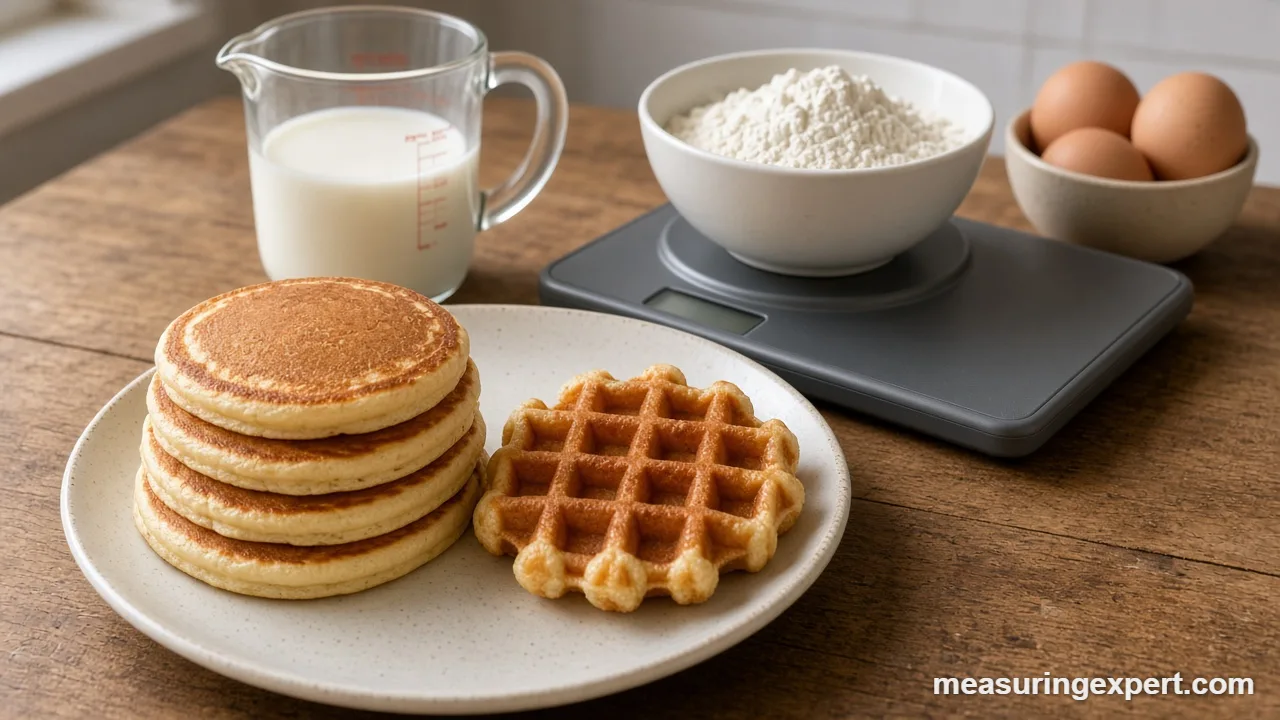
| Batch | Flour | Baking powder | Milk | Eggs | Butter |
|---|---|---|---|---|---|
| Half | 120 g (1 cup) | 1 tsp | 170 g (3/4 cup) | 1 | 2 tbsp |
| Standard | 240 g (2 cups) | 2 tsp | 340 g (1 1/2 cups) | 2 | 4 tbsp |
| 1 1/2 times | 360 g (3 cups) | 1 tbsp | 510 g (2 1/4 cups) | 3 | 6 tbsp |
| Double | 480 g (4 cups) | 4 tsp | 680 g (3 cups) | 4 | 8 tbsp |
A bigger batter also rests longer in the bowl, so the baking powder loses some of its lift while the last pancakes cook. In that case, work in two bowls and keep the second one covered.
High Altitude Adjustments
King Arthur says high-altitude changes start above roughly 3,000 to 3,500 feet. Its high-altitude baking guide recommends less leavening, a little more liquid and slightly less sugar. For example, at 3,000 to 5,000 feet, 1 teaspoon of baking powder becomes 7/8 teaspoon.
- Leavening: Cut it by the amounts on the King Arthur chart, starting at 7/8 of the recipe amount.
- Liquid: Add 1 to 2 tablespoons at 3,000 feet, plus 1 1/2 teaspoons for each extra 1,000 feet.
- Sugar: Reduce it by 1 tablespoon per cup.
Pancakes are forgiving, so make one change at a time and cook a test pancake first.
Common Measuring Mistakes
Do
- Weigh flour whenever you can.
- Level baking powder with a straight edge.
- Stir wet and dry mixes only until a few lumps remain.
- Use the same scoop or ladle for every pancake.
- Cook a small test pancake first.
Don’t
- Scoop flour straight from the bag with the cup.
- Use a dry cup for milk.
- Swap baking soda and baking powder.
- Pour in extra milk without tasting the batter.
- Judge an iron’s batter amount by eye.
Honest Limits of Pancakes and Waffles Measurements
The numbers above are a starting point, not a guarantee. For example, flour brands differ in protein and absorb liquid at different rates. In addition, King Arthur notes that lower-protein flour may need a bit more flour to reach the right thickness. Likewise, eggs vary in size, and milk fat changes the feel of the batter.
In short, trust the batter’s behavior over the number. Therefore, if it falls from the spoon in a thick ribbon, it is close. On the other hand, if it runs like cream or sits like paste, adjust by a tablespoon at a time.
When Accuracy Really Matters
For example, a few grams either way will not matter at a casual Sunday breakfast. However, accuracy counts in three cases. First, leavening in a gluten-free or egg-free recipe leaves little room for error. Second, batter for a person with a food allergy needs clean bowls and a clean scale, because flour, milk and eggs are common allergens. Third, if you sell or serve food, follow your local food rules for labeling and storage.
Frequently Asked Questions
How much flour do I need for pancakes and waffles?
A standard batch uses about 240 g (2 cups) of all-purpose flour. Meanwhile, half that amount makes a small batch for one or two people.
How many grams are in a cup of flour for pancakes and waffles?
One cup of all-purpose flour weighs about 120 g (4 1/4 oz) according to the King Arthur ingredient weight chart.
What is the ratio of liquid to flour in pancakes and waffles?
By weight, use about twice as much liquid as flour. Therefore, count the milk, eggs and melted butter together as the liquid.
How much baking powder do pancakes and waffles need?
The formula here uses 2 teaspoons for 2 cups of flour, or 1 teaspoon per cup. In addition, one level teaspoon weighs about 4 g.
How many eggs do I need for pancakes and waffles?
King Arthur suggests about 1 egg per cup of flour. For example, 2 cups of flour take 2 large eggs, which weigh about 100 g together.
How much batter goes in each pancake?
Pour about 1/4 cup per pancake on a griddle. For waffles, follow the waffle iron manual, because irons differ in size.
Are pancakes and waffles made from the same ingredients?
Mostly yes, because both use flour, leavening, eggs, milk and fat. However, waffle batter often has a little more fat and sugar for a crisper outside.
How do I measure pancake mix without measuring cups?
Use a kitchen scale and weigh the mix in grams. Otherwise, use measuring spoons, since 16 US tablespoons equal 1 cup.
Why are my pancakes and waffles dense?
Common causes are too much flour from scooping, overmixing the batter, or old baking powder. Instead, spoon and level the flour, and stir until just combined.
How do I adjust pancakes and waffles for high altitude?
Above about 3,000 feet, cut the baking powder slightly, add a little liquid, and reduce the sugar. For example, King Arthur lists 7/8 of the leavening at 3,000 to 5,000 feet.
Pancakes and Waffles: The Bottom Line
To sum up, weigh the flour at 120 g per cup, keep liquid at about twice the flour by weight, and add 1 egg and 1 teaspoon of baking powder per cup of flour. Also, level every spoon, and stir only until a few lumps remain.
Finally, use the converter above whenever a recipe and your scale disagree on units. Then write down what worked, so the next batch comes out the same way.
1 thought on “How to Measure Ingredients for Pancakes and Waffles”