

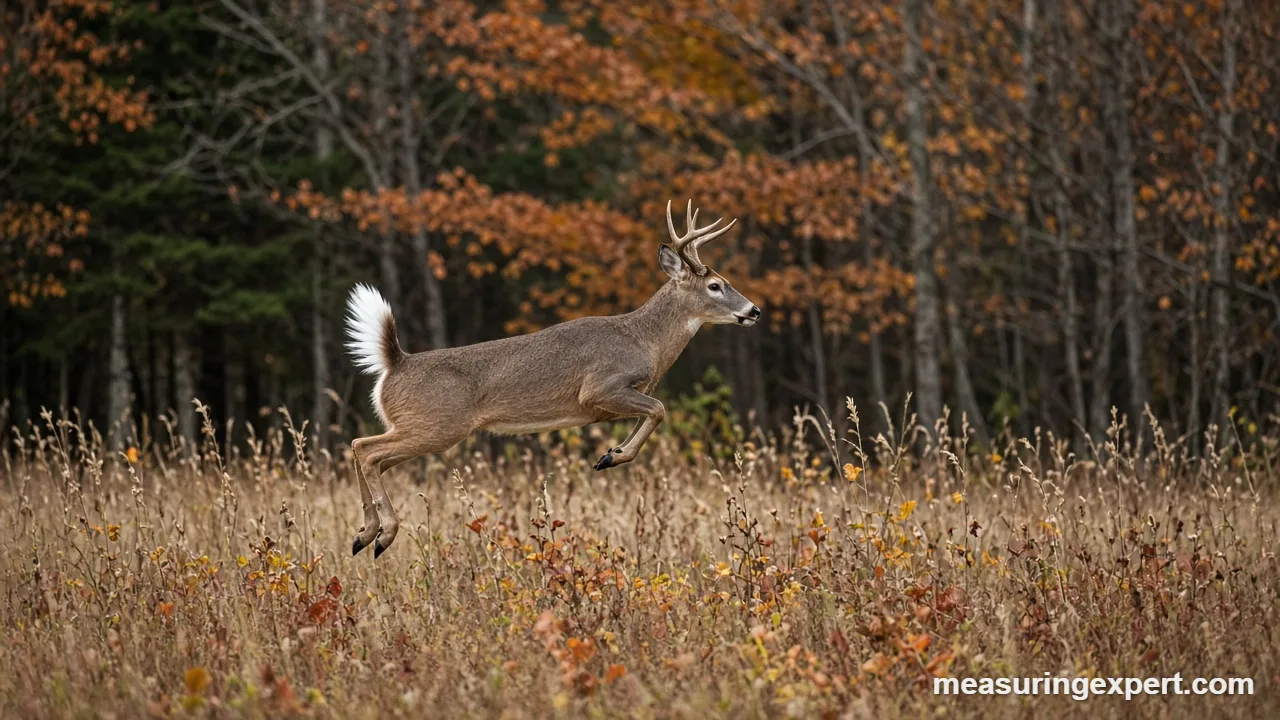
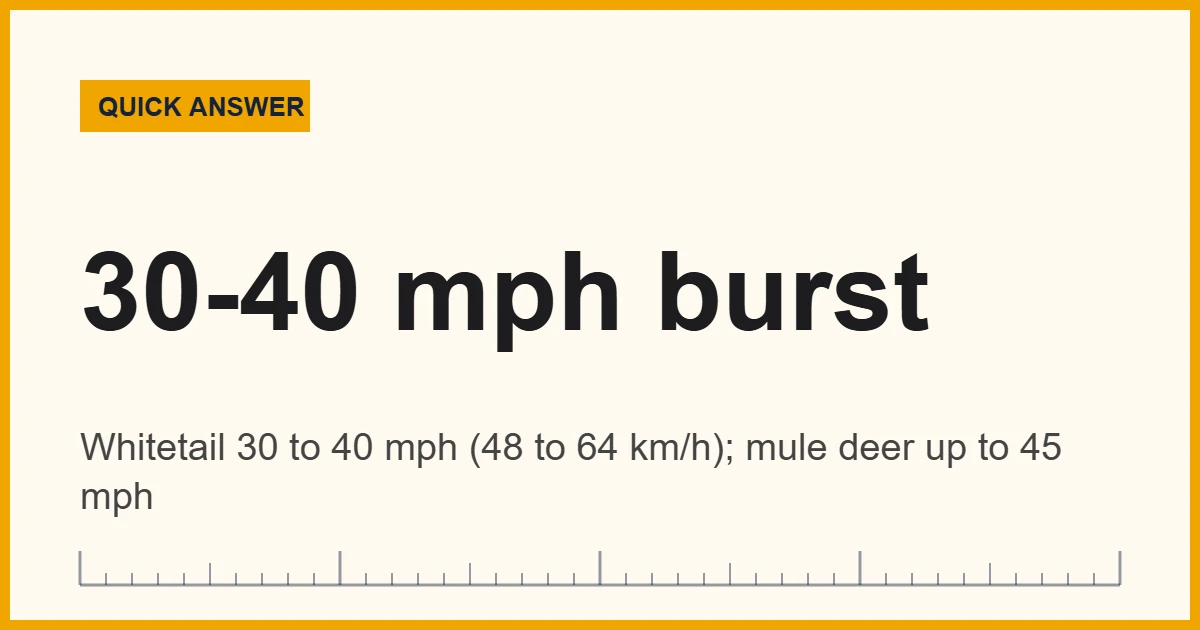
How fast deer run depends on the species. A white-tailed deer tops out at about 30 to 40 mph (48 to 64 km/h) in a short burst, and it can hold about 25 mph (40 km/h) for longer. Mule deer reach up to 45 mph (72 km/h) in short bursts, while caribou can run up to 50 mph (80 km/h).
Convert Fast Deer Speeds to km/h, m/s and Knots
Enter any speed below and pick its unit. Next, note that the box starts at 40 mph, the burst speed that wildlife agencies give for whitetails. You can also type 25 to see the cruising pace, or 45 for the mule deer burst.
So how fast is a deer in plain terms? At 40 mph, a whitetail covers almost 59 feet (about 18 m) every second. In other words, that is faster than any human sprinter. Still, these animals are built for quick escapes, not long races. For that reason, the honest answer is a range with two parts: a short burst speed and a slower pace the animal can keep up.
Overall, the figures on this page come from state and federal wildlife sources. For example, the Massachusetts Division of Fisheries and Wildlife says in its living with deer fact sheet that whitetails can run 40 mph for short bursts and keep up 25 mph for longer periods. In addition, the Pennsylvania Game Commission gives a top speed of about 30 mph. However, both numbers are field estimates, so this guide treats them as a range rather than one exact reading.
How Fast Deer Run: Chart in mph, km/h, m/s and ft/s
First, this chart converts the speeds you will meet in wildlife fact sheets. Moreover, every value starts from the exact definition of a mile (1.609344 km), and the results are rounded to two decimals.
| mph | km/h | m/s | ft/s | Knots | What it means |
|---|---|---|---|---|---|
| 5 | 8.05 | 2.24 | 7.33 | 4.34 | Brisk walk or easy trot |
| 15 | 24.14 | 6.71 | 22.00 | 13.03 | Relaxed bounding run |
| 25 | 40.23 | 11.18 | 36.67 | 21.72 | Whitetail pace held over longer distances |
| 30 | 48.28 | 13.41 | 44.00 | 26.07 | Whitetail top speed (Pennsylvania Game Commission) |
| 35 | 56.33 | 15.65 | 51.33 | 30.41 | Fast sprint; also a common moose figure |
| 40 | 64.37 | 17.88 | 58.67 | 34.76 | Whitetail short burst (Massachusetts fact sheet) |
| 45 | 72.42 | 20.12 | 66.00 | 39.10 | Mule deer burst (National Park Service) |
| 50 | 80.47 | 22.35 | 73.33 | 43.45 | Caribou top speed |
To put the chart in context, a whitetail running 30 mph crosses a 100-yard football field in about 6.8 seconds. By comparison, at 40 mph the same distance takes about 5.1 seconds. Also, if you want to understand the knot column, see our guide on how fast a knot is.
Recommended Tools for Watching and Ranging Wildlife
You cannot read an animal’s speed off a field guide, but you can measure the pieces yourself. First, a laser rangefinder gives you the distance between two landmarks. Next, binoculars let you follow the animal without spooking it. Finally, a trail camera records time-stamped video, so you can time a run frame by frame later. In addition, the picks below come from established optics and trail camera brands, based on manufacturer specs and buyer reports.


As an Amazon Associate, Measuring Expert earns from qualifying purchases.
Top Speeds by Species, From Whitetail to Caribou
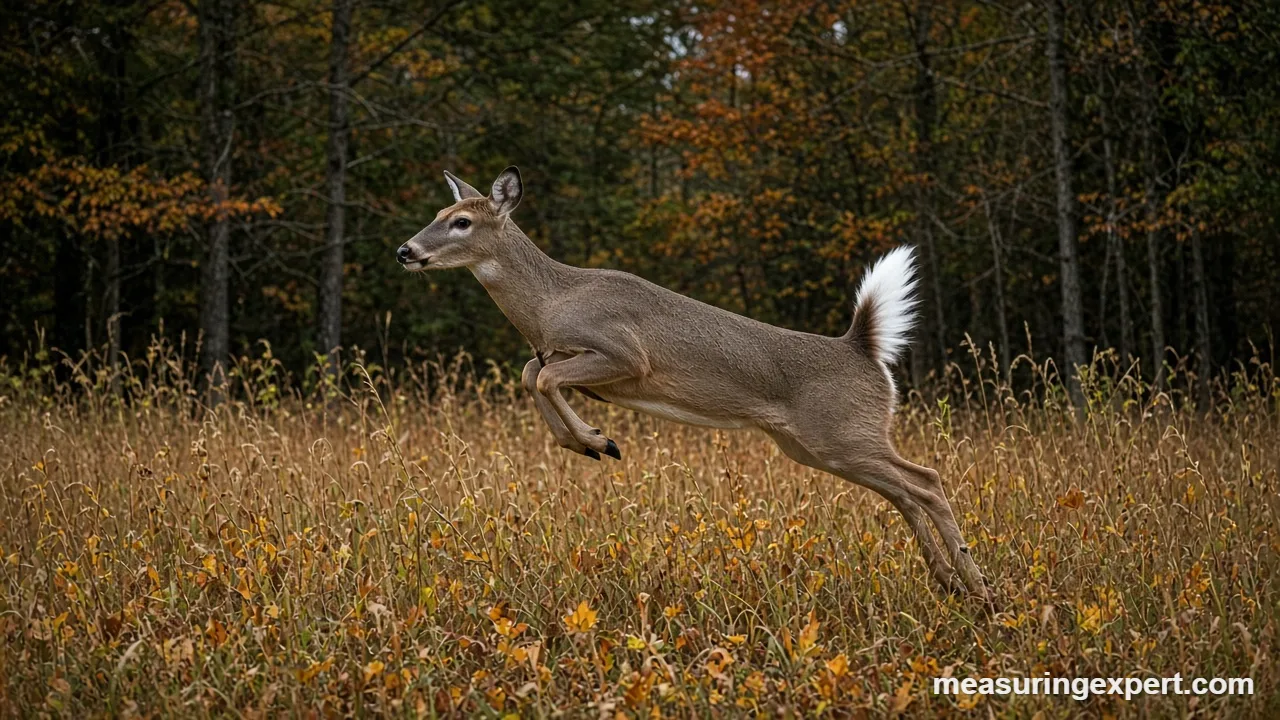
The family Cervidae covers small whitetails as well as moose and caribou. Not surprisingly, the speeds differ a lot. For that reason, the table below lists the North American members of the family and names the source for each figure.
| Species | Top speed | Source |
|---|---|---|
| Whitetail | About 30 mph (48 km/h); up to 40 mph (64 km/h) in short bursts; about 25 mph (40 km/h) over longer runs | Pennsylvania Game Commission; Massachusetts Division of Fisheries and Wildlife |
| Mule deer | Up to 45 mph (72 km/h) in short bursts | National Park Service |
| Elk | Up to about 45 mph (72 km/h) | Field and Stream |
| Moose | About 35 mph (56 km/h) | Field and Stream |
| Caribou (reindeer) | Up to 50 mph (80.5 km/h) | New Hampshire PBS NatureWorks |
Overall, caribou are the fastest members on the list. Meanwhile, some websites claim that whitetails are faster than mule deer. However, no agency source we found supports that. In fact, the National Park Service mule deer page puts their burst at up to 45 mph. Mule deer also have a special gait called stotting, in which all four legs push off together. As a result, the deer bounces up and forward, which helps on steep, rocky ground. For a closer look at the largest member of the family, read how fast a moose can run.
Burst vs Cruising Speed: Two Ways Fast Deer Move
Most confusion about how fast deer run comes from mixing two different numbers. On one hand, a burst is a short, all-out sprint, and it is the figure that ends up in headlines. By contrast, cruising speed is the pace the animal can hold while it puts distance between itself and a threat.
| People often confuse | What it really means |
|---|---|
| Top speed (burst) | A short sprint, about 40 mph for a whitetail. However, it lasts only a short distance. |
| Sustained speed | The pace held over longer runs, about 25 mph for a whitetail. |
| mph vs km/h | Same speed, different unit: 1 mph = 1.609344 km/h exactly. |
| Knots | Nautical miles per hour: 1 knot = 1.852 km/h, about 1.15 mph. |
So when one site says 30 mph and another says 40 mph, they are not always wrong. Instead, they may be describing different parts of the same escape. Also, a whitetail rarely runs in a straight line. In fact, it bounds, cuts and jumps, so its speed over the ground is lower than its peak stride speed.
Whitetails vs Predators and People
A whitetail does not need to be the fastest animal in the woods. Instead, it only needs to be fast enough to reach cover first. With that in mind, here is how the numbers line up.
| Animal | Top speed | Notes |
|---|---|---|
| Whitetail | 30 to 40 mph (48 to 64 km/h) | Short bursts, then about 25 mph |
| Gray wolf | 36 to 38 mph (58 to 61 km/h) | Short bursts; trots at about 5 mph over long distances (International Wolf Center) |
| Mountain lion | About 40 to 50 mph (64 to 80 km/h) | Short bursts only; an ambush hunter (Field and Stream) |
| Black bear | About 35 mph (56 km/h) | Short bursts (Field and Stream) |
| Elite human sprinter | About 27 to 28 mph (43 to 45 km/h) | Peak speed during a 100 m race |
On paper, a wolf and a whitetail sprint at about the same speed. Therefore, the outcome of a chase usually depends on the head start, the terrain and the prey’s ability to jump. Similarly, a mountain lion is quicker over a few seconds, but it hunts by stalking close rather than chasing. For the wolf side of the story, see how fast a wolf is. In addition, our guide to how fast a human can run explains the sprinter figure.
What Makes Whitetails So Quick and Agile
In fact, several body features work together here. First, whitetails walk on the tips of their toes, which are covered by hard hooves, so each leg acts like a long lever. Second, most of the leg muscle sits high near the body, which keeps the lower leg light and quick to swing. Third, they have no collarbone, so the shoulder blade is held in place by muscle. Because of that, the front legs can absorb hard landings and allow sharp turns.
In addition, jumping is the other half of the escape. For example, the Massachusetts fact sheet says a whitetail can clear obstacles up to 9 feet (2.7 m) high or 25 feet (7.6 m) wide. Likewise, the Pennsylvania Game Commission notes that a whitetail can clear a 7-foot (2.1 m) obstacle from a standstill, and the National Park Service says mule deer can leap up to 24 feet (7.3 m). In short, a fence or a fallen log slows a predator far more than it slows its prey.
How to Time How Fast Deer Run
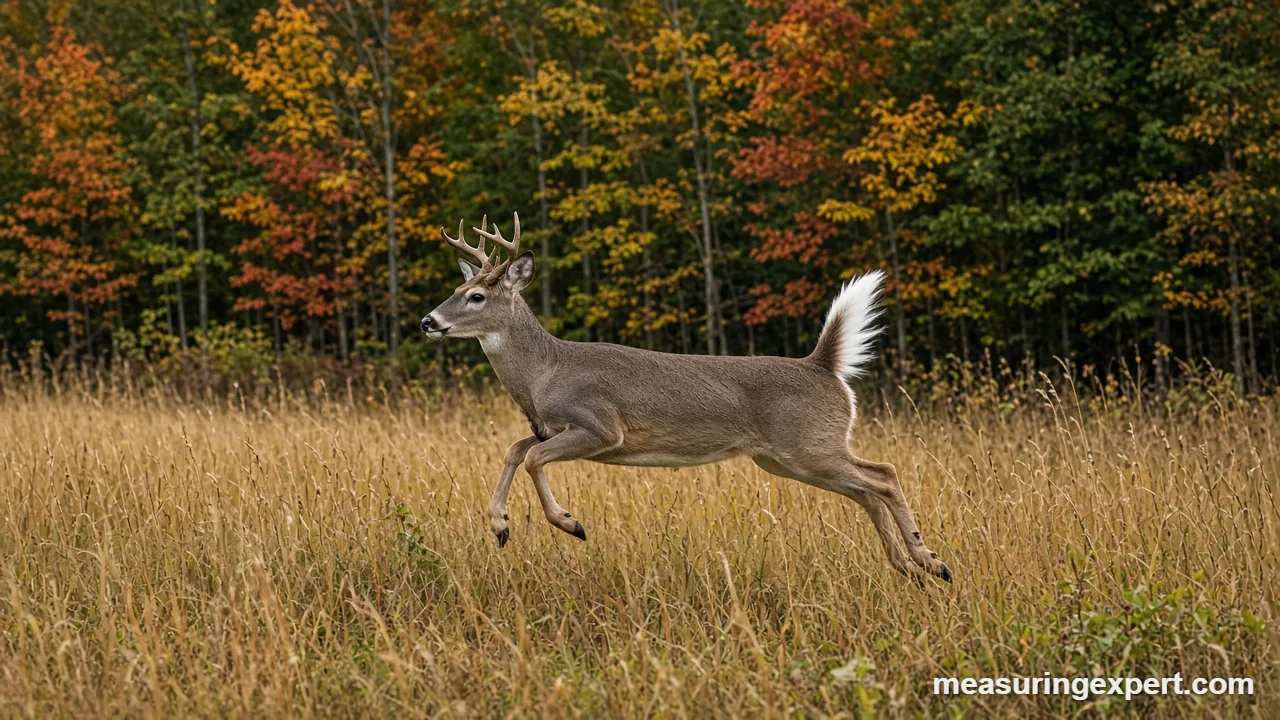
Fortunately, you can estimate a running animal’s speed with simple tools. After all, you only need a distance and a time. Then, the converter above does the rest.
- Pick two landmarks. First, choose two fixed points along a game trail, such as a fence post and a tree.
- Measure the gap. Use a laser rangefinder or a tape to find the distance between them in feet or yards.
- Record the run. Set a trail camera or phone to video so you can see when the animal passes each landmark.
- Time it from the video. Then step through the clip and note the seconds between the two landmarks.
- Divide distance by time. For example, 150 feet in 4 seconds is 37.5 feet per second.
- Convert the result. Multiply feet per second by 0.6818 to get mph, so 37.5 ft/s is about 25.6 mph. Alternatively, enter the ft/s value in the converter.
- Repeat and average. Time several runs, because one clip can mislead you.
Finally, check the result against the chart. For instance, a reading of 60 mph almost always means a timing error, not a record-breaking whitetail.
Do and Don’t When Watching Running Wildlife
Do
- Watch from a distance with binoculars.
- Measure landmark gaps before the animals arrive.
- Time several runs and average them.
- Slow down on roads at dawn and dusk.
- Expect more animals after you see one.
Don’t
- Chase or flush wildlife to make it run.
- Trust a single phone clip as a record.
- Mix up burst speed and cruising speed.
- Swerve hard to avoid an animal on the road.
- Approach fawns or try to feed wildlife.
Honest Limits: How Fast Deer Really Run
To be clear, every number on this page is an estimate. In practice, wild animals are hard to clock, because they run through cover, change direction and rarely pass a radar gun on open ground. As a result, agencies round their figures to the nearest 5 mph, and sources disagree by 5 to 10 mph for the same species. Also, the speed of one animal depends on its age, its condition, the snow or mud underfoot and the slope. Therefore, treat 30 to 40 mph as a typical range for a whitetail, not a guarantee. Likewise, the predator speeds in the comparison table are field estimates from different methods, so small differences between animals do not mean much.
When Fast Deer Really Matter: Roads and the Field
For drivers, however, the key point is not the top speed but the timing. Whitetails are most active around dawn and dusk, and at 30 mph they cover 44 feet every second. Consequently, an animal that is beside the road one moment can be in your lane the next.
For hunters and wildlife photographers, how fast deer move explains why a running shot is a bad idea. After all, a whitetail at full speed moves several feet in the time it takes to press a shutter or a trigger. Therefore, ethical hunters wait for a standing, broadside animal, and photographers pre-focus on a spot the animal will pass.
Frequently Asked Questions
How fast can a deer run?
A whitetail can run about 30 to 40 mph (48 to 64 km/h) in short bursts. Over longer distances, it holds about 25 mph (40 km/h).
What is the top speed of fast deer in km/h?
For a whitetail, the top speed is about 64 km/h (40 mph). Mule deer reach about 72 km/h (45 mph), and caribou about 80 km/h (50 mph).
Which member of the family is the fastest?
Caribou are the fastest North American members of the family, with a top speed of up to 50 mph (80.5 km/h). Mule deer and elk follow at about 45 mph.
Can a whitetail outrun a wolf?
Often, yes. Wolves sprint at about 36 to 38 mph, close to a whitetail’s burst speed. So a whitetail escapes by keeping its head start, jumping obstacles and reaching cover.
How long can fast deer keep up a full sprint?
Not long. In fact, wildlife agencies describe the 40 mph figure as a short burst. After that, a whitetail drops to about 25 mph, which it can keep up for longer.
How high and how far can a whitetail jump?
A whitetail can clear obstacles up to 9 feet (2.7 m) high or 25 feet (7.6 m) wide, and about 7 feet from a standstill. Mule deer can leap up to 24 feet (7.3 m).
Can a whitetail outrun a human?
Yes, easily. After all, even an elite sprinter peaks at about 27 to 28 mph, while a whitetail bursts to 30 to 40 mph and jumps far higher.
How many feet per second do fast deer cover?
At 30 mph, a whitetail covers 44 feet (13.4 m) per second. At 40 mph, it covers about 58.7 feet (17.9 m) per second.
Can deer swim?
Yes. They are capable swimmers and will cross rivers and lakes. Caribou, for example, can swim at up to 6 mph (9.7 km/h).
Why do fast deer matter for drivers?
Because a whitetail at 30 mph moves 44 feet every second, it can reach your lane very quickly. So slow down at dawn and dusk, brake firmly and stay in your lane.
How Fast Deer Run: The Bottom Line
To sum up, a whitetail runs about 30 to 40 mph (48 to 64 km/h) in a short burst and about 25 mph (40 km/h) over longer runs. Mule deer and elk reach about 45 mph, and caribou are the fastest of all at up to 50 mph.
In the end, though, speed is only part of the escape. In addition, these animals rely on sharp turns, big jumps and nearby cover. If you want to test a number yourself, time a run between two landmarks and enter the result in the converter at the top of this page.
3 thoughts on “How Fast Is a Deer? Top Speeds of Whitetail, Mule Deer, Elk and Caribou”