

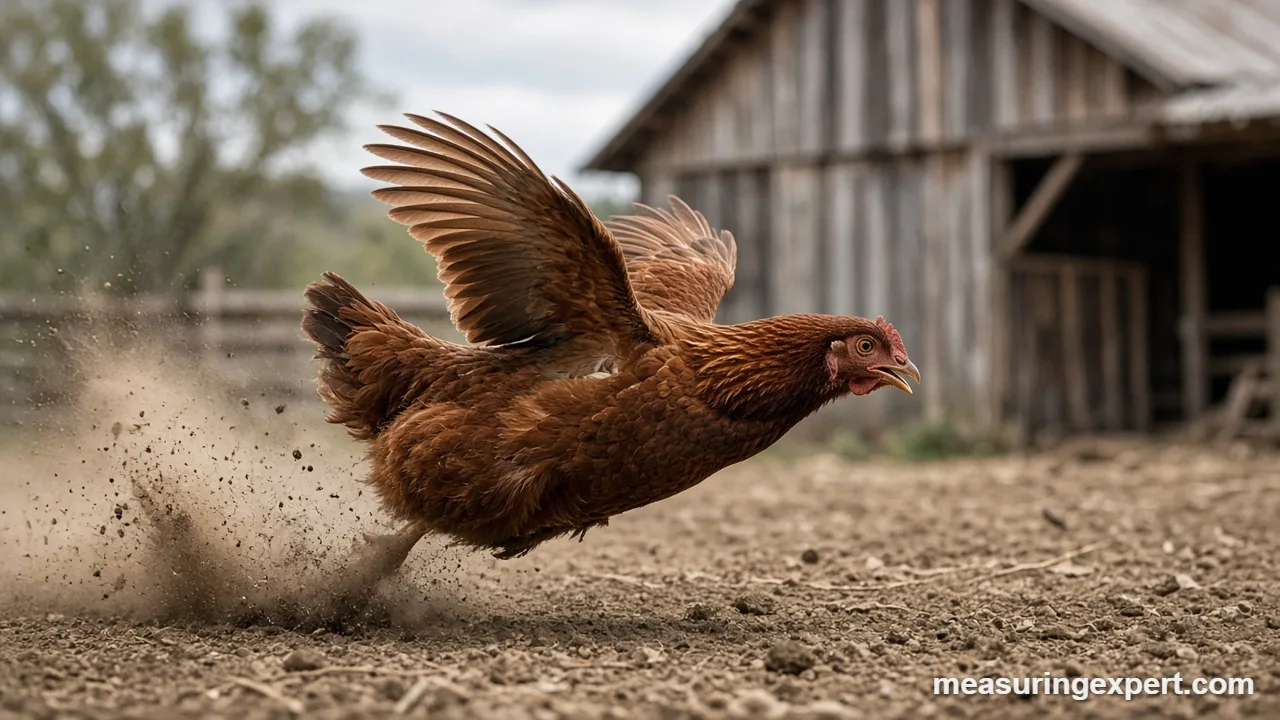
Chicken speed tops out at roughly 9 mph (about 14.5 km/h, or 4 m/s) in a short, flapping sprint, according to common estimates. However, that burst lasts only a few seconds. In lab tests on a treadmill, Leghorn chickens could keep up only about 1.4 m/s (3.1 mph, 5 km/h) for several minutes.
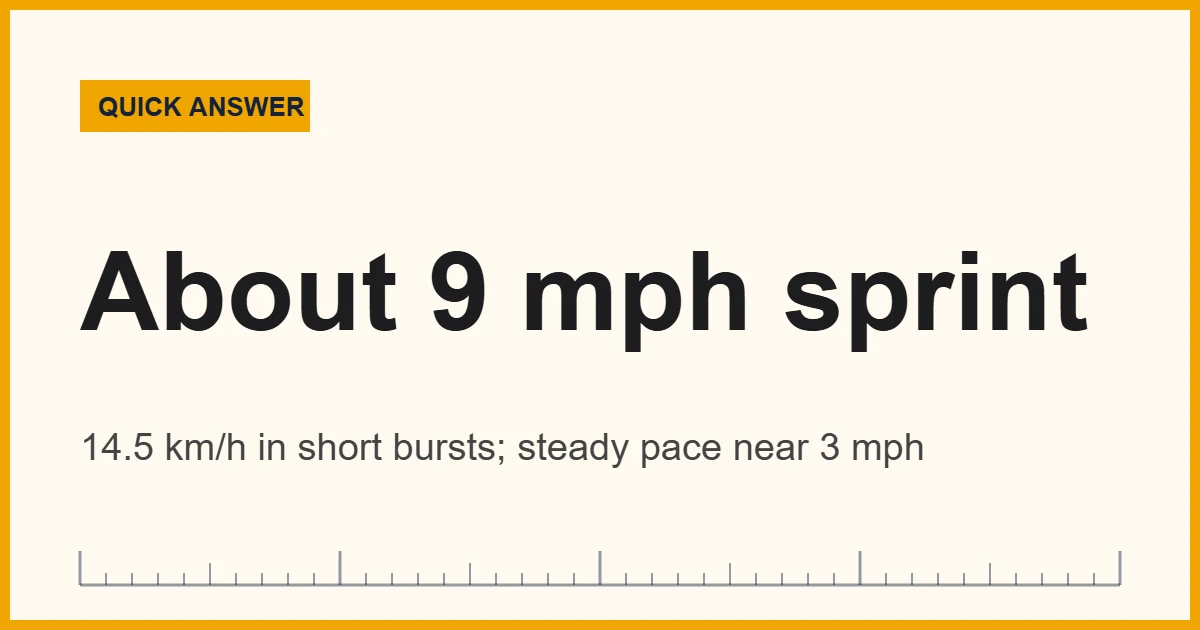
Convert Chicken Speed to mph, km/h and m/s
Scientists measure animals in meters per second, while most backyard keepers think in miles per hour. So type any speed below, for example the 9 mph sprint estimate, and the converter shows it in km/h, m/s, feet per second and knots.
Anyone who has tried to catch a loose hen knows the feeling. She waits until you are close, then she drops her head, spreads her wings and is gone. That burst looks fast, and in a backyard it is. Still, a chicken is a short-distance runner, not a racer.
Numbers online vary a lot. For example, some sites say 9 mph, others claim 15 mph, and a few list exact speeds for each breed. In reality, nobody has published a careful sprint test of domestic chickens on a measured course. As a result, the 9 mph figure is a reasonable estimate, but it is not a lab record.
The best hard data comes from a 2015 study in Biology Open. In it, researchers ran standard and bantam Leghorns on a treadmill. According to Rose and colleagues (2015), the fastest steady speed any group could hold was 1.39 m/s, reached by the standard-size roosters.
Chicken Speed: What the Measurements Show
Two kinds of numbers describe how a chicken moves. First, there is the sprint, a few seconds of all-out running, often with wing flaps for extra push. Second, there is the speed a bird can hold for minutes. The two differ by almost three times, so it pays to know which one a website means.
| Situation | Speed | Same speed in other units | Source |
|---|---|---|---|
| Short escape sprint (estimate) | about 9 mph | 14.48 km/h, 4.02 m/s | Common estimate, not lab-measured |
| Standard Leghorn roosters, top steady speed | 1.39 m/s | 5.00 km/h, 3.11 mph | Rose et al. 2015 (treadmill) |
| Standard Leghorn hens, top steady speed | 1.11 m/s | 4.00 km/h, 2.48 mph | Rose et al. 2015 |
| Bantam Leghorn roosters, top steady speed | 0.97 m/s | 3.49 km/h, 2.17 mph | Rose et al. 2015 |
| Bantam Leghorn hens, top steady speed | 0.83 m/s | 2.99 km/h, 1.86 mph | Rose et al. 2015 |
The treadmill numbers are not sprints. Instead, the birds had to hold each speed for more than three minutes while the team measured their oxygen use. In the same study, roosters reached higher speeds than hens in both varieties. Also, the larger standard birds beat the bantams, so bigger legs helped.
Recommended Tools for Measuring Chicken Speed
You only need two things to clock a chicken: a known distance and an accurate time. A long tape or a laser measure marks the distance, and a stopwatch with lap times handles the clock. Meanwhile, a phone video works as a backup, because you can count frames later.


As an Amazon Associate, Measuring Expert earns from qualifying purchases.
Does Breed Change Chicken Speed?
Breed matters, but probably less than people think. So far, no study has raced breeds against each other on the same course. Therefore, the neat breed-by-breed speed tables you may see online are guesses. Here is what we can say with confidence.
- Light, active breeds. Leghorns, game breeds and other lean birds tend to be flighty and quick to bolt. They also fly over fences more easily.
- Heavy, calm breeds. Brahmas, Cochins and Orpingtons carry more weight and feathering. As a result, they usually move off at a slower trot.
- Meat-type broilers. Fast-growing broilers gain weight so quickly that many walk slowly and rest often. Because of that, they are the slowest chickens most people meet.
- Body size inside one breed. In the Leghorn study, the standard birds held faster speeds than the smaller bantams. Similarly, roosters beat hens by roughly 15 to 25 percent.
Age and health matter too. For instance, a young, fit pullet will usually outrun an old hen with sore feet. Likewise, any bird that is limping, molting heavily or overheated will move more slowly.
Chicken Speed Compared With People and Predators
A sprinting chicken feels fast because it is small and changes direction in an instant. Yet in a straight line, most adults could keep pace with one. To put it in numbers, 9 mph means about 25 seconds for 100 meters. By contrast, Usain Bolt’s 9.58-second world record works out to an average of about 23.35 mph, roughly 2.6 times faster.
| Runner | Speed | Notes |
|---|---|---|
| Chicken, steady pace (Leghorn rooster) | 3.11 mph (5.00 km/h) | Treadmill, held for minutes |
| Chicken, short sprint | about 9 mph (14.5 km/h) | Estimate, lasts seconds |
| Usain Bolt, 100 m average | 23.35 mph (37.58 km/h) | 100 m in 9.58 s |
| Fox, dog or hawk | much faster than a chicken | Chickens survive by dodging and hiding, not outrunning |
That last row is the important one for keepers. The old version of this page claimed a fox runs only 6 to 8 mph. That is wrong, since foxes and dogs easily outrun a chicken. Instead, hens rely on alarm calls, sudden turns, short flights and cover. So a secure run and a locked coop do far more than any amount of speed.
If you like animal speed comparisons, see how fast elephants can run or how fast a deer can run.
How to Measure Chicken Speed in Your Yard
Timing your own birds is easy and kind of fun. Just keep it calm: never chase a chicken to make it run. Instead, use a treat to call it toward you.
- Mark a straight course. Measure 10 meters (about 33 feet) on flat, dry ground and mark both ends with a stake.
- Set up a camera or a helper. Place a phone on a stand level with the finish line, or ask a helper to work the stopwatch.
- Call the bird. Stand past the finish line and shake the treat cup so the chicken runs toward you.
- Time the run. Start the clock when its body crosses the first stake and stop it at the second.
- Do the math. Divide the distance by the time. For example, 10 meters in 2.5 seconds is 4 m/s, about 8.95 mph.
- Convert the result. Enter the speed in the converter above to see it in mph, km/h and feet per second.
- Repeat and average. Run three to five trials on different days, then keep the median, not the single best time.
Do and Don’t When Timing Chickens
Do
- Lure birds with food or a treat cup.
- Run tests in cool morning hours.
- Use a measured, flat course.
- Average several runs per bird.
- Keep dogs and children out of the way.
Don’t
- Chase or corner a bird to force a sprint.
- Test birds that are sick, limping or molting.
- Run trials in hot weather.
- Guess the distance by pacing it out.
- Trust a single lucky time.
Chicken Speed Claims the Old Figures Got Wrong
An earlier version of this page repeated several popular claims. After checking them against the research, we corrected these:
- “Some breeds reach 15 mph.” There is no published measurement behind this. Therefore, treat 9 mph as a generous estimate for a short burst.
- “Brahmas run 3 mph and Orpingtons 4 mph.” These exact breed figures have no source. Heavy breeds are slower, but nobody has timed them that precisely.
- “Chickens cannot fly.” They can. Most chickens flap up to a perch or over a low fence, and light breeds can clear surprisingly tall ones.
- “Chickens run faster in cool weather.” This part is fair. Chickens cope poorly with heat, so they slow down and rest more on hot days.
Honest Limits of Chicken Speed Data
Every number on this page has a limit. To begin with, the treadmill data comes from one breed, the Leghorn, and from a small number of birds. Moreover, birds on a treadmill are not escaping a predator, so they do not try their hardest. On the other hand, the 9 mph sprint figure is widely repeated but not backed by a published test. In short, the true top speed of a domestic chicken is probably somewhere between 3 and 9 mph, depending on the bird and the moment. For the unit math, we use the exact NIST factor in the NIST Guide to the SI: 1 mph equals 0.44704 m/s.
When Accuracy Really Matters
For a school project or a backyard bet, a stopwatch and a tape are fine. However, a few cases need more care:
- Science fair or class projects. Report the distance, the number of trials and the median time, so others can repeat your work.
- Bird health checks. A sudden drop in how fast or how far a hen walks can be a sign of leg or foot trouble. In that case, a vet who treats poultry is the right call.
- Fence and run design. Plan for height and cover, not speed. A secure run matters more than how quickly a hen can sprint.
Curious how quickly the birds themselves change? Our guide to how fast chickens grow covers weight gain by week.
Frequently Asked Questions
What is a chicken’s top speed in mph?
A chicken’s top speed is usually estimated at about 9 mph in a short sprint. That figure is an estimate. In treadmill tests, Leghorn roosters held about 3.1 mph for several minutes.
What is chicken speed in km/h?
A 9 mph sprint equals about 14.5 km/h. The fastest steady treadmill pace in the Leghorn study was 1.39 m/s, which is about 5 km/h.
Can a human outrun a chicken?
Yes, in a straight line most adults can keep up with or pass a chicken. Catching one is harder, though, because hens dodge, turn and flutter away.
Are roosters faster than hens?
In the 2015 Leghorn study, roosters held top speeds about 15 to 25 percent higher than hens of the same variety.
Which chicken breed is the fastest?
No study has raced breeds head to head. Even so, light, active breeds such as Leghorns and game breeds are generally quicker than heavy breeds like Brahmas or Cochins.
Can chickens fly?
Yes, for short distances. Most chickens can flap up to a roost or over a low fence, and wing flaps also help them accelerate when they run.
How far can a chicken run?
Chickens sprint only a few seconds at a time. At a steady pace of 1.39 m/s, a fit rooster would cover about 83 meters (274 feet) in one minute.
How is chicken speed measured?
Researchers use treadmills and video. At home, you can time a bird over a measured 10-meter course and divide the distance by the time.
Do chicks run faster than adult chickens?
Chicks are quick and nimble for their size, but their short legs cover less ground. Adult birds, especially young fit ones, reach higher speeds.
Why does chicken speed matter for keepers?
It mostly shows that chickens cannot outrun predators. So a covered run, a locked coop at night and good fencing matter far more than speed.
Chicken Speed: The Bottom Line
To sum up, a chicken can burst to roughly 9 mph (14.5 km/h) for a few seconds, but its steady pace is closer to 1 to 3 mph. The only careful lab data, from Leghorns on a treadmill, puts the best sustained pace at 1.39 m/s.
Finally, if you time your own flock, use a measured course, calm birds and several trials. Then plug your number into the converter at the top of this page.
1 thought on “How Fast Can a Chicken Run? Chicken Speed in mph and km/h”