

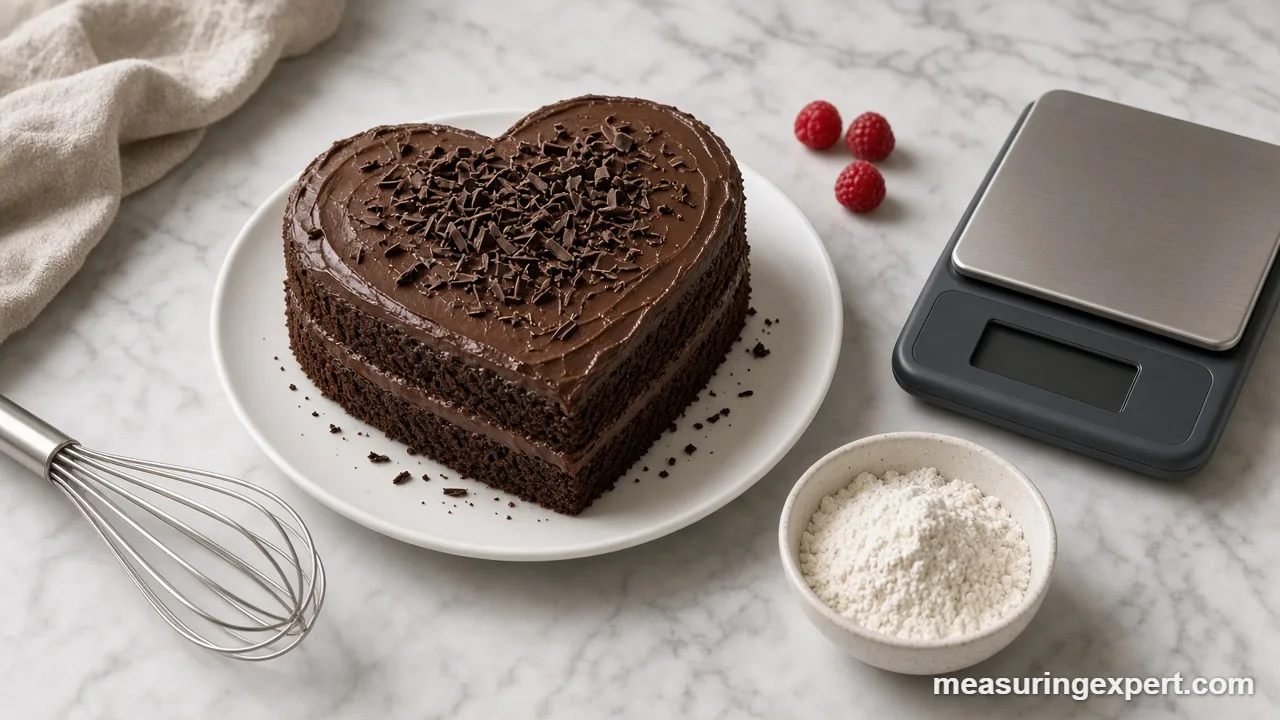
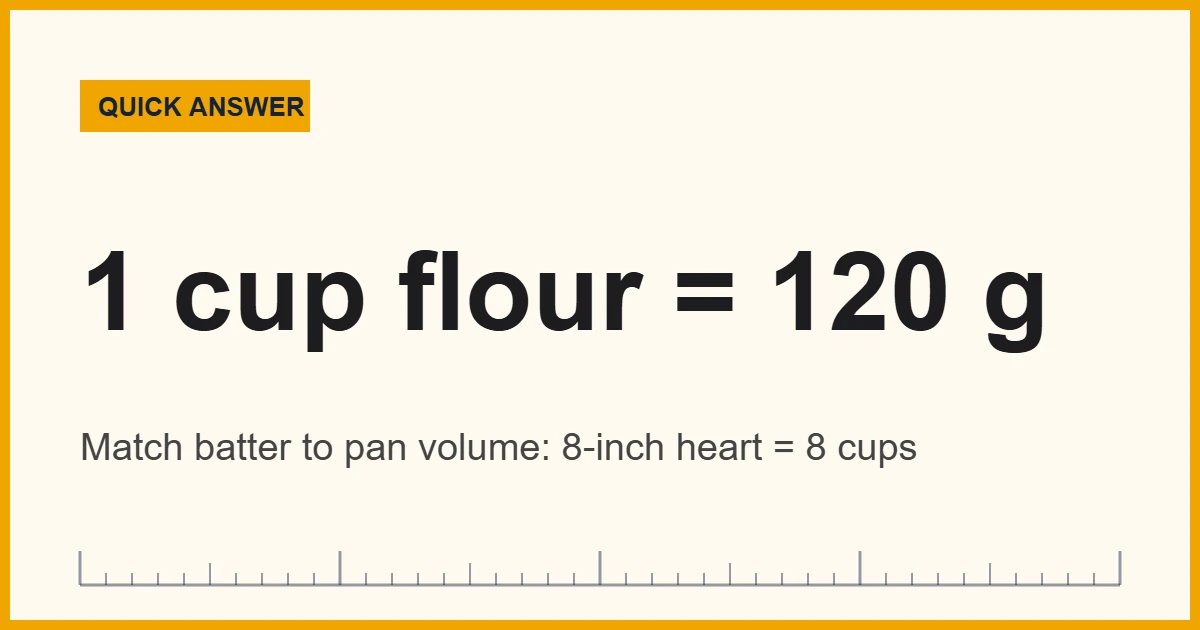
Valentine’s Day dessert measurements come down to two numbers: weight and pan volume. Weigh flour at 120 g (4 1/4 oz) per cup and granulated sugar at 198 g (7 oz) per cup, then match your pan. An 8-inch heart pan holds about 8 cups (1.9 L), the same as an 8-inch square pan.
Convert Ounces to Grams for Valentine’s Day Dessert Measurements
Many US dessert recipes list ounces, while scales and European recipes use grams. Enter the ounces from your recipe below, and the converter then shows grams, pounds and kilograms. As a result, you can switch between a cup recipe and a weighed recipe without guessing.
A heart-shaped cake, a pot of chocolate mousse or a tray of cookies all depend on the same thing: the right amount of each ingredient. Valentine’s Day desserts add two twists, though. First, they are often small, so one extra tablespoon of flour is a big error. Second, they are often baked in unusual pans, such as hearts or ramekins, because batter depth changes the bake.
That is why this guide focuses on weights and pan sizes instead of general baking advice. In other words, once you know what a cup of each ingredient weighs and how much batter your pan holds, most Valentine’s Day dessert measurements become simple.
The figures below come from two baking references: the King Arthur Baking ingredient weight chart and the Joy of Baking pan size chart. Therefore, treat every weight as an average, because flour and sugar pack differently from one kitchen to the next.
Key Takeaways
- One cup of all-purpose flour weighs about 120 g, while one cup of granulated sugar weighs about 198 g.
- Weighing beats scooping, because a scooped cup of flour can weigh noticeably more than a spooned one.
- An 8-inch heart pan holds about 8 cups (1.9 L), the same as an 8 x 8 inch square pan.
- To change pans, first divide the new pan’s volume by the old pan’s volume to find how much to scale the batter.
- One large egg is about 50 g without the shell, so half an egg is about 25 g.
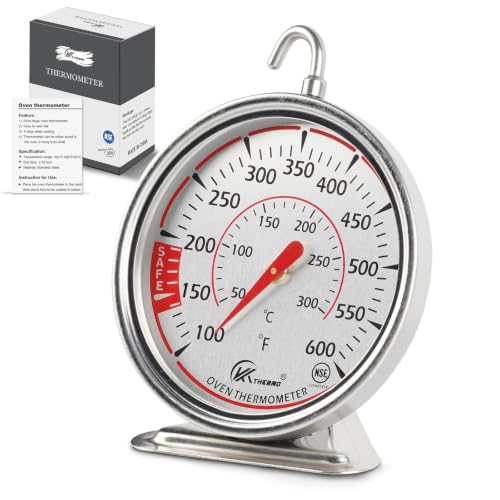
- Also, check your oven with a separate oven thermometer, because dial settings can be off.
Valentine’s Day Dessert Measurements: Weight Chart
The table below lists the ingredients that show up most often in cakes, brownies, cookies, truffles and cheesecakes. In addition, it gives the weight of a standard cup or spoonful.
| Ingredient | Measure | Ounces | Grams |
|---|---|---|---|
| All-purpose flour | 1 cup | 4 1/4 | 120 |
| Granulated sugar | 1 cup | 7 | 198 |
| Confectioners’ sugar (unsifted) | 1 cup | 4 | 113 |
| Brown sugar (packed) | 1 cup | 7 1/2 | 213 |
| Unsweetened cocoa | 1/2 cup | 1 1/2 | 42 |
| Butter | 8 tablespoons (1 stick) | 4 | 113 |
| Heavy cream | 1 cup | 8 | 227 |
| Milk | 1 cup | 8 | 227 |
| Cream cheese | 1 cup | 8 | 227 |
| Chocolate chips | 1 cup | 6 | 170 |
| Honey | 1 tablespoon | 3/4 | 21 |
| Vanilla extract | 1 tablespoon | 1/2 | 14 |
| Large egg, no shell | 1 egg | 1 3/4 | 50 |
For example, a cup of sugar weighs far more than a cup of flour. Because of that, you cannot swap flour and sugar by volume and expect the same result. For quick ounce conversions, see how much an ounce is.
Pan Sizes for Valentine’s Day Dessert Measurements
In fact, pan volume matters as much as ingredient weight. For instance, a recipe written for a 9 x 13 inch pan will overflow or bake thin in a small heart pan. Joy of Baking lists these approximate volumes, so use them as a guide.
| Pan | Volume (cups) | Volume (L) |
|---|---|---|
| 8 x 2 inch round | 6 | 1.4 |
| 9 x 2 inch round | 8 | 1.9 |
| 8 x 8 x 2 inch square | 8 | 1.9 |
| 9 x 9 x 2 inch square | 10 | 2.4 |
| 9 x 13 x 2 inch rectangle | 14 | 3.3 |
| 8 x 2 1/2 inch heart | 8 | 1.9 |
| 9 x 2 1/2 inch springform | 10 | 2.4 |
How to Swap Pans Without Changing the Bake
Joy of Baking gives a simple rule. First, divide the volume of the pan you want to use by the volume of the pan in the recipe. The answer is then the scaling factor for your batter.
| Recipe pan | Your pan | Scaling factor |
|---|---|---|
| 9 x 9 square (10 cups) | 8 inch heart (8 cups) | 0.8 |
| 9 x 13 rectangle (14 cups) | 8 inch heart (8 cups) | 0.57 |
| 9 x 2 round (8 cups) | 8 x 2 round (6 cups) | 0.75 |
| 8 x 8 square (8 cups) | 8 inch heart (8 cups) | 1.0 |
For example, a brownie recipe made for a 9 x 9 pan needs 80 percent of the batter in an 8-inch heart. As a result, you use 96 g of flour instead of 120 g. In short, an 8 x 8 recipe fits an 8-inch heart pan with no changes.
The same source also adds that a pan with the same area as the original keeps the batter depth, so time and temperature stay the same. However, if the new pan makes the batter shallower, shorten the bake time. If it makes the batter deeper, lengthen the time and lower the oven temperature slightly.
Halving a Valentine’s Day Dessert Recipe for Two
Many couples want a small dessert instead of a full cake. Halving by weight is easy, since you just divide each gram figure by two. However, the egg is the one awkward item.
| Ingredient | Full recipe | Half recipe |
|---|---|---|
| All-purpose flour | 1 cup (120 g) | 60 g (1/2 cup) |
| Granulated sugar | 1 cup (198 g) | 99 g (1/2 cup) |
| Butter | 1 cup (227 g) | 113 g (1 stick) |
| Cocoa | 1/2 cup (42 g) | 21 g |
| Heavy cream | 1 cup (227 g) | 113 g |
| Eggs | 2 large (100 g) | 1 large (50 g) |
To halve a single egg, beat it well, then weigh out 25 g, which is half of a 50 g egg. Meanwhile, use the rest in scrambled eggs or an egg wash. Alternatively, make a half batch of a recipe with an even number of eggs, so you never have to split one.
Small batches also bake faster. Therefore, start checking early and rely on a toothpick, color and an oven thermometer, not the original time. For cup measures of liquids, see how much 30 mL is.
Recommended Tools for Valentine’s Day Dessert Measurements
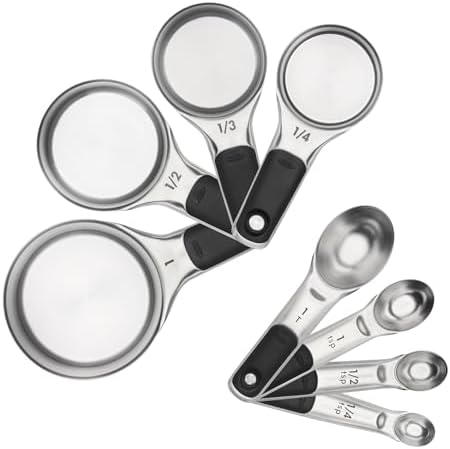
Good tools matter more with small desserts, because errors show quickly. First of all, a digital scale that reads to the gram handles flour, sugar and chocolate. Next, measuring cups and spoons cover liquids and small amounts. In addition, a heart pan and ramekins give you the shapes, while an oven thermometer confirms the heat.




As an Amazon Associate, Measuring Expert earns from qualifying purchases.
To see why scales help, read our food scale guide.
Step-by-Step: Valentine’s Day Dessert Measurements by Weight
- Pick the pan first. First, check its volume in the chart above, then scale the recipe by the factor.
- Set the scale to grams. Next, place the mixing bowl on it and press tare to zero.
- Add the flour. Then pour or spoon it in until the display reaches the target weight.
- Tare and add the next ingredient. Reset to zero after each addition, so you never do arithmetic.
- Weigh liquids and sticky items too. Also, honey, cream and vanilla all weigh accurately in the same bowl.
- Weigh the eggs. Aim for about 50 g per large egg, and then adjust a beaten egg to the exact weight.
- Check the oven. Preheat with a thermometer inside, and adjust the dial if it reads off.
- Test for doneness. Finally, start early on small desserts, and use a toothpick or fork.
Valentine’s Day Dessert Measurements for Sticky and Tricky Ingredients
However, chocolate, honey and cream cheese cause most of the trouble. For example, honey clings to spoons, and cream cheese sticks to cups. Weighing solves both problems, because the ingredient goes straight from the container to the bowl.
If you must use a cup or spoon, a light coat of oil helps sticky liquids slide out. Even so, honey weighs about 21 g per tablespoon, so a scale is more reliable. Likewise, for a dessert with melted chocolate, weigh the chocolate before melting. Chocolate chips run about 170 g per cup, but bars of different brands vary.
Instead, cream cheese is easier by block. In fact, a standard 8 oz block is 227 g, which is the same as one cup. Therefore, a recipe that calls for 1 cup can use one full block.
Do and Don’t for Valentine’s Day Dessert Measurements
Do
- Weigh flour, sugar and chocolate in grams.
- Check the pan volume before you pour the batter.
- Tare the scale after each ingredient.
- Start checking small desserts early, because they bake faster.
- Use an oven thermometer, because dials can drift.
Don’t
- Scoop flour straight from the bag with the cup.
- Swap flour and sugar by volume, because they weigh differently.
- Pour batter into a pan before checking its volume.
- Use a liquid cup for dry ingredients, because it is hard to level.
- Pack confectioners’ sugar into the cup.
Honest Limits of These Figures
First, every weight above is an average. For instance, a scooped cup of flour can weigh more than a spooned and leveled cup, so a cup recipe can drift from the chart. Moreover, brands of cocoa, chocolate and cream cheese differ slightly. In addition, pan volumes are approximate, and shapes like hearts hold slightly different amounts depending on the maker.
Overall, the scaling factors work well for batters and brownies. However, they are less reliable for delicate cakes and custards, where small changes in depth affect texture. So when a recipe’s results matter, do a trial bake before the big day.
When to Ask an Expert
This guide is for home baking, so it skips commercial rules. However, if you are baking for a large event or selling desserts, check your local rules for food businesses. Likewise, if someone has a food allergy or a medical diet, ask their doctor or a registered dietitian before you change ingredients.
Frequently Asked Questions
How many grams are in a cup of flour for Valentine’s Day desserts?
One cup of all-purpose flour weighs about 120 g (4 1/4 oz), according to King Arthur Baking. To get the closest match, spoon the flour into the cup and level it.
How many grams are in a cup of sugar?
Also, one cup of granulated sugar weighs about 198 g (7 oz). In comparison, packed brown sugar weighs about 213 g per cup.
How many cups does an 8-inch heart pan hold?
An 8 x 2 1/2 inch heart pan holds about 8 cups (1.9 L), according to Joy of Baking. In other words, that equals an 8 x 8 inch square pan.
Can I bake a 9 x 13 recipe in a heart pan?
Yes, but scale it first. A 9 x 13 pan holds 14 cups and an 8-inch heart holds 8, so use about 57 percent of the batter.
How do I halve an egg?
First, beat the egg, then weigh out 25 g. After all, a large egg without the shell is about 50 g.
How much does a stick of butter weigh?
Because a US stick is 8 tablespoons, it weighs 4 oz (113 g). Therefore, two sticks make 1 cup, about 227 g.
Should I measure by weight or by cup?
Overall, weight is more consistent, because cups pack differently each time. Use a scale for flour, sugar and chocolate, and use cups for liquids when you are in a hurry.
How much does a tablespoon of honey weigh?
Because honey is dense, one tablespoon weighs about 21 g (3/4 oz). As a result, weighing it avoids the sticky spoon.
Do I need to change the oven time when I change pans?
Often, yes. A shallower batter bakes faster, while a deeper one takes longer at a slightly lower temperature. So start checking early either way.
How many ounces are in a cup of cream cheese?
One cup of cream cheese is about 8 oz (227 g), which equals one standard block.
The Bottom Line on Valentine’s Day Dessert Measurements
To sum up, weigh your ingredients, match your batter to the pan volume, and halve by weight when you want a smaller dessert. A cup of flour is about 120 g, a cup of sugar is about 198 g, and an 8-inch heart pan holds about 8 cups.
Finally, bake a trial batch before the day itself, and keep the converter above handy for any ounce-to-gram switch. For another seasonal example, see our Christmas baking measurements guide.