

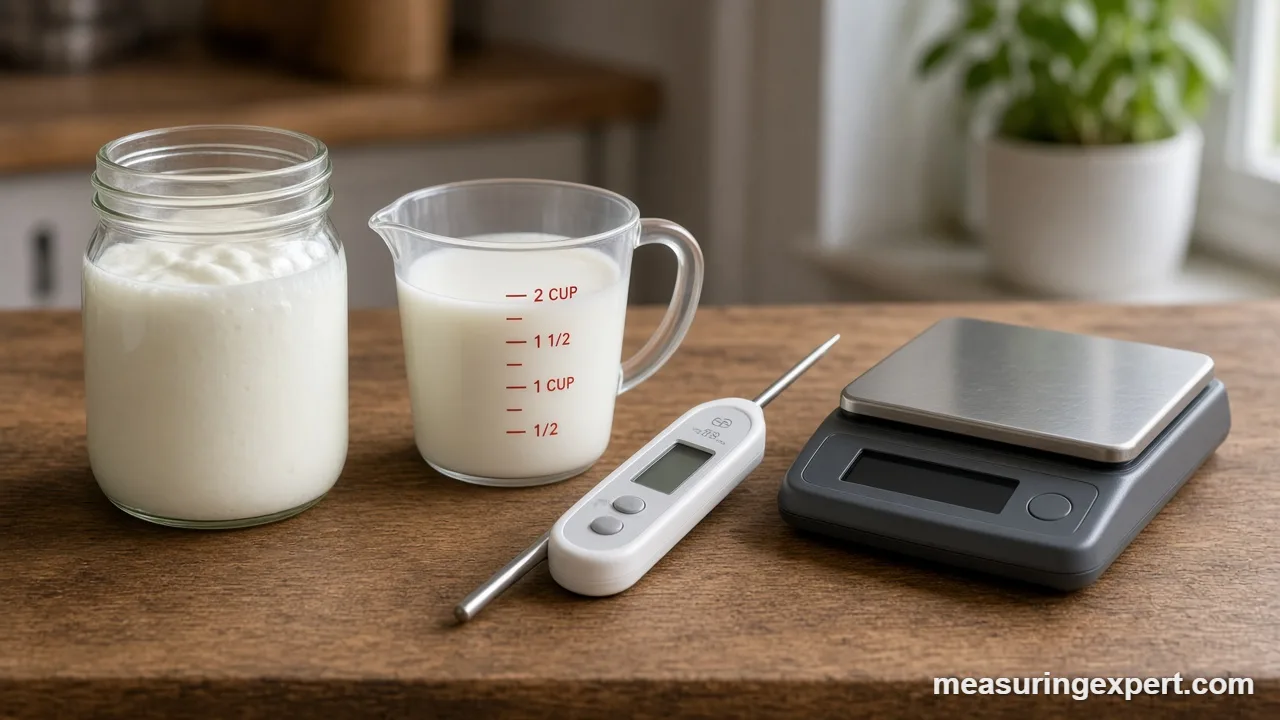
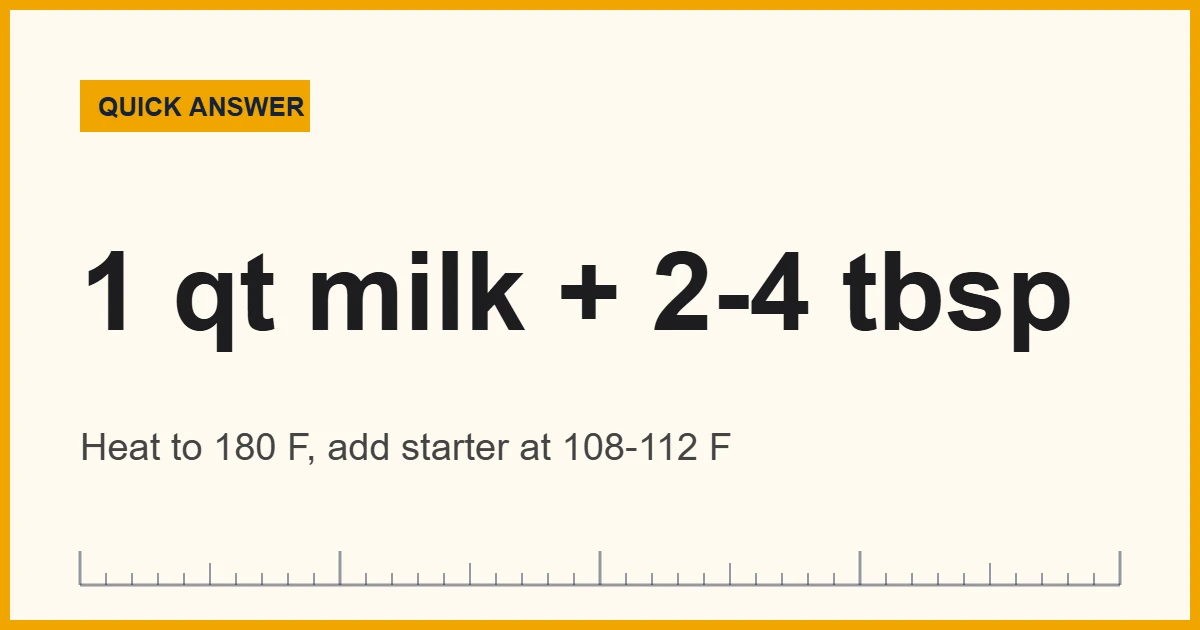
To measure ingredients for yogurt, start with 1 quart (946 mL) of milk. Heat it to 180 F (82 C), cool it to 108-112 F (42-44 C), and stir in 2 to 4 tablespoons of plain yogurt with live cultures. Extension guides differ slightly, so trust the thermometer more than the spoon.
Yogurt has only two ingredients, so each one has to be right. For example, if the milk is too hot, it kills the cultures. However, if it is too cool, nothing happens. Likewise, too little starter makes a slow, thin batch. In short, this page shows how to measure ingredients for yogurt by volume and by weight, with a temperature table you can keep next to the stove.
Specifically, the numbers below come from two university extension guides and from USDA food safety rules. In addition, the converter scales a recipe from one cup up to a gallon of milk.
Measure Ingredients for Yogurt: Batch Size Converter
First, enter the amount of milk you plan to use. The converter shows the same volume in cups, pints, milliliters and liters, so you can match it to the containers you own.
How to Measure Ingredients for Yogurt by Batch Size
However, starter is the part people guess. Two extension guides give different amounts, so the table shows both. First, the University of California guide uses 2 to 3 teaspoons of starter per cup of milk. Meanwhile, the University of Illinois recipe uses 2 tablespoons of plain yogurt for 1 quart.
| Milk | Milk in mL | Starter, UC guide | Starter, Illinois recipe |
|---|---|---|---|
| 1 cup | 237 mL | 2-3 tsp (10-15 mL) | 1 1/2 tsp (7 mL) |
| 1 pint (2 cups) | 473 mL | 4-6 tsp (20-30 mL) | 1 tbsp (15 mL) |
| 1 quart (4 cups) | 946 mL | 8-12 tsp (39-59 mL) | 2 tbsp (30 mL) |
| 1/2 gallon (8 cups) | 1,893 mL | 16-24 tsp (79-118 mL) | 4 tbsp (59 mL) |
| 1 gallon (16 cups) | 3,785 mL | 32-48 tsp (158-237 mL) | 8 tbsp (118 mL) |
The Illinois amount is about 3% of the milk, while the UC range is about 4% to 6%. Therefore, the lower figure suits a patient cook and the higher one suits a cool kitchen. First, mix the starter into a cup of warm milk first, then stir that mixture back into the pot.
Recommended Tools to Measure Ingredients for Yogurt
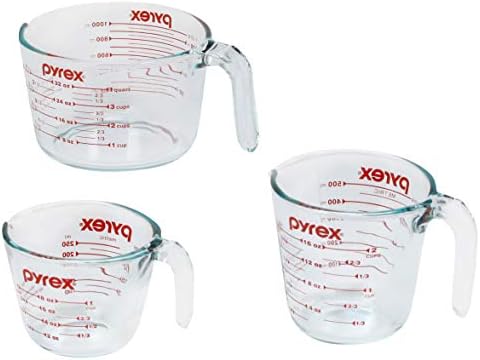
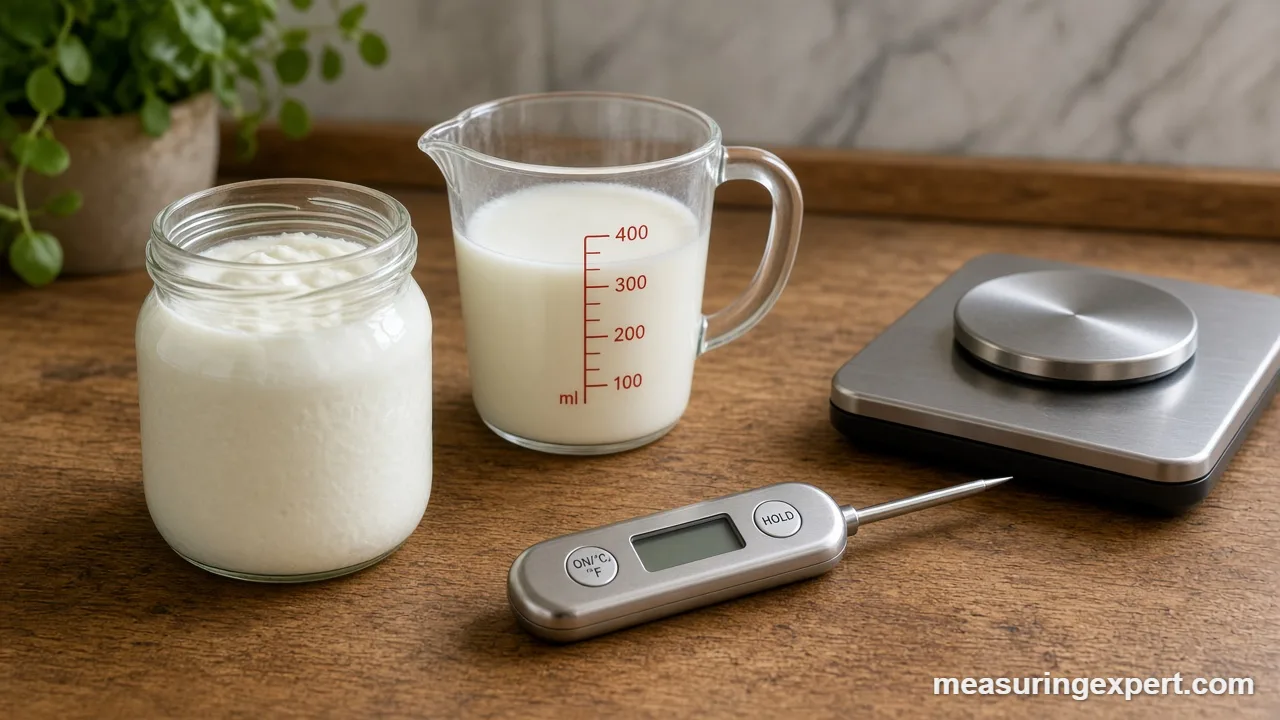
In fact, three tools do most of the work. First, a thermometer with a fast, accurate probe. Next, a scale that can tare a pot of milk. Finally, a liquid measuring cup with clear markings at eye level.



As an Amazon Associate, Measuring Expert earns from qualifying purchases.
- 1 quart of milk is 4 cups, or about 946 mL.
- Heat the milk to 180 F (82 C) before you start.
- Add the starter at 108-112 F (42-44 C).
- Use 2 to 4 tablespoons of starter per quart, depending on the guide.
- Most batches set in 6 to 10 hours, undisturbed.
- Refrigerate at 40 F (4 C) or below once the yogurt has set.
Thermometer Table to Measure Ingredients for Yogurt
First, temperature decides whether the cultures live. Consequently, every step has a number. Next, keep the probe in the center of the pot, away from the bottom and sides, because those spots run hotter.
| Step | Fahrenheit | Celsius | Source |
|---|---|---|---|
| Heat the milk | 180-185 °F | 82-85 °C | UC, Illinois |
| Hold at heat (UC guide) | 180 °F for 10-20 minutes | 82 °C | UC |
| Cool before adding starter | 108-115 °F | 42-46 °C | UC, Illinois |
| Incubate | 108-115 °F | 42-46 °C | UC, Illinois |
| Oven method: warm up first | 200 °F, then off | 93 °C | UC |
| Oven method: stay above | 100 °F | 38 °C | UC |
| Danger zone for perishable food | 40-140 °F | 4-60 °C | USDA FSIS |
| Refrigerator storage | 40 °F or below | 4 °C or below | USDA, UC, Illinois |
The UC guide says that a temperature too high kills the bacteria, while one too low stops their growth. Therefore, check the temperature twice before you stir in the starter.
Measure Ingredients for Yogurt: Milk by Volume or Weight
In most cases, volume is fine for home batches. Pour into a liquid measuring cup, set it on a flat counter, and read the line at eye level. For example, four cups make 1 quart, and 1 quart is 946.35 mL by definition. Also, see how much 30 mL is in spoons and ounces.
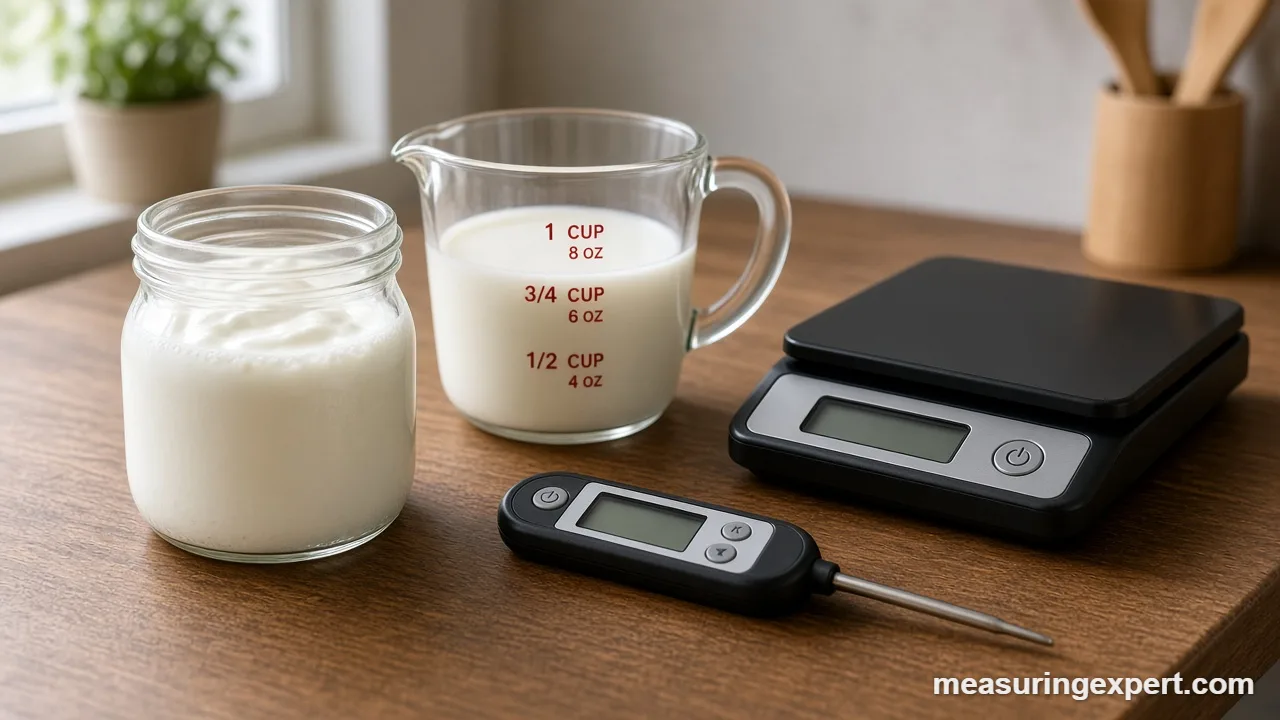
However, weight is better for repeat batches. First, place the empty pot on the scale, press tare, and pour. Milk is slightly denser than water, so 1 quart weighs a little under 1 kg (about 2.1 lb). However, the exact figure varies with fat content, so weigh your own milk once and write the number on the recipe card.
Measuring Starter Culture With Spoons or a Scale
Starter is plain yogurt with live cultures or, alternatively, a freeze-dried culture packet. Spoons also work for yogurt. Next, dip a clean spoon, level it, and drop it into a cup of the warm milk. Finally, whisk until smooth.
Alternatively, a scale gives the same result with less mess. Since a tablespoon of yogurt is close to 15 mL, 30 g and 2 tablespoons are close enough for a quart. Packets are different, so follow the label on the packet instead of the table above.
Also, use clean tools. Any residue of soap or old food can stop the milk from setting, and the UC guide notes that detergent residue is a common cause.
How to Measure Ingredients for Yogurt, Step by Step
- Measure the milk. Pour 4 cups (946 mL) into a clean pot, or weigh it on a scale.
- Heat to 180 F (82 C). Stir now and then, and watch the thermometer.
- Cool to 108-112 F (42-44 C). A water bath in the sink makes this faster.
- Measure the starter. Use 2 to 4 tablespoons of plain yogurt with live cultures.
- Blend the starter. Whisk it into 1 cup of warm milk, then pour it back into the pot.
- Incubate undisturbed. Keep the jars at 108-115 F (42-46 C) for 6 to 10 hours.
- Chill. Move the set yogurt to a refrigerator at 40 F (4 C) or below.
Common Mistakes When You Scale a Yogurt Recipe
| Mistake | What happens | Fix |
|---|---|---|
| Adding starter to hot milk | Cultures die and the milk stays liquid | Wait until the probe reads 108-112 F |
| Too little starter in a big batch | Slow set, thin texture | Scale the starter with the milk |
| Stirring during incubation | The gel breaks | Leave the jars undisturbed |
| Guessing temperature by touch | Missed window, failed batch | Use a probe thermometer |
| Skipping the water bath at scale | A gallon cools slowly | Set the pot in cold water |
Larger batches also cool and heat more slowly. For instance, a gallon pot can take far longer to reach 110 F than a quart. So check the temperature every few minutes instead of relying on a timer. For a related fermented recipe, see how to measure ingredients for fermentation.
Food Safety When You Measure Ingredients for Yogurt
For instance, USDA defines the danger zone as 40 to 140 F, where perishable food spoils quickly. Likewise, cold food should stay at or below 40 F. Yogurt incubates inside that range on purpose, so the safety rests on other steps.
- Use pasteurized milk. The UC guide says to pasteurize at home or buy commercially pasteurized milk.
- Rely on acid. Similarly, the same guide says protection comes from heat and acidity, with a pH near 4.
- Clean the jars. Also, wash in hot, soapy water, rinse well, and air dry.
- Refrigerate promptly. Finally, once set, cool the yogurt at 40 F or below.
Do and Don’t for Yogurt Measurements
Do
- Use a thermometer at every temperature step.
- Scale starter with the milk volume.
- Write down your own weights after one good batch.
- Keep jars clean and rinsed of soap.
- Refrigerate as soon as the yogurt sets.
Don’t
- Add starter while the milk is above 115 F.
- Stir or shake the jars while they set.
- Mix up fluid ounces and weight ounces.
- Reuse a starter that smells or looks wrong.
- Judge temperature with a fingertip.
Honest Limits of Yogurt Numbers
Overall, these amounts come from published extension guides, and as a result they disagree a little. For example, the UC guide gives 6 to 8 hours of incubation, while the Illinois recipe gives 6 to 10. In addition, your kitchen, your milk and your starter all change the result. In short, treat the ranges as a starting point, then adjust after one or two batches. Weights for milk are approximate, because no source here claims that a batch will set at a particular time.
Using the Leftovers: Yogurt Cheese and Smaller Batches
For example, the UC guide notes that a quart of yogurt strained for 8 to 24 hours yields about 1 1/2 to 2 cups of yogurt cheese. If you plan to make soft cheese too, our guide to how to measure cheese ingredients covers the next step. For a first try, however, a single quart is the easiest batch to control.
Frequently Asked Questions
How much starter do I need per quart of milk?
Use 2 tablespoons (Illinois Extension) to 8-12 teaspoons, or 2 2/3 to 4 tablespoons (UC guide), per quart of milk.
How do I measure ingredients for yogurt without a scale?
Use a liquid measuring cup for the milk (4 cups per quart) and measuring spoons for the starter. Check the temperature with a thermometer.
How many cups of milk make 1 quart?
Four US cups make 1 quart, which is 946.35 mL.
What temperature should milk be when I add the starter?
Between 108 and 112 F (42-44 C) in the UC guide, or 108 to 115 F (42-46 C) in the Illinois recipe.
Why heat the milk to 180 F first?
Heat pasteurizes the milk and prepares it to set. The UC guide holds 180 F for 10 minutes for thinner yogurt or 20 minutes for thicker yogurt.
How long does yogurt take to set?
Most guides say 6 to 8 hours (UC) or 6 to 10 hours (Illinois), kept undisturbed in a warm place.
How do I measure ingredients for yogurt in grams?
Weigh the pot with a scale in grams. A quart of milk is a little under 1,000 g, and 2 tablespoons of yogurt starter is close to 30 g.
Can I use non-dairy milk?
The guides cited here cover dairy milk only. Non-dairy milks can set differently, so follow the instructions on the culture or milk package.
How long does homemade yogurt last in the fridge?
Illinois Extension says to eat it within 14 days at 40 F or below. The UC guide gives a range of 10 to 21 days, so the shorter limit is safer.
Is it safe to leave yogurt warm for 6 to 10 hours?
It is the normal method. USDA calls 40-140 F the danger zone, but the UC guide says yogurt is protected by pasteurized milk, heat and acidity. Use clean tools and refrigerate once set.
Measure Ingredients for Yogurt: The Bottom Line
In short, the recipe is 1 quart of milk, 2 to 4 tablespoons of starter, 180 F on the way up and 108-112 F before you add the starter. So scale the starter with the milk, and let a thermometer make the calls.
Finally, the sources for this page are the University of California yogurt guide, the University of Illinois Extension recipe, and USDA FSIS danger zone guidance.