

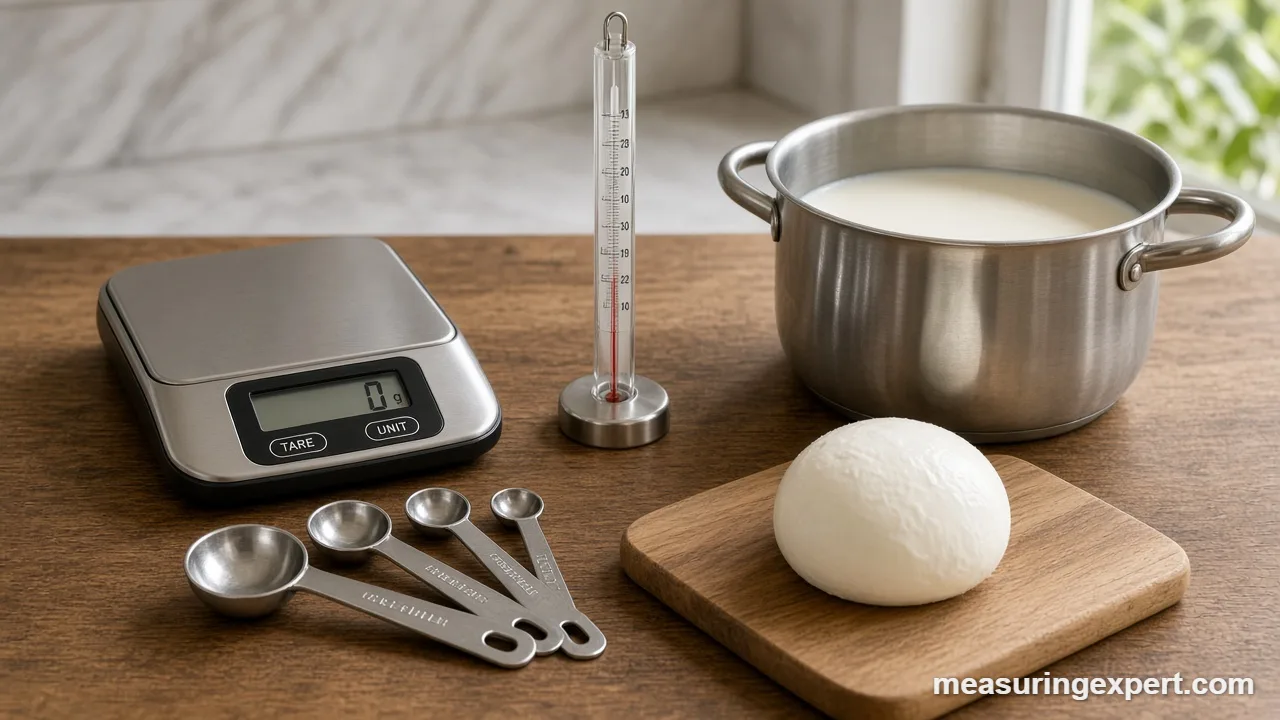
To measure cheese ingredients well, start with the milk and scale everything else to it. One US gallon of milk is 3.785 L, and a typical mozzarella recipe uses about 1/4 teaspoon of liquid rennet for that gallon. Check every temperature with a calibrated thermometer, and follow a tested recipe exactly.
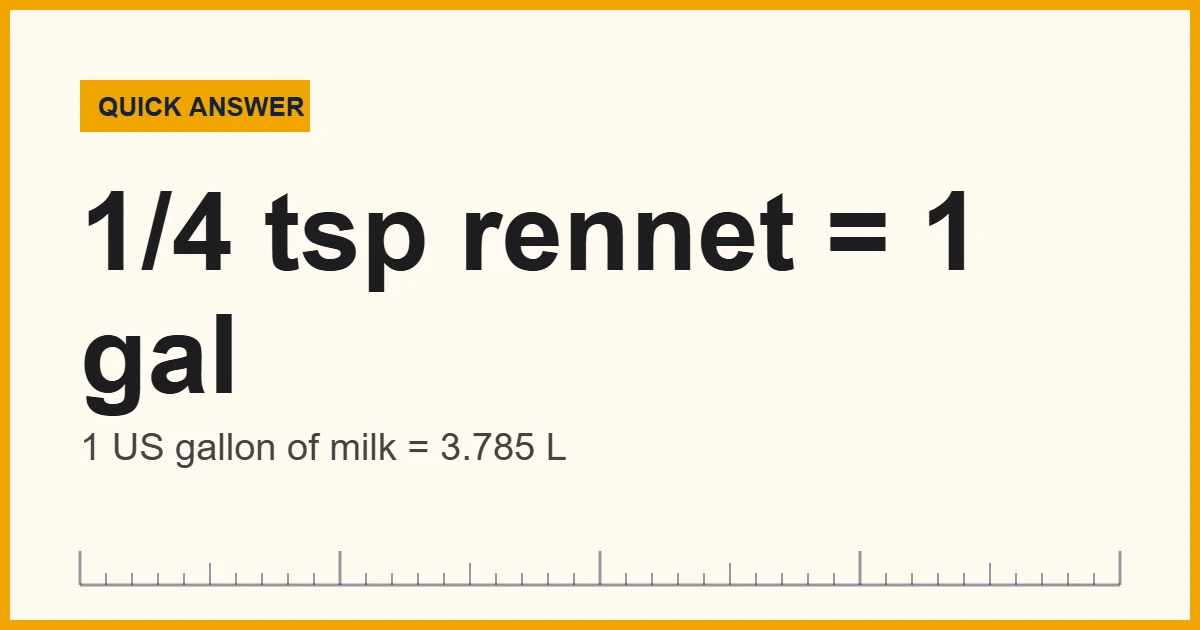
Convert Milk Volume Before You Measure Cheese Ingredients
First, enter the amount of milk you plan to use. The converter then shows gallons, quarts, liters and milliliters, so you can match a recipe written in any unit. In addition, it lists spoons and cups for the small ingredients that follow.
Cheese recipes look simple, yet a small slip can change the result. For example, a rennet dose that is off by a factor of two can change how the milk sets. Therefore it pays to know how much milk you have, how much rennet or culture it needs, and how warm it should be.
This guide shows how to measure cheese ingredients by volume and by weight, and how to scale a recipe up or down. It also covers milk choices, thermometers and the food-safety limits that no measuring tool can fix. Moreover, the numbers come from extension and cheesemaking sources listed in the text, and every conversion uses the exact US definitions.
Cheese Ingredient Amounts per Gallon of Milk
First, the table below scales one tested starting point: about 1/4 teaspoon of single-strength liquid rennet per gallon, and one culture packet for up to 2 gallons. The rennet figure matches a Clemson Cooperative Extension mozzarella recipe, as reprinted by UC Master Food Preservers. Likewise, a retailer lists 1/2 teaspoon of liquid animal rennet for 2 gallons, and says that the amount varies with your milk, the season and the cheese.
| Milk | Metric | Liquid rennet (single strength) | Culture packets (up to 2 gal each) | Mozzarella estimate |
|---|---|---|---|---|
| 1/2 gallon | 1.89 L | 1/8 tsp (0.6 mL) | 1 packet | 6 oz (170 g) |
| 1 gallon | 3.785 L | 1/4 tsp (1.2 mL) | 1 packet | 12 oz (340 g) |
| 2 gallons | 7.571 L | 1/2 tsp (2.5 mL) | 1 packet | 24 oz (680 g) |
| 3 gallons | 11.36 L | 3/4 tsp (3.7 mL) | 2 packets | 36 oz (1,021 g) |
| 5 gallons | 18.93 L | 1 1/4 tsp (6.2 mL) | 3 packets | 60 oz (1,701 g) |
Double-strength rennet needs half as much. For example, the same extension recipe lists 1/8 teaspoon of double-strength rennet where single-strength takes 1/4 teaspoon. As a result, always read the strength on your own bottle before you copy a number from any recipe.
Recommended Tools to Measure Cheese Ingredients
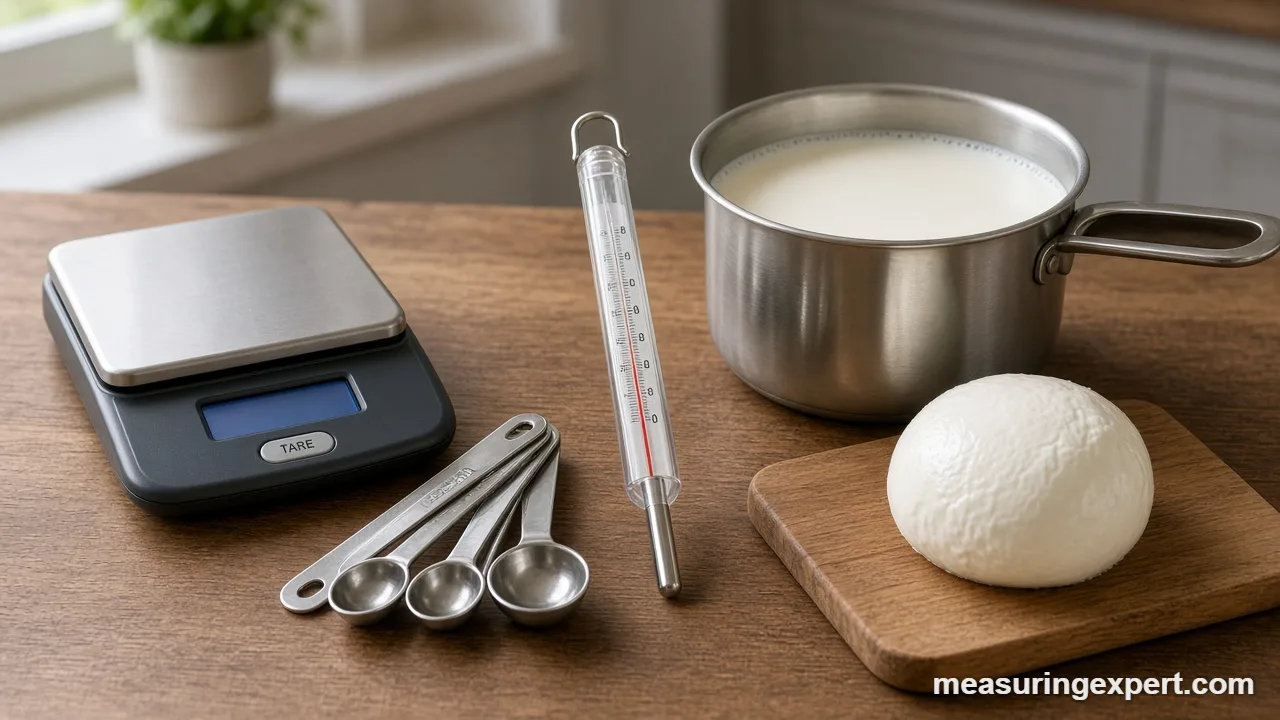
In practice you need three kinds of tools. First, a digital scale handles anything sold by weight, such as salt and finished cheese. Next, measuring spoons cover rennet, citric acid and other small liquid doses. Finally, a calibrated thermometer protects the temperatures that matter most. Also look for a scale with a tare button, so you can zero out the bowl, and for spoons with engraved markings that will not wear off.


As an Amazon Associate, Measuring Expert earns from qualifying purchases.
Key Takeaways
- Milk is the base number: 1 US gallon equals 3.785 L, or 3,785 mL.
- A common rennet dose is 1/4 teaspoon of single-strength liquid rennet per gallon.
- Dilute rennet in about 1/4 cup (59 mL) of cool, non-chlorinated water before you add it.
- One gallon of milk makes roughly 12 ounces of mozzarella in tested home recipes.
- Use pasteurized milk that is not ultra-pasteurized for stretched-curd cheese.
- Check your thermometer in ice water, where it should read 32 degrees F.
- Scale every ingredient together when you change a recipe’s size.
How to Measure Cheese Ingredients Step by Step
- Read the recipe once, then list the amounts. Write down milk, rennet, culture, acid, salt and water, along with the strength of your rennet.
- Measure the milk. First, use a marked pot or a measuring jug, and confirm it holds the gallon you expect before you heat it.
- Scale small doses. Next, multiply the per-gallon dose by the number of gallons, and use the table above for quick checks.
- Measure rennet last, and level the spoon. Use a clean measuring spoon, or an oral syringe for amounts under 5 mL.
- Dilute the rennet. Stir it into about 1/4 cup of cool, non-chlorinated water, then use it within about 30 minutes.
- Check the milk temperature. Then use a calibrated thermometer, and add rennet only at the temperature your recipe names.
- Stir gently for one minute. This spreads the rennet evenly, then the milk should rest undisturbed.
- Weigh the finished cheese. Finally, record the weight so you can compare batches and fix problems later.
If you also make fermented foods, our guide to how to measure ingredients for fermentation covers salt by weight in more detail.
How Much Cheese Does a Gallon of Milk Make?
Yield depends on the cheese. For instance, the Cheese Science Toolkit gives a rule of thumb of about 10 pounds of milk for every pound of cheese, and it notes that yield depends on milk quality and the type of cheese. Water weighs about 8.35 pounds per US gallon, and milk is slightly heavier. Therefore a gallon of milk gives a little under a pound of cheese by that rule.
Tested home recipes agree. In fact, a Mother Earth News recipe lists about 12 ounces of mozzarella and about 8 ounces of ricotta from 1 gallon of milk, because the ricotta comes from the leftover whey. Similarly, the Clemson recipe expects about 3/4 pound of mozzarella, which is the same 12 ounces.
| Milk | Rule of thumb (10 lb milk per lb cheese) | Mozzarella in a tested recipe | Ricotta from the whey |
|---|---|---|---|
| 1 gallon | about 0.8 lb (13 oz) | about 12 oz (340 g) | about 8 oz (227 g) |
| 2 gallons | about 1.7 lb | about 24 oz (680 g) | about 16 oz (454 g) |
The 2-gallon row simply doubles the recipe figures, so treat it as an estimate. In addition, your own results will vary with the milk, the temperature and how much whey you press out.
Milk Choices and Food Safety
Measuring cannot make an unsafe recipe safe. For instance, the FDA states that pasteurization kills harmful germs, and it lists unpasteurized soft and hard cheeses as high-risk choices. Consequently, most home recipes call for pasteurized milk.
The type of pasteurized milk matters as well. For example, ultra-pasteurized milk forms a weaker curd. In one test, a supplier reports that its mozzarella from such milk became a dry, granular mass instead of a stretchy curd. For that reason, buy milk labeled pasteurized only, not ultra-pasteurized, for mozzarella.
Thermometers: Check the Temperatures Cheese Recipes Depend On
Temperature steers curd formation, so a bad thermometer can undo careful measuring. Fortunately, most mozzarella recipes use a small set of target temperatures, and the Clemson and Mother Earth News recipes name them in degrees Fahrenheit.
| Step in a mozzarella recipe | Fahrenheit | Celsius |
|---|---|---|
| Warm the milk before rennet | 90 F | 32.2 C |
| Heat the cut curd | 105 F | 40.6 C |
| Stretch in the microwave method | 135 F | 57.2 C |
| Curd stretches (hot-water method) | about 145 F | about 62.8 C |
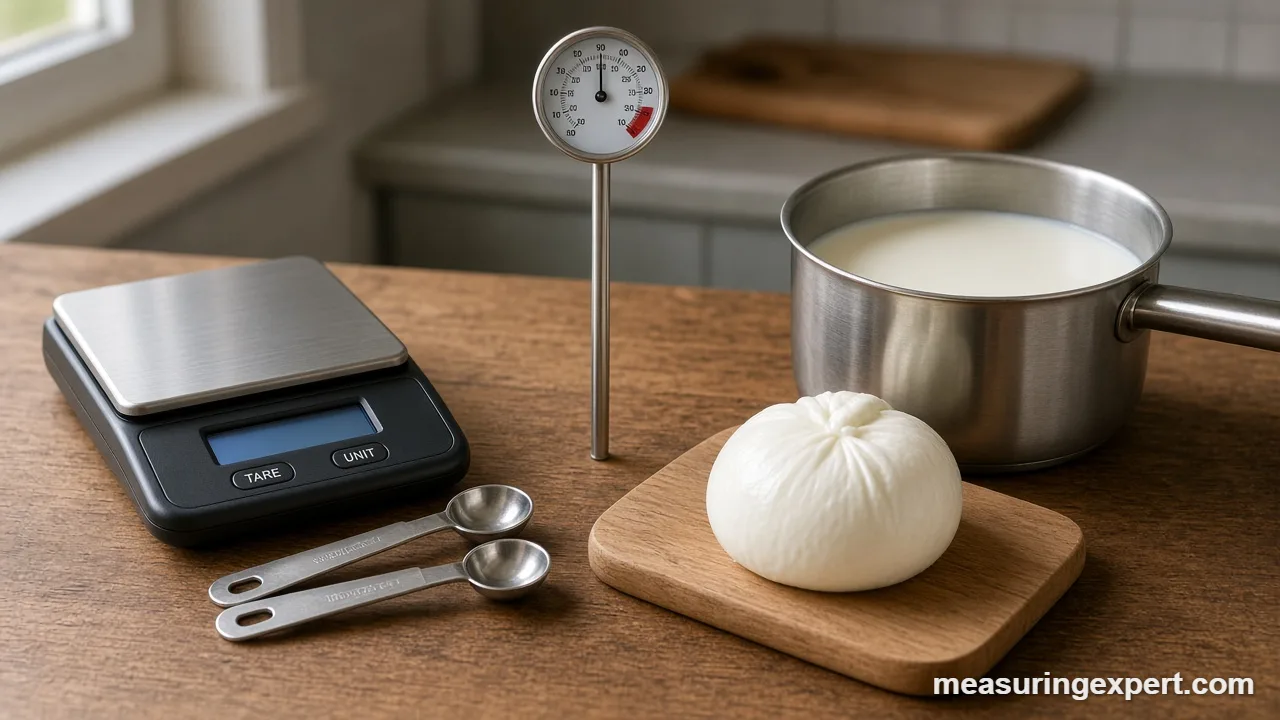
To calibrate, first fill a glass with ice and water, stir, and put the stem in at least 2 inches without touching the sides. According to the USDA Food Safety and Inspection Service, the thermometer should read 32 degrees F after 30 seconds. If it does not, adjust it as the manufacturer directs. Also, a related guide, how to use a measuring jug, helps with the milk side.
Common Mistakes When You Measure Cheese Ingredients
| Mistake | Why it matters | Better habit |
|---|---|---|
| Using tap water with chlorine to dilute rennet | Sources advise cool, chlorine-free water | Use bottled or boiled-and-cooled water |
| Mixing up single- and double-strength rennet | Double strength needs half the volume | Read the strength on the label first |
| Using a kitchen spoon for a tiny dose | Eating spoons vary in size | Use measuring spoons or a syringe in mL |
| Scaling only the milk | The dose no longer matches the volume | Scale every ingredient by the same factor |
| Trusting an uncalibrated thermometer | A wrong reading means a wrong temperature | Test it in ice water before each session |
Do and Don’t When You Measure Cheese Ingredients
Do
- Weigh salt and finished cheese on a scale.
- Write down amounts and results for each batch.
- Rinse and dry spoons between ingredients.
- Use a tested recipe from an extension or trusted supplier.
- Keep finished cheese cold.
Don’t
- Guess a rennet dose by eye.
- Swap raw milk for pasteurized milk without checking the risks.
- Change the rennet when you change only the flavor.
- Let diluted rennet sit for hours.
- Skip the thermometer check.
Honest Limits of Cheese Measurements
Numbers on this page are starting points, not guarantees. For one thing, rennet comes in single and double strength, and milk changes with the season. In addition, the yield figures come from specific home recipes, so a different method can give a different weight. In short, treat each amount as the first trial, then adjust by small steps and keep notes.
When to Ask an Expert
If you plan to sell cheese, age it for months or use raw milk, then talk to your state dairy regulator or local cooperative extension office first. Because they know local rules, they can explain licensing and testing rules that a measuring guide cannot cover.
Frequently Asked Questions
How do you measure cheese ingredients for a recipe?
Measure the milk first, then scale rennet, culture and acid to its volume. Also use measuring spoons for small liquids and a scale for salt and finished cheese.
How much rennet do I need per gallon of milk?
A common starting point is 1/4 teaspoon of single-strength liquid rennet per gallon, or 1/8 teaspoon of double strength. However, strengths differ, so follow your bottle’s label.
How many mL is a gallon of milk?
One US gallon is 3.785 L, which is 3,785 mL. In addition, it equals 4 quarts or 16 cups.
How much culture do I add per gallon?
One supplier states that each of its mesophilic culture packets sets up to 2 gallons of milk. However, you should check the label for your own culture.
How much mozzarella does one gallon of milk make?
Tested home recipes give about 12 ounces (340 g) of mozzarella per gallon. In addition, the ricotta from the whey adds about 8 ounces.
Should I measure cheese ingredients by weight or volume?
Use volume for milk and small liquid doses, and weight for salt and cheese. As a result, a scale reduces scooping errors.
Can I use ultra-pasteurized milk?
It is a poor choice for mozzarella because the curd turns weak and granular. Instead, choose pasteurized milk that is not ultra-pasteurized.
Why dilute rennet before adding it?
Dilution in about 1/4 cup of cool, non-chlorinated water spreads the rennet evenly. Then add it right away and stir gently for one minute.
How do I measure cheese ingredients without a scale?
Use marked measuring spoons and cups, and a syringe for tiny liquid doses. However, salt by volume varies, so a scale is better when you can get one.
How do I check my cheese thermometer?
First, put the stem in ice water at least 2 inches deep. Then it should read 32 degrees F, or 0 C, after 30 seconds.
Measure Cheese Ingredients: The Bottom Line
To sum up, begin with an accurate milk volume, scale the rennet and culture to it, and verify every temperature. Use the converter above for gallons, liters and spoons, and the table for quick per-gallon doses.
Finally, remember that measuring supports a good recipe but cannot replace food safety. Choose pasteurized milk, use tested recipes and keep notes, so each batch teaches you something.