

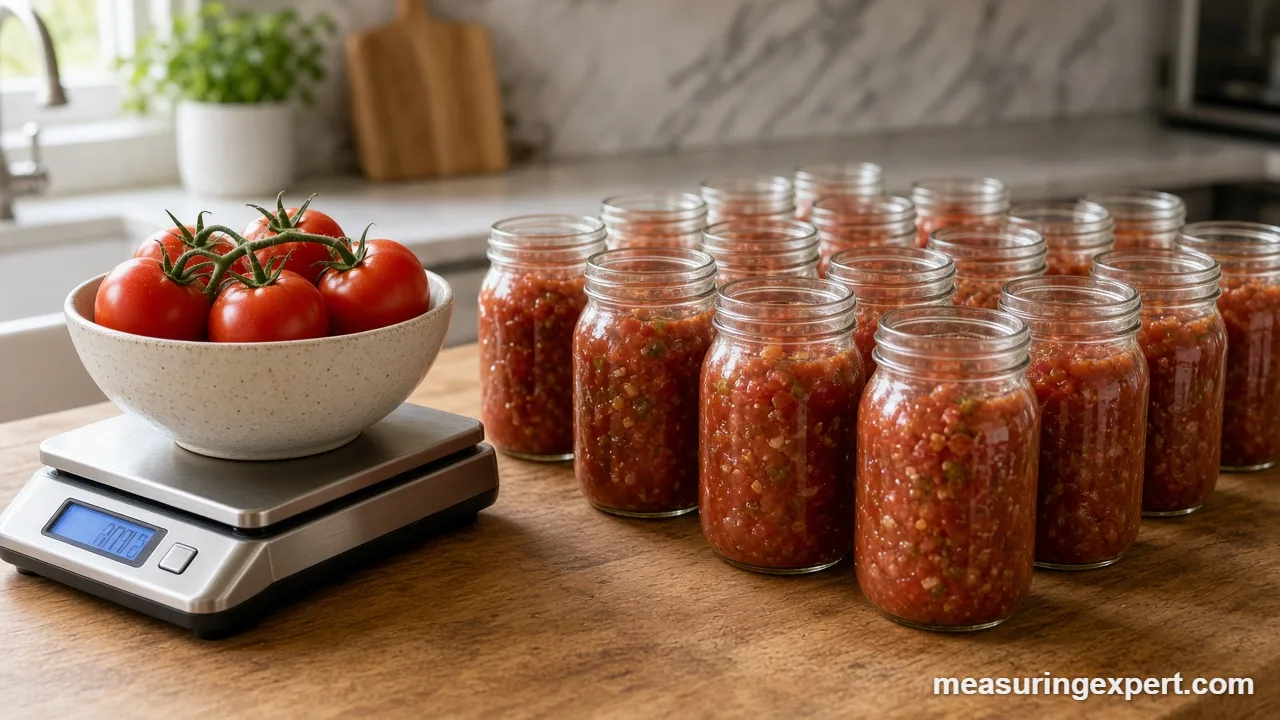
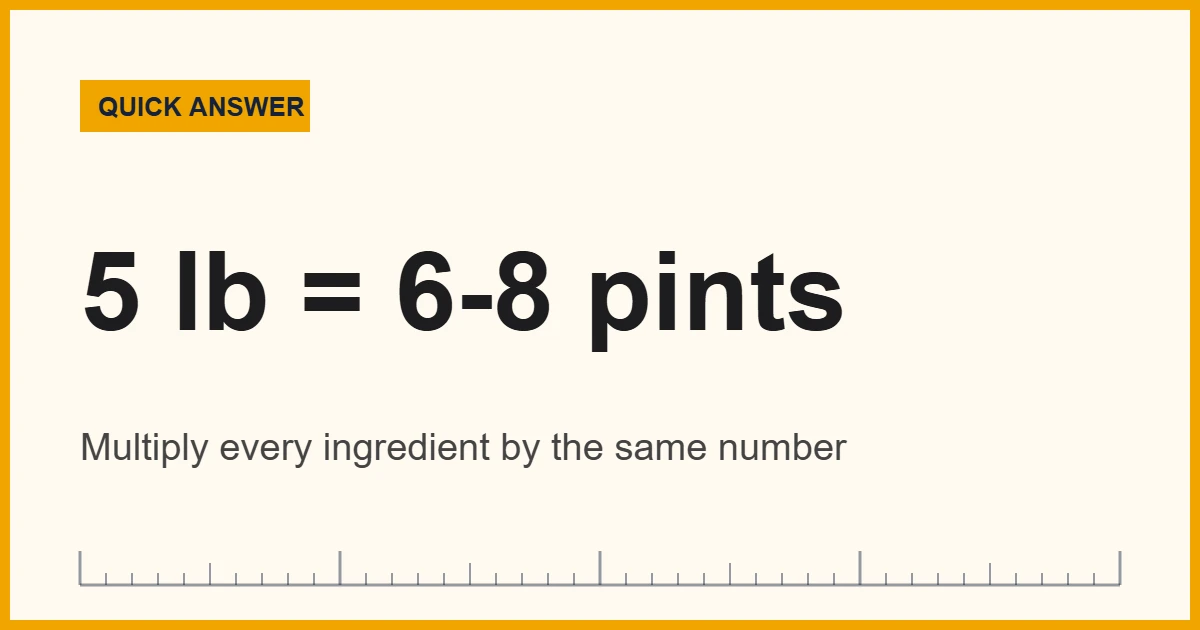
A homemade salsa batch scales safely only when every ingredient is multiplied by the same number. The tested NCHFP chile salsa uses 5 lb of tomatoes, 2 lb of chiles, 1 lb of onions and 1 cup of vinegar, and it fills 6 to 8 pints. Double it, and you get 12 to 16 pints.
Scale a Homemade Salsa Batch by Weight
First, enter the pounds of tomatoes, chiles or onions your recipe calls for. The converter then shows grams, kilograms and ounces, so you can weigh each ingredient on a kitchen scale.
Making a big pot of salsa for the pantry is a different job from stirring up a bowl for tonight. First, a canned salsa has to be safe on a shelf for months, so its proportions matter more than its taste. Next, the batch has to fill whole jars, which means you need to know your yield before you start chopping.
In short, a homemade salsa batch is a ratio problem. Meanwhile, for fresh bowls of salsa, see our guide to measuring ingredients for salsa. For jars that stay on the shelf, this page instead covers the scaling, the yields and the safety limits. In addition, our broader guide to measuring ingredients for canning explains jars, headspace and liquids in general.
Overall, the numbers below come from two research-based sources. The National Center for Home Food Preservation (NCHFP) publishes the tested tomato recipes used here, and the University of Kentucky extension publishes a salsa canning guide with more tested recipes and yields.
Homemade Salsa Batch Yield Chart (Tested Chile Salsa)
First, this chart scales the NCHFP chile salsa, which lists its tomatoes, chiles and onions in pounds as purchased. Therefore, every row multiplies all six ingredients by the same factor. Also, the gram values use 1 lb = 453.59 g, rounded.
| Batch | Tomatoes | Chile peppers | Onions | Vinegar (5%) | Salt | Black pepper | Pints made |
|---|---|---|---|---|---|---|---|
| Half | 2.5 lb (1,134 g) | 1 lb (454 g) | 0.5 lb (227 g) | 1/2 cup (118 mL) | 1 1/2 tsp | 1/4 tsp | 3 to 4 |
| Standard | 5 lb (2,268 g) | 2 lb (907 g) | 1 lb (454 g) | 1 cup (237 mL) | 3 tsp | 1/2 tsp | 6 to 8 |
| Double | 10 lb (4,536 g) | 4 lb (1,814 g) | 2 lb (907 g) | 2 cups (473 mL) | 6 tsp | 1 tsp | 12 to 16 |
| Triple | 15 lb (6,804 g) | 6 lb (2,722 g) | 3 lb (1,361 g) | 3 cups (710 mL) | 9 tsp | 1 1/2 tsp | 18 to 24 |
The yield is a range because chopped vegetables pack differently from one kitchen to the next. For that reason, plan for the high number of jars but expect the low number. In addition, a half-pint jar holds 8 fl oz (237 mL), so every pint of salsa fills two half-pints.
Recommended Tools for Measuring a Homemade Salsa Batch
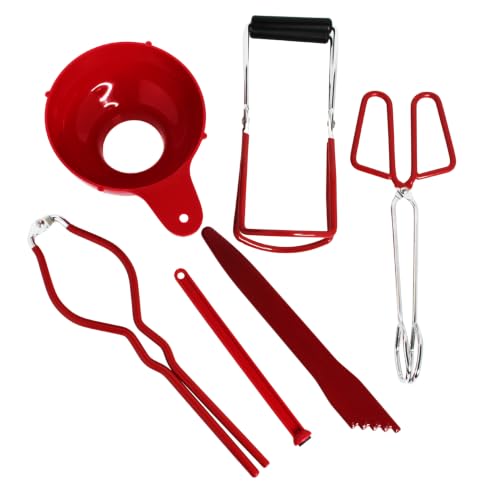
Because the NCHFP chile salsa lists its produce by weight, a digital scale saves the most guesswork. Meanwhile, measuring spoons and cups handle the vinegar and salt, and a basic canning kit helps with filling jars and checking headspace.


As an Amazon Associate, Measuring Expert earns from qualifying purchases.
- Multiply every ingredient by the same factor; never change one ingredient alone.
- The NCHFP chile salsa makes 6 to 8 pints from 5 lb of tomatoes, 2 lb of chiles and 1 lb of onions.
- As a result, that works out to roughly 10 to 13 oz of tomatoes per pint in that recipe.
- Vinegar and bottled lemon or lime juice keep the salsa acidic enough for a boiling water canner.
- Also, process times depend on altitude and jar size, not on how big the batch was.
- Use only tested recipes for jars that will sit on a shelf.
Pounds of Tomatoes per Pint of Homemade Salsa
Recipes do not agree on one number, because peppers, onions and cooking time change the volume. For example, the table compares what the tested recipes actually list. As a result, you can see the range instead of trusting a single rule of thumb.
| Tested recipe | Tomatoes used | Yield | Tomatoes per pint |
|---|---|---|---|
| Chile salsa (NCHFP) | 5 lb as purchased | 6 to 8 pints | 0.63 to 0.83 lb (283 to 378 g) |
| Medium salsa (Kentucky) | 6 lb (about 18 medium) | about 5 pints | about 1.2 lb (544 g) |
| Traditional salsa (Kentucky) | 7 cups chopped | about 4 pints | about 1 3/4 cups |
| Tomato and green chile salsa (NCHFP) | 3 cups peeled, chopped | about 3 pints | about 1 cup |
The Kentucky medium salsa gives a handy conversion: 6 lb is about 18 medium tomatoes, so one medium tomato weighs roughly 5.3 oz (151 g). Therefore three medium tomatoes make about a pound. Buy a little extra, however, because cores, skins and seeds are trimmed away after weighing.
Why a Homemade Salsa Batch Must Keep Its Acid
In fact, tomatoes, peppers and onions on their own are not acidic enough for a boiling water canner. For that reason, tested recipes add vinegar or bottled lemon or lime juice in fixed amounts. First, the Kentucky guide says to never change or reduce the lemon juice, lime juice or vinegar, and it requires commercial vinegar of at least 5% acidity.
Likewise, the NCHFP tomato and green chile recipe warns that changing the ratio of vegetables to acid and tomatoes might make the salsa unsafe. Also, fresh-squeezed juice varies from fruit to fruit. Instead, the Kentucky guide calls for bottled juice because its acidity is standardized.
| You can change | You should not change |
|---|---|
| Salt, if the recipe allows it | The amount of vinegar or bottled juice |
| Dried herbs and spices, such as oregano or cumin | The ratio of tomatoes to peppers and onions |
| Batch size, if every ingredient scales together | The vinegar strength (use 5% or higher) |
| Bottled lemon juice in place of vinegar, where the NCHFP recipe says so | Fresh juice in place of bottled juice |
How to Scale a Homemade Salsa Batch Step by Step
- Choose a tested recipe. Pick one from NCHFP or a university extension, and note its yield and jar size.
- Pick a multiplier. Divide the pints you want by the recipe yield, then round up to a whole number or a clean half.
- Multiply every ingredient. Include the vinegar, salt and spices, and write the new amounts down before you shop.
- Weigh the produce as purchased. Use a scale for any ingredient the recipe lists in pounds.
- Prepare the salsa in pot-sized portions. Cook in a pot with room to stir, and keep the proportions the same in each pot.
- Fill the jars to the recipe headspace. Most Kentucky recipes call for 1/2 inch (12.7 mm).
- Process for the listed time. Use the time for your jar size and altitude, then store the sealed jars as the recipe directs.
For example, to fill 14 pints from the NCHFP chile salsa, divide 14 by 8 to get 1.75, and then round up to 2. Then make the double batch, and plan on 12 to 16 pints. In contrast, if you only need 4 pints, a half batch makes 3 to 4.
Jar Counts, Headspace and Processing Times
Jar count follows from yield, but the processing time follows from the recipe. The table below shows the NCHFP chile salsa times for pint jars in a boiling water canner. Other recipes list their own times, so always read the one you are using.
| Altitude | Metric | Pint jars |
|---|---|---|
| 0 to 1,000 ft | 0 to 305 m | 15 minutes |
| 1,001 to 6,000 ft | 305 to 1,829 m | 20 minutes |
| Above 6,000 ft | Above 1,829 m | 25 minutes |
The Kentucky guide times most of its salsas at 15 minutes for sea-level kitchens, but the medium salsa takes 40 minutes and the salsa verde 20. Consequently, a faster recipe does not tell you how long a different recipe needs. Also, a bigger batch does not change the time; it only means more jars or more rounds in the canner.
Common Homemade Salsa Batch Mistakes
Do
- Scale every ingredient by the same factor.
- Weigh produce when the recipe lists pounds.
- Use bottled juice and 5% vinegar.
- Write down the new amounts before you start.
- Check altitude before you set the timer.
Don’t
- Add extra peppers or onions to a tested recipe.
- Swap fresh juice for bottled juice.
- Reduce the vinegar to make the salsa less sharp.
- Can a family recipe that nobody has tested.
- Assume the process time scales with the batch.
Honest Limits of Yield Estimates
Yields on paper, however, are estimates. For one thing, a pint jar holds 16 fl oz (473 mL), but the salsa takes up less once the headspace is left empty. Moreover, tomatoes that are very juicy or very meaty change how far a pound goes. In short, treat the range as a plan, keep a few extra jars ready, and refrigerate any leftover salsa that does not fill a jar.
When to Check With an Extension Office
Home canning is a food-safety task, so it helps to confirm a recipe when something is unclear. For instance, your local extension office can answer questions about altitude, jar types and unusual ingredients. In particular, ask before you change a recipe in any way beyond salt and herbs.
Frequently Asked Questions
How many pints does a homemade salsa batch make?
It depends on the recipe. The NCHFP chile salsa makes 6 to 8 pints, and the tomato and green chile salsa makes about 3 pints.
How many pounds of tomatoes make a pint of salsa?
In the NCHFP chile salsa, 5 lb of tomatoes fills 6 to 8 pints, so each pint uses about 0.63 to 0.83 lb. Other recipes use more.
Can I double a homemade salsa batch for canning?
Yes, if you double every ingredient, including the vinegar. Keep the process time and headspace the same as in the original recipe.
Can I add extra peppers to a homemade salsa batch?
No. Extra peppers or onions lower the share of acid, which might make the salsa unsafe. Adjust only the salt, herbs and spices.
Is fresh lime juice safe in a homemade salsa batch?
Not for canning. The Kentucky guide specifies bottled lemon or lime juice because its acidity is standardized, unlike fresh juice.
How many jars do I need for a homemade salsa batch?
Divide your pint target by the recipe yield, round up, and plan for the high end of the range. Two half-pints equal one pint.
How much headspace should salsa jars have?
Most of the Kentucky salsa recipes call for 1/2 inch (12.7 mm). Always follow the headspace listed in your own recipe.
Does altitude change the canning time for salsa?
Yes. The NCHFP chile salsa takes 15 minutes in pints at 0 to 1,000 ft, 20 minutes up to 6,000 ft and 25 minutes above that.
Should I weigh the tomatoes or use cups?
Use whichever unit the recipe lists. The NCHFP chile salsa lists pounds as purchased, so weigh the whole tomatoes before you trim them.
How many medium tomatoes are in 6 pounds?
The Kentucky medium salsa recipe lists about 18 medium tomatoes for 6 lb, which is roughly 3 per pound.
The Bottom Line on Scaling Salsa
To sum up, a homemade salsa batch grows or shrinks by one multiplier applied to every ingredient. The NCHFP chile salsa shows the pattern: 5 lb of tomatoes, 2 lb of chiles, 1 lb of onions and 1 cup of vinegar fill 6 to 8 pints, and a double batch fills 12 to 16.
Finally, keep the vinegar, the produce ratio and the process time exactly as tested. Use the converter above to turn pounds into grams, weigh before you chop, and save the creative changes for the refrigerator.