

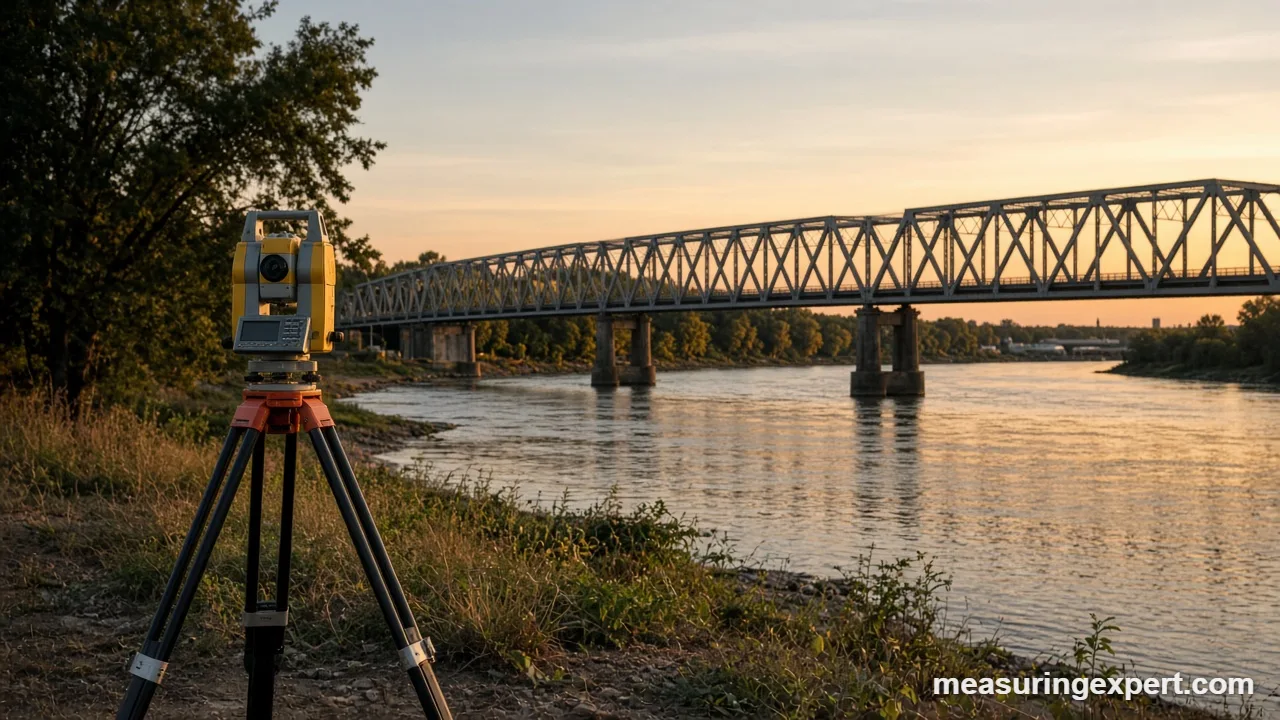
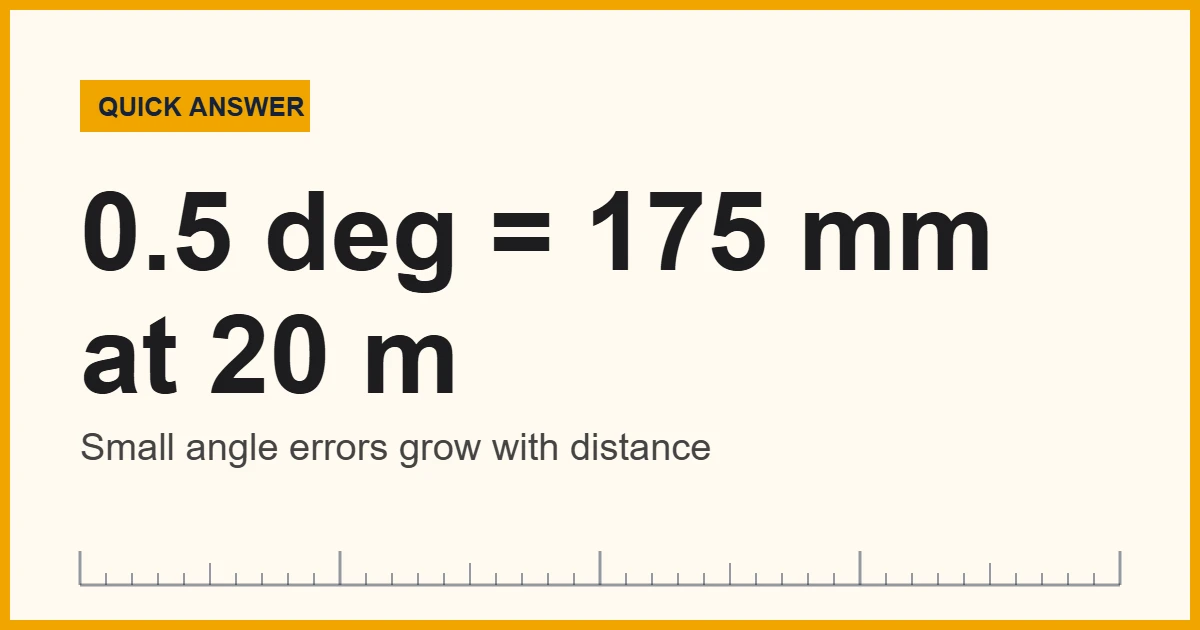
Bridge angle measurement matters because every pier line, truss member and cable must meet at the angle the engineers drew. A small error grows with distance: a 0.5 degree miss on a 20 m line moves its far end about 175 mm (6.9 in). Crews therefore check angles with total stations and digital inclinometers.
Bridge Angle Measurement Converter: Degrees, Grade and Pitch
Bridge plans mix several ways of describing the same slope. For example, a deck profile uses percent grade, a truss uses degrees, and a roof-style detail uses rise per 12. Enter any angle below, and the converter shows the others.
A bridge is a chain of connected parts. Also, each part leans, bends or meets its neighbor at a planned angle. As a result, bridge angle measurement is not a single task. Instead, it runs from the first survey stake to the final bearing check.
In short: angles control where loads travel and where parts fit. For example, if an angle is off, a joint may not close, a girder may not seat, or a cable may carry more force than planned. Crews measure angles often because the cost of finding a mistake late is high.
The Federal Highway Administration gives a good example of how precisely the field defines angles. Its bridge inventory coding guide defines the skew of a structure as the angle between the centerline of a pier and a line normal to the roadway centerline.
Why Bridge Angle Measurement Matters
First, angles decide how forces move through a structure. For instance, a truss diagonal at the wrong angle carries a different share of the load. Likewise, a skewed pier that sits a few degrees off changes where the girders land. Therefore, designers set the angles first, and builders then prove that the real structure matches them.
Fit and alignment
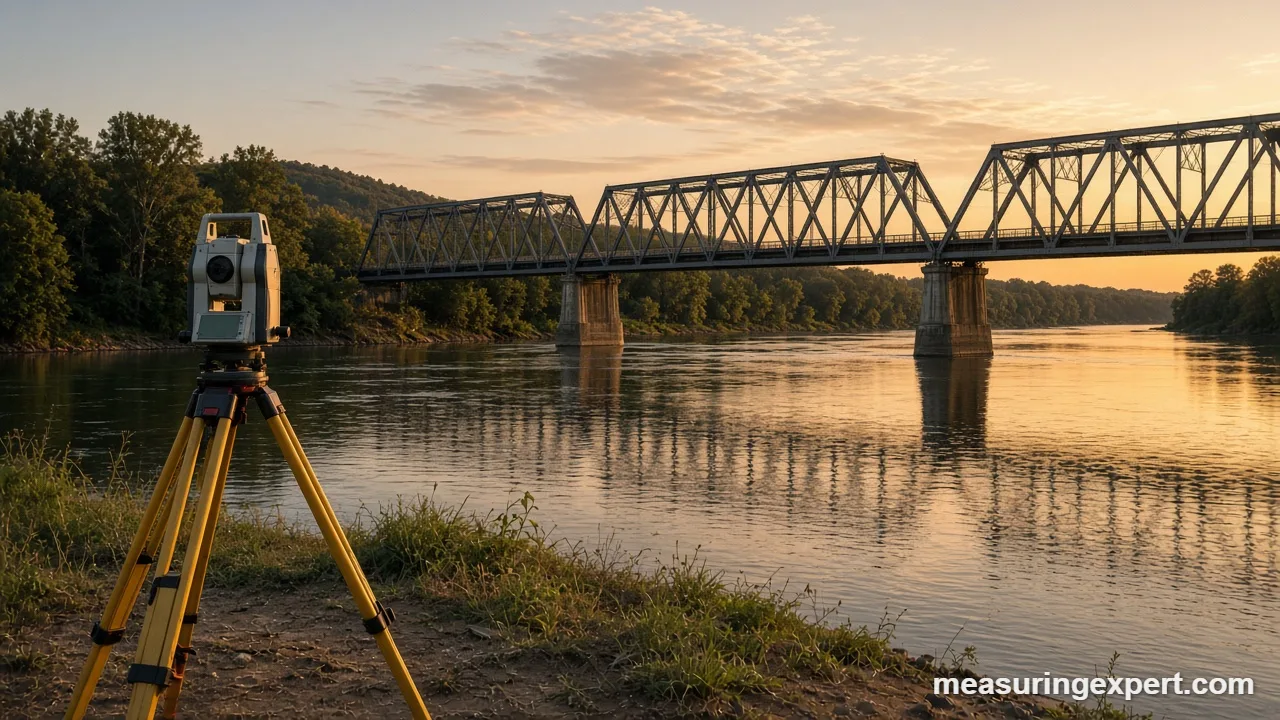
First, steel and precast parts arrive from a factory cut to exact angles. Next, at the site, the crew must place supports at the matching angles, or the parts will not meet. For example, a bolted splice with a misaligned plate may need drilling or shimming, which costs time and can weaken the joint.
Load paths and safety
Moreover, in a truss or cable-stayed bridge, each member works in tension or compression along its own line. Because a force splits into components by angle, even a small angle change shifts the force in the member. Consequently, engineers check final angles against the design and record the results.
Long-term performance
Similarly, bearings, expansion joints and drainage slopes all depend on correct angles. Also, a deck with the wrong cross slope can hold water, which speeds up corrosion. In addition, good records from construction give inspectors a baseline for later comparisons.
Recommended Tools for Bridge Angle Measurement
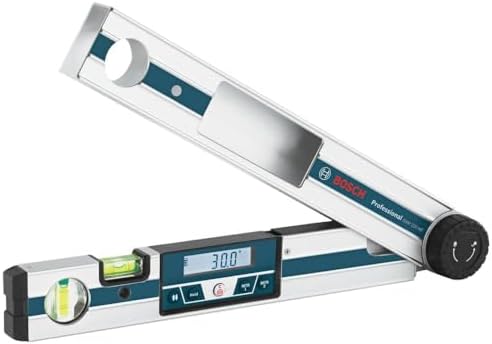
Large bridges, for example, need survey-grade equipment that a licensed surveyor operates. However, smaller jobs such as footbridges, deck repairs and model checks work well with simpler tools. First, a digital angle gauge reads slopes in degrees. Next, an angle finder checks corners and brackets. Finally, a cross-line laser gives a level reference over a span.



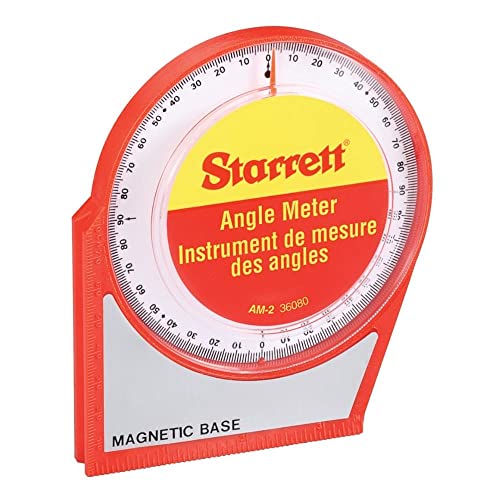
As an Amazon Associate, Measuring Expert earns from qualifying purchases.
Key Takeaways on Bridge Angle Measurement
- Every bridge part meets its neighbors at a planned angle, so angle errors spread through the structure.
- A 0.5 degree error on a 20 m line moves the far end about 175 mm.
- Skew is the angle between a pier centerline and a line normal to the roadway, per FHWA.
- Construction-grade total stations commonly reach 5 to 10 arc-seconds; high-end models reach 0.5.
- Longer baselines make the same angle error easier to see, but also larger in millimeters.
- Large bridge work belongs to licensed surveyors and engineers.
Angles That Control a Bridge
In practice, several different angles appear on a set of bridge plans. Also, each one has its own tool and tolerance. The table lists the main ones.
| Angle | Where it appears | Typical way to check it |
|---|---|---|
| Skew angle | Pier and abutment lines compared with the roadway | Total station, tape triangles |
| Truss member angle | Diagonals and verticals | Digital angle gauge, layout by coordinates |
| Cable angle | Stay cables and hangers | Total station, inclinometer on the cable |
| Grade and cross slope | Deck surface and drainage | Level, digital inclinometer |
| Bearing rotation | Girder ends on bearings | Inclinometer on the girder |
For a broader look at angles in survey work, see our guide to angle measurement in surveying.
Bridge Angle Measurement Errors in Numbers
In fact, angle error turns into position error as distance grows. In other words, the same small angle gives a bigger miss on a longer line. The table uses the exact relation, error = distance x tan(angle error).
| Angle error | Miss at 100 m | Miss at 300 m |
|---|---|---|
| 1 arc-second | 0.48 mm | 1.45 mm |
| 5 arc-seconds | 2.42 mm | 7.27 mm |
| 10 arc-seconds | 4.85 mm | 14.54 mm |
| 0.5 degrees (1,800 arc-seconds) | 873 mm | 2,618 mm |
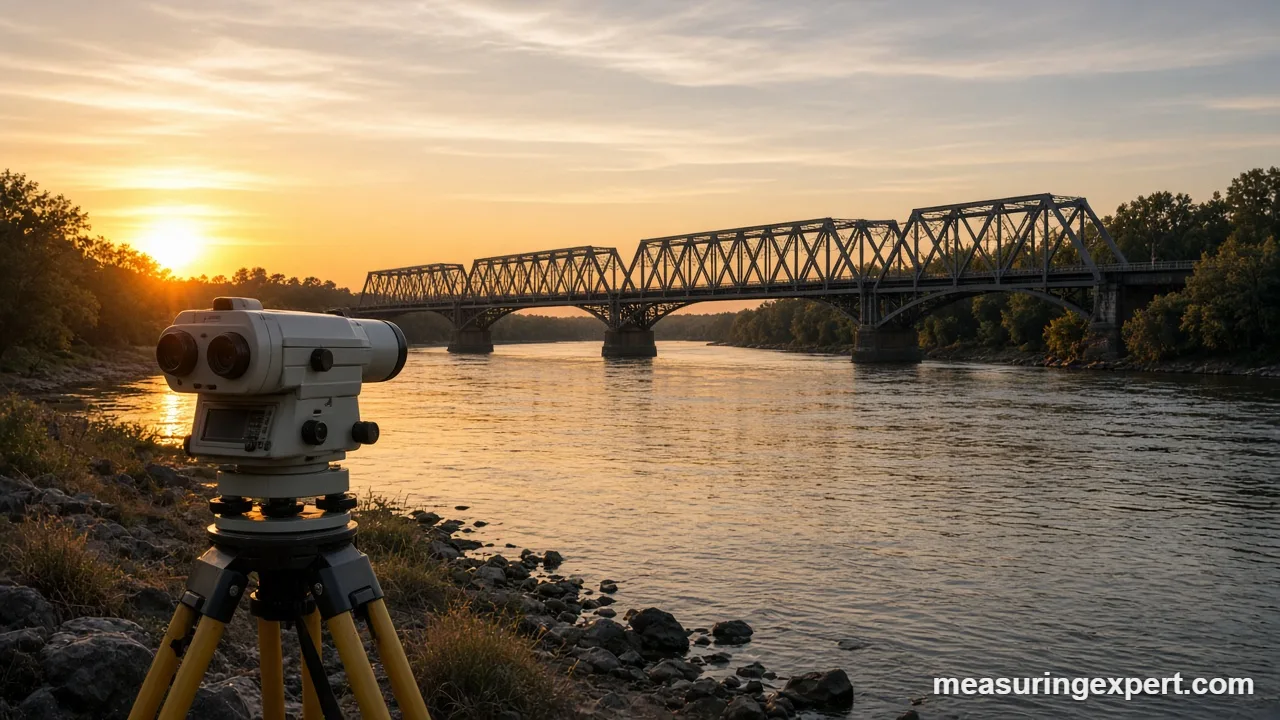
Consequently, that last row shows why a hand-held gauge is never a substitute for survey equipment on a big span. According to the overview of total stations, high-end instruments measure angles to a standard deviation of 0.5 arc-seconds, while inexpensive construction-grade models reach 5 or 10 arc-seconds. As a result, survey crews rely on them for control points.
How to Check a Bridge Angle Step by Step
- Find the design angle. First, read the angle on the plans, such as the skew of a pier or the slope of a diagonal.
- Pick the right instrument. Use a total station for control and long lines. Instead, use a digital angle gauge for member slopes.
- Zero or calibrate the tool. Place a digital gauge on a known flat surface, set zero, then flip it and confirm the reading.
- Measure from a stable reference. Next, sit the tool on a clean, firm surface of the member or the survey mark.
- Take the reading twice. Then repeat from the opposite side or the other face of the instrument and compare.
- Compare with the design. Finally, subtract the design value from the field value and record the difference.
- Report out-of-tolerance angles. Tell the engineer of record, because only they can accept or fix the difference.
Bridge Angle Measurement Instruments Compared
| Instrument | Best for | Strength | Limit |
|---|---|---|---|
| Total station | Control points, skew, long baselines | Very fine angle reading plus distance | Needs a trained operator and setup time |
| Digital inclinometer or angle gauge | Member slope, bearing rotation, cross slope | Fast reading in degrees | Needs contact; limited accuracy at a distance |
| Cross-line laser level | Level reference across a span | Easy visible line | Does not read angles itself |
| Tape and trigonometry | Checking a skew or diagonal with distances | Needs only a tape and calculator | Tape sag and wind add error |
To see how the survey instrument works in the field, read our guide on how to use a total station. In addition, our best inclinometer guide covers hand-held options for smaller checks.
Worked Examples of Bridge Angle Measurement
Example 1: a skewed pier
A deck is 40 ft wide, and the pier line has a 30 degree skew. As a result, the pier line measures 40 / cos(30 degrees) = 46.19 ft long. Its two ends sit 40 x tan(30 degrees) = 23.09 ft apart along the roadway. Consequently, the girders on one side land more than 23 ft ahead of the other side.
Example 2: a stay cable
A tower rises 100 m above the deck, and the cable anchors 250 m away horizontally. The cable angle is arctan(100 / 250) = 21.80 degrees. In addition, its length is the square root of (100 squared plus 250 squared), or 269.26 m.
Example 3: a truss diagonal
For example, a truss panel is 8 m wide and 6 m tall. The diagonal rises at arctan(6 / 8) = 36.87 degrees and measures exactly 10 m. In other words, the panel is a 3-4-5 triangle scaled up by two.
angle = arctan(rise / run)
pier line length = deck width / cos(skew)
error = distance x tan(angle error)
For one more useful rule of thumb, a 5% deck grade equals only 2.86 degrees. Thus, small angles hide in big-looking percentages, so convert before you compare.
Common Mistakes in Bridge Angle Measurement
- Mixing angle conventions. Skew can be measured from the roadway or from its normal. So always check which one the plans use.
- Short baselines. Because of this, a tiny setup error looks large when you measure only a short line.
- Temperature changes. Steel grows about 12 millionths of its length per degree Celsius, so a 100 m girder that warms by 20 degrees Celsius lengthens roughly 24 mm.
- Wind and vibration. Traffic and wind shake light instruments, so wait for a steady reading.
- Skipping the repeat reading. Otherwise, one reading hides random errors.
Do and Don’t for Bridge Angle Measurement
Do
- Use the instrument that matches the tolerance.
- Calibrate digital gauges before each use.
- Record the time, temperature and tool.
- Repeat each reading at least once.
- Send out-of-tolerance results to the engineer.
Don’t
- Use a hand tool for long baselines.
- Mix degrees, grade and pitch without converting.
- Measure from a dirty or loose surface.
- Change a member to fit a reading.
- Skip site safety for a quick check.
Honest Limits of Bridge Angle Measurement
This page gives the ideas and the math. However, it does not replace plans, specifications or a licensed professional. For one thing, real bridges deflect under load and change with temperature, so one angle reading is a snapshot. Moreover, the numbers here are examples, not tolerances. Instead, each project sets its own limits in its specifications. In short, use the examples to understand the geometry and not to accept or reject real work.
When to Call a Professional
First, call a licensed land surveyor for control points, alignment and layout. Likewise, a licensed professional engineer must approve any change to a bridge member, bearing or connection. Also, inspectors and certified bridge teams handle load ratings and condition reports. In addition, even a small footbridge on private land deserves an engineer’s review if people will cross it.
Frequently Asked Questions
Why is bridge angle measurement important?
Angles decide how parts fit and how forces travel. Even a small error grows with distance, so a 0.5 degree miss on a 20 m line moves its end about 175 mm.
What is a skew angle on a bridge?
The skew is the angle between the centerline of a pier and a line normal to the roadway centerline. In other words, a zero skew means the pier sits square to the road.
Which tool measures angles on a bridge?
Surveyors use total stations for control points and long lines. Meanwhile, crews use digital inclinometers and angle gauges for member slopes and bearing rotation.
How accurate is a total station for angles?
High-end models reach about 0.5 arc-seconds. In contrast, inexpensive construction-grade models reach about 5 to 10 arc-seconds.
How many arc-seconds are in a degree?
There are 3,600 arc-seconds in 1 degree, and 60 arc-minutes. In addition, one arc-minute equals 60 arc-seconds.
How do you find the angle of a bridge cable?
Divide the vertical rise by the horizontal run and take the arctangent. For example, 100 m over 250 m gives 21.80 degrees.
Does temperature change bridge angles?
Yes. Steel and concrete expand and shrink with temperature, so member lengths and angles shift a little during the day. For that reason, crews note the time and temperature of critical readings.
Can a digital angle gauge check a bridge member?
Yes, for slope readings on a flat contact surface. However, it cannot replace a total station for long lines or control points.
How do I convert a bridge grade to degrees?
Take the arctangent of the grade as a decimal. For example, a 5% grade is arctan(0.05), which equals 2.86 degrees.
Who approves a change to a bridge angle?
Only the engineer of record can accept or change a design angle. Report out-of-tolerance readings instead of fixing them on site.
Bridge Angle Measurement: The Bottom Line
To sum up, bridge angle measurement keeps every pier, member and cable where the design needs it. Small angle errors turn into large position errors over long lines, so match the tool to the tolerance and repeat each reading.
Finally, use the converter at the top of this page to move between degrees, grade and pitch. For real bridge work, bring in a licensed surveyor and the engineer of record.