

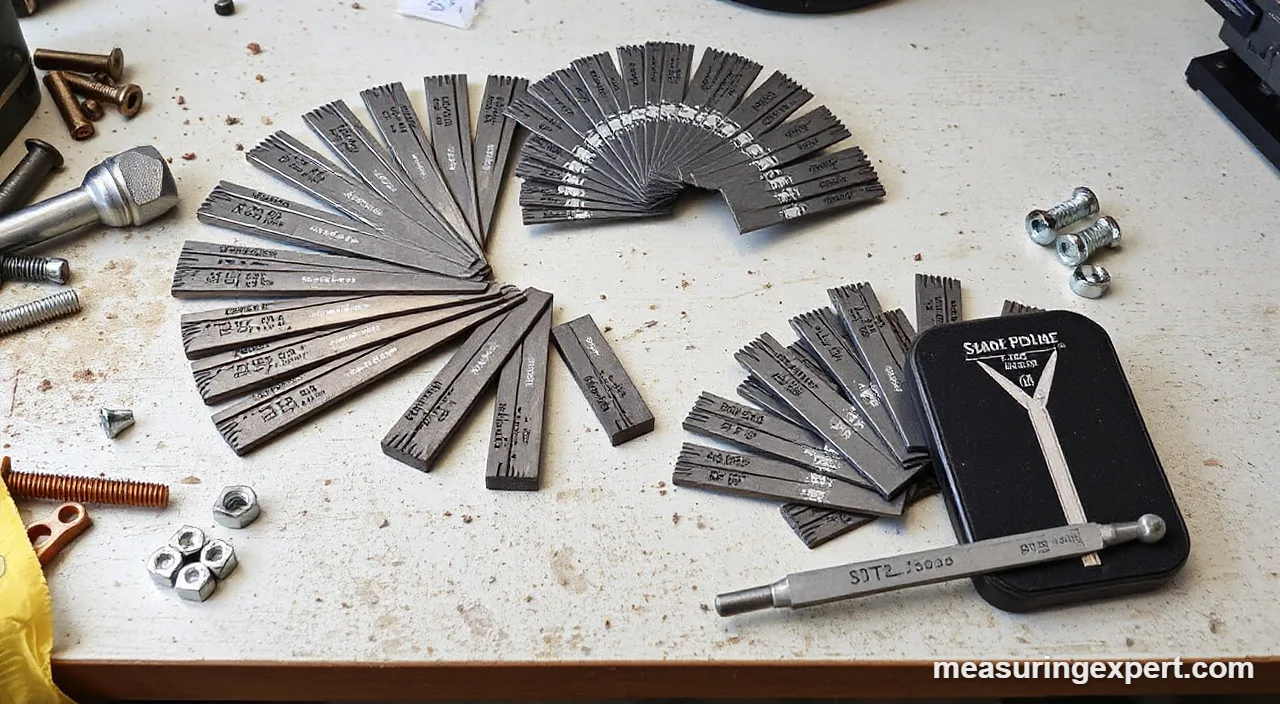
The best thread pitch gauge for most people is the Mitutoyo 188-151, a 51-leaf set that reads both metric pitch and inch threads per inch. First, pick by thread system, then by range, because a gauge only helps when its leaves match your fasteners.
In short: buy a combined set if you mix inch and metric hardware, a single-system set if you do not, and always confirm the result with a caliper.
As an Amazon Associate, Measuring Expert earns from qualifying purchases. Our picks are based on research, specifications and owner feedback, not paid placement.
Best Overall
Best for Inch Threads
Best Compact Combo

Quick Answer: Which Gauge Fits Your Job
- Both systems: Mitutoyo 188-151 or PEC Tools 5629.
- Inch only: Starrett 6, or Shars 303-4329 if you need fine threads up to 80 TPI.
- Metric only: Starrett 156M for fine steps, Insize 4820-124 for a wider range.
- Fast fastener ID: Grip US gauge or the Screw Chek’r.
- Acme lead screws: a 29 degree Acme set.
- Always: also check the diameter with a caliper before trusting a pitch reading.
On This Page
- The 9 Best Thread Pitch Gauges, Reviewed
- How We Chose the Best Thread Pitch Gauge
- SAE vs Metric: Choosing the Best Thread Pitch Gauge Type
- TPI vs Pitch in mm: Conversion Table
- How to Read a Thread Pitch Gauge
- Honest Limits of a Thread Pitch Gauge
- Thread Pitch Gauge FAQ
- Bottom Line
| # | Product | Best For | Standout Feature | Link |
|---|---|---|---|---|
| 1 | Mitutoyo 188-151 | Best Overall | Widest range in one case | View |
| 2 | Starrett 6 | Best for Inch Threads | Folding steel-case inch gauge | View |
| 3 | Starrett 156M | Best for Metric Threads | Fine-step metric gauge | View |
| 4 | PEC Tools 5629 | Best Mixed Set | Inch and metric in 28 leaves | View |
| 5 | Insize 4820-124 | Best Wide Metric Range | Metric 0.25 to 7 mm | View |
| 6 | Shars 303-4329 | Best Fine Inch Range | Inch to 80 TPI | View |
| 7 | Grip US Thread Pitch Gauge | Best Compact Combo | Compact metric and SAE | View |
| 8 | Screw Chek’r (Ruelle) | Best Screw Identifier | Size, TPI and drill sizes | View |
| 9 | QWORK Acme Set | Best for Acme Threads | 29 degree Acme leaves | View |
The 9 Best Thread Pitch Gauges, Reviewed
Every pick below is research-based. First, we compared manufacturer and distributor specifications and left out anything we could not confirm.
Best Overall
1. Mitutoyo 188-151, the Best Thread Pitch Gauge Set Overall
Best for: shops that handle both metric and inch fasteners.
The Mitutoyo 188-151 is the best thread pitch gauge for most workshops because one purchase covers both measurement systems. The distributor listing describes 51 leaves for 60 degree threads, spanning 0.4 to 7 mm metric pitch and 4 to 42 threads per inch (TPI). In addition, the set combines the Mitutoyo 188-122 and 188-111 gauges.
Because the pitch is stamped on each leaf, you read the answer straight off the blade that meshes. As a result, there is no chart to consult. Overall, Mitutoyo is a long-established metrology brand, which makes this a safe default when you do not yet know what you will be sorting. Overall, it is the simplest way to avoid owning two gauges.
- 51 leaves for 60 degree threads
- Metric range 0.4 to 7 mm
- Inch range 4 to 42 TPI
- Pitch stamped on every leaf
Pros
- Metric and inch in one set
- Stamped pitch is easy to read
- Covers nearly every common bolt and screw
Cons
- Many leaves to sort through
- Stops at 42 TPI, so fine instrument threads are out
- Blade material is not stated on the listing
Skip it if: you only ever work in one system, because a single-system gauge is simpler to use.
Best for Inch Threads
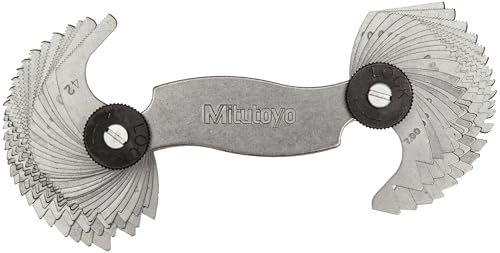
2. Starrett 6, the Best Thread Pitch Gauge for Inch Threads
Best for: mechanics and machinists who work on SAE fasteners.
The Starrett 6 is a classic inch screw pitch gage. For starters, Starrett lists 30 leaves covering 4 to 42 TPI for 60 degree threads, held in a steel case with leaves that fold out at both ends. Also, a locking device keeps the leaf in place while you read it.
Because the range matches Unified Coarse and most Unified Fine fasteners, it handles the bolts found on cars, bikes and general machinery. In addition, the listing states it is made in the USA. As a result, it is a dependable choice for an inch-only toolbox.
- 30 leaves, 4 to 42 TPI
- 60 degree thread form
- Steel case with locking device
- Made in the USA (per Starrett)
Pros
- Sturdy steel case
- Folding leaves at both ends
- Covers the common SAE range
Cons
- Inch only
- Nothing finer than 42 TPI
Skip it if: you need metric pitches or threads finer than 42 TPI.
Best for Metric Threads
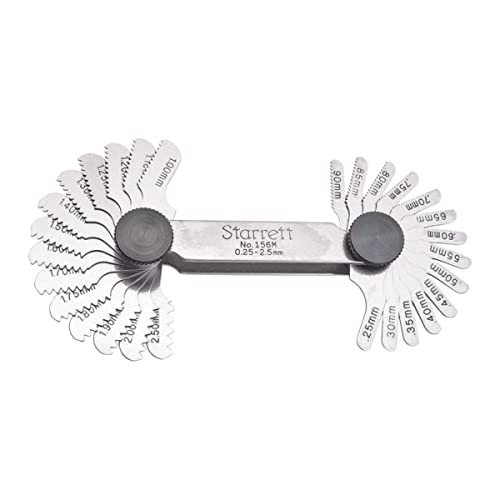
3. Starrett 156M, a Best Thread Pitch Gauge Pick for Metric Fasteners
Best for: anyone who works mostly on metric hardware.
The Starrett 156M is the metric counterpart. First, the manufacturer page lists 28 leaves from 0.25 mm to 2.50 mm, with 0.05 mm steps at the fine end, followed by 1.00, 1.10, 1.20, 1.25 and on up to 2.00 and 2.50 mm.
For instance, those fine steps matter for small electronics screws and fine-pitch metric bolts. Meanwhile the 2.50 mm top end still reaches the coarse threads on common sizes up to M20. Finally, the leaves are steel with a locking device. In short, it is the better choice for small metric work.
- 28 leaves, 0.25 to 2.50 mm
- 60 degree thread form
- Steel construction, locking device
- Metric units only
Pros
- Fine 0.05 mm steps for small threads
- Wide set of 1.x mm sizes
- Starrett build
Cons
- No pitches above 2.50 mm
- Metric only
Skip it if: you work on large metric threads such as M24 and up, or on inch hardware.
Best Mixed Set
4. PEC Tools 5629, the Best Thread Pitch Gauge Set for Mixed Hardware
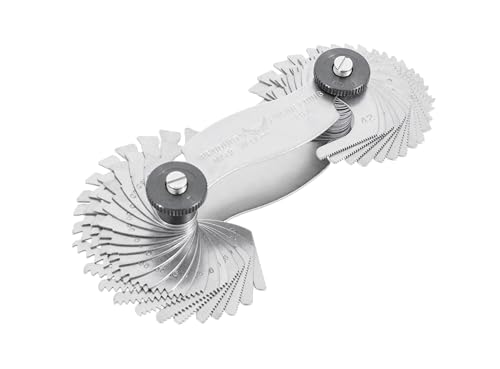
Best for: a single compact gauge for inch and metric.
Likewise, the PEC Tools 5629 splits its 28 leaves evenly: 14 inch and 14 metric. For example, the listing names inch counts of 4, 6, 8, 10, 11, 11-1/2, 12, 13, 16, 20, 28, 32, 40 and 56 TPI, plus metric pitches from 0.5 mm up to 6 mm.
Also, the blades are narrow, so they reach into both internal and external threads. Also, locking devices sit at each end of the steel case. For this reason, it works well as a single gauge for a small kit.
- 28 leaves: 14 inch, 14 metric
- Inch 4 to 56 TPI
- Metric 0.5 to 6 mm
- 60 degree thread form
Pros
- Both systems in a smaller set than 51 leaves
- Narrow blades fit inside and outside threads
- Reaches 6 mm metric pitch
Cons
- No 18 or 24 TPI leaf, so some common 5/16 and #10 threads need a different gauge
- Only 14 leaves per system
Skip it if: you regularly need 18 or 24 TPI, which are common Unified Fine counts.
Best Wide Metric Range
5. Insize 4820-124, a Best Thread Pitch Gauge Option for Wide Metric Range
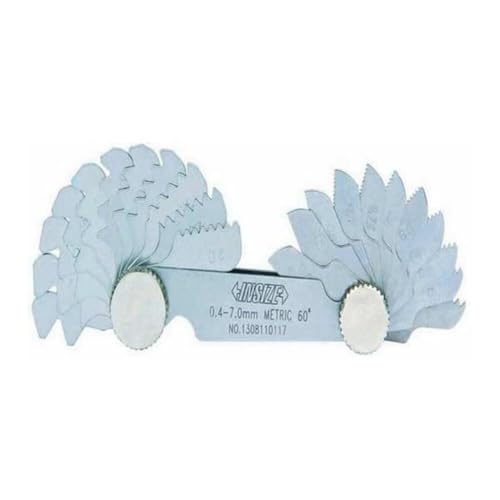
Best for: metric work from 0.25 to 7 mm.
Meanwhile, the Insize 4820-124 is a 24-leaf metric set. A distributor listing gives a pitch range of 0.25 to 7.00 mm for 60 degree threads, and says it checks both external and internal threads.
Besides that, it is steel with a locking mechanism. The range runs higher than the Starrett 156M, so it suits larger metric bolts, whereas the Starrett offers finer steps at the small end. In other words, the Insize trades fine steps for extra reach.
- 24 leaves, 0.25 to 7.00 mm
- 60 degree thread form
- Steel, locking mechanism
- External and internal threads
Pros
- Reaches 7 mm pitch
- Covers fine and coarse metric
- Steel leaves
Cons
- Metric only
- Fewer leaves than 28-leaf sets, so some fine pitches may be missing
Skip it if: your fasteners are inch-based.
Best Fine Inch Range
6. Shars 303-4329, the Best Thread Pitch Gauge for Fine Inch Threads
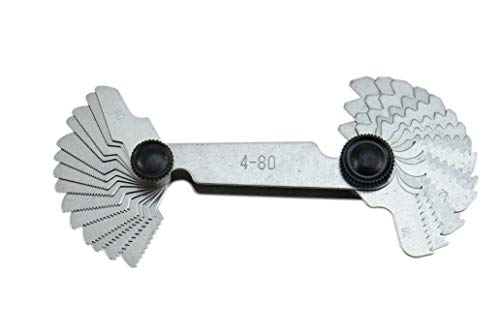
Best for: inch work that includes fine and extra-fine counts.
Next, the Shars 303-4329 is an inch gauge. Its listing describes a 60 degree set of 28 blades running from 4 to 80 TPI, which is a longer range than the 42 TPI limit on the Starrett 6 and Mitutoyo sets.
Therefore, that extra range helps with small machine screws and instrument threads. Check the listing for the exact blade list, because the manufacturer has not published a detailed page we could open. Because of that, treat the listing numbers as the working spec.
- 28 blades
- 4 to 80 TPI
- 60 degree thread form
- Inch only
Pros
- Reaches 80 TPI
- Handles small screw sizes
- Single-system set is simple to read
Cons
- Detailed blade list not confirmed
- Inch only
Skip it if: you need metric pitches.
Best Compact Combo
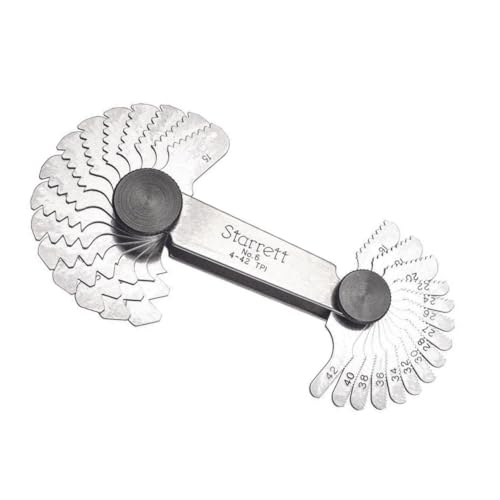
7. Grip US Pitch Gauge, the Best Thread Pitch Gauge for a Toolbox
Best for: a toolbox or drawer gauge with both systems.
Overall, the Grip US gauge carries both metric and SAE markings in a compact body. A retailer page lists SAE counts from 4 to 42 and metric pitches starting at 0.25 mm, using 60 degree profiles and heavy-duty gauge steel.
Also, a locking device holds the reading steady. In addition, it is sized to fit a tool chest or drawer, so it is easy to keep close to the bench. As a result, it works well for quick everyday checks.
- Metric and SAE markings
- SAE 4 to 42
- Metric from 0.25 mm
- Locking device, 60 degree profiles
Pros
- Both systems in a compact tool
- Locking device steadies readings
- Fits in a drawer
Cons
- Blade count is not stated
- Listed metric top end varies (5.5 or 6 mm) between sections of the page
Skip it if: you want a large, fully documented set with published leaf lists.
Best Screw Identifier
8. Screw Chek’r, the Best Thread Pitch Gauge Alternative for Screws

Best for: quickly identifying inch screws and bolts.
The Screw Chek’r works differently from a leaf gauge. You thread a screw into the matching hole, and the gauge tells you size, threads per inch, tap drill size, clearance drill size, length and basic diameter, according to the seller.
It covers No. 4 through 1/2 inch in both UNC and UNF. Moreover, the plate is heavy-gauge, chrome-plated steel and includes a clear case. The listed brand is Ruelle, and the product is made in the USA. In addition, it is faster than testing leaves one by one.
- No. 4 to 1/2 inch
- UNC and UNF
- Reads TPI and drill sizes
- Heavy-gauge plated steel
Pros
- Identifies size and thread count in one step
- Lists tap and clearance drill sizes
- Durable steel plate
Cons
- Inch only
- Not a leaf gauge, so it will not read an unknown pitch
Skip it if: you need to measure metric threads or a pitch that is not on the plate.
Best for Acme Threads
9. QWORK 29 Degree Acme Set, a Best Thread Pitch Gauge for Lead Screws

Best for: lead screws and Acme-thread hardware.
Finally, the QWORK set is a specialty tool. The listing describes a 16-piece steel set with a 29 degree profile for Acme threads, which are found on lead screws, vises and jacks. However, a standard 60 degree gauge will not mesh with them.
For comparison, Fowler’s 16-blade Acme gage covers 1 to 12 TPI, so sets of this type typically sit in that range. Therefore, confirm the exact range on the QWORK listing before you order. In short, buy it only if you actually work with Acme threads.
- 16 pieces
- 29 degree profile
- Steel
- For Acme threads
Pros
- Matches the Acme thread form
- Fills a gap standard sets cannot
- Compact set
Cons
- Not for ordinary fasteners
- Exact TPI range should be checked on the listing
Skip it if: you only work with standard bolts and screws.
How We Chose the Best Thread Pitch Gauge
We did not run hands-on tests. Instead, we researched each candidate and judged it on five points.
- Thread system: metric, Unified inch or Acme, and whether the set covers the common pitches.
- Range: the finest and coarsest pitch on the leaves.
- Build: steel leaves, a locking device and a protective case.
- Documentation: a published leaf list or manufacturer page that confirms the numbers.
- Brand: established makers, with no more than two picks per brand.
Sources included Starrett’s product page for the 6, distributor listings for Mitutoyo, PEC Tools and Insize, and the retailer pages for Grip and the Screw Chek’r. However, we dropped one popular multi-gauge because its product page did not describe a leaf-style pitch gauge. Because prices and ratings change, we leave them out. Instead, we weighed range, build and documentation. As a result, every pick states what it covers and what it does not.
SAE vs Metric: Choosing the Best Thread Pitch Gauge Type
The first decision when buying the best thread pitch gauge is the thread system. However, both main systems use a 60 degree V-profile, but they describe pitch differently. According to the Unified Thread Standard, inch threads state threads per inch, while ISO metric threads state the distance between threads in millimeters.
| Type | How pitch is stated | Example | Best gauge choice |
|---|---|---|---|
| Unified inch (UNC, UNF) | Threads per inch | 1/4-20 UNC | Starrett 6, Shars 303-4329 |
| ISO metric | Pitch in mm | M10 x 1.5 | Starrett 156M, Insize 4820-124 |
| Mixed shop | Both | Cars, imports, appliances | Mitutoyo 188-151, PEC 5629 |
| Acme | Threads per inch, 29 degrees | Lead screws | QWORK Acme set |
Therefore, check the thread system before you buy anything. First, look at where the part came from, because imports and many appliances use metric. Next, measure the diameter, since a caliper settles the question quickly. Finally, buy a combined set if the answer changes from job to job.
Leaf Gauge vs Nut-and-Bolt Checker
A leaf gauge reads an unknown pitch. A plate such as the Screw Chek’r, on the other hand, identifies a screw by threading it into a matching hole. As a result, the plate is quicker for sorting loose hardware, while the leaf gauge is the better thread pitch gauge for odd or unknown threads.
Coarse and Fine Pitches
Each diameter has a default coarse pitch. For example, the coarse pitch for M8 is 1.25 mm, and fine options are 1 mm or 0.75 mm. In short, if a bolt does not match the coarse leaf, try the fine ones before you assume the gauge is wrong. Similarly, inch hardware comes in coarse UNC and fine UNF counts, so try both.
TPI vs Pitch in mm: Conversion Table
Pitch is the reciprocal of threads per inch. Therefore, pitch in millimeters equals 25.4 divided by TPI. The table below uses that rule. Also, values are rounded to three decimals.
| TPI | Pitch (mm) |
|---|---|
| 4 | 6.35 |
| 8 | 3.175 |
| 10 | 2.54 |
| 12 | 2.117 |
| 13 | 1.954 |
| 16 | 1.587 |
| 18 | 1.411 |
| 20 | 1.27 |
| 24 | 1.058 |
| 28 | 0.907 |
| 32 | 0.794 |
| 40 | 0.635 |
| 56 | 0.454 |
| 80 | 0.318 |
Near Matches to Watch
Some inch and metric pitches are close. For instance, 3/8-16 has a pitch of 1.587 mm, while M10 x 1.5 is 1.5 mm. In addition, 1/2-20 is 1.27 mm and M12 x 1.25 is 1.25 mm. The pitch values differ by less than 0.1 mm, so confirm the diameter too. Therefore, never trust pitch alone. A caliper, such as those in our best digital caliper guide, reads 9.525 mm for a 3/8 inch bolt and 10 mm for M10.
How to Read a Thread Pitch Gauge
- First, clean the threads with a brush so dirt does not hide the thread form.
- Next, measure the major diameter with a caliper or micrometer to decide between inch and metric.
- Then choose the gauge family that matches, such as SAE or metric.
- After that, press a leaf into the threads and hold it up to a light source.
- Next, try neighboring leaves until one meshes fully with no light gaps along the flank.
- Then read the number stamped on that leaf. It is TPI on an inch gauge and millimeters on a metric gauge.
- Finally, confirm by threading a known nut or bolt onto the part before you order replacements.
Also, work in good light. Meanwhile, keep a magnifier handy for fine pitches, because the teeth on small leaves are tiny. However, never judge by a single leaf. Instead, check the leaves on either side, since a wrong leaf can look close.
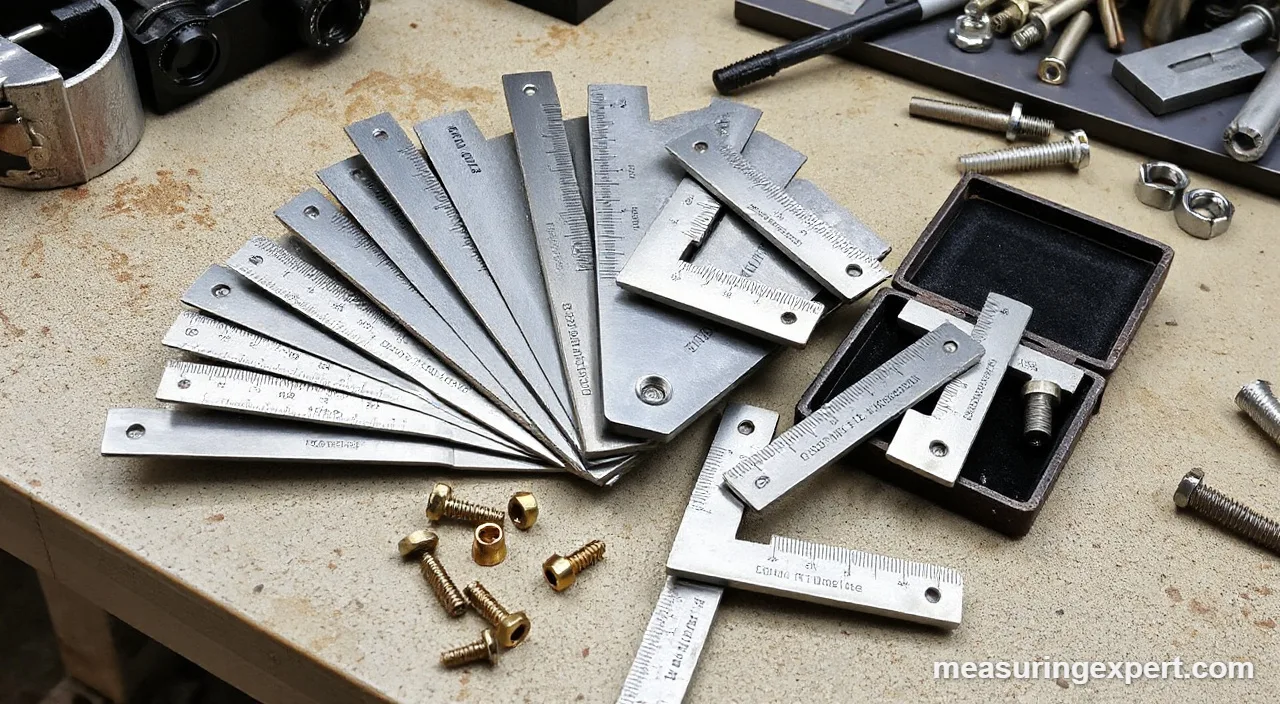
For tighter size checks, see our best micrometer screw gauge guide and our best thickness gauge guide for feeler-style leaf tools.
Do and Do Not
Care and Storage for Your Thread Pitch Gauge
First, wipe each leaf after use. Also, add a drop of light oil before storage, because steel leaves can rust. Meanwhile, keep the gauge closed so the teeth stay protected. However, avoid using the leaves as scrapers or picks. Instead, keep a small brush for cleaning threads. As a result, the teeth stay accurate longer.
Honest Limits of a Thread Pitch Gauge
A thread pitch gauge is not a precision instrument. As the overview of thread gauges notes, it is a best approximation for a known thread standard. Besides, it cannot tell you tolerance class, thread fit or wear. For example, it cannot separate a worn thread from a new one. Likewise, it cannot spot a damaged thread root. As a result, treat the reading as a first step. Therefore, verify with a mating part.
Likewise, a 60 degree gauge is the wrong match for 55 degree Whitworth threads or 29 degree Acme threads. For calibration habits that keep your measuring tools trustworthy, read our guide on tool calibration.
Thread Pitch Gauge FAQ
What is a thread pitch gauge?
A thread pitch gauge is a set of thin steel leaves with teeth cut to standard spacings. For example, you press a leaf into a thread and find the one that meshes, then read the number stamped on it.
How do you use a thread pitch gauge?
First, clean the thread, press a leaf into it and hold it to the light. Then, when no gaps show, the stamped number is the pitch or TPI. Next, try the neighboring leaves to confirm.
What is the difference between pitch and TPI?
Pitch is the distance between neighboring threads, usually in millimeters. TPI is the number of threads in one inch. Pitch equals 25.4 divided by TPI. For example, 20 TPI equals a pitch of 1.27 mm.
Can an SAE gauge measure metric threads?
No, because metric and inch pitches are different, so an SAE gauge may only seem to fit. Use a metric gauge or a combined set.
Which is the best thread pitch gauge for beginners?
A combined set such as the Mitutoyo 188-151 or the Grip US gauge is a good start because both cover metric and SAE, so you do not need to know the system first.
Do I need a caliper as well?
Yes, because a caliper gives the diameter, and the gauge gives the pitch. Together, they identify a thread such as M10 x 1.5 or 3/8-16. Also, a caliper helps you tell M10 from 3/8 inch.
How accurate is a thread pitch gauge?
It is a comparison tool, not a precision instrument. However, it is accurate enough to identify standard threads but not to certify fit.
Can a pitch gauge measure pipe threads?
Not reliably, because the sets above target 60 degree Unified and metric threads, plus one Acme set. Instead, pipe threads have their own forms and need gauges made for them.
Which is the best thread pitch gauge for metric work only?
The Starrett 156M suits fine metric pitches from 0.25 mm, whereas the Insize 4820-124 reaches 7 mm. So pick by the pitches you meet most often.
What does a 60 degree gauge mean?
In short, it means the leaf teeth match the 60 degree V-shaped profile used by Unified inch and ISO metric threads. However, Whitworth threads use 55 degrees, so they need a different gauge.
Bottom Line
For most people the Mitutoyo 188-151 is the best thread pitch gauge: one set, both systems, and a pitch stamped on every leaf. However, choose a single-system Starrett, Insize or Shars set if you only work in one system. Also, pair it with a caliper, because pitch alone does not identify a thread. Meanwhile, add a second single-system gauge only if you need finer steps.