

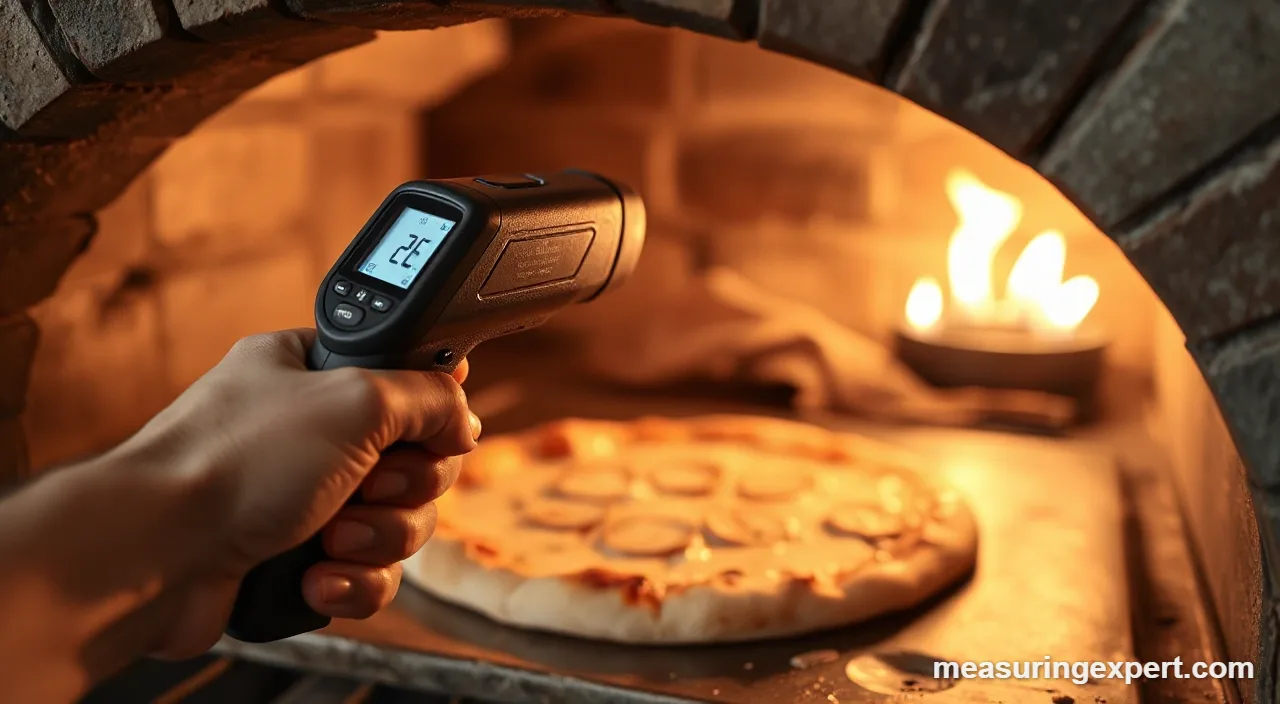
Choosing an infrared thermometer is mostly about two numbers, not the brand: the distance-to-spot ratio, which says how small a target you can read from how far away, and the temperature range. For serious HVAC, electrical and shop work, the Fluke 62 Max is the best infrared thermometer in this group. For cooking and grilling, the TempPro TempScan with two lasers or the Etekcity guns are better value, and the TempPro 2-in-1 adds a probe for meat. Remember that every one of these reads surface temperature only, so none replaces a food thermometer for doneness. This guide sorts seven options by the job they suit.
Point, pull the trigger, read a temperature from across the room: infrared thermometers feel like magic, which is why people trust them more than they should. They measure the heat radiating from a surface, not the inside of the thing, and they are easily fooled by shiny metal, steam and a target that is smaller than the spot they see.
In short: match the thermometer to the job. Choose a higher distance-to-spot ratio if you measure small things from farther away, choose a wide range if you cook on a pizza oven or inspect hot equipment, and choose a known brand if you rely on the numbers for work.
Fluke, the test tool maker, explains the key idea: a 12:1 ratio means the thermometer reads a 1 in spot from 12 in away, and a target smaller than that spot lets surrounding temperatures leak into the reading. It also notes that shiny metals read low because of low emissivity (Fluke on getting great results with an infrared thermometer).
Because we found only seven closely matching infrared guns, this page is a buying guide with seven picks rather than a top-10 list. It also overlaps with our infrared surface thermometer roundup and laser thermometers for cooking, so here we focus on how to choose, with each product matched to a job.
Below you will find a Fahrenheit-to-Celsius calculator, a quick-pick summary, the seven recommended thermometers, and sections on spot size, emissivity, cooking use, accuracy checks and honest limits.
As an Amazon Associate we earn from qualifying purchases. Picks are based on manufacturer specs, listing details and buyer reports, not lab testing. We found seven closely matching products, so this is a buying guide rather than a top-10 list.
Key takeaways
- Best overall: the Fluke 62 Max is the industrial-grade choice for HVAC, electrical and shop checks.
- Best for trades: the Klein Tools IR10 adds a dual targeting laser for faster aiming.
- Best high range for hobby use: the Etekcity gun rated -58 F to 1130 F suits pizza ovens and forges.
- Check the distance-to-spot ratio. A bigger number lets you measure smaller targets from farther away.
- Infrared guns read surface temperature, not inside temperature. Use a probe for meat doneness.
- Shiny metal reads low. Use matte tape or paint on bare metal for better readings.
- Compare your gun with a known reference now and then.
- How we shortlisted the seven
- Recommended infrared thermometers for cooking, HVAC and shop work
- How an infrared thermometer works
- Distance-to-spot ratio: what the spot size will be
- Emissivity: why shiny things read wrong
- How to take a good reading
- Using an infrared gun in the kitchen
- How to check your gun
- Honest limits of infrared thermometers
- When to call a professional
- Frequently asked questions
- The bottom line
How we shortlisted the seven
We looked for infrared thermometers whose listings show strong ratings from many shoppers and compared each page with the maker’s description for range, targeting and intended use. Listings with unclear ranges or few reviews were dropped.
We did not pad the list. We found seven closely matching guns, kept to two per brand, and describe each by the job it suits. This is a research-based guide from manufacturer specs and buyer reports, not lab testing, and we have not used these units ourselves.
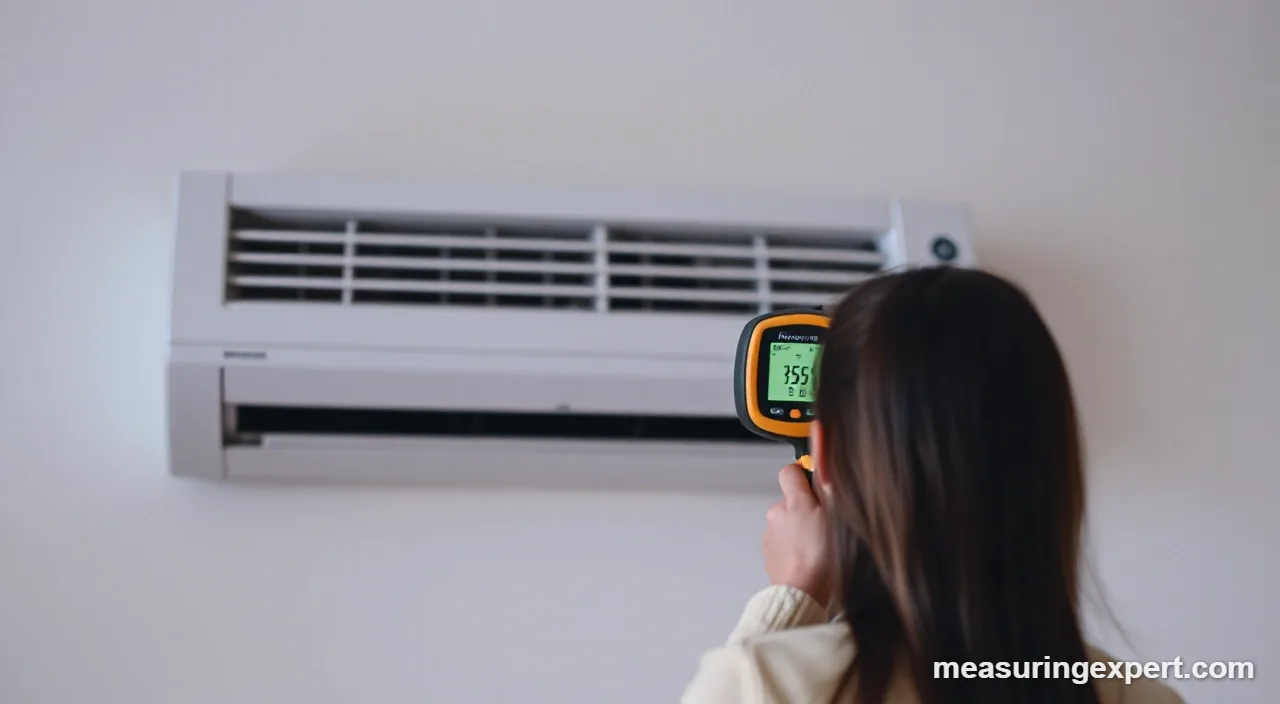
Recommended infrared thermometers for cooking, HVAC and shop work
Check the current listing for range, spot ratio and battery details before you buy, since models change.
| # | Product | Range or feature | Best job |
|---|---|---|---|
| 1 | Fluke 62 Max | -22 to +932 F per the title | HVAC, electrical, shop |
| 2 | Klein IR10 | Dual targeting laser | HVAC, plumbing, electrical |
| 3 | Etekcity -58 to 1130 F | -58 to 1130 F per the title | Pizza ovens, forges, grills |
| 4 | TempPro TempScan 2-in-1 | IR gun plus meat probe | Cooking and grilling |
| 5 | TempPro TempScan | 2 lasers | Pizza, grill, oven |
| 6 | Etekcity 774 | Laser temperature gun | General household |
| 7 | Klein IR1 | Targeting laser, auto-hold | Trades, home |
Buying from this list? Get it fast, and catch Black Friday deals, with Prime
Fluke 62 Max industrial infrared thermometer: the work-grade pick
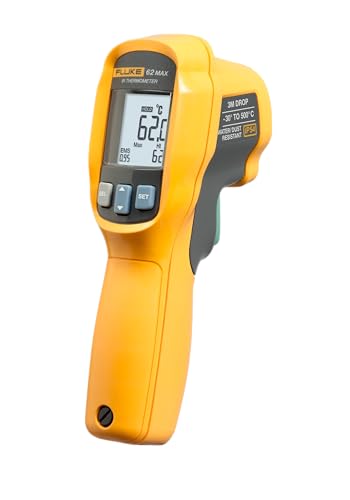
Best for: professionals and serious DIYers who rely on the reading.
The Fluke 62 Max is a work-oriented infrared thermometer with a range stated as -22 to +932 F in the listing title. Fluke builds test tools for tradespeople, and the 62 series is a long-running workhorse.
It suits checking HVAC vents, bearings, breaker panels (from a safe distance) and shop equipment. For cooking above 932 F, such as a wood-fired pizza oven, pick a higher-range gun.
- Industrial infrared thermometer
- -22 to +932 F range per the title
- Made by Fluke
- Check the listing for spot ratio and emissivity setting
- Trusted work-grade brand
- Built for daily professional use
- Good targeting and documentation
- Costs more than hobby guns
- Range stops below pizza-oven heat
Skip it if you need to read very hot pizza ovens or forges.
Klein Tools IR10 with dual targeting laser: faster aiming for tradespeople

Best for: trade work where aiming and quick readings matter.
Klein Tools makes gear for electricians and HVAC techs, and the IR10 is an infrared thermometer with a dual targeting laser, per the listing. Two lasers help frame the measurement area instead of a single center dot.
That makes it easier to see roughly what the gun is reading, which helps with small targets such as pipes and wires. Check the listing for range and spot ratio.
- Infrared thermometer
- Dual targeting laser per the title
- Made by Klein Tools
- Check the listing for range and ratio
- Easier aiming
- Trade-brand build
- Good for HVAC and plumbing
- Lasers show the area roughly, not exactly
- Not meant for cooking above its range
Skip it if you only need a gun for the kitchen.
Etekcity infrared thermometer, -58 F to 1130 F: a wide-range hobby gun
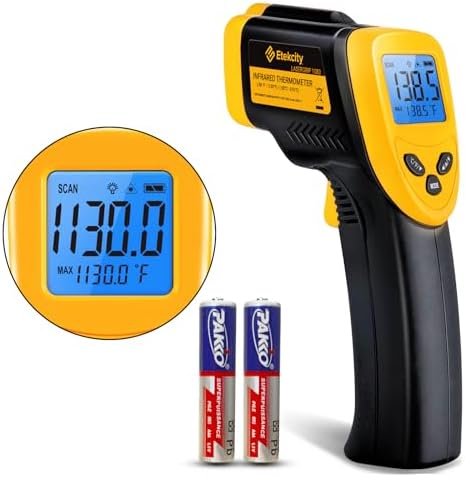
Best for: hobbyists measuring very hot surfaces such as pizza stones and forges.
Etekcity lists this laser temperature gun at -58 to 1130 F, a wider top end than many rivals. That reaches the heat of a home pizza oven floor or a hot grill.
It is a straightforward point-and-read tool aimed at home users. Treat the readings as good for comparing surfaces, and check accuracy against a reference if the number matters.
- Infrared thermometer with laser
- -58 to 1130 F range per the title
- Handheld trigger design
- Check the listing for spot ratio and emissivity
- High maximum temperature
- Simple operation
- Good for hobby cooking and crafts
- Less documented than Fluke or Klein
- Fixed emissivity on many consumer guns
Skip it if you need work-grade documentation.
TempPro TempScan 2-in-1 infrared thermometer with meat probe: surface plus inside

Best for: cooks who want a surface reading and a probe in one tool.
This TempPro model combines an infrared gun with a meat probe, per the listing. The infrared side checks the cooking surface, and the probe reads the inside of the food.
That pairing addresses the main weakness of infrared guns in the kitchen, which is that they cannot read the center of a roast. It suits grilling and baking.
- Infrared thermometer gun
- Includes a meat probe per the title
- Made by TempPro
- Check the listing for range and probe length
- Surface and probe in one
- Good for grill and oven
- Handy for cooks
- Probe adds a cable to manage
- Less suited to industrial work
Skip it if you want a trades-focused gun.
TempPro TempScan infrared thermometer with 2 lasers: for pizza stones and grills

Best for: checking pizza stones, griddles and grill grates.
TempPro’s TempScan has two lasers to mark the measurement area, and the listing calls it out for pizza. A pizza stone is a flat, matte target, which suits infrared well.
Aim at the stone’s center and edges to see hot spots before you launch the pizza. Check the listing for the maximum temperature.
- Infrared thermometer gun
- Two lasers per the title
- Marketed for pizza use
- Check the listing for range and ratio
- Two lasers frame the spot
- Targeted at cooking
- Easy to use
- Surface only
- Check range for hot ovens
Skip it if you need a trade-grade tool.
Etekcity infrared thermometer 774: a simple blue point-and-read gun

Best for: general household use, such as checking fridges, vents and pans.
The Etekcity 774 is a laser temperature gun for general household tasks. It is a simple, compact gun suited to checking vents, pans, kids’ bath water surfaces and car engine bays.
Because it is a general-purpose model, check its range before you point it at a very hot oven. As with all guns, remember that it reads surface temperature.
- Infrared thermometer with laser
- Model 774 per the title
- Handheld point-and-read design
- Check the listing for range and spot ratio
- Simple operation
- Good for household checks
- Light
- Lower range than the other Etekcity
- Basic features
Skip it if you want a work-grade tool.
Klein Tools IR1 infrared thermometer with targeting laser and auto-hold
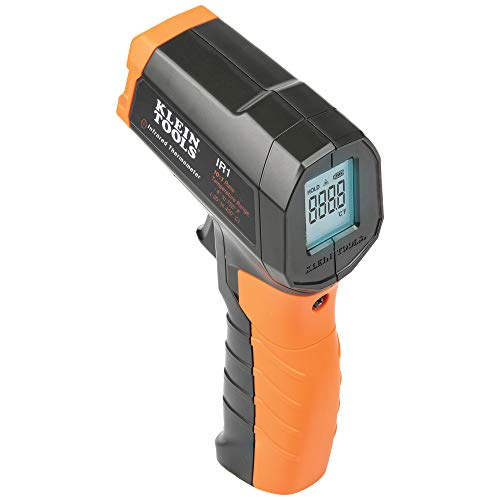
Best for: homeowners and trades who want a basic Klein gun with a hold feature.
Klein’s IR1 has a targeting laser and an auto-hold feature, per the listing. Auto-hold keeps the reading on the screen after you release the trigger, which helps when the target is hard to reach.
It is a simple and sturdy gun for HVAC, plumbing and home checks, and a good step-down from the IR10 if you do not need dual lasers.
- Infrared thermometer
- Targeting laser and auto-hold per the title
- Made by Klein Tools
- Check the listing for range and ratio
- Auto-hold keeps the reading
- Trade-brand build
- Simple
- Single laser
- Less range than hobby high-range guns
Skip it if you need a very high maximum temperature.
How an infrared thermometer works
An infrared thermometer measures the infrared energy a surface radiates and converts it to a temperature. It does not touch the target, which is why it is quick and safe for hot, moving or hard-to-reach things.
| Good for | Poor for |
|---|---|
| Pizza stones, griddles, grill grates | Inside of a roast or a chicken breast |
| HVAC vents and ducts | Shiny metal pots without tape or paint |
| Bearings, motors, breaker panels from a distance | Liquids, because the surface is not the bulk |
| Engine and exhaust areas | Targets smaller than the spot size |
Those limits are why we pair every infrared gun with a contact thermometer in the kitchen.
Distance-to-spot ratio: what the spot size will be
The distance-to-spot (D:S) ratio tells you how big the measured area is at a given distance. Spot diameter equals distance divided by the ratio.
| Distance | 8:1 gun | 12:1 gun | 20:1 gun |
|---|---|---|---|
| 6 in | 0.75 in | 0.5 in | 0.3 in |
| 12 in | 1.5 in | 1 in | 0.6 in |
| 24 in | 3 in | 2 in | 1.2 in |
| 36 in | 4.5 in | 3 in | 1.8 in |
If your target is a 1 in pipe, a 12:1 gun must be within about 12 in. Fluke also warns that the laser only marks the center, so check the manual for the real spot size.
Emissivity: why shiny things read wrong
Emissivity describes how well a surface radiates infrared energy. Matte, dark and painted surfaces radiate well. Polished metal radiates poorly, so a gun may report a temperature far below the real one.
Many consumer guns have a fixed emissivity setting, so tape or paint is the practical workaround.
How to take a good reading
Follow these steps for consistent readings.
- Let the thermometer sit in the room for a while so it matches the surrounding temperature.
- Stand close enough that the target fills the spot.
- Aim the laser at the center and pull the trigger.
- Keep the lens clear of steam, smoke and dust.
- Take two or three readings in slightly different spots and compare.
- For shiny metal, apply a bit of matte tape and read that.
Using an infrared gun in the kitchen
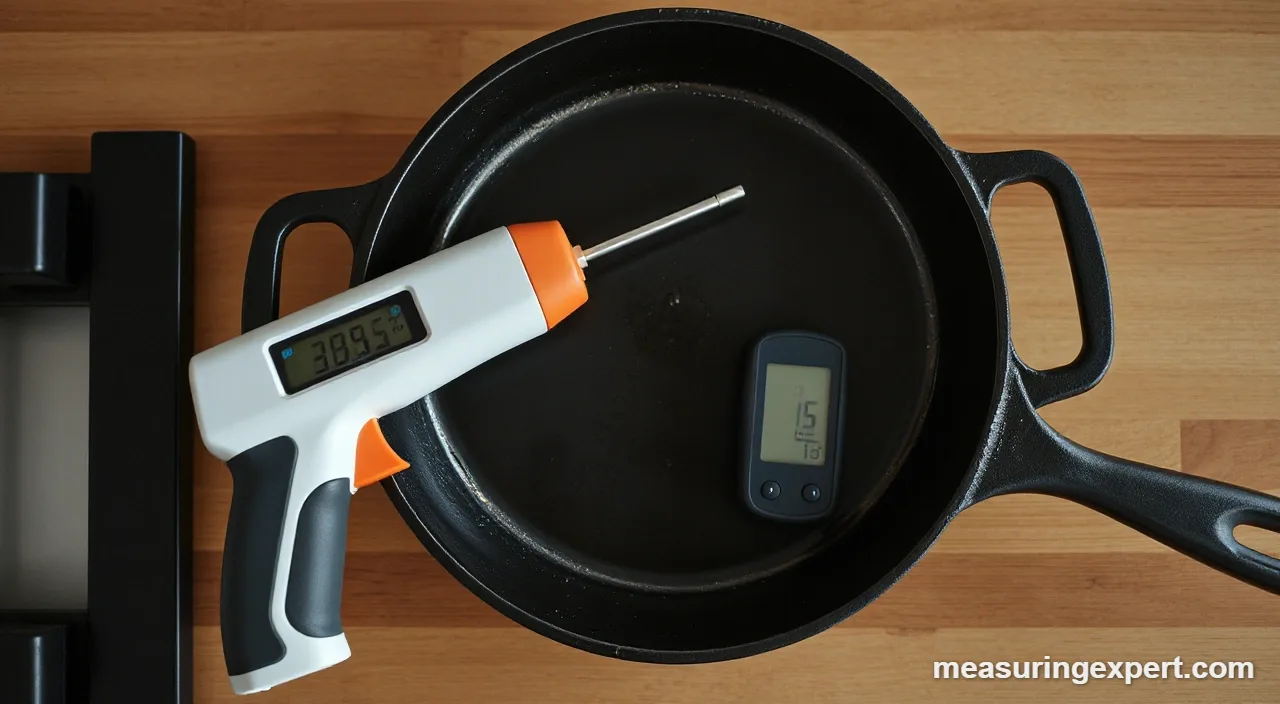
Infrared guns are great for pans, griddles, pizza stones and grill grates, and for finding cold spots in a fridge or freezer. They cannot tell you whether food is cooked inside.
The USDA’s safe minimum temperatures, such as 165 F (73.9 C) for poultry, are measured with a food thermometer, not a surface gun (USDA FSIS safe temperature chart). For doneness, use a probe. Our guide on using a digital thermometer for cooking shows how.
- Use it on pans, stones and grates
- Check oven hot spots
- Compare fridge shelves
- Pair with a probe for meat
- Judge meat doneness with it
- Point at shiny pots
- Measure through glass
- Trust it in steam
How to check your gun
A quick comparison is the easiest check. Heat a pot of water and hold a trusted probe thermometer in it, then read the surface of a matte target at the same temperature, such as a dark ceramic mug of hot water, with the gun.
A small difference is normal because the gun reads the surface. If the gun is off by a large margin on several matte targets, consult the manual or contact the maker.
Honest limits of infrared thermometers
Accuracy figures such as plus or minus 2 percent are best-case specifications under controlled conditions. Real readings vary with emissivity, distance, ambient temperature and how steadily you aim.
Infrared thermometers are also not medical devices. Do not use a general-purpose gun to check a person’s temperature, and follow the guidance of a clinician for health decisions.
When to call a professional
Call an HVAC technician, electrician or qualified inspector when a reading suggests a problem such as an overheated breaker or a failing motor. A gun can flag a hot spot, but a professional should diagnose and fix it.
Frequently asked questions
What is the best infrared thermometer?
For work use, the Fluke 62 Max is the best of these seven. For cooking and hobby use, the Etekcity -58 to 1130 F gun and the TempPro TempScan are strong choices.
Can I use an infrared thermometer to check if meat is cooked?
No. It reads only the surface. Use a food probe thermometer, and compare with the USDA safe temperatures.
What does 12:1 mean on an infrared thermometer?
It is the distance-to-spot ratio. At 12 in away the gun reads a 1 in spot, so a bigger ratio lets you measure smaller targets from farther away.
Why does my gun read low on a metal pan?
Shiny metal has low emissivity, so it radiates little infrared energy. Put matte tape on the pan and read that.
Can an infrared thermometer measure through glass?
No. Glass blocks or distorts infrared energy, so the gun reads the glass surface instead of what is behind it.
How accurate are infrared thermometers?
Specifications often state a percentage or a few degrees, but real accuracy depends on the target, the distance and how well you aim.
Can I use one to check a fever?
No. General-purpose infrared guns are not medical thermometers. Use a device designed for body temperature and ask a clinician.
What temperature range do I need for pizza?
Home pizza ovens can reach 700 F or more, so choose a gun with a high maximum, such as the Etekcity -58 to 1130 F model.
How do I convert Fahrenheit to Celsius?
Subtract 32 and multiply by 5/9. For example, 450 F is 232.2 C. The calculator above does it for you.
What does auto-hold do?
Auto-hold keeps the reading on the screen after you release the trigger, which helps when the target is hard to reach or in a tight spot.
The bottom line
Pick the infrared thermometer for the job and the heat you will meet. The Fluke 62 Max is the work-grade choice, the Klein IR10 adds easy aiming for trades, and the Etekcity -58 to 1130 F gun reaches the temperatures of pizza ovens and forges.
Then use it well: get close enough, tape over shiny metal, and remember it reads the surface only. Keep a probe thermometer next to it in the kitchen and you will have both views of what is happening.
Add ad-free music to your kitchen or workshop
1 thought on “7 Best Infrared Thermometers (2026): Pick by Spot Size and Job”