

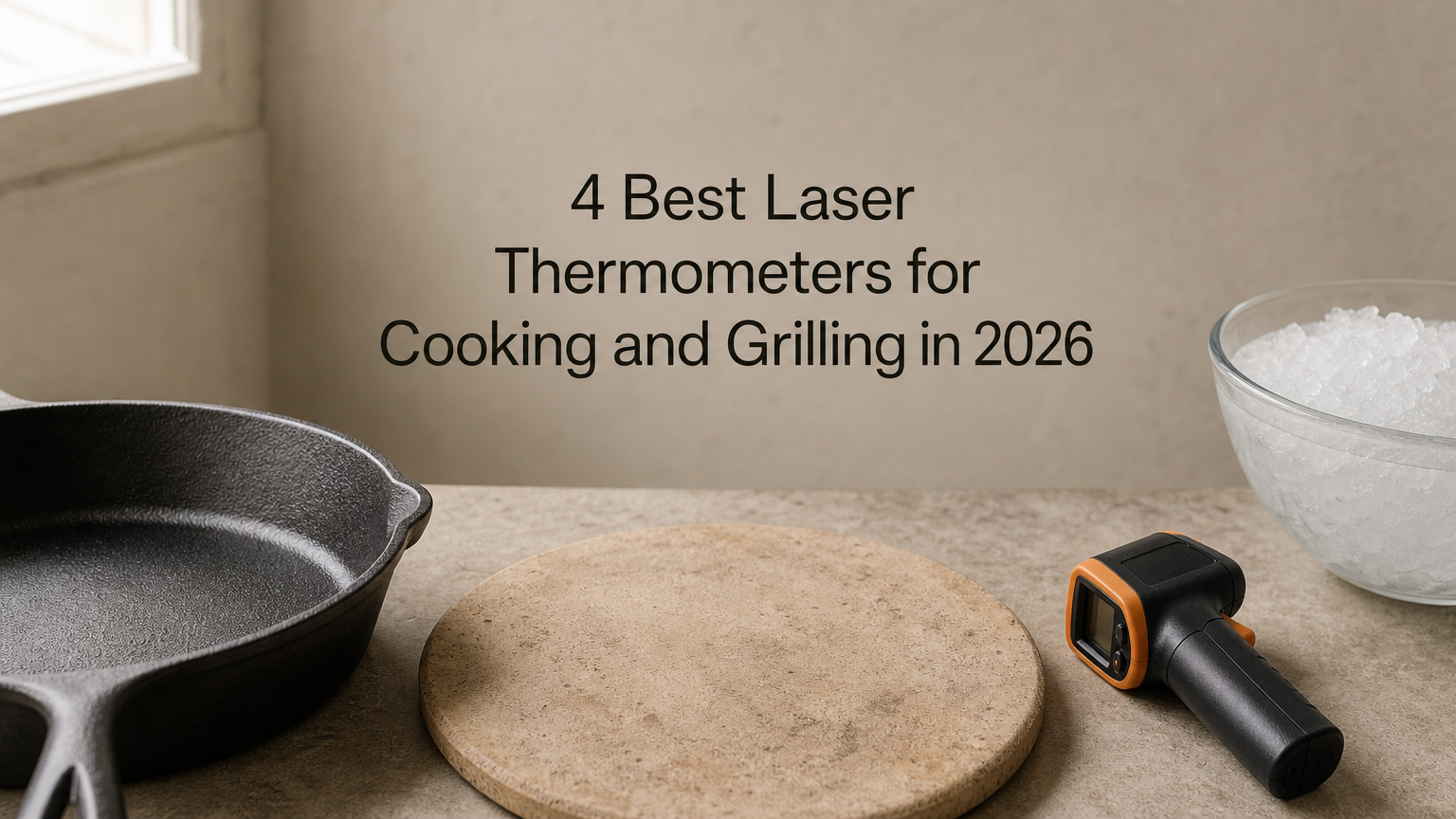
For laser thermometer cooking tasks like checking a skillet, grill grate, pizza stone or pot of oil, a good infrared model gives you a surface reading in about a second without touching anything hot. What separates a good pick from a toy is a stable reading, a spot size that fits your target, and a range that reaches your hottest surface. The ThermoWorks Food Safety Infrared suits cooks who want a food-tuned tool. The Etekcity Lasergrip 800 suits anyone who wants one safe all-round buy. The Klein Tools IR1 suits grillers who are hard on gear, and the Eventek ET312 suits budget buyers who want adjustable settings.
The problem is guessing. Most cooks preheat a pan by feel, add oil when it looks ready, and wonder why a steak sears unevenly. A probe thermometer cannot help here, because you cannot push a probe into a pan surface or a grate. A cheap infrared gun can mislead you just as easily if you aim it at the wrong surface.
Measuring Expert focuses on how accurate a measuring tool is and what it is good for. This guide compares four infrared kitchen thermometers using published specs and independent ice-bath and hot-oil test readings. It also explains what these tools cannot do, because an infrared reading never tells you whether the middle of your chicken is safe.
Listen to a free audiobook while you cook, work or wait
Do laser thermometers work for cooking?
Yes, for surface temperatures. A laser thermometer reads the heat radiating from the outside of a pan, grate, stone or oil surface, and it does that faster and more safely than any contact probe. It cannot tell you how hot the inside of food is.
What an infrared thermometer measures
An IR thermometer detects thermal radiation from the outermost layer of whatever you aim at. That is why it is excellent for surface temperatures and useless as a meat thermometer for doneness. For poultry, burgers or roasts, push a probe into the thickest part of the food.
Liquids work the same way. You get the temperature of the oil or water surface, so stir first, then read.
An infrared thermometer tells you how hot the surface is, never how cooked the middle is.
Where it earns its place
These are the jobs where an infrared cooking thermometer beats the alternatives:
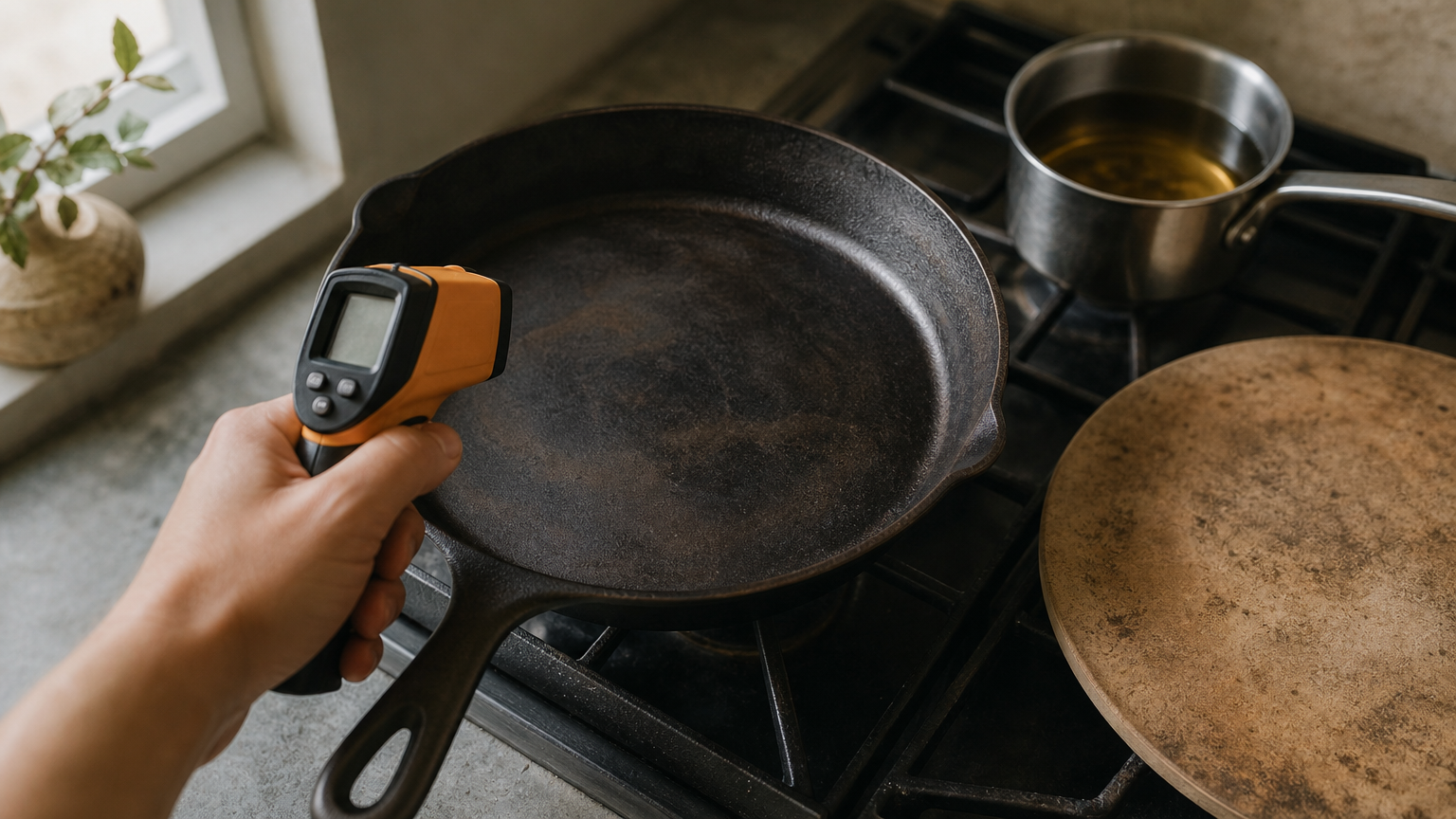
- Pan preheating: confirm a skillet or griddle is hot and even before food goes on.
- Frying oil: many recipes call for oil around 350 to 375°F, and a quick scan beats waiting for a shimmer.
- Grills and pizza stones: find hot and cold zones across a grate or stone.
- Sugar and dough work: check a caramel pan, or the water before it meets your yeast.
- Cold storage: spot-check the surface of chilled or frozen food and fridge shelves.
Why readings can be wrong
Two settings of physics cause most errors. Emissivity is how readily a surface gives off infrared. Food, water and dark matte cookware read true, while bare shiny stainless or polished aluminum reads low. The distance-to-spot ratio matters too: at 12:1, the sensor averages a 1-inch circle from 12 inches away. Stand farther back or aim at something small, and background heat leaks into the number. Most kitchen models claim accuracy of about ±2°F.
1. ThermoWorks Food Safety Infrared (IRFS)
The IRFS is the one pick here built specifically for food, and its spec sheet shows it. It is the most precise on paper, but it has a lower ceiling than the others may have.
How it performs
The IRFS reads from -67°F to 536°F, responds in 1 second, and uses a fixed emissivity of 0.97, which suits food, water and most cookware. Accuracy is tighter than most budget guns. It ships with a certificate of conformance.
- Accuracy: ±1.8°F from 32 to 150°F, ±1.5% of reading from 150 to 536°F
- Distance-to-spot ratio: 12:1
- Power: 2 AAA batteries, rated for 140 hours
- Weight: 0.4 lb (179 g), auto-off after 15 seconds
Fixed emissivity is a feature, not a flaw, when a thermometer’s only job is food.
Who it suits and what it costs
It suits cooks who check chilled, frozen and hot food, and who want a documented tool rather than a gadget. The listing shows a sale price near $59 against a regular $84, so it costs several times what the budget picks do.
The trade-offs matter on the grill. The 536°F ceiling is below what a hot pizza stone or searing grate can reach. Its operating range of 32 to 122°F ambient also means a freezing winter patio can throw off readings. You cannot tune emissivity for shiny metal either.
2. Etekcity Lasergrip 800
The Lasergrip 800 is the safe all-round buy. It does not top any single test, but it performs consistently, costs little and comes from a brand with a track record.
How it performs
Its 16:1 distance-to-spot ratio is the best of the four, so it reads a small target from farther away. In independent tests it averaged 28.7°F against a 32°F ice bath and 368.4°F against 361°F hot oil. That is good enough for kitchen decisions. The laser is bright, the backlit LCD is easy to read, and the battery arrives installed.
- Size and weight: 5 x 2.75 x 7 inches, 6.8 oz
- Extras: none (no min/max, average or audio cue)
- Weak points: smooth grip, loose battery door
Buy the Lasergrip 800 if you want one dependable tool and no menu to learn.
Who it suits and what it costs
It suits home cooks who want a single tool for pans, ovens and grills and do not need adjustable settings. It runs about $26 to $29.
The ice reading ran about 3°F low, which hardly matters for oil or a skillet. It does matter if you rely on it for cold storage. A smooth handle also gets slippery with greasy hands, so wipe up first.
3. Klein Tools IR1
The IR1 is the one to buy if your thermometer lives near a grill or in a toolbox. It is built for knocks, and it was the closest of the three tested models on the hot side.
How it performs
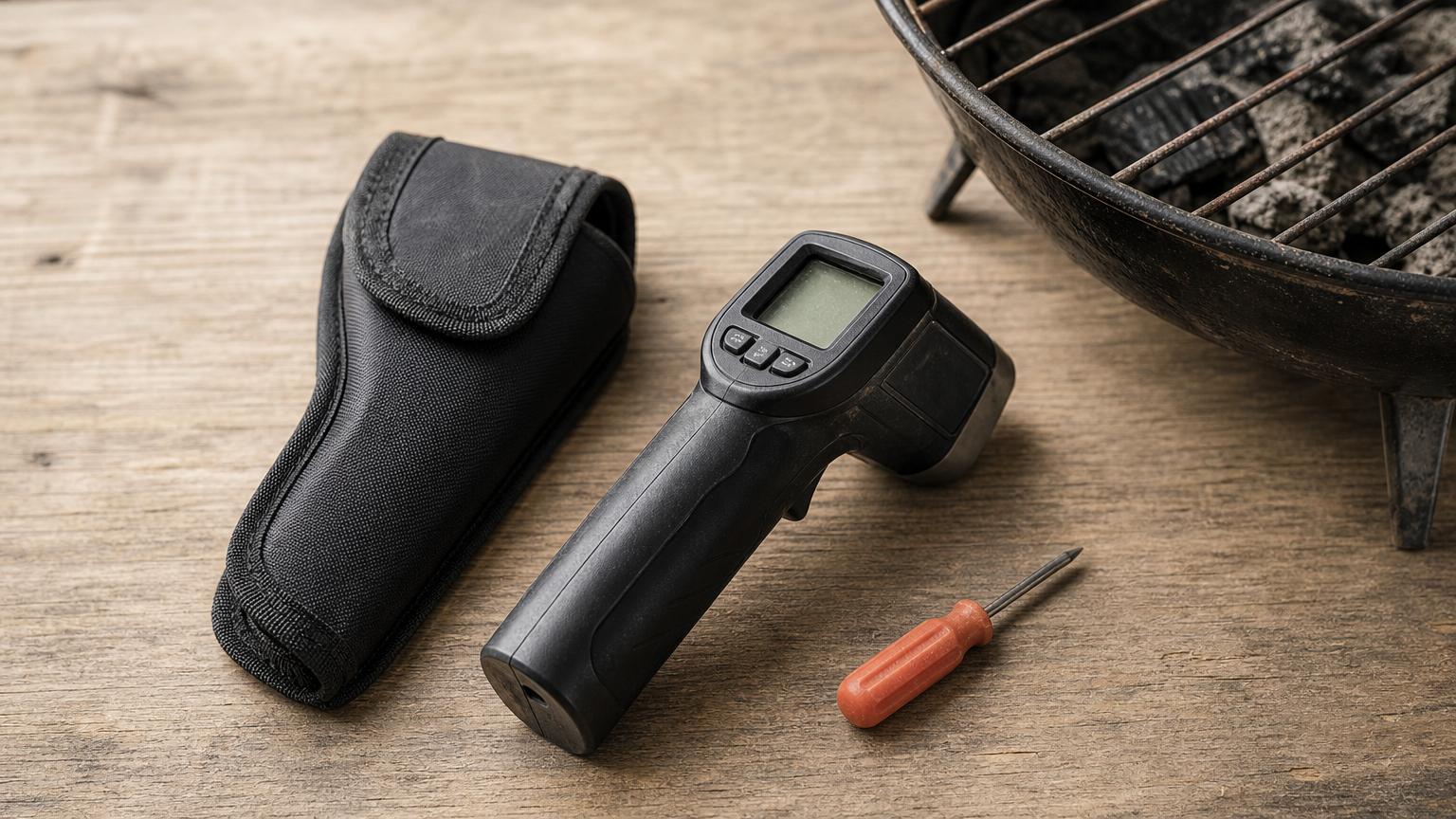
In the hot-oil test it averaged 364.4°F against 361°F. The ice bath was weaker at 30°F against 32°F. The housing is rugged, the grip is textured, the backlit LCD is bright, and a holster is included.
- Size and weight: 4 x 1.77 x 5.9 inches, 6.8 oz
- Extras: none
- Annoyance: the °C/°F switch sits inside the battery compartment, so you need a screwdriver
For hot surfaces and rough handling, the IR1 is the sturdier choice.
Who it suits and what it costs
It suits outdoor cooks and anyone who also uses an IR thermometer for projects around the house. The price is about $32 to $40. Set your preferred unit once, because changing it later means opening the case. If you rarely check cold items, the lower ice-bath accuracy will not affect you.
4. Eventek ET312
The ET312 is the budget pick, and it is the only one of the four with real adjustments. It costs about $15 to $17 and still tested well.
How it performs
It averaged 32.85°F in the ice bath and 365.2°F against 361°F hot oil, a strong result for the price. It has four modes: adjustable emissivity, average, minimum and maximum. A calibration mode lets you fine-tune the sensor. The speaker is loud and clear.
- Size and weight: 3.14 x 1.65 x 6.3 inches, 4.36 oz
- Display: backlit LCD
- Weak points: smooth plastic that feels cheap and slips in wet hands
The ET312 proves accurate and adjustable does not have to cost much.
Who it suits and what it costs
It suits tinkerers, bakers and cooks who work with shiny stainless and want to set emissivity instead of working around it. It is also the easiest to carry. The build is not premium, so treat it gently and keep it out of splatter. For a first infrared thermometer, it is the lowest-risk purchase.
How to choose and use an infrared kitchen thermometer
Choose by temperature range, adjustability and handling, then verify it with an ice bath. Accuracy claims across all four are close, so the surface you cook on matters more than the model.
What to check and how the four compare
Confirm the maximum temperature reaches your hottest surface, since pizza stones and grates can pass 500°F. Check whether emissivity is adjustable if you cook on bare metal. Then look at grip, display and battery access.
| Model | Best for | Ice bath (32°F) | Hot oil (361°F) | Adjustments | Approx. price |
|---|---|---|---|---|---|
| ThermoWorks IRFS | Food-focused use | n/a | n/a | None, fixed 0.97 | $59 to $84 |
| Etekcity Lasergrip 800 | Safe all-round buy | 28.7°F | 368.4°F | None | $26 to $29 |
| Klein Tools IR1 | Grilling, rough use | 30°F | 364.4°F | None | $32 to $40 |
| Eventek ET312 | Budget, tunable | 32.85°F | 365.2°F | Emissivity, avg, min, max | $15 to $17 |
Readings are averages from 12 and 16 inch distances in independent bench tests.
How to take a reliable reading
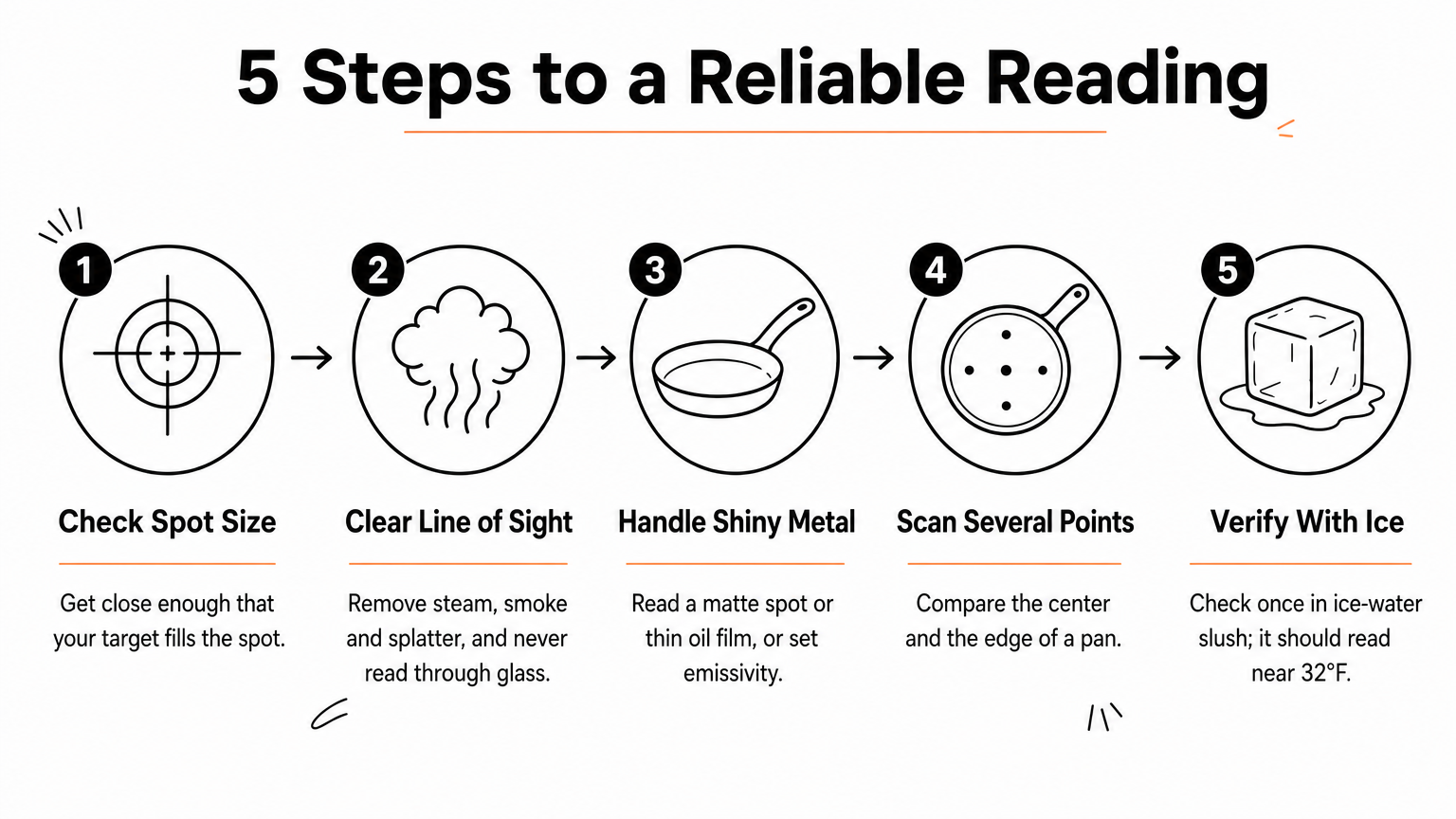
- Check the spot size, then get close enough that your target fills it.
- Clear steam, smoke and splatter from the line of sight, and never read through glass such as an oven door.
- On shiny metal, read a matte spot or a thin film of oil, or set emissivity if your model allows it.
- Scan several points, such as the center and the edge of a pan, and compare.
- Verify the tool once in an ice-water slush. It should read close to 32°F.
Black Friday is coming: shop the deals with Prime