

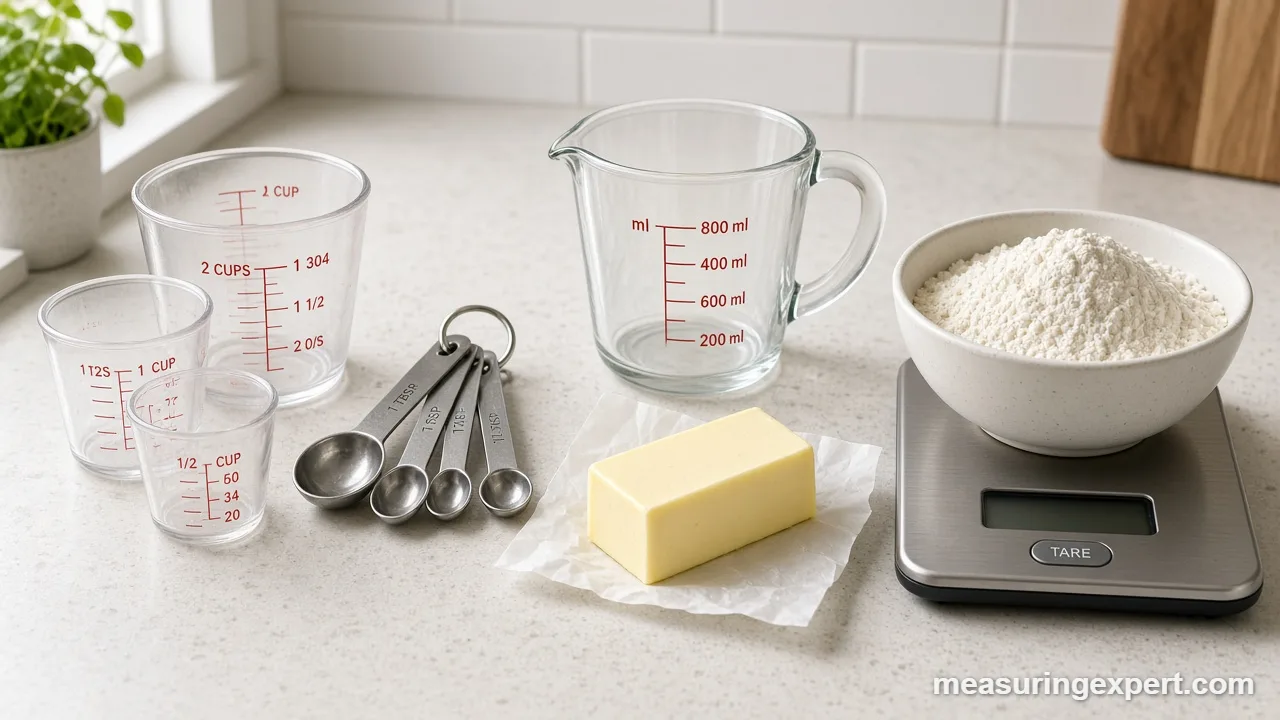
To convert American recipes to metric, use the exact US values: 1 cup = 236.59 mL, 1 tablespoon = 14.79 mL, 1 teaspoon = 4.93 mL, 1 ounce = 28.35 g and 1 pound = 453.59 g. For oven heat, subtract 32 from Fahrenheit and multiply by 5/9. Also, weigh flour, sugar and butter in grams instead of converting cups.
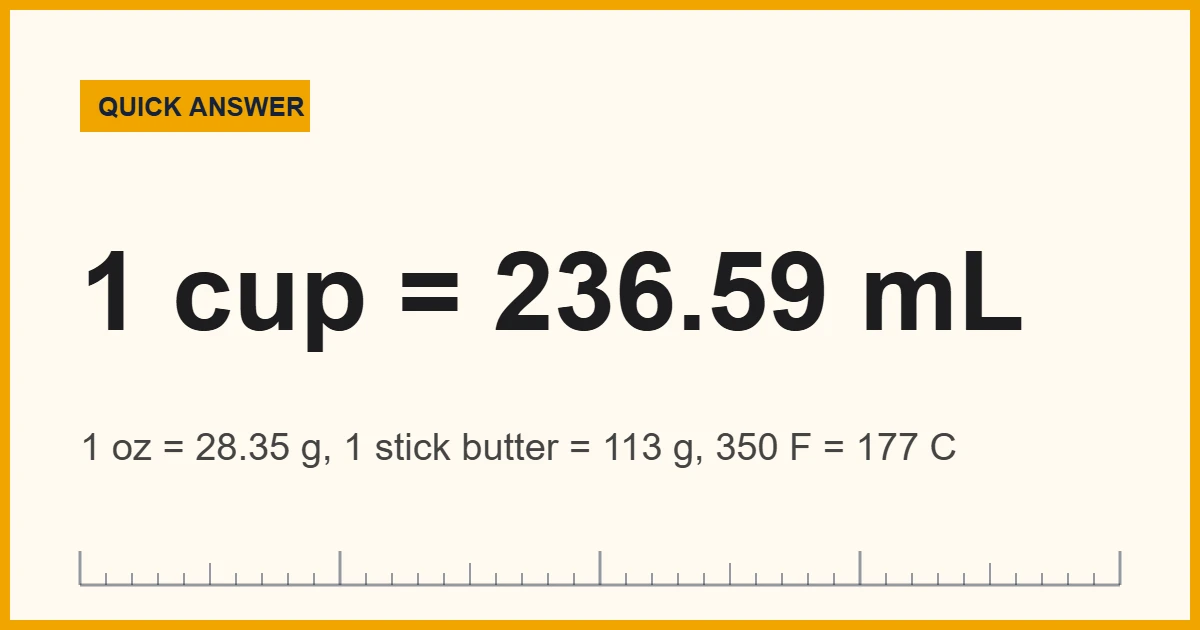
Convert American Recipes to Metric by Volume
First, enter the amount from your recipe and choose the US unit. The converter then uses the exact US customary definitions and shows milliliters, liters and the matching metric spoon or cup.
American recipes measure most ingredients by volume, in cups, tablespoons and teaspoons, and they also give oven heat in degrees Fahrenheit. Most other kitchens, by contrast, work in grams, milliliters and degrees Celsius. So a cookie recipe from a US blog can look like a puzzle if your scale and oven only show metric numbers.
Even so, every US kitchen unit has a fixed metric value. For example, the US cup holds exactly 236.5882365 mL, and the avoirdupois ounce weighs exactly 28.349523125 g. The National Institute of Standards and Technology (NIST) publishes a metric kitchen equivalents table that rounds these to friendly numbers such as 240 mL for a cup and 15 mL for a tablespoon.
Still, a straight number swap is only half the job. Dry ingredients such as flour change weight depending on how you fill the cup. Therefore, the most reliable way to move American recipes to metric is to convert liquids by volume and dry ingredients by weight. This guide covers both and also explains butter sticks, oven temperatures and sensible rounding.
US Cups and Spoons in Milliliters
This chart lists the exact US values next to the rounded numbers most cooks use. In addition, the rounded figures match the lines on most metric spoons and jugs, so you can measure without a calculator.
| US measure | Exact metric (rounded for cooking) |
|---|---|
| 1/4 tsp | 1.23 mL (about 1.25 mL) |
| 1/2 tsp | 2.46 mL (about 2.5 mL) |
| 1 tsp | 4.93 mL (about 5 mL) |
| 1 tbsp (3 tsp) | 14.79 mL (about 15 mL) |
| 1 fl oz (2 tbsp) | 29.57 mL (about 30 mL) |
| 1/4 cup | 59.15 mL (about 60 mL) |
| 1/3 cup | 78.86 mL (about 80 mL) |
| 1/2 cup | 118.29 mL (about 120 mL) |
| 2/3 cup | 157.73 mL (about 160 mL) |
| 3/4 cup | 177.44 mL (about 180 mL) |
| 1 cup | 236.59 mL (about 240 mL) |
| 1 pint (2 cups) | 473.18 mL (about 475 mL) |
| 1 quart (4 cups) | 946.35 mL (about 950 mL) |
Also, feel free to print this chart and tape it inside a cupboard door. For a deeper look at small liquid amounts, see how much 30 mL is in spoons and ounces.
Recommended Tools for Converting American Recipes to Metric
Above all, two tools do most of the work. First, a digital kitchen scale that reads in grams lets you skip cup conversions for dry ingredients altogether. Next, a clear measuring jug with both cup and mL markings handles liquids. Finally, a set of cups with printed metric lines helps when a recipe mixes both systems.

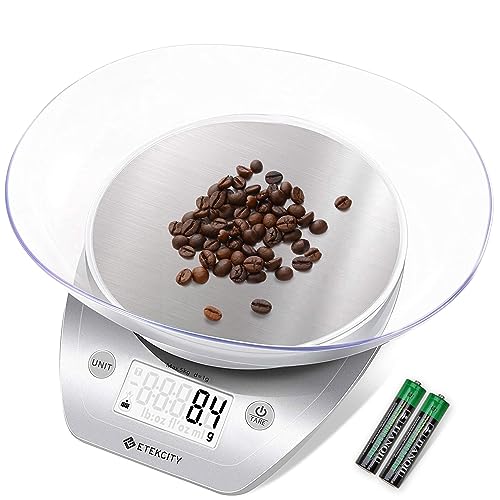
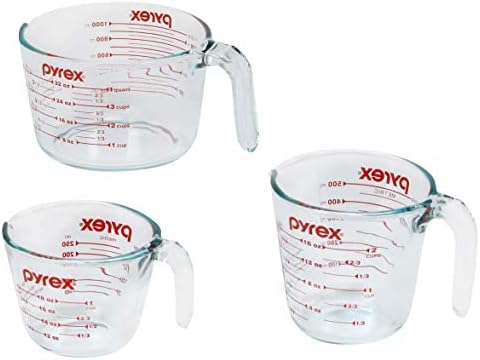

As an Amazon Associate, Measuring Expert earns from qualifying purchases.
Weight or Volume? How to Convert American Recipes to Metric
A cup measures space, while a gram measures mass. For water, milk and other thin liquids, the two line up closely, because 1 mL of water weighs about 1 g. As a result, converting liquids by volume works well.
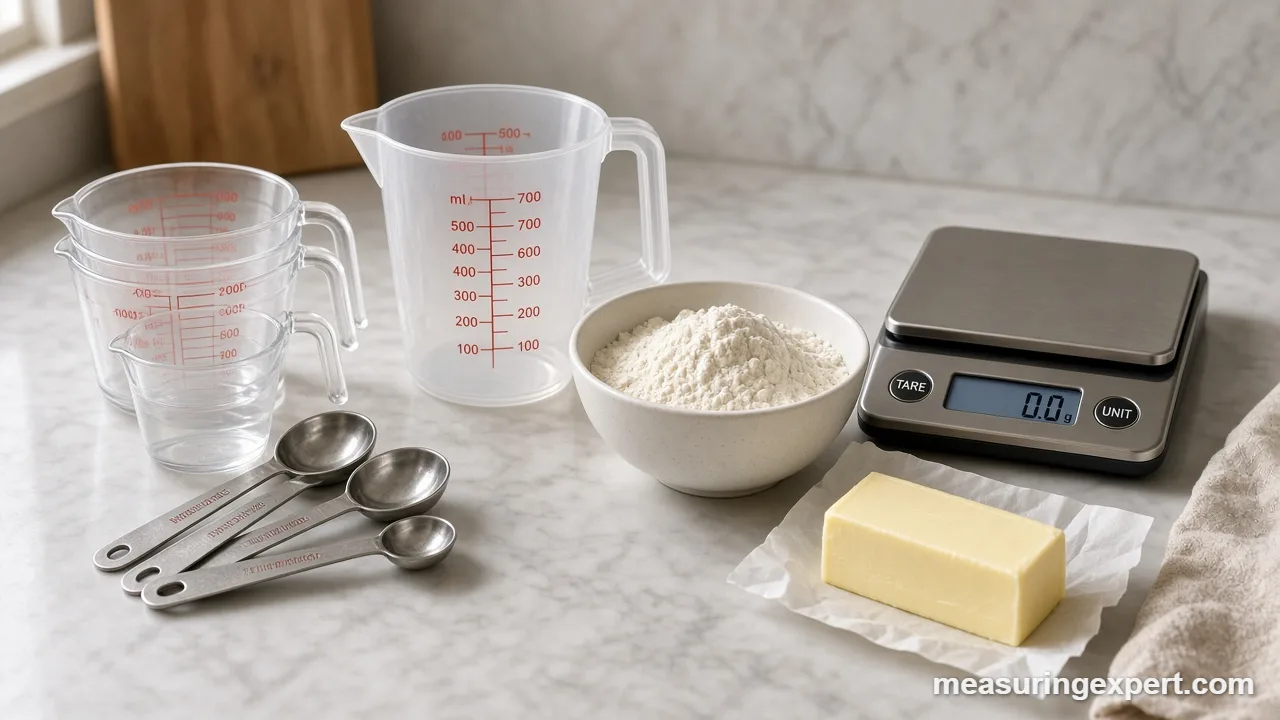
Dry ingredients, however, behave differently. A cup of flour scooped straight from the bag packs down and weighs noticeably more than a cup spooned in lightly, which comes to about 120 g. In fact, that gap is big enough to turn a soft cake dry. For this reason, bakers convert flour, sugar, cocoa, oats and butter to grams instead of milliliters.
| Ingredient type | Best metric unit and why |
|---|---|
| Water, milk, stock, juice | mL, because weight and volume match closely |
| Oil, vinegar, cream | mL, since they pour easily and read well on a jug |
| Flour, sugar, cocoa, oats | g, because volume changes with packing |
| Butter | g, since wrappers list weight |
| Small spices, baking soda, salt | mL spoons, because they are too light for most home scales |
| Honey, syrup, peanut butter | g, since sticky foods cling to cups |
People also confuse two kinds of ounce. A fluid ounce (fl oz) measures volume and equals 29.57 mL. In contrast, a weight ounce (oz) measures mass and equals 28.35 g. In short, “8 oz of cheese” means weight, while “8 fl oz of milk” means one cup by volume.
Ounces and Pounds to Grams
Meat, cheese, chocolate and canned goods usually appear in ounces or pounds, especially in older recipes. Since these are weights, they convert straight to grams with no density guesswork. One ounce equals exactly 28.349523125 g, and one pound (16 oz) equals exactly 453.59237 g.
| US weight | Grams (rounded for cooking in brackets) |
|---|---|
| 1 oz | 28.35 g (28 g) |
| 2 oz | 56.70 g (57 g) |
| 4 oz (1/4 lb) | 113.40 g (113 g) |
| 8 oz (1/2 lb) | 226.80 g (227 g) |
| 12 oz | 340.19 g (340 g) |
| 16 oz (1 lb) | 453.59 g (454 g) |
| 1.5 lb | 680.39 g (680 g) |
| 2 lb | 907.18 g (907 g) |
| 5 lb | 2,267.96 g (2.27 kg) |
For a full ounce chart with kitchen examples, read our guide to ounces to grams for cooking.
How Many Grams Is a Stick of Butter?
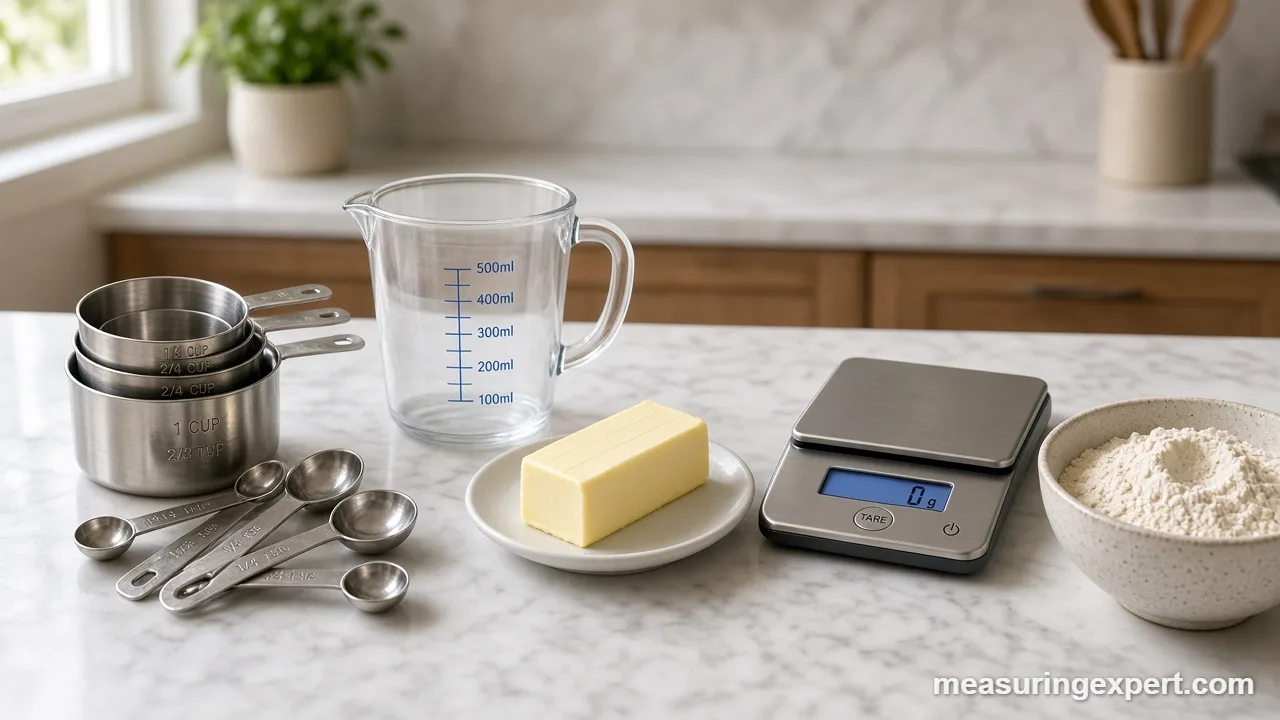
American butter comes in 4-ounce sticks, usually sold four to a 1-pound box. One stick equals 1/2 cup, or 8 tablespoons, and weighs 113.4 g. So most cooks simply call it 113 g. The paper wrapper usually shows tablespoon lines, so you can also cut by the marks.
| Butter in a US recipe | Grams |
|---|---|
| 1 tbsp | 14 g |
| 1/4 cup (1/2 stick), 4 tbsp | 57 g |
| 1/2 cup (1 stick), 8 tbsp | 113 g |
| 3/4 cup (1 1/2 sticks), 12 tbsp | 170 g |
| 1 cup (2 sticks), 16 tbsp | 227 g |
| 1 lb box (4 sticks), 32 tbsp | 454 g |
Common Ingredients in Grams per Cup
The figures below come from the King Arthur Baking ingredient weight chart, which assumes flour spooned lightly into the cup and leveled. Even so, your own results can vary by a few percent, depending on the brand and how you fill the cup.
| Ingredient (1 US cup) | Grams |
|---|---|
| All-purpose flour | 120 g |
| Bread flour | 120 g |
| Granulated sugar | 198 g |
| Brown sugar, packed | 213 g |
| Powdered (confectioners) sugar | 113 g |
| Rolled oats | 113 g |
| Unsweetened cocoa | 84 g |
| Butter | 227 g |
| Honey | 336 g |
| Water | about 236 g |
For more ingredients, including nuts and chocolate chips, see our chart of cups to grams for baking.
Oven Temperatures: Fahrenheit to Celsius
To change Fahrenheit to Celsius, subtract 32 and then multiply by 5/9. For example, 350 F minus 32 is 318, and 318 times 5/9 is 176.7 C. Most ovens step in 5 or 10 degree jumps, so 180 C is the usual setting. To go the other way, first multiply Celsius by 9/5 and then add 32.
| Fahrenheit | Exact Celsius (oven setting) |
|---|---|
| 250°F | 121.1°C (set 120°C) |
| 300°F | 148.9°C (set 150°C) |
| 325°F | 162.8°C (set 160 to 165°C) |
| 350°F | 176.7°C (set 175 to 180°C) |
| 375°F | 190.6°C (set 190°C) |
| 400°F | 204.4°C (set 200 to 205°C) |
| 425°F | 218.3°C (set 220°C) |
| 450°F | 232.2°C (set 230°C) |
Fan (convection) ovens cook faster, so many cooks lower the converted setting by about 15 to 20 C (25 F). Meanwhile, keep meat safety targets exact: 165 F is 74 C and 145 F is 63 C.
How to Convert American Recipes to Metric, Step by Step
- Read the whole recipe first. Circle every cup, spoon, ounce, pound and Fahrenheit value before you start.
- Sort each ingredient. Mark liquids for mL and dry or solid ingredients for grams.
- Convert liquids by volume. Use 236.59 mL per cup, or 240 mL when a round number is fine.
- Convert dry ingredients by weight. Look up grams per cup for each item, then multiply by the amount.
- Change weights directly. Multiply ounces by 28.35 and, likewise, pounds by 453.59.
- Keep small spoon amounts as spoons. Swap 1 tsp for a 5 mL spoon and 1 tbsp for a 15 mL spoon, since these swaps are close enough for cooking.
- Convert the oven temperature. Subtract 32, multiply by 5/9, then round to your oven’s nearest setting.
- Write the metric version down. Note your numbers on the recipe so you only convert once.
Rounding Rules That Keep Recipes Working
Exact values look precise, but nobody can pour 236.59 mL by eye. Instead, round in a way that keeps the ratios between ingredients steady. So here is a simple approach:
- Round every item the same way. If you use 240 mL per cup for the milk, also use it for the water.
- Keep flour and liquid in proportion. Otherwise, small errors in both directions can stack up in bread and cake.
- Round grams to the nearest 5 g for amounts over 100 g, and to the nearest 1 g below that.
- Leave leaveners alone. Instead, keep baking soda and baking powder in level metric spoons.
- Scale before you round. When you double a recipe, multiply the exact value first, then round once.
Rounding 236.59 mL up to 240 mL adds about 1.4%, which no recipe will notice. On the other hand, swapping in a 250 mL metric cup adds about 5.7%. That difference can matter for flour in a delicate cake, so stick with one system per recipe.
Do and Don’t
Do
- Weigh flour, sugar and butter in grams, because cups vary.
- Level dry spoonfuls with a straight edge.
- Check whether “cup” means US or metric.
- Read liquid lines at eye level.
- Tare the scale again between ingredients.
Don’t
- Mix up fluid ounces and weight ounces.
- Scoop flour straight from the bag into a cup.
- Convert a pinch of salt to grams.
- Trust an oven dial without a thermometer.
- Switch between rounding methods mid-recipe.
Honest Limits
Every conversion on this page uses exact definitions, yet real ingredients add some fuzz. For one thing, grams per cup depend on humidity, brand, grind and how firmly you fill the cup. Moreover, eggs vary in size, and a US large egg weighs roughly 50 g without the shell. Also, old American cookbooks sometimes assume slightly different cup sizes. So treat ingredient weight tables as good starting points, not lab values. If a converted recipe comes out a little dry or wet, adjust the liquid by a spoonful next time and write the change down.
When Accuracy Really Matters
In general, most stews and soups forgive small conversion errors. However, three areas need care. Bread and pastry depend on the flour to water ratio, so weigh both. Similarly, candy and jam rely on exact temperatures, so a thermometer in Celsius beats any conversion. Finally, salt in brines and cures needs measured weights, because too much makes food unsafe to eat or simply inedible.
FAQs About American Recipes to Metric Conversion
What is the easiest way to convert American recipes to metric?
Use a kitchen scale for dry ingredients and butter, a jug with mL markings for liquids, and metric spoons for small amounts. Then convert the oven temperature from Fahrenheit to Celsius.
How many mL are in a US cup?
A US cup holds exactly 236.5882365 mL, or about 236.59 mL. However, nutrition labels and many cooks round it to 240 mL.
Is a metric cup the same as a US cup?
No. A metric cup holds 250 mL, while a US cup holds about 236.59 mL. As a result, the metric cup is about 5.7% larger.
Should I weigh or measure when moving American recipes to metric?
Weigh dry ingredients such as flour, sugar, cocoa and butter, because their volume changes with packing. Measure thin liquids by volume, since 1 mL of water weighs about 1 g.
How many grams is a stick of butter?
One US stick of butter weighs 4 oz, which is 113.4 g. It also equals 1/2 cup or 8 tablespoons.
How do I convert 350 F to Celsius?
Subtract 32 to get 318, then multiply by 5/9 to get 176.7 C. So most people set the oven to 175 or 180 C.
How many grams is a cup of flour in American recipes to metric charts?
A cup of all-purpose flour weighs about 120 g when spooned into the cup and leveled. Scooping straight from the bag packs the flour and adds weight.
How do I convert ounces to grams?
Multiply ounces by 28.35. For example, 8 oz is 226.8 g. Similarly, a pound is 16 oz, or 453.59 g.
Can I convert American recipes to metric for teaspoons and tablespoons?
Yes. A US teaspoon is 4.93 mL and a tablespoon is 14.79 mL, so 5 mL and 15 mL metric spoons work as direct swaps.
Are fluid ounces and ounces the same in American recipes to metric conversion?
No. A fluid ounce is volume, equal to 29.57 mL. An ounce, however, is weight, equal to 28.35 g. Recipes for liquids use fluid ounces; recipes for meat or cheese use weight ounces.
Bottom Line
In short, moving American recipes to metric comes down to three swaps. First, convert liquids at 236.59 mL per cup (240 mL is fine). Next, change ounces and pounds to grams at 28.35 and 453.59. Then, turn Fahrenheit into Celsius with the minus 32, times 5/9 rule.
For flour, sugar and butter, skip the cups and weigh in grams, since that removes the biggest source of error. Also, keep the converter at the top of this page handy for any odd amount your recipe throws at you.