

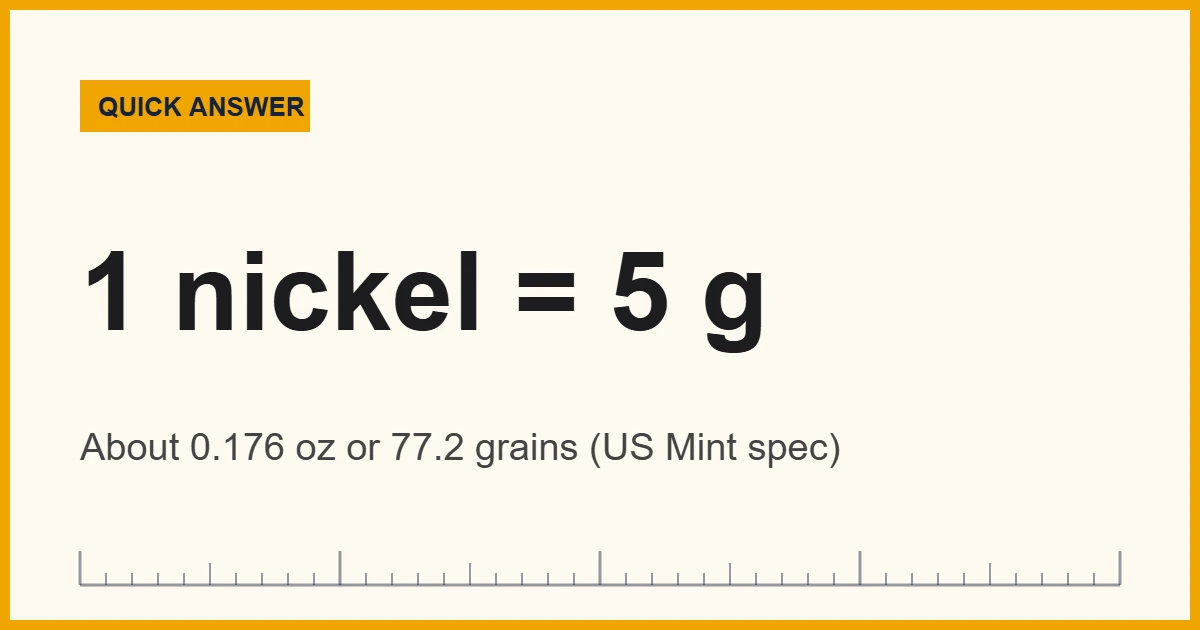
Nickel weight: a US nickel weighs exactly 5.000 grams, which is about 0.176 ounces or 77.2 grains, according to the US Mint. That figure is the official standard for the coin, so 20 nickels (one dollar) weigh 100 grams and a standard 40-coin roll weighs 200 grams, or about 7.05 ounces.
Convert Nickel Weight to Ounces, Grains and Pounds
The converter starts at 5 grams, the weight of one nickel. To weigh a pile of coins, simply multiply the number of nickels by 5 and type the total in grams. After that, the tool shows the same mass in ounces, pounds, grains and milligrams.
To begin with, the five-cent coin is one of the few American coins whose weight is a round metric number. The US Mint lists every circulating coin on its coin specifications page, and the nickel line reads 5.00 g, 0.835 inches across and 0.077 inches thick. In other words, the number is a manufacturing standard, not an estimate.
Besides, that round figure is useful well beyond trivia. For example, a nickel makes a handy check weight for a pocket scale, and banks count coins by weighing them instead of counting by hand. Because the weight is fixed, you can also turn a jar of nickels into a dollar value with nothing but a kitchen scale.
First, below you will find a quick chart, a comparison with the other US coins, a short history of the nickel’s metal, and finally a step-by-step method for using nickels to check a scale.
Nickel Weight Chart: From One Coin to a Bag
Every value in this chart starts from 5 grams per coin. In addition, the ounce figures use the exact avoirdupois ounce of 28.349523125 grams, as defined by NIST, and are rounded to two or three decimals.
| Number of nickels | Face value | Grams | Ounces | Pounds |
|---|---|---|---|---|
| 1 | 5 cents | 5 g | 0.176 oz | 0.011 lb |
| 2 | 10 cents | 10 g | 0.353 oz | 0.022 lb |
| 10 | 50 cents | 50 g | 1.76 oz | 0.110 lb |
| 20 | 1 dollar | 100 g | 3.53 oz | 0.220 lb |
| 40 (one roll) | 2 dollars | 200 g | 7.05 oz | 0.441 lb |
| 100 | 5 dollars | 500 g | 17.64 oz | 1.10 lb |
| 200 | 10 dollars | 1 kg | 35.27 oz | 2.20 lb |
| 1,000 | 50 dollars | 5 kg | 176.4 oz | 11.02 lb |
| 2,000 | 100 dollars | 10 kg | 352.7 oz | 22.05 lb |
Going the other way, one pound holds about 90.7 nickels, and one ounce is about 5.67 nickels. So a pound of nickels is worth roughly 4.54 dollars in face value. Also, print the chart if you count coins often, because it fits on one page.
Nickel Weight and Size: The Full US Mint Specs
Weight is only one line of the specification. So here is the complete set for the current Jefferson nickel, with both US and metric values as the Mint publishes them.
| Property | US customary | Metric |
|---|---|---|
| Weight | 0.176 oz (77.2 grains) | 5.000 g |
| Diameter | 0.835 in | 21.21 mm |
| Thickness | 0.077 in | 1.95 mm |
| Edge | Plain (no reeds) | Plain (no reeds) |
| Composition | 75% copper, 25% nickel, solid alloy (not plated) | |
As a result, the alloy split means each coin holds 3.75 g of copper and 1.25 g of nickel. Also, unlike the dime and quarter, the nickel is the same metal all the way through, so a worn nickel loses weight evenly instead of showing a copper stripe on the edge.
How Nickel Weight Compares With Other US Coins
At first glance, people often assume a smaller coin is lighter in proportion to its value. However, US coin weights do not follow face value at all. The nickel, for instance, weighs more than twice as much as the dime, even though it is worth half as much.
| Coin | Weight (g) | Weight (oz) | Diameter | Coins per pound |
|---|---|---|---|---|
| Penny (1983 and later) | 2.50 g | 0.088 oz | 19.05 mm | about 181 |
| Nickel | 5.00 g | 0.176 oz | 21.21 mm | about 91 |
| Dime | 2.268 g | 0.080 oz | 17.91 mm | about 200 |
| Quarter | 5.670 g | 0.200 oz | 24.26 mm | about 80 |
| Half dollar | 11.340 g | 0.400 oz | 30.61 mm | about 40 |
| Dollar coin | 8.100 g | 0.286 oz | 26.49 mm | about 56 |
In short, the order from lightest to heaviest is dime, penny, nickel, quarter, dollar coin, half dollar. Meanwhile, the quarter is only about 13% heavier than a nickel, which is why the two feel similar in the hand. By contrast, pennies made before mid-1982 were 95% copper and weigh about 3.11 g; as a result, a mixed jar of old and new pennies will not weigh out evenly. In addition, the US Mint struck its last circulating pennies in November 2025, although existing cents remain legal tender.
For more on the ounce itself, see how much is an ounce, which explains the weight ounce versus the fluid ounce.
Has the Nickel Weight Ever Changed?
In short, the answer is no. The first five-cent nickel was struck in 1866, and Congress set its weight at 5 grams, or about 77.2 grains. Since then, the design has changed several times, but the weight has stayed the same.
- 1866 to 1883: Shield nickel.
- 1883 to 1913: Liberty Head nickel.
- 1913 to 1938: Buffalo (Indian Head) nickel.
- 1938 to today: Jefferson nickel, with special Westward Journey designs in 2004 and 2005 and a forward-facing portrait from 2006.
Instead, the one big change was the metal, not the mass. From mid-1942 to 1945, nickel was needed for the war effort, so the Mint switched to an alloy of 56% copper, 35% silver and 9% manganese. Even so, these “war nickels” still weighed 5 grams, and each one contains 1.75 g of silver (about 0.056 troy ounces). Today, you can spot them by the large mint mark above the dome of Monticello on the back. In short, the old claim that nickels were silver “to save nickel” is half right: the silver replaced the nickel, but only for those wartime years.
Recommended Scales for Weighing Coins
For example, a kitchen scale that reads in whole grams is fine for counting rolls and jars. To weigh a single coin precisely, however, you need a pocket scale with 0.01 g resolution. Also look for a calibration weight in the box and a tare button, so you can zero out a cup or coin tube.


As an Amazon Associate, Measuring Expert earns from qualifying purchases.
How to Check a Scale Using Nickel Weight
Because the standard is a round 5 grams, nickels make a cheap reference weight. Of course, they are not certified calibration masses, but they are good enough to spot a scale that has drifted.
- Pick clean, undamaged coins. First, choose recent nickels without dents, grime or heavy wear.
- Place the scale on a firm, level surface. Then turn it on and let it settle for a few seconds.
- Press tare. As a result, the display should read 0.00 g with nothing on the pan.
- Add one nickel. In that case, a good scale should read close to 5.00 g.
- Add more coins in steps. Next, try 4 nickels (20 g) and 20 nickels (100 g) to check the scale across its range.
- Compare the readings. Finally, if the error grows with load or is off by more than a few tenths of a gram, recalibrate with the weight that came with the scale.
Similarly, you can use the same idea to count coins: weigh a jar of nickels, subtract the jar, divide by 5 grams, and you have the coin count. If small masses are new to you, our guide to how much 1 gram is puts the unit in everyday terms, and the grain measurement guide explains the 77-grain figure.
Do and Don’t When Weighing Nickels
Do
- Use 5.000 g as the standard for any nickel from 1866 on.
- Also weigh coins in a cup and tare the cup first.
- Check a scale at several loads, not just one, because errors grow with load.
- For scale checks, pick clean, unworn coins.
- Look at the date if you hunt for wartime silver.
Don’t
- Expect every coin to read exactly 5.00 g, since wear changes it.
- Mix pennies and nickels when counting by weight.
- Treat coins as certified calibration weights, because they are not.
- Weigh coins on a scale near a fan or a draft.
- Assume heavier coins are worth more.
Honest Limits of the 5-Gram Figure
To be clear, the 5.000-gram value is the design standard. Real coins, however, leave the press within a small manufacturing tolerance, so a brand-new nickel can read a few hundredths of a gram above or below 5. Moreover, decades in circulation wear metal away, and dirt or oil adds a little back. As a result, a handful of old nickels can easily read 4.9 g each, while a new roll reads very close to 5 g.
In addition, scale quality matters. For example, a kitchen scale with 1 g resolution cannot tell 4.9 g from 5.1 g, so it will show “5 g” for both. Therefore, use a pocket scale for single coins and weigh many coins at once when you only need a count.
When Coin Weight Really Matters
For most people, of course, 5 grams is simply a fun fact. Still, a few situations call for more care:
- Coin collecting. For example, a coin that is far off 5 grams may be damaged, altered or counterfeit, so collectors weigh suspect coins on a 0.01 g scale.
- Counting deposits. Similarly, banks and coin machines rely on weight, so mixed or foreign coins throw the count off.
- Classroom science. Nickels make an easy known mass for balance experiments; for instance, students can drop 20 nickels (100 g) into a measuring cup of water to find their volume by displacement.
Nickel Weight FAQs
How much does a nickel weigh in grams?
A US nickel weighs 5.000 grams. In fact, that is the official US Mint standard for the five-cent coin.
How much does a nickel weigh in ounces?
One nickel weighs about 0.176 ounces. In other words, it takes about 5.67 nickels to make one ounce.
Is nickel weight the same for old and new coins?
Yes. Every nickel since 1866 has the same 5-gram standard, including the 1942 to 1945 silver war nickels. However, worn coins may read slightly lighter.
How much does a roll of nickels weigh?
A standard roll holds 40 nickels, worth 2 dollars, and weighs 200 grams, or about 7.05 ounces, not counting the wrapper.
How many nickels are in a pound?
About 90.7 nickels make one pound, so a pound of nickels is worth roughly 4.54 dollars in face value.
Is a nickel heavier than a quarter?
No. A quarter weighs 5.67 grams and a nickel weighs 5 grams, so the quarter is about 13% heavier.
Does a nickel weigh more than a dime?
Yes. A nickel weighs 5 grams and a dime weighs 2.268 grams, so a nickel is more than twice as heavy.
How much do 20 nickels weigh?
In total, twenty nickels, or one dollar, weigh 100 grams, which is about 3.53 ounces.
What is a nickel made of?
A modern nickel is a solid alloy of 75% copper and 25% nickel. From mid-1942 to 1945 it was 56% copper, 35% silver and 9% manganese.
Can I use a nickel to calibrate a scale?
You can use nickels to check a scale roughly, since each one should read close to 5 grams. For real calibration, however, use the certified weight that came with the scale.
The Bottom Line on Nickel Weight
A US nickel weighs 5 grams, or about 0.176 ounces, and it has kept that weight since 1866. Also, twenty nickels make 100 grams, a roll of 40 makes 200 grams, and about 91 nickels make a pound. Finally, use the converter above to turn any pile of nickels into ounces or pounds, and remember that worn coins can read slightly light.
2 thoughts on “How Much Does a Nickel Weigh? Exact Nickel Weight in Grams and Ounces”