

The most accurate volume measurement tool is Class A volumetric glassware. For one fixed volume, a Class A volumetric flask (100 mL, plus or minus 0.08 mL) or volumetric pipette (10 mL, plus or minus 0.02 mL) wins. For variable amounts, a Class A buret (50 mL, plus or minus 0.05 mL) is best.
Many guides still name the graduated cylinder as the most accurate tool. That answer is out of date, because a cylinder is only the most accurate of the everyday containers. Volumetric glassware, however, is built for one job, so its tolerance is roughly five to ten times tighter. In addition, the ranking changes depending on whether you need one exact volume or any amount you choose.
In short: use a volumetric flask to make up an exact volume, a volumetric pipette to transfer one, and a buret to deliver a variable amount. Then, if you need to beat all three, weigh the liquid on a balance instead.
The numbers on this page come from published Class A tolerances. For example, a University of Texas chemistry handout lists the Class A tolerances for pipets, burets and graduated cylinders. Similarly, DWK Life Sciences lists the ASTM E288 Class A tolerances for its Kimble volumetric flasks.
This page focuses on one question: which tool gives the most accurate volume measurement, and by how much. If you want a tour of every piece of lab glassware and what each one does, see our guide to lab equipment to measure volume instead.
Convert a Measured Lab Volume to US Units
Lab glassware usually reads in milliliters. So, if you need the same amount in US fluid ounces, teaspoons or cups, enter it below. The converter uses the exact US definitions, for example 1 US fl oz = 29.5735295625 mL.
Recommended Class A Glassware for Accurate Volumes
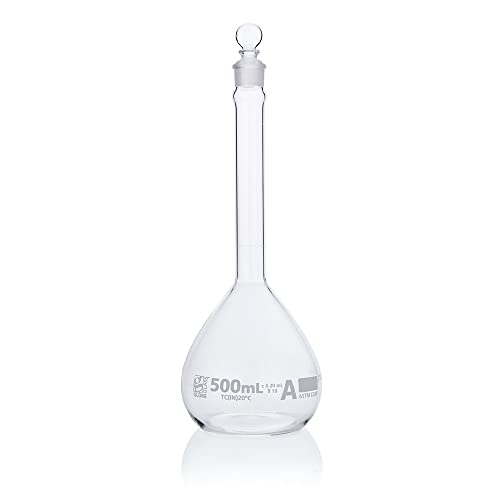
If accuracy is the goal, buy glassware marked “Class A” with the ASTM standard or tolerance printed on it. Also, match the tool to the task: a flask for preparing solutions, a pipette for transfers, and a buret for titrations. The picks below are Class A items from established lab brands, chosen from manufacturer specs and buyer reports.


As an Amazon Associate, Measuring Expert earns from qualifying purchases.
Key Takeaways
- Class A volumetric glassware gives the most accurate volume measurement of any common lab tool.
- A 100 mL Class A volumetric flask holds its volume to within 0.08 mL, or 0.08 percent.
- For transfers, a 10 mL Class A volumetric pipette delivers within 0.02 mL (0.2 percent).
- When the amount varies, a 50 mL Class A buret is the best choice, at plus or minus 0.05 mL.
- Graduated cylinders rank fourth; beakers and Erlenmeyer flasks only give estimates.
- Class B glassware generally allows about twice the Class A error.
- Weighing the liquid on a balance beats every piece of glassware.
Most Accurate Volume Measurement Tools, Ranked
The table ranks common tools by percent error near full capacity, because that is the fairest way to compare a 10 mL pipette with a 1,000 mL flask. Also, all values are Class A tolerances. However, beakers and Erlenmeyer flasks have no Class A volume rating, so their figure is only a typical estimate.
| Rank | Tool (size) | Class A tolerance | Error at capacity | What it does |
|---|---|---|---|---|
| 1 | Volumetric flask (100 mL) | ±0.08 mL | 0.08% | Contains one exact volume (TC) |
| 1 | Volumetric flask (1,000 mL) | ±0.30 mL | 0.03% | Contains one exact volume (TC) |
| 2 | Volumetric pipette (10 mL) | ±0.02 mL | 0.2% | Delivers one exact volume (TD) |
| 2 | Volumetric pipette (50 mL) | ±0.05 mL | 0.1% | Delivers one exact volume (TD) |
| 3 | Buret (50 mL) | ±0.05 mL | 0.1% | Delivers any volume up to 50 mL |
| 4 | Graduated cylinder (100 mL) | ±0.4 mL | 0.4% | Measures any volume, quickly |
| 4 | Graduated cylinder (10 mL) | ±0.09 mL | 0.9% | Measures small volumes |
| 5 | Beaker or Erlenmeyer flask | no Class A rating | about 5% (estimate) | Mixing, heating, rough volumes |
So why does the pipette rank below the flask when its percent error looks similar? First, a flask only has to contain its volume, while a pipette has to deliver it, and drainage adds a small extra uncertainty. Second, the flask figures improve as size grows, whereas pipettes top out at about 100 mL. In practice, both are excellent, and you will often use them together.
Why Fixed-Volume Glassware Gives the Most Accurate Volume Measurement
A volumetric flask or pipette has one calibration line on a narrow neck. Because the neck is thin, a small change in volume moves the liquid level a long way. As a result, you can set the meniscus very precisely. A graduated cylinder, by contrast, has a wide body, so the same volume error barely moves the surface.
Fixed-volume glassware also avoids reading a scale. Instead, you simply fill to the line. Meanwhile, every graduated tool asks you to estimate between marks, and that estimate adds its own error on top of the printed tolerance.
Finally, Class A volumetric glassware is made to tighter standards. For example, the ASTM specification for flasks is E288, and makers state compliance on the glass. Serialized versions also come with an individual certificate, which matters in regulated labs.
Volumetric Pipette vs Buret: Which Is More Accurate?
First of all, the answer depends on the job. A volumetric pipette delivers one volume, so it needs only one reading: the fill line. A buret, on the other hand, needs two readings, the start and the end, and each one adds reading error. For a deeper look at how burets compare with cylinders, see buret vs graduated cylinder.
| Feature | Class A volumetric pipette | Class A buret |
|---|---|---|
| Volumes | One fixed volume (1, 5, 10, 25, 50 mL) | Any volume up to capacity |
| Typical tolerance | ±0.02 mL at 10 mL | ±0.05 mL at 50 mL |
| Readings needed | One (fill to the line) | Two (start and end) |
| Error on a 20 mL delivery | Not possible in one step | About 0.25% (0.05 mL of 20 mL) |
| Best for | Aliquots, standards, dilutions | Titrations |
In other words, the pipette is more accurate for the volume it was made for. However, the buret is the most accurate tool when you do not know the volume in advance, which is exactly the case in a titration.
Class A vs Class B Glassware for Accurate Volume Measurement
Two labels cause most of the confusion. The first one is the class. Class A glassware meets the tighter tolerance in its ASTM or ISO standard. By contrast, Class B glassware generally allows about twice the error, so it suits teaching labs and routine work. For instance, a 50 mL Class B buret is about plus or minus 0.10 mL instead of 0.05 mL.
The second label problem is the difference between accuracy, precision and resolution. Although these three words often get swapped, they describe different things.
| Term | Meaning | Example |
|---|---|---|
| Accuracy | How close a reading is to the true volume | A pipette delivering 10.01 mL when 10.00 mL is the target |
| Precision | How closely repeated readings agree | Five deliveries all within 0.005 mL of each other |
| Resolution | The smallest change you can read | A buret marked every 0.1 mL, read to about 0.02 mL |
How to Get the Most Accurate Volume Measurement From a Pipette
Of course, Class A tolerances only hold when you use the glassware correctly. These steps apply to a volumetric pipette, and the same habits help with flasks and burets.
- Check the markings. Look for “A”, “TD” and the calibration temperature, usually 20 degrees C.
- Clean the pipette. Water should sheet off the inside without beading, because droplets mean grease.
- Rinse with your solution. Draw up a small amount, tilt to coat the walls, and discard it.
- Fill above the line with a bulb. Never pipette by mouth.
- Set the meniscus at eye level. Release liquid slowly until the bottom of the curve sits on the line.
- Wipe the outside of the tip. A drop hanging on the outside would add volume.
- Drain and wait. Let it flow freely, touch the tip to the receiving wall, and leave the last drop inside unless the pipette says “blow out”.
Beating Glassware: Measuring Volume by Weight
The most accurate volume measurement of all does not use volume markings. Instead, you weigh the liquid and divide by its density. In fact, calibration labs check glassware this way: they weigh the water a pipette delivers and convert the mass to volume. For water at 20 degrees C, the density is about 0.998 g/mL, so 9.98 g of water is about 10.00 mL.
An analytical balance that reads to 0.1 mg can therefore beat even a Class A pipette. However, you need the liquid’s density at your working temperature. In addition, very precise work corrects for air buoyancy. For everyday liquids with an unknown density, glassware is still the practical choice.
Do and Don’t for Accurate Volumes
Do
- Pick Class A glassware with a printed tolerance.
- Choose the smallest tool that holds the whole volume.
- Read the bottom of the meniscus at eye level.
- Work near the calibration temperature.
- Keep glassware clean and grease-free.
Don’t
- Trust beaker or Erlenmeyer markings for exact work.
- Heat volumetric glassware in an oven or over a flame.
- Blow out a TD pipette unless it is marked for it.
- Pour from a TC flask and expect its full volume.
- Mix Class A and Class B tools in one careful procedure.
Beakers deserve a special mention, because many readers use them anyway. Our guide on measuring volume with a beaker explains when that is good enough.
Honest Limits
A printed tolerance is the maximum error the standard allows for a new, clean item at its calibration temperature. Even so, your result can drift outside it for ordinary reasons. For example, warm liquids expand, and heat can permanently distort glass. Similarly, a dirty pipette leaves droplets behind, and a rushed drain delivers less than the stated volume.
In addition, reading error stacks on top of the tolerance. A buret delivery, for instance, combines the tolerance with two readings. So the true uncertainty of a careful measurement is often a little larger than the number on the glass. Finally, the figures here are typical Class A values from published tables; always check the tolerance printed on your own item.
When to Call a Calibration Lab
For school labs and hobby chemistry, Class A glassware used carefully is more than enough. However, regulated work is different. For example, pharmaceutical, clinical, environmental and food-testing labs usually need traceable calibration records. In those cases, buy certified, serialized glassware or send items to an accredited calibration lab, which checks them gravimetrically and issues a certificate.
Frequently Asked Questions
What is the most accurate volume measurement tool?
Class A volumetric glassware. A volumetric flask or pipette is best for one fixed volume, and a Class A buret is best for variable amounts.
Is a graduated cylinder the most accurate volume measurement tool?
No. A graduated cylinder is more accurate than a beaker, but a Class A pipette, flask or buret is roughly five to ten times more accurate.
Which is more accurate, a pipette or a buret?
For its one fixed volume, a volumetric pipette is more accurate. For an unknown or variable volume, such as a titration, a buret is the better tool.
How accurate is a Class A volumetric flask?
A 100 mL Class A flask is accurate to plus or minus 0.08 mL, and a 1,000 mL flask to plus or minus 0.30 mL, under ASTM E288.
Why are beakers not used for the most accurate volume measurement?
Beakers have wide bodies and approximate markings with no Class A rating. Their volume marks are often off by around 5 percent.
What does Class A mean on glassware?
Class A means the item meets the tighter tolerance in its ASTM or ISO standard. Class B allows about twice the error.
What do TD and TC mean?
TD means to deliver: the tool pours out the stated volume. TC means to contain: the tool holds the stated volume, as volumetric flasks do.
Is weighing more accurate than measuring volume?
Usually, yes. An analytical balance plus the liquid’s density gives a more accurate volume than glassware, and labs calibrate glassware this way.
What is the most accurate volume measurement for very small amounts?
For a few milliliters, use a small Class A volumetric pipette. For microliters, use a calibrated micropipette with the right tip.
Does temperature affect volume accuracy?
Yes. Glassware is calibrated at a set temperature, usually 20 degrees C, and liquids expand when warm. Work near that temperature for the best results.
Bottom Line on the Most Accurate Volume Measurement
In the end, the graduated cylinder is not the winner. Instead, Class A volumetric glassware takes the top spots: a volumetric flask to make up an exact volume, a volumetric pipette to transfer one, and a buret when the amount varies. After that, a cylinder comes next, while beakers and Erlenmeyer flasks only give estimates.
So pick the smallest Class A tool that fits the job, read the meniscus at eye level, and work near 20 degrees C. Then, if you need even more accuracy, weigh the liquid on an analytical balance and convert with its density.