


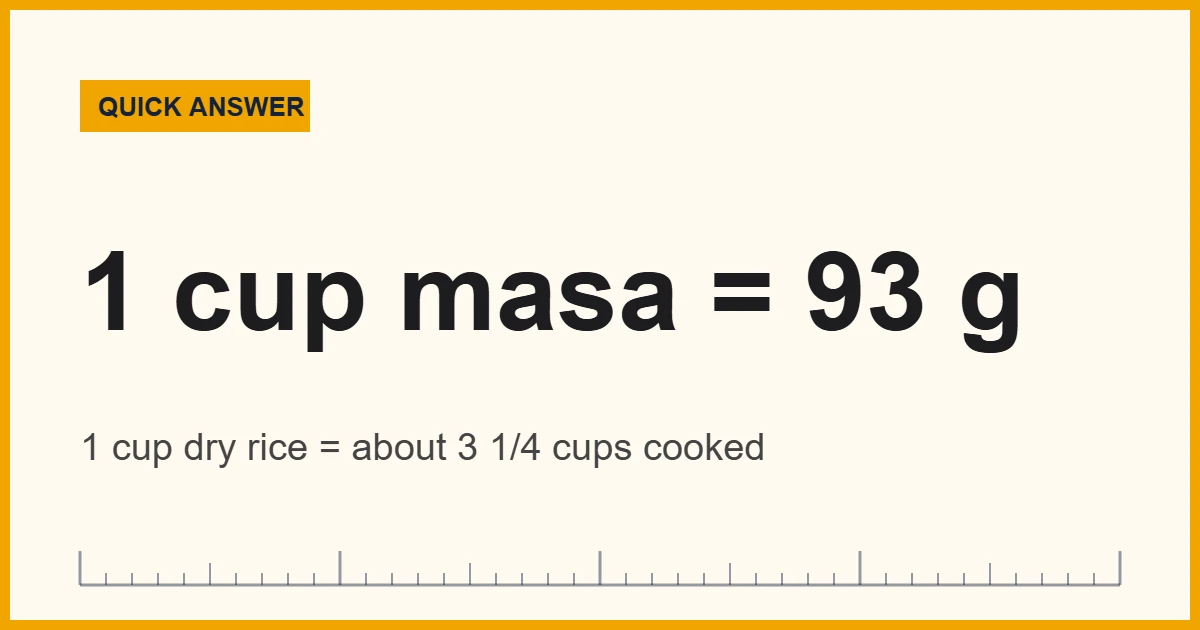
Mexican cooking measurements come down to four habits. Weigh masa harina (1 cup is about 93 g), measure rice and water by volume (1 cup dry rice makes about 3 1/4 cups cooked), use 3 cups of water per cup of dry beans, and add chiles and salt in small steps. Start low, then taste.
Mexican Cooking Measurements Converter
Because recipes for tortillas, rice and beans mix cups, spoons and milliliters, convert first. Enter an amount below and pick your unit. The converter then shows the same volume in the other common kitchen units, using the exact US definitions.
Mexican home cooking has long relied on feel: a handful of masa, a pinch of salt, a chile or two. That works for experienced cooks, but it leaves beginners guessing. As a result, the same recipe can turn out dry one night and mushy the next. In short, a few numbers remove most of that guesswork.
Overall, this guide covers the basics that most Mexican recipes share, including masa and tortillas, rice, beans, dried chiles, spices and salt. Salsa has its own page, so see our salsa measuring guide for tomatoes, onions and lime. In addition, the numbers here come from King Arthur’s ingredient weight chart, USDA data and university extension recipes, and each is named where it appears.
Measuring Masa Harina for Corn Tortillas
Masa harina is corn flour made from nixtamalized corn, which is corn cooked and soaked in an alkaline solution. However, it is not the same as ordinary cornmeal. King Arthur’s ingredient weight chart lists 1 cup of masa harina at 93 g (3 1/4 oz) and 1 cup of whole cornmeal at 138 g (4 7/8 oz). Swapping one for the other therefore changes both the weight and the dough.
A community cooking class recipe from the Food Literacy Center makes 12 tortillas from 2 cups of masa harina, 1/2 teaspoon of salt and 1 1/2 cups of very warm water. Also, its dough should feel firm and springy, not crumbly, and it rests for an hour before pressing. Each tortilla then cooks for about a minute per side over medium heat.
| Ingredient | US measure | Metric |
|---|---|---|
| Masa harina | 2 cups | about 186 g (6.6 oz) |
| Salt | 1/2 tsp | about 2.5 mL |
| Very warm water | 1 1/2 cups | about 355 mL |
| Dough per tortilla (12 balls) | a bit bigger than a golf ball | about 45 g each |
The 45 g figure is our own arithmetic from those amounts, and the gram weights assume the King Arthur cup of 93 g. In practice, a scooped cup of masa harina can weigh more than a spooned one. Therefore, add the last quarter cup of water slowly and judge by touch. For example, dough that cracks at the edges when pressed needs a spoonful more water.
Recommended Tools for Mexican Cooking Measurements
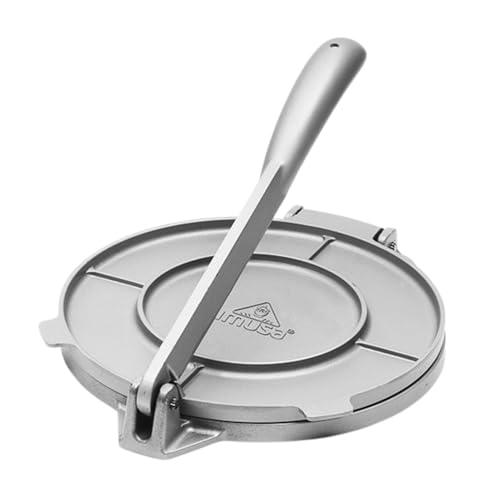
You can cook every recipe on this page with cups and spoons. However, a few tools make the results repeatable. First, a digital scale with a tare button handles masa and rice. Next, a leveled set of measuring spoons handles spices, and a tortilla press gives evenly thick rounds from equal dough balls.



As an Amazon Associate, Measuring Expert earns from qualifying purchases.
Rice: Cups of Dry Rice to Cups Cooked
Rice triples in volume, so plan the pot accordingly. The USDA Food Buying Guide lists 1 cup of dry long-grain white rice as about 3 1/4 cups cooked, and 1 pound dry as about 7 1/2 cups cooked. Meanwhile, King Arthur lists 1/2 cup of long-grain rice at 99 g, so a full cup is about 198 g.
For Mexican-style rice, the liquid includes broth and tomato sauce. An Illinois Extension Spanish rice recipe uses 1/2 cup of white rice, 1 cup of chicken broth and 1/4 cup of tomato sauce. That works out to 2 1/2 parts liquid to 1 part rice, because the tomato sauce counts as liquid. Finally, the recipe covers the pot tightly and simmers it on low for 15 minutes.
| Dry rice | Approximate dry weight | Cooked rice (USDA) | Servings of 1/2 cup cooked |
|---|---|---|---|
| 1/2 cup | 99 g | about 1 5/8 cups | 3 to 4 |
| 1 cup | about 198 g | about 3 1/4 cups | 6 to 7 |
| 2 cups | about 396 g | about 6 1/2 cups | 13 |
Keep in mind that brands differ, and so do pots. Instead, follow the package directions for the water ratio of the rice you buy, then use these yields to decide how much to start with.
Beans: Dry Cups, Water and Cooked Yield
Kansas State Research and Extension gives a clear starting point for pots of beans. Use 3 cups of water per 1 cup of dry beans, and expect 1 cup of dry beans to make 2 to 3 cups cooked. Its quick-soak method boils the beans for 3 minutes, then refrigerates them overnight. After draining, cover them with fresh water and simmer until tender, which takes 1 to 2 hours depending on the bean.
| Dry beans | Water for cooking | Cooked beans (approx.) |
|---|---|---|
| 1 cup | 3 cups (710 mL) | 2 to 3 cups |
| 2 cups | 6 cups (1.4 L) | 4 to 6 cups |
| 3 cups | 9 cups (2.1 L) | 6 to 9 cups |
Because the yield is a range, plan for the low end when you feed a crowd. Meanwhile, add salt in small steps and taste as the beans soften. For more on measuring dry and wet ingredients correctly, read our guide to dry and liquid measurements.
Salt in Mexican Cooking Measurements: The Hidden Variable
Salt is where measuring goes wrong most often. For instance, King Arthur’s chart lists 1 tablespoon of table salt at 18 g, Morton kosher salt at 16 g and Diamond Crystal kosher salt at 8 g. That is more than a twofold gap between brands, so a recipe that says “1 teaspoon kosher salt” can be twice as salty depending on the box.
| Salt type | Per tablespoon | Per teaspoon (one third) |
|---|---|---|
| Table salt | 18 g | 6.0 g |
| Morton kosher | 16 g | 5.3 g |
| Diamond Crystal kosher | 8 g | 2.7 g |
Generally, start with the lower amount for rice, beans and masa. You can always add more, but you cannot take it out. In addition, check whether canned tomatoes, broth or cheese in the recipe already carry salt.
Measuring Chiles, Spices and Herbs
Dried chiles vary in size, so counting pods is unreliable. Instead, weigh them, and note whether the recipe means the weight before or after the stems and seeds are removed. One ounce is 28.35 g. Soak the pods as the recipe directs, then puree them and add the paste a spoonful at a time.
By contrast, ground spices are easier. Level each measuring spoon with a straight edge, because a heaped teaspoon of ground cumin or chile powder can hold much more than a level one. Likewise, check whether the recipe means whole seeds or ground spice, since the same spoon holds different amounts of each. For example, toasted whole cumin ground in a mortar will not match a spoonful of pre-ground cumin.
When a recipe swaps fresh herbs for dried, a common rule of thumb is 1 teaspoon dried for 1 tablespoon fresh, a ratio of 1 to 3. Because dried herbs are more concentrated, start with less than you think you need. Our guide to how much an ounce is helps when a recipe lists chiles by weight.
Scaling Mexican Cooking Measurements Up or Down
Fortunately, doubling a tortilla recipe is easy if you keep the ratio fixed. The table below scales the Food Literacy Center recipe. The water is a starting amount, so hold back the last quarter cup and add it only if the dough is dry.
| Tortillas | Masa harina | Salt | Very warm water |
|---|---|---|---|
| 12 | 2 cups (186 g) | 1/2 tsp | 1 1/2 cups (355 mL) |
| 24 | 4 cups (372 g) | 1 tsp | 3 cups (710 mL) |
| 36 | 6 cups (558 g) | 1 1/2 tsp | 4 1/2 cups (1,065 mL) |
The same idea applies to rice and beans. Rice and beans scale by the cup, but large pots cook more slowly and may need extra time. As a result, check doneness by taste instead of the clock.
Common Mistakes in Mexican Cooking Measurements
- Treating masa harina like cornmeal. They differ in processing and in weight per cup, so they are not interchangeable in tortillas.
- Adding all the water at once. Humidity and brand change how much masa absorbs, so add the last portion slowly.
- Ignoring the salt brand. Diamond Crystal and Morton kosher salt differ by about a factor of two in weight per spoon.
- Cooking too little rice. It triples in volume, so a small cup can leave you short.
- Counting chile pods. Pod size varies, so weigh them.
- Using heaped spoons. Also, heaped spices throw off the heat and the flavor.
Do and Don’t
Do
- Weigh masa harina when you can.
- Let tortilla dough rest before pressing.
- Level every spoon of spice.
- Season beans and rice in small steps.
- Keep a note of the salt brand you use.
Don’t
- Substitute cornmeal for masa harina.
- Pour in all the water at the start.
- Assume 1 cup of dry beans fills the pot.
- Count dried chiles by pod.
- Taste raw dough or undercooked beans.
Honest Limits of These Numbers
Every figure here is an average. For example, a cup of masa harina varies with how you fill it, rice varies by variety and age, and beans take longer when they are old. However, the King Arthur, USDA and extension figures are reliable starting points, not guarantees. Therefore, use them to plan, then adjust by sight and taste. For recipes with food safety steps, such as canning beans or holding cooked rice, follow guidance from your local extension service or the USDA.
Frequently Asked Questions
How much does 1 cup of masa harina weigh?
King Arthur lists 1 cup of masa harina at 93 g, or 3 1/4 oz. A heavily scooped cup can weigh more, so weigh it when precision matters.
What are the right Mexican cooking measurements for corn tortillas?
One tested class recipe uses 2 cups of masa harina, 1/2 teaspoon of salt and 1 1/2 cups of very warm water for 12 tortillas. The dough should feel firm and springy.
Can I use cornmeal instead of masa harina?
No. Masa harina is made from nixtamalized corn, and cornmeal is not, so tortillas made with cornmeal will crumble and taste different.
How much cooked rice does 1 cup of dry rice make?
The USDA Food Buying Guide lists 1 cup of dry long-grain white rice as about 3 1/4 cups cooked.
How much water do I use for 1 cup of dry beans?
Kansas State Research and Extension recommends 3 cups of water per 1 cup of dry beans. That yields about 2 to 3 cups of cooked beans.
Do I have to soak beans?
Soaking shortens the cooking time. The Kansas State method boils the beans for 3 minutes, then chills them overnight before the final simmer of 1 to 2 hours.
Why do kosher salt brands taste different in recipes?
The crystals differ in size. A tablespoon of Diamond Crystal weighs about 8 g, while Morton weighs about 16 g, so the same spoon can hold twice as much salt.
Should I weigh dried chiles or count them?
Weigh them. Pod sizes differ a lot, and one ounce is 28.35 g, so a scale gives a more consistent result than counting.
How do I convert fresh herbs to dried?
A common rule of thumb is 1 teaspoon of dried herb for 1 tablespoon of fresh. Start with less, taste, and add more if needed.
Where do I find salsa measurements?
Salsa has its own guide on this site, covering tomatoes, onions, chiles and lime. See the salsa measuring guide linked in the introduction.
Mexican Cooking Measurements: The Bottom Line
To sum up, weigh masa harina at about 93 g per cup, plan on 3 1/4 cups of cooked rice for every cup dry, and use 3 cups of water for each cup of dry beans. Treat salt by brand, weigh your chiles, and add water, salt and heat a little at a time.
Finally, use the converter at the top whenever a recipe gives cups and you prefer milliliters. Next, try our salsa guide to finish the meal.