

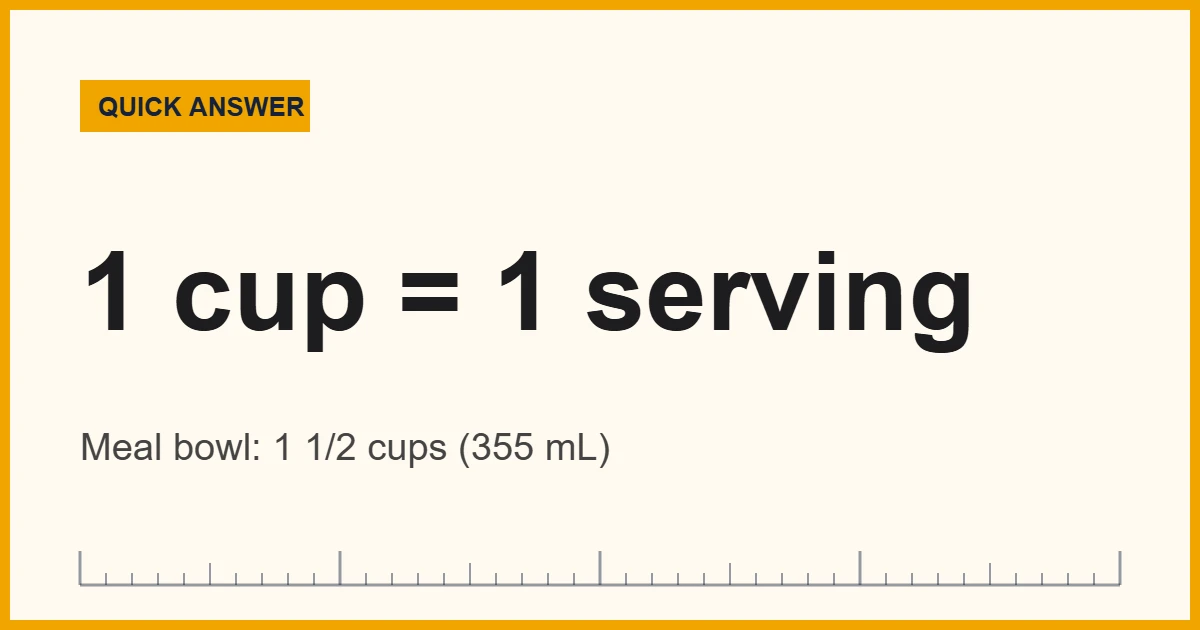
To measure soup ingredients, start with the bowl. Plan 1 cup (237 mL) per serving for a first course or 1 1/2 cups (355 mL) for a meal, then size the pot to match. Next, weigh vegetables, grains and meat, measure broth by volume, and add salt in small steps.
Soup Pot Size Calculator: Cups, Quarts and Liters
First, enter the amount of finished soup you want and read it in the units your pot, ladle and storage containers use. For example, 9 cups of soup is 2 1/4 quarts, or about 2.13 L, which feeds 6 people at 1 1/2 cups each.
In fact, most soup problems come from guessing. A pot that looks full may hold 3 quarts or 6, and a spoonful of salt can weigh twice as much as the same spoonful from another box. As a result, a few measured numbers do more for a pot of soup than any fancy technique.
Specifically, this guide covers how to measure soup ingredients: portions per bowl, pot sizes, weights for grains and dairy, salt by brand, and measured freezer portions. Overall, it is about measuring only. In other words, it makes no health claims, and the recipe choices stay yours. If you want a cups-to-grams chart for vegetables and stews, see our companion guide to soup and stew measurements.
How Much Soup Per Bowl: Portions and Pot Sizes
The US Department of Agriculture sets a reference amount for soups in its labeling rule, 9 CFR 381.412: 245 g per serving for all soup varieties. Overall, that is about 8.6 oz by weight, and a thin soup of that weight fills roughly 1 cup. Therefore, 1 cup is a sensible unit for a small first-course bowl, while a bowl served as a meal runs closer to 1 1/2 cups.
| Servings (1 1/2 cups each) | Soup needed | Quarts | Liters |
|---|---|---|---|
| 4 | 6 cups | 1 1/2 qt | 1.42 L |
| 6 | 9 cups | 2 1/4 qt | 2.13 L |
| 8 | 12 cups | 3 qt | 2.84 L |
| 12 | 18 cups | 4 1/2 qt | 4.26 L |
| 16 | 24 cups | 6 qt | 5.68 L |
First, the pot must be bigger than the finished soup. In practice, choose a pot with at least a quarter more capacity than the amount in the table, so the soup can simmer without boiling over. For example, 12 cups (3 qt) of soup fits comfortably in a 4-quart pot. In addition, if you serve smaller 1-cup bowls, multiply the servings by 1 cup instead and look up the total in the converter above.
Measure Soup Ingredients by Weight: Grains, Dairy and Fats
Cups vary with how you scoop, so weights are more reliable. The King Arthur Baking ingredient weight chart lists the following values for ingredients that often end up in a pot. Also, keep in mind that one ounce here is a weight ounce, as explained in how much an ounce is.
| Ingredient | Amount | Weight (US) | Weight (metric) |
|---|---|---|---|
| Pearled barley, dry | 1 cup | 7 1/2 oz | 213 g |
| Barley, cooked | 1 cup | 7 5/8 oz | 215 g |
| Brown rice, cooked | 1 cup | 6 oz | 170 g |
| Long-grain rice, dry | 1/2 cup | 3 1/2 oz | 99 g |
| Milk | 1 cup | 8 oz | 227 g |
| Butter | 8 tbsp (1/2 cup) | 4 oz | 113 g |
As a result, these numbers lead to a useful habit. First, decide whether the recipe means dry or cooked grain, because dry grain swells in the pot. Next, weigh the amount on a scale. Otherwise, a recipe that lists “1 cup rice” can mean 198 g dry (two of the 1/2-cup measures above) or 170 g cooked brown rice, which is a very different pot.
Measure Soup Ingredients Carefully: Why 1 Tsp of Salt Varies
Above all, salt is the one soup ingredient where the same spoon gives very different results. The King Arthur chart lists table salt at 18 g per tablespoon, Morton kosher salt at 16 g and Diamond Crystal kosher salt at 8 g. Next, divide by 3 to get the weight per teaspoon.
| Salt (per level teaspoon) | Weight | Compared with table salt |
|---|---|---|
| Table salt | 6.0 g | 100 percent |
| Morton kosher salt | 5.3 g | 89 percent |
| Diamond Crystal kosher salt | 2.7 g | 44 percent |
In other words, a teaspoon of table salt can carry more than twice the salt of a teaspoon of Diamond Crystal. As a result, a soup seasoned with the wrong box can end up far too salty or flat. Therefore, if your recipe gives a weight, use it. Otherwise, start with less than the recipe says, stir, taste after a few minutes, and add a pinch at a time.
Recommended Tools to Measure Soup Ingredients
In general, soup rewards a few simple tools. A digital scale handles grains, dairy and meat, while a 4-cup measuring cup handles broth. In addition, an 8-ounce ladle gives every bowl the same portion, and reusable freezer containers turn leftovers into measured servings.


As an Amazon Associate, Measuring Expert earns from qualifying purchases.
Key Takeaways
- In short, plan 1 cup (237 mL) of soup for a first course and 1 1/2 cups (355 mL) for a meal.
- Also, size the pot at least a quarter larger than the finished soup.
- Instead of scooping, weigh grains, dairy and meat.
- However, 1 tsp of table salt weighs about 6 g, while Diamond Crystal weighs about 2.7 g.
- Next, chill leftovers within 2 hours, or within 1 hour above 90 F (32 C).
- Finally, keep refrigerated soup for 3 to 4 days and frozen soup for 3 to 4 months.
How to Measure Soup Ingredients Step by Step
- Pick the serving size. Choose 1 cup for a first course or 1 1/2 cups for a meal, then multiply by the number of people.
- Find the pot size. Next, look up the total in the converter above and choose a pot with a quarter more room.
- Weigh the solids. First, put the pot or a bowl on the scale, press tare, and add chopped vegetables, grains and meat by weight.
- Measure the liquid. Pour broth into a liquid measuring cup, set the cup on a flat counter, and read the line at eye level.
- Season in steps. Add about half of the salt the recipe lists, simmer, taste, and then adjust.
- Portion with a ladle. Use an 8-ounce ladle (1 cup), so each bowl matches the plan.
For instance, to make 12 cups for 8 people, set up a 4-quart pot, measure 10 cups (2.37 L) of broth, add the weighed solids, and check that the finished pot holds about 12 cups. Because solids take up room, the broth you add is a little less than the finished total.
Cooling and Freezer Portions for Measured Soup
However, a big pot of soup cools slowly, which is a food safety issue. The Texas A&M AgriLife leftovers guidance advises splitting a large pot into smaller portions and shallow containers so the food reaches 40 F (4 C) or below quickly. It also says to refrigerate leftovers within 2 hours, or within 1 hour if the temperature is above 90 F (32 C).
| Portion | US | Metric | Storage guidance |
|---|---|---|---|
| Single small bowl | 1 cup (8 fl oz) | 237 mL | Fits a 1-cup freezer mold |
| Single meal bowl | 1 1/2 cups | 355 mL | Use a 2-cup container with room at the top |
| Two servings | 2 cups (1 pint) | 473 mL | Use a 2-cup mold or pint container |
| Family portion | 4 cups (1 quart) | 946 mL | Use a quart container |
| Refrigerator | – | – | 3 to 4 days |
| Freezer | – | – | 3 to 4 months |
Leave a little empty space at the top of each container, because liquid expands as it freezes. Also, label every container with the date and the amount in cups, so you can plan later. For a related guide that sizes food for a crowd, see our page on measuring ingredients for a buffet.
Do and Don’t When You Measure Soup Ingredients
Do
- Weigh grains, meat and dairy on a scale.
- Check which salt you are using, and note its weight per teaspoon.
- Use a pot with a quarter more room than the soup.
- Portion leftovers into labeled, shallow containers.
- Taste as you season, and adjust in small steps.
Don’t
- Swap table salt and kosher salt teaspoon for teaspoon.
- Mix up dry and cooked grain amounts, because they weigh differently.
- Fill the pot to the brim, since soup can boil over.
- Cool a large pot on the counter for hours, because it stays warm too long.
- Guess portions when a ladle can measure them.
Honest Limits of Soup Measurements
Overall, soup is forgiving, but its numbers are not exact. For one thing, a cup of chopped vegetables weighs differently depending on the size of the pieces and how tightly you pack them. Moreover, broths and thick stews have different densities, so a 245 g reference serving fills a bit more or less than 1 cup. In short, treat the portion sizes as planning guides, and trust the scale and your taste for the final adjustment.
Frequently Asked Questions
How do I measure soup ingredients for a large pot?
First, decide on the serving size, multiply by the number of guests, and choose a pot with a quarter more room. Then weigh the solids and measure the broth.
How much soup is one serving?
The USDA labeling reference for soups is 245 g, which is about 1 cup for a thin soup. A meal-size bowl is closer to 1 1/2 cups (355 mL).
How many cups of soup are in a quart?
There are 4 cups in a US quart, which is 946 mL. A 3-quart batch therefore makes 12 cups.
How big a pot do I need to measure soup ingredients for 8 people?
Eight meal-size servings need 12 cups (3 quarts), so choose a pot of about 4 quarts to leave room for simmering.
Why does a teaspoon of salt vary from brand to brand?
In short, crystal shape changes how much salt fits in a spoon. Per teaspoon, table salt is about 6 g, Morton kosher about 5.3 g and Diamond Crystal about 2.7 g.
Should I measure soup ingredients by weight or by cups?
Weigh when you can. In fact, scooped cups change with piece size and packing, whereas a scale gives the same number each time.
Is a cup of dry rice the same as a cup of cooked rice?
No. Half a cup of dry long-grain rice weighs about 99 g, while a cup of cooked brown rice weighs about 170 g, so check which one your recipe means.
How fast should I cool a large pot of soup?
Instead, divide it into shallow containers and refrigerate within 2 hours, or within 1 hour if the room is above 90 F (32 C).
How long does soup last in the refrigerator and freezer?
Leftovers keep for 3 to 4 days in the refrigerator and 3 to 4 months in the freezer, according to Texas A&M AgriLife guidance.
How many 1-cup portions are in 2 quarts of soup?
There are 8 portions of 1 cup in 2 quarts, since 1 quart equals 4 cups. In metric, 2 quarts is about 1.89 L.
Measure Soup Ingredients: The Bottom Line
To sum up, measure soup ingredients in three passes: plan the bowl, size the pot, and weigh the solids. Then season in small steps, because salt weight changes with the brand and a measured start keeps the pot in your control.
Finally, finish with the same care. Portion leftovers into labeled shallow containers, chill them within the time limits, and use the converter at the top whenever the batch size changes.