

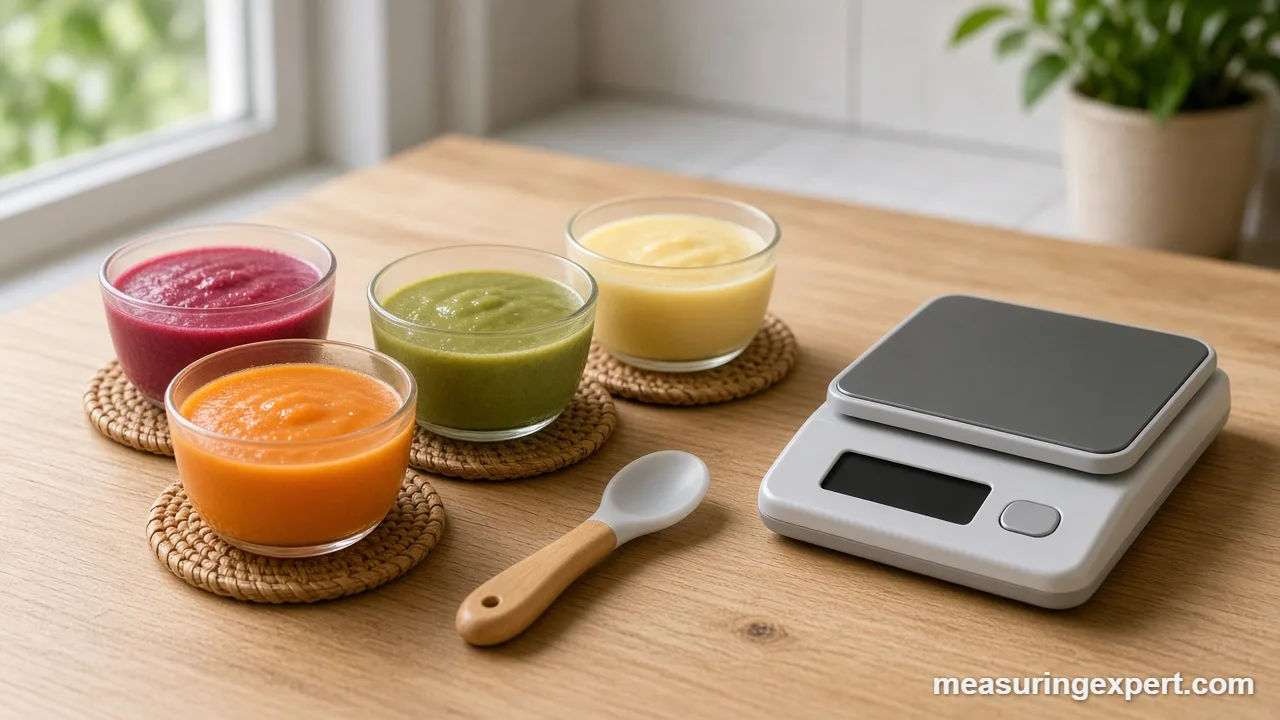
To measure baby food, start with 1 or 2 tablespoons (about 15 to 30 mL) of a new food at a time, as the CDC advises. Use level measuring spoons or a kitchen scale so each portion stays the same. Your pediatrician can tell you how much suits your baby.
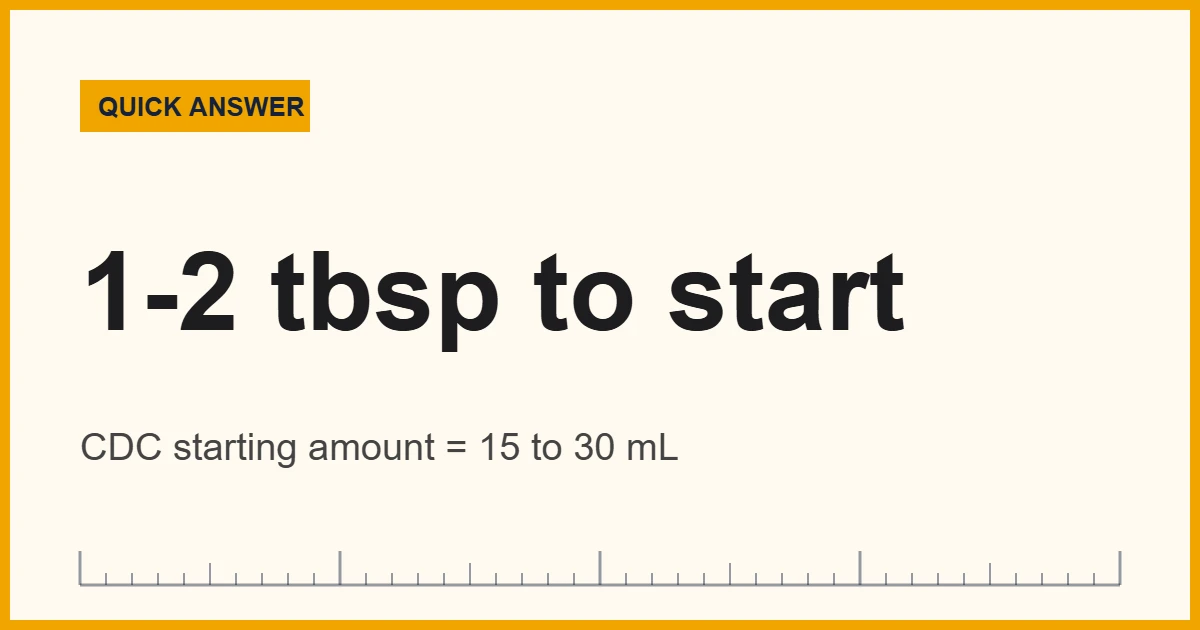
Convert Spoons and Ounces to Measure Baby Food
Enter an amount below to switch between tablespoons, fluid ounces, milliliters and cups. The converter uses the exact US definitions, so it helps when a feeding guide lists ounces and your spoons list milliliters.
Parents often ask how to measure baby food in a way that is simple and repeatable. First, pick one method and stick with it. Next, keep the portions small, because a baby who is new to solids eats only a spoonful or two at a time. In addition, plan every step around food safety, since a baby’s feeding routine needs clean hands, clean tools and safe storage.
Sources Used to Measure Baby Food
This guide uses only authoritative sources that we opened and read: the Centers for Disease Control and Prevention (CDC), the American Academy of Pediatrics (AAP) and the US Department of Agriculture (USDA). It covers portion sizes, conversions, tools and storage. However, it does not give medical advice, and your pediatrician always has the final word on what and how much your baby eats.
Typical Amounts When You Measure Baby Food
The CDC says to start with 1 or 2 tablespoons of food at a time. It also says to offer something to eat or drink every 2 to 3 hours, which works out to about 5 or 6 times a day, or roughly 3 meals and 2 to 3 snacks. Meanwhile, the CDC notes that breast milk or infant formula stays the main source of nutrition from 6 to 12 months. Solid foods gradually grow into a bigger part of the diet.
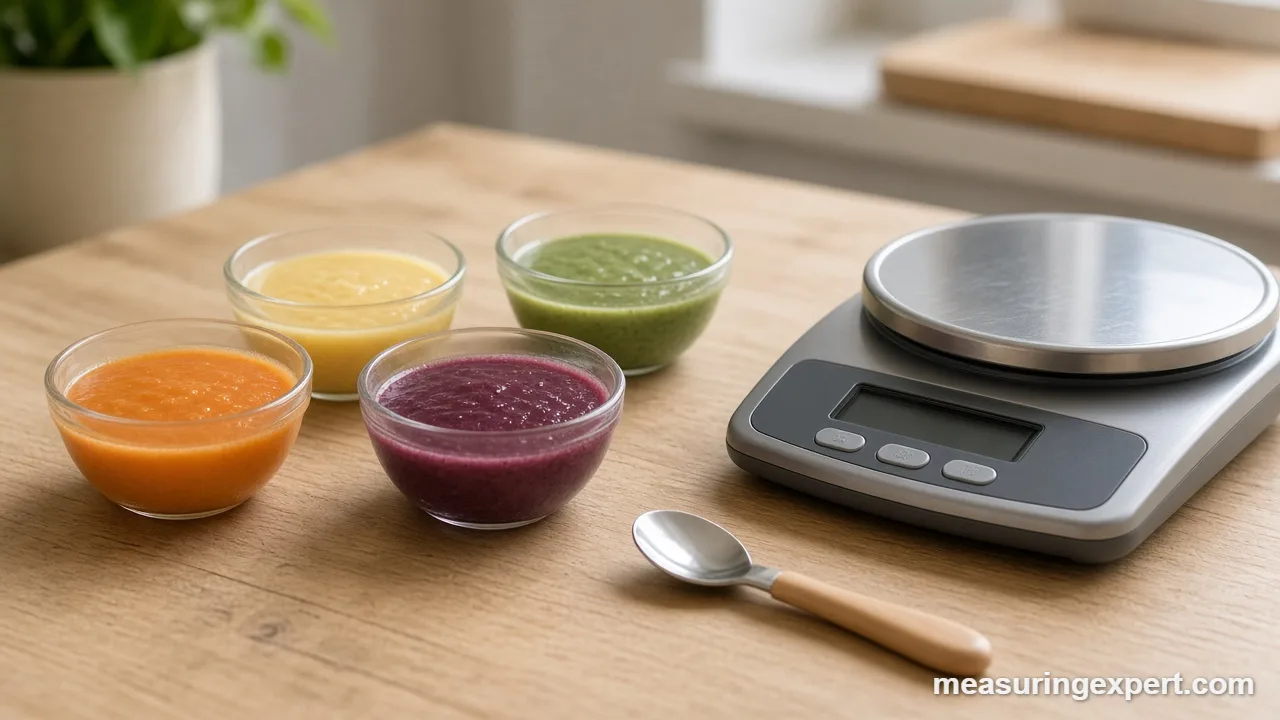
Larger servings for older babies
For larger servings, the AAP sample menu for babies 8 to 12 months old lists portions of 2 to 4 oz per food at meals, such as cooked vegetables, fruit, yogurt or soft proteins. The AAP key on that page treats 1 cup as 8 oz (240 mL), so 4 oz is half a cup. Therefore, a 2 to 4 oz serving equals 4 to 8 tablespoons.
| Amount | Tablespoons | Milliliters (US) | Cups |
|---|---|---|---|
| CDC starting amount, low | 1 tbsp | 14.79 mL | 1/16 cup |
| CDC starting amount, high | 2 tbsp | 29.57 mL | 1/8 cup |
| AAP frozen cube (about 1 oz) | 2 tbsp | 29.57 mL | 1/8 cup |
| AAP serving, low (2 oz) | 4 tbsp | 59.15 mL | 1/4 cup |
| AAP serving, mid (3 oz) | 6 tbsp | 88.72 mL | 3/8 cup |
| AAP serving, high (4 oz) | 8 tbsp | 118.29 mL | 1/2 cup |
Amounts are not targets
These are the amounts the sources describe, not targets. For one thing, babies eat different amounts from day to day, and the CDC suggests watching for signs that your child is hungry or full. If you have concerns about how much or how often your baby eats, the CDC advises talking to your child’s doctor or nurse.
See the CDC page How Much and How Often To Feed and the AAP sample menu for a baby 8 to 12 months old for the original wording.
Recommended Tools to Measure Baby Food
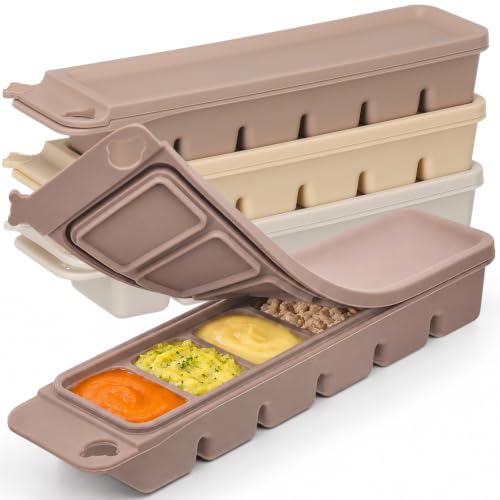
You do not need much equipment. Instead, a set of measuring spoons covers the small amounts, a marked measuring cup handles purees and water, and a scale checks the portions that matter most. Freezer trays with fixed cavities are handy too, because each cavity holds the same amount every time. For example, the AAP suggests an ice cube tray in which each cube holds about 1 oz.



As an Amazon Associate, Measuring Expert earns from qualifying purchases.
Check the cavity size printed on any tray before you buy it. For instance, some trays hold 1 oz per cavity, while others hold 0.7 oz or 1.5 oz, so your cube count changes with the tray.
Weigh or Scoop: Which Method Is Better?
First, volume measures take up room, and weight measures mass. A tablespoon is the same volume for every food, but a tablespoon of thick mashed banana can weigh more than a tablespoon of a thin, airy puree. In short, spoons are quick and a scale is steadier.
| Method | Best for | Watch out for |
|---|---|---|
| Measuring spoons | Small first portions of 1 to 2 tbsp | Heaped spoons hold more than level ones |
| Liquid measuring cup | Thinning purees with water or milk | Read the mark at eye level on a flat counter |
| Dry measuring cup | Cooked grains and mashed foods | Packing the food changes the amount |
| Digital kitchen scale | Repeatable portions and batch cooking | Press tare after placing the bowl |
| Freezer tray | Fixed portions of leftovers | Cavity sizes differ between brands |
The word “ounce” causes confusion here. A fluid ounce measures volume (about 29.57 mL), whereas an ounce of weight is about 28.35 g. The AAP menu uses ounces as a quick unit for portions, so a scale reading in ounces will not always match a cup reading. For a closer look at the weight unit, read how much is an ounce, and for milliliter conversions see how much is 30 mL.
How to Measure Baby Food Step by Step
- Wash your hands and tools. Start with clean hands, clean spoons and a clean bowl so nothing carries germs into the food.
- Place the bowl on the scale and press tare. The display resets to zero, so only the food is counted.
- Add the food in small spoonfuls. Stop at the amount you chose, such as 2 tablespoons (about 30 mL).
- Or level the spoon. If you use spoons, scrape a flat edge across the top so the spoonful is not heaped.
- Portion what you will not eat today. Spoon leftovers into labeled containers or freezer cubes of a known size.
- Label and date every container. Write the food and the date so you can use older portions first.
Storing and Reheating Homemade Purees
Safe storage matters as much as accurate portions, so plan it from the start. The AAP says to freeze leftovers in an ice cube tray, move the frozen cubes to a zip-top bag or container, label them with the food and date, and eat frozen baby food within 3 months. The AAP page does not give refrigerator times for baby food.
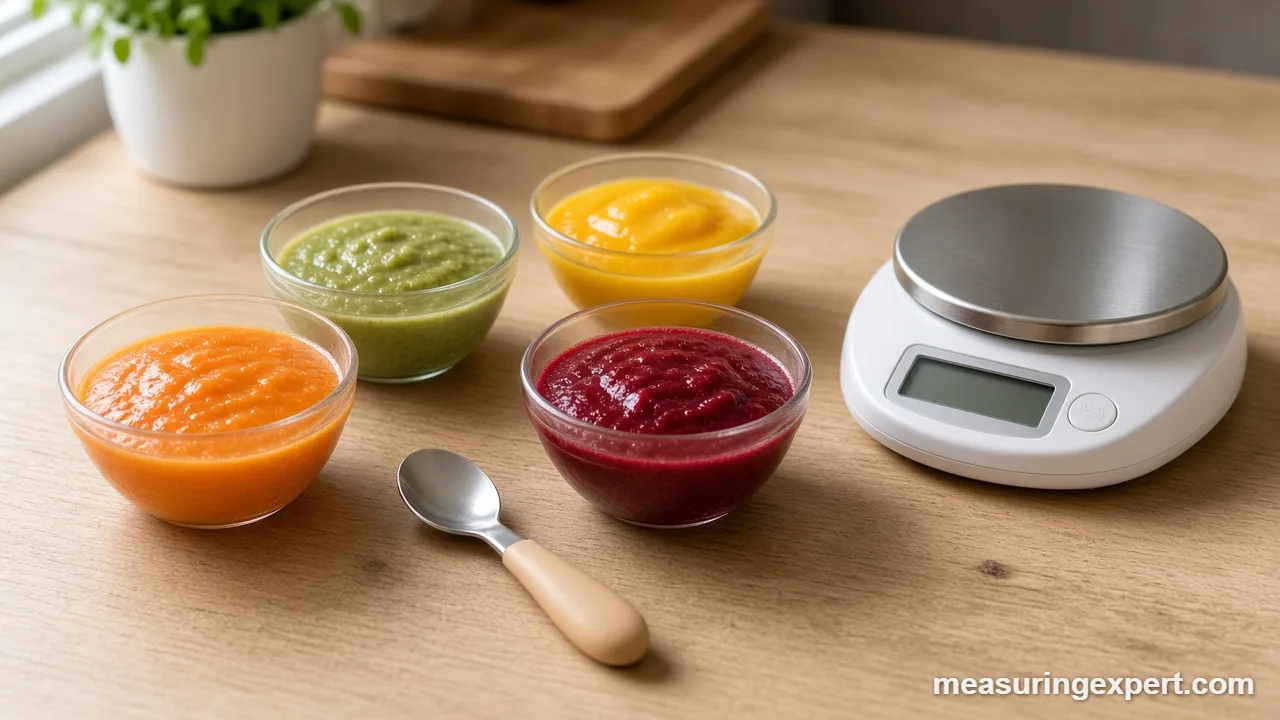
For general leftovers, the USDA says they keep for 3 to 4 days in the refrigerator or 3 to 4 months in the freezer. In addition, it says to refrigerate food within 2 hours after cooking, or within 1 hour if the temperature is above 90 F (32 C). It also advises dividing large amounts into shallow containers so they cool to 40 F (4 C) or below quickly, and reheating leftovers to 165 F (74 C), checked with a food thermometer.
| Step | What the source says | Source |
|---|---|---|
| Freeze portions | Use an ice cube tray, about 1 oz per cube | AAP |
| Freezer time | Eat frozen baby food within 3 months | AAP |
| Cool quickly | Refrigerate within 2 hours (1 hour above 90 F) | USDA |
| Refrigerator time for leftovers | 3 to 4 days | USDA |
| Reheat | 165 F (74 C), checked with a thermometer | USDA |
Common Mistakes
- Heaped spoons. A heaped tablespoon holds noticeably more than a level one, so level every spoonful.
- Packing the cup. Pressing a puree into a cup changes the amount, so instead spoon it in loosely.
- Mixing up ounces. A fluid ounce and a weight ounce are different units.
- Skipping labels. Unlabeled cubes are hard to date, so as a result you may throw out good food or keep old food too long.
- Replacing milk with homemade food. The AAP says homemade food should not replace breast milk or formula.
Do and Don’t
Do
- Level spoons and zero the scale first.
- Start with 1 to 2 tablespoons, as the CDC says.
- Label and date every frozen portion.
- Cool leftovers quickly in shallow containers.
- Check food temperature before serving.
Don’t
- Guess portions with cutlery spoons.
- Keep frozen baby food past 3 months.
- Leave cooked food out for over 2 hours.
- Serve honey to a baby under 1.
- Skip your pediatrician’s advice.
Honest Limits of Measuring Baby Food
Measuring helps you stay consistent, but it cannot tell you what your baby needs. Appetite changes with growth, mood and health. As a result, a baby may eat a few spoonfuls one day and much more the next. The converter on this page applies exact unit definitions, yet the weight of a spoonful still depends on the food. Similarly, cube trays are labeled by their maker, so measure the water they hold once if you want to be sure.
Talk to Your Pediatrician
Your pediatrician knows your baby’s growth, health history and readiness for solid foods. Ask when to start, which foods to offer first, how much to give and how to introduce common allergen foods. The AAP says early allergen foods can be offered in small amounts, but it also says to talk with your pediatrician first if your child has severe eczema or an egg allergy. This page does not list ages for introducing any food, because your pediatrician is the right person to set that plan.
Likewise, ask before you try baby-led weaning, a style of feeding where the baby self-feeds soft foods in small bites. The AAP advises talking with your pediatrician first. If you also prepare other family recipes, our guide to measuring ingredients for homemade yogurt covers scales and spoons in the same way.
Frequently Asked Questions
How much food should I give when I start to measure baby food?
The CDC says to start with 1 or 2 tablespoons of food at a time. That is about 15 to 30 mL. Your pediatrician can tell you how much fits your own baby.
How many tablespoons are in 1 ounce of baby food?
One US fluid ounce holds 2 tablespoons, or about 29.57 mL. A frozen cube of about 1 ounce, as the American Academy of Pediatrics (AAP) describes, is therefore about 2 tablespoons.
How many ounces are in a cup of baby food?
The AAP uses 1 cup = 8 oz (240 mL) on its sample menus. However, by the exact US definition, a cup is 8 fluid ounces or about 236.6 mL.
Should I weigh or use spoons to measure baby food?
Both work. For example, spoons and cups are quick, but a scale gives more repeatable portions, especially for thick purees that pack down differently each time.
How long can I keep homemade baby food in the freezer?
The AAP says to eat frozen baby food within 3 months. Label each container with the food and the date so you can keep track.
How long can leftovers stay in the refrigerator?
The USDA says leftovers keep for 3 to 4 days in the refrigerator. Refrigerate them within 2 hours of cooking, or within 1 hour if the room is above 90 F (32 C).
What temperature should I reheat leftovers to?
The USDA says to reheat leftovers to 165 F (74 C), measured with a food thermometer. For baby, let the food cool and stir it before serving, and check a spoonful yourself first.
Is it safe to use honey when I measure baby food?
No. The AAP says not to feed honey to infants under age 1 because it can contain bacteria that could make them sick.
When should I introduce allergen foods?
Ask your pediatrician. The AAP notes that early allergen foods can be offered in small amounts, but it says to talk with your pediatrician first if your child has severe eczema or an egg allergy.
Do I need exact ratios to measure baby food at home?
Not for most purees. The AAP says ratios do not need to be exact. Still, consistent portions help you track what your baby eats, and a scale or spoons make that easy.
Measure Baby Food: The Bottom Line
To sum up, measure baby food with level spoons, a marked cup or a kitchen scale, and begin with the 1 to 2 tablespoons the CDC describes. Convert ounces to tablespoons with the chart above, and freeze extra portions in labeled trays for up to 3 months, following the AAP.
Finally, keep food safety first: cool leftovers fast, reheat them to 165 F, and let them cool before serving. Above all, talk to your pediatrician about timing, amounts and allergen foods, because this guide shares measuring information only.