

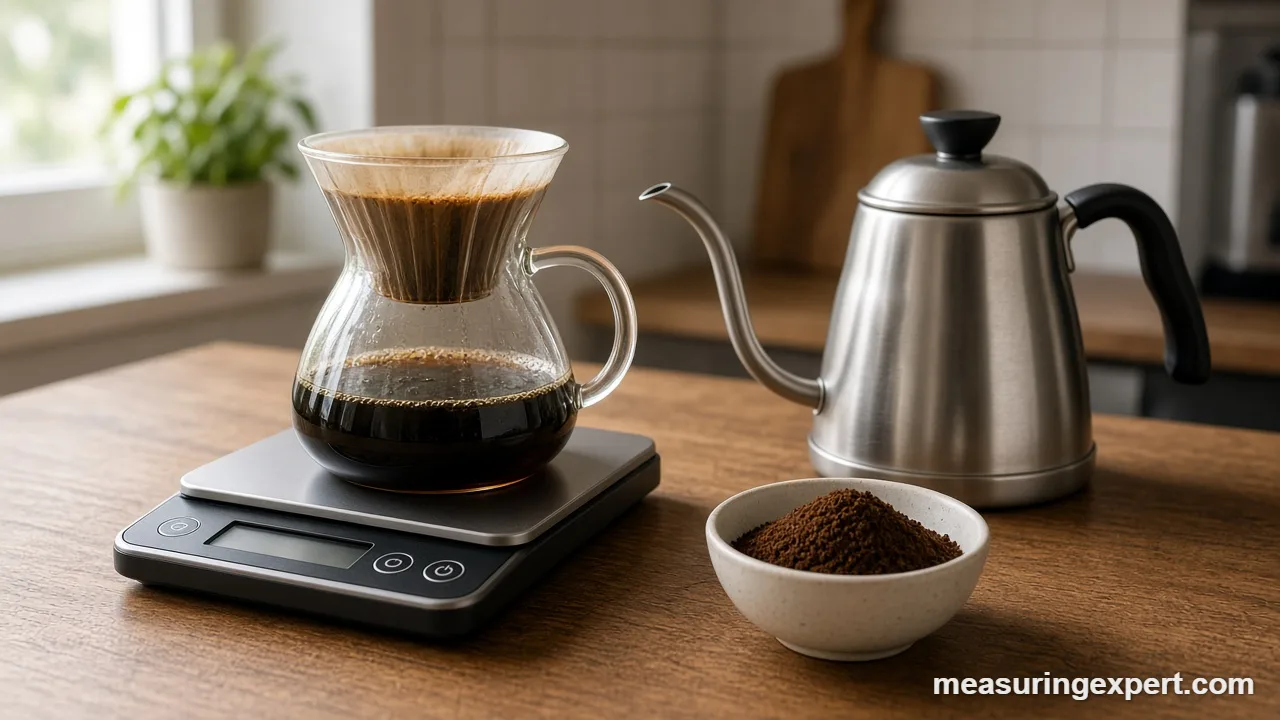
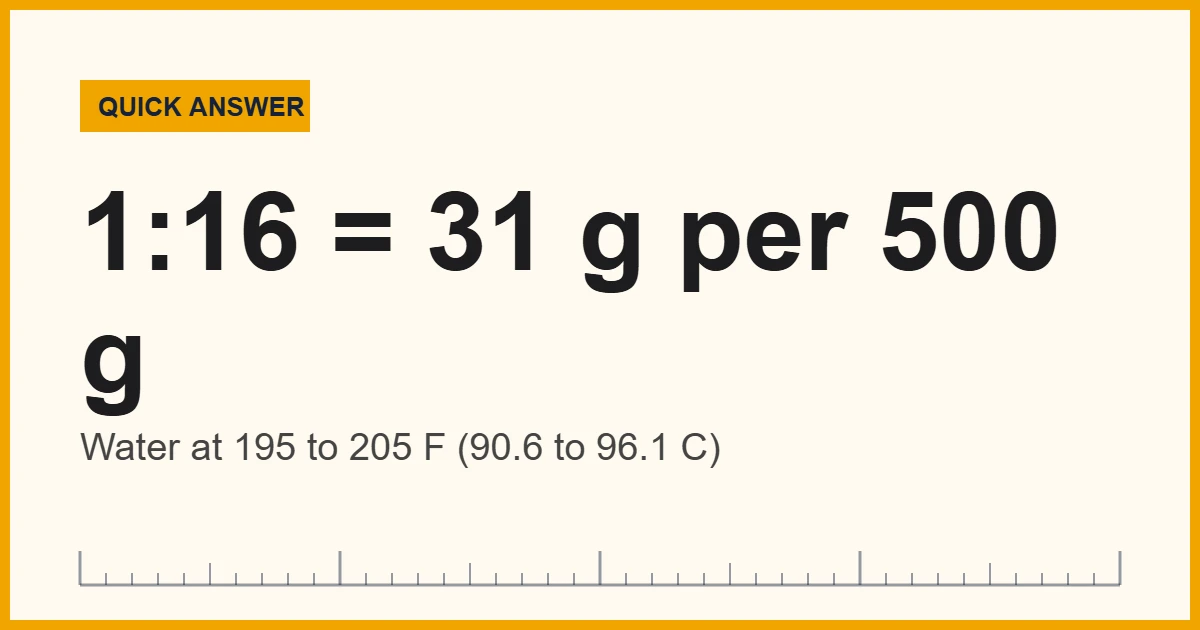
The standard coffee brewing ratio is about 1 gram of coffee to 16 grams of water (1:16), or 55 g per liter (about 1:18) for the Specialty Coffee Association Gold Cup. For 500 g of water, that means 28 to 31 g of coffee, brewed with water at 195 to 205 degrees F (90.6 to 96.1 degrees C).
Weight Converter for Your Coffee Brewing Ratio
First, weigh your coffee in grams, then check the same amount in ounces here. The converter uses the exact NIST gram-to-ounce definition, so you can follow a recipe written in either system.
Most weak, sour, or bitter cups come down to three numbers: how much coffee, how much water, and how hot the water is. In practice, a good coffee brewing ratio fixes the first two, and a thermometer handles the third. As a result, you can repeat a great cup instead of hoping for one.
First, the reference points are simple. For example, the Specialty Coffee Association Gold Cup standard, as summarized by Seattle Coffee Gear, calls for 55 g of coffee per liter of water and water at 195 to 205 degrees F. In addition, the National Coffee Association’s brewing guides give a ratio and grind for each method.
Next, you will find a ratio chart, a grind guide, and a scale-and-thermometer table for each brew method. After that come step-by-step instructions and a fix-it table for sour or bitter coffee.
Coffee Brewing Ratio Chart by Weight
For example, a ratio of 1:16 means 1 gram of coffee for every 16 grams of water. Because 1 mL of water weighs about 1 g, you can read the water column in milliliters too. Also, the coffee amounts below are rounded to the nearest tenth of a gram.
| Coffee brewing ratio | Strength | 250 g water | 500 g water | 1000 g water |
|---|---|---|---|---|
| 1:14 | Strong | 17.9 g | 35.7 g | 71.4 g |
| 1:15 | Medium-strong | 16.7 g | 33.3 g | 66.7 g |
| 1:16 | Balanced | 15.6 g | 31.3 g | 62.5 g |
| 1:17 | Medium-light | 14.7 g | 29.4 g | 58.8 g |
| 1:18 (55 g per liter) | Gold Cup | 13.9 g | 27.8 g | 55.6 g |
For instance, the Gold Cup figure is exactly 55 g per 1,000 g of water, which works out to 13.75 g for 250 g and 27.5 g for 500 g. Meanwhile, the ratio rows above are rounded. If you also cook, our guide to how much an ounce is shows why grams and ounces are not interchangeable.
Recommended Tools for Your Coffee Brewing Ratio
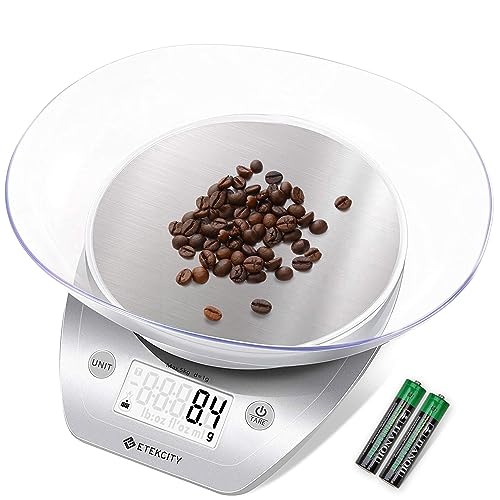
In short, you need only two tools: a scale and a thermometer. First, choose a scale that reads in 0.1 g steps, because a 1 g error is 3 to 7 percent of a typical dose. Next, look for a built-in timer and a tare button. Also, pick a thermometer with a fast reading and a probe long enough to reach into a kettle.




As an Amazon Associate, Measuring Expert earns from qualifying purchases.
Key Takeaways
- Start with a coffee brewing ratio of 1:16, then move between 1:14 and 1:18 to taste.
- Weigh the coffee and the water in grams; scoops vary with roast and grind.
- Gold Cup reference: 55 g of coffee per liter of water.
- Brew water should be 195 to 205 degrees F (90.6 to 96.1 degrees C), so let a boiling kettle rest briefly.
- Espresso uses a much tighter ratio of about 1:2 by weight, and cold brew concentrate uses 1:4 to 1:5.
- Grind coarser for immersion brewing and finer for faster methods.
- Change one variable at a time when you adjust the taste.
Why Weight Beats Scoops for a Coffee Brewing Ratio
First, a scoop measures volume, but coffee is sold by weight. For instance, dark roasts are less dense than light roasts, and finely ground coffee packs tighter than coarse. Therefore, the same scoop can hold noticeably different amounts of coffee from one bag to the next.
The National Coffee Association’s drip guide suggests 1 to 2 tablespoons of ground coffee per 6 fluid ounces of water. Meanwhile, six fluid ounces is about 177 mL, or 177 g of water. A tablespoon of ground coffee often weighs roughly 5 g, so that range spans about 1:35 to 1:18. In short, the low end is much weaker than the Gold Cup target.
| What people mix up | What it actually measures |
|---|---|
| Coffee “cup” on a brewer | Often a smaller serving than a US cup (236.59 mL); check your brewer’s manual |
| Fluid ounce (fl oz) | Volume of water: 29.57 mL |
| Ounce (oz) | Weight of coffee: 28.35 g |
| Tablespoon of grounds | Volume; the weight changes with grind and roast |
For a 12-cup brewer that counts a cup as 5 fl oz, the full pot is 60 fl oz, or about 1,774 mL. At 55 g per liter, that needs roughly 98 g of coffee. Since brewers differ, confirm the marked capacity before you scale. For a related kitchen conversion, see how much 30 mL is.
Grind Size and Coffee Brewing Ratio by Method
In fact, grind size sets how fast water pulls flavor from the coffee. Finer grounds extract faster, so they need less contact time. Similarly, a coarser grind needs more. In contrast, coarser grounds extract slowly, which suits long steeps. The National Coffee Association guides give these starting points.
| Method | Typical ratio (coffee:water) | Grind | Contact time |
|---|---|---|---|
| Espresso | 1:2 (dry coffee to liquid espresso) | Fine, like table salt | 20 to 30 seconds |
| Pour-over | 1:13 to 1:16 | Medium, like kosher salt | 2 to 4 minutes |
| Drip machine | 1 to 2 tbsp per 6 fl oz | Medium, like kosher salt | About 5 minutes |
| French press | 1:10 to 1:16 | Coarse, like rock salt | About 4 minutes |
| Cold brew (concentrate) | 1:4 to 1:5 | Coarse | About 12 hours |
Also, notice how wide the French press range is. As a result, start in the middle, near 1:13, and adjust from there. In addition, a burr grinder gives more even particles than a blade grinder, which makes any ratio easier to repeat.
Scale and Thermometer Targets for Each Brew
In addition, this table combines both tools. First, weigh the coffee and water, then check the water temperature just before you pour. Also, the temperature range comes from the SCA figure of 93 degrees C plus or minus 3, which matches 195 to 205 degrees F.
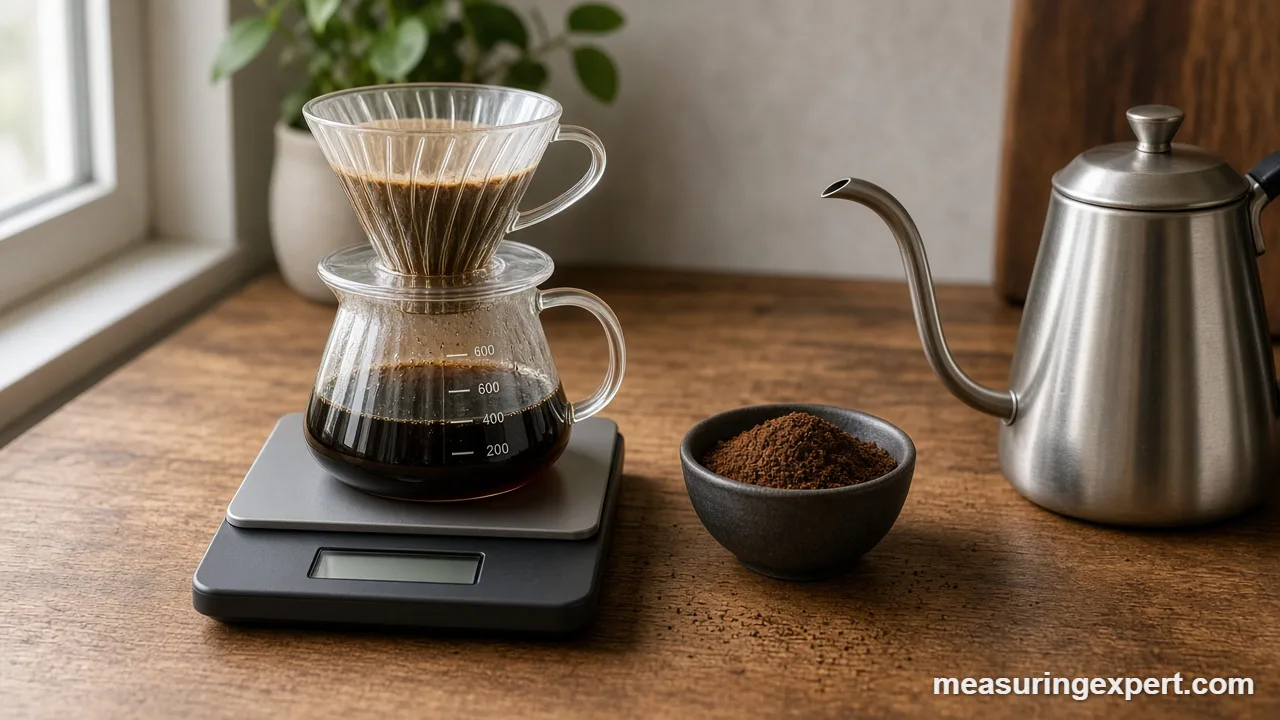
| Setting | Coffee | Water by scale | Water by thermometer |
|---|---|---|---|
| Pour-over, one mug | 18.8 to 23.1 g | 300 g | 195 to 205 °F (90.6 to 96.1 °C) |
| Balanced drip, 1:16 | 31.3 g | 500 g | 195 to 205 °F (90.6 to 96.1 °C) |
| Gold Cup, 55 g per liter | 27.5 g | 500 g | 195 to 205 °F (90.6 to 96.1 °C) |
| French press, 1:13 | 38.5 g | 500 g | About 199 °F (93 °C) |
| Espresso, 1:2 | 18 g in | 36 g out | Set by the machine |
| Cold brew concentrate, 1:5 | 100 g | 500 g | Room temperature or cooler |
For reference, water boils at 212 degrees F (100 degrees C) at sea level, and the boiling point drops as altitude rises. Therefore, a kettle straight off the boil is slightly too hot for most brews. Instead, wait 30 to 60 seconds, then check the reading. A thermometer also helps if you use a kettle without a temperature setting.
How to Weigh a Coffee Brewing Ratio Step by Step
- Pick a ratio. Start at 1:16 unless the method calls for something else.
- Decide how much to brew. Choose the water weight, for example 500 g for two mugs.
- Divide to find the coffee. Water weight divided by 16 gives 31.3 g for 500 g.
- Tare the scale. Place the grinder cup or filter on the scale and press tare so it reads zero.
- Weigh the beans, then grind. Weigh before grinding so no grounds are left behind.
- Heat the water and check it. Aim for 195 to 205 degrees F, and use the thermometer.
- Pour onto the scale. Tare again with the brewer on the scale, then pour until you reach the target water weight.
- Log it and adjust. Write down the ratio, grind, and taste, then change only one thing next time.
Fixing Sour and Bitter Cups
In general, under-extracted coffee tends to taste sour and thin, while over-extracted coffee tends to taste bitter and harsh. Because several factors cause both, change only one at a time. Next, the table lists the usual levers.
| Symptom | Likely cause | First fix |
|---|---|---|
| Sour, thin, salty | Under-extracted | Grind finer, raise water temperature, or extend the contact time |
| Bitter, harsh, dry | Over-extracted | Grind coarser, lower water temperature, or shorten the contact time |
| Watery but not bitter | Ratio too low | Use more coffee, such as 1:15 instead of 1:17 |
| Strong but muddy | Ratio too high or grind too fine | Add water or grind slightly coarser |
Do and Don’t for a Reliable Coffee Brewing Ratio
Do
- Weigh coffee and water in grams.
- Tare the scale before every addition.
- Check water temperature before pouring.
- Change one variable per brew.
- Keep notes on ratio, grind, and taste.
Don’t
- Trust a scoop to hold the same weight every time.
- Pour water straight off a rolling boil.
- Judge a ratio by volume alone.
- Change grind and ratio together.
- Reuse wet grounds for a second brew.
Honest Limits of Any Ratio
In fact, a ratio is a starting point, not a guarantee. For one thing, taste is personal, and the Gold Cup numbers describe a target for drip brewers, not a rule for every cup. Moreover, a kitchen scale reading to 0.1 g still has some error, and cheap thermometers can be off by a few degrees. In addition, roast level and bean freshness change how fast coffee extracts. In short, treat every figure here as a place to start, then adjust the cup to your own taste.
When Accuracy Really Matters
Overall, most home brewing forgives small mistakes. Still, three situations deserve more care:
- Espresso. A 1 g change in a short 18 g dose shifts the ratio by over 5 percent.
- Small brews. A 15 g dose magnifies each rounding error, so use the 0.1 g setting if the scale has one.
- Selling or serving coffee. Consistent weights make every cup match the last one.
If you bake as well, the same habit of weighing pays off. For example, the pastry guide on measurement in pastry making explains why grams beat cups for dough.
Frequently Asked Questions
What is the best coffee brewing ratio?
A ratio of 1:16 (1 g of coffee to 16 g of water) is a balanced starting point. However, the Gold Cup standard of 55 g per liter is about 1:18. Also, you can move within 1:14 to 1:18 to suit your taste.
How many grams of coffee per cup of water?
For a 240 mL cup at 1:16, use about 15 g of coffee. However, at the Gold Cup rate of 55 g per liter, a 240 mL cup needs about 13.2 g.
How much coffee do I put in a 12 cup coffee maker?
If your brewer counts 5 fl oz per cup, the pot holds about 1,774 mL. Therefore, at 55 g per liter, you need roughly 98 g of coffee. Also, check your brewer’s manual for its cup size first.
Is a coffee scoop 1 or 2 tablespoons?
Scoop sizes vary, and many are about 2 tablespoons. Therefore, check the scoop’s markings or weigh a level scoop on a scale, because the weight depends on roast and grind.
What water temperature is best for a coffee brewing ratio?
Use water at 195 to 205 degrees F (90.6 to 96.1 degrees C). Also, if your kettle just boiled, wait 30 to 60 seconds before pouring.
What grind size should I use?
Use fine for espresso, medium for pour-over and drip, and coarse for French press and cold brew. After that, adjust one step finer or coarser based on taste.
What is the espresso ratio?
A common espresso ratio is 1:2 by weight. For example, 18 g of dry coffee yields about 36 g of liquid espresso in 20 to 30 seconds.
What ratio should I use for cold brew?
Cold brew concentrate typically uses 1:4 to 1:5. For example, 100 g of coffee with 500 g of water steeps for about 12 hours, then you dilute it.
Do I need a thermometer to brew coffee?
No, but it helps. In fact, a reading confirms the water is between 195 and 205 degrees F, which makes your results easier to repeat from day to day.
Why does my coffee taste bitter or sour?
Bitter coffee is often over-extracted, so try a coarser grind or cooler water. Sour coffee is often under-extracted, so try a finer grind or hotter water.
The Coffee Brewing Ratio: Bottom Line
To sum up, weigh your coffee and water, start near 1:16, and keep the water between 195 and 205 degrees F. A scale and a thermometer turn a guess into a repeatable recipe.
Finally, change one thing at a time. Over a few brews, you will find the coffee brewing ratio that tastes best to you, and you can reuse it every morning.